QR code asset packs for businesses turn a simple square barcode into a repeatable marketing, operations, and brand system. In practice, an asset pack is a downloadable bundle of ready-to-use files, templates, usage guidelines, and production specs that let teams deploy QR codes quickly without reinventing layouts, error correction settings, print sizes, or call-to-action copy each time. For companies managing retail signage, product packaging, event materials, direct mail, invoices, menus, equipment labels, and employee training documents, that consistency matters. I have seen projects stall not because the QR destination was wrong, but because design teams, franchise owners, and local printers all made different assumptions about safe sizing, quiet zones, and file formats.
This is why downloadable assets deserve a dedicated place within a broader QR code resources, templates and tools library. A well-built pack reduces production errors, speeds approvals, protects scanability, and helps every department use the same branded system. It also creates internal linking logic for a content hub: users looking for QR code templates, poster mockups, vector downloads, print specifications, editable stickers, or campaign checklists all start here, then move to more specific guides. In that sense, a hub page is not just informational content. It is a practical navigation layer that answers core business questions up front: what belongs in a QR code asset pack, who needs one, which file types are essential, how should teams organize downloadable assets, and how can businesses maintain quality at scale?
Key terms are straightforward. A static QR code points to data that cannot be changed after creation. A dynamic QR code uses a short redirect URL so the destination can be edited later, with analytics attached. A quiet zone is the blank margin around the symbol required for reliable scanning. Error correction determines how much damage the code can tolerate while still being readable. Vector files such as SVG, EPS, and PDF scale cleanly for print, while raster files such as PNG and JPG are fixed-resolution images better suited to screens or lightweight office use. Businesses that understand these distinctions build asset packs that are durable, reusable, and production-ready instead of attractive but fragile.
This hub article covers downloadable assets comprehensively so teams can standardize how QR codes are designed, stored, distributed, and governed. It also acts as the parent page for supporting articles on templates, stickers, signage, print specs, branded frames, packaging inserts, tracking sheets, and testing checklists. If your organization uses QR codes in more than one channel, the most efficient next step is not generating another code. It is building an asset pack that makes every future code easier to launch, safer to print, and simpler to manage.
What a QR Code Asset Pack Includes
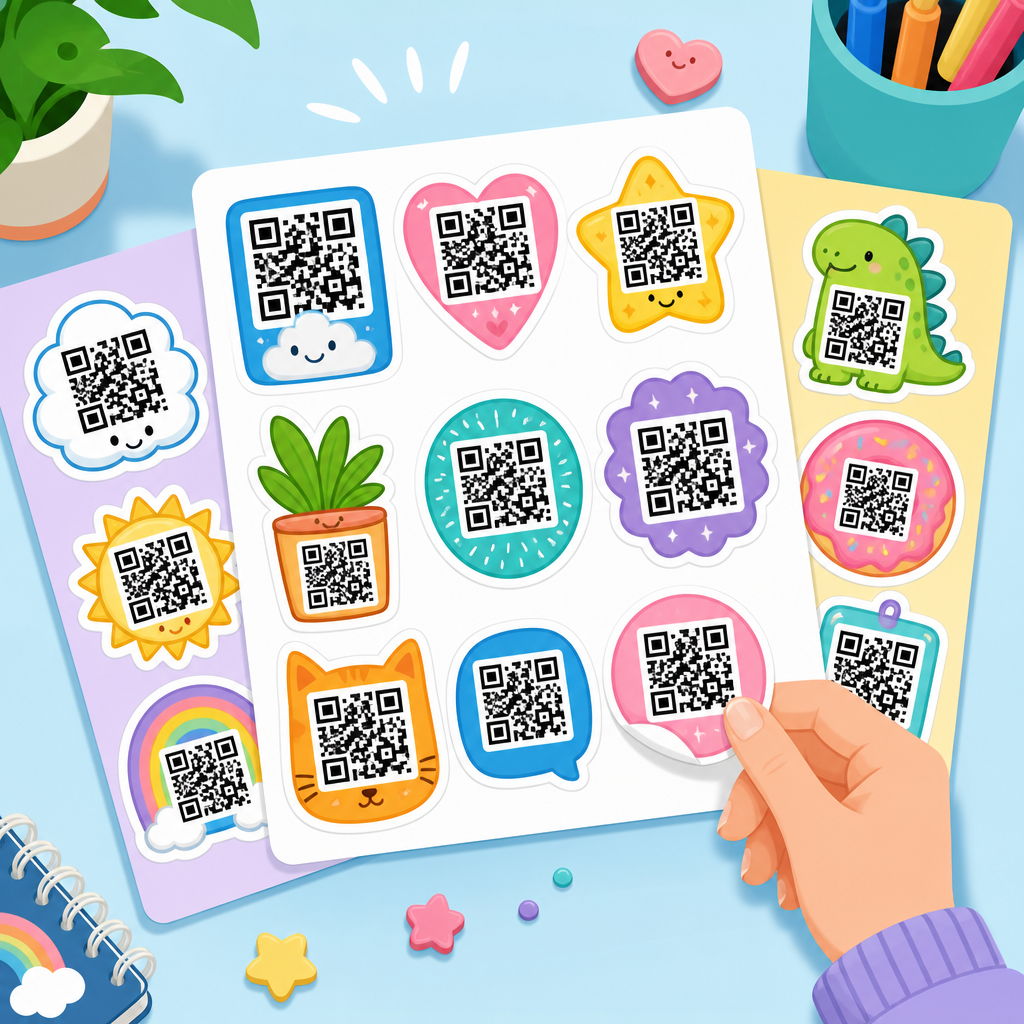
A business-grade QR code asset pack should contain more than the code image itself. At minimum, I recommend a master folder with dynamic and static versions, vector exports, web-ready PNG files, a one-page usage guide, and channel-specific templates. For example, a retail pack may include shelf talker artwork, window cling dimensions, countertop sign files, and A4 and US Letter poster layouts. A packaging pack often needs dieline-safe placement mockups, monochrome variants for flexographic printing, and minimum-size rules based on substrate and print method. Service businesses may prioritize invoice inserts, vehicle decals, appointment reminder cards, and technician handouts.
Useful packs also include copy assets. Teams repeatedly ask what text should sit near a QR code. Strong packs solve that by providing approved calls to action such as “Scan to download the setup guide,” “Scan for warranty registration,” or “Scan to view live inventory.” That sounds basic, yet conversion rates often improve when the instruction is specific. In one multi-location rollout I worked on, replacing a generic “Scan me” label with “Scan to join the loyalty program and get 10% off today” produced materially better engagement because the value proposition was explicit. Asset packs should remove guesswork from these micro-decisions.
Another essential component is a testing and governance layer. Include a scan verification checklist, device testing notes for iOS and Android, URL naming conventions, ownership details, and expiration or review dates. Dynamic codes can outlive their landing pages, so every asset should identify who owns the destination and who updates redirects. If a code appears on printed packaging with a twelve-month shelf life, the linked experience must be maintained for at least that period, ideally longer. Downloadable assets are only useful when businesses pair them with retention rules and version control.
Core File Types, Specifications, and Production Standards
The right file mix prevents expensive rework. For print, SVG and EPS are the safest defaults because vectors preserve edge clarity at any size. Press-ready PDF is useful when the QR code is already embedded in approved artwork. PNG remains valuable for slide decks, websites, email signatures, marketplace listings, and office printers, but it should never be the only download offered. A common failure point is a marketing team pulling a small PNG from a presentation deck, enlarging it for a trade show banner, and ending up with softened modules that scan poorly from distance.
Specifications matter just as much as format. Businesses should document minimum print size, quiet zone, foreground-to-background contrast, and whether logo insertion is permitted. ISO/IEC 18004 defines the QR code symbology itself, while practical scanability guidance comes from testing under real lighting, angles, and camera quality. In most business contexts, dark code on a light background remains the safest choice. Reversed or heavily stylized designs may still work, but they require larger sizes and stronger testing discipline. Error correction levels L, M, Q, and H each trade data density for resilience. If a logo sits inside the code, higher correction may be necessary, but increasing correction can make the pattern denser and demand more print space.
The table below shows the asset categories I advise most businesses to include in a downloadable pack and why each one matters.
| Asset type | Recommended formats | Primary use | Key note |
|---|---|---|---|
| Master QR code files | SVG, EPS, PDF, PNG | Print and digital distribution | Store versioned originals in a locked folder |
| Placement templates | AI, PSD, PDF, PPTX, Canva link | Posters, packaging, flyers, menus | Show safe area and minimum size |
| Brand usage guide | Internal and partner reference | Define color, contrast, CTA, and logo rules | |
| Testing checklist | XLSX, Google Sheet, PDF | Pre-launch validation | Record devices, lighting, distance, and results |
| Tracking sheet | XLSX, CSV, Notion template | Ownership and analytics governance | Map each code to URL, owner, and review date |
Production standards should also reflect the physical environment. Codes printed on corrugated boxes, thermal labels, fabric hangtags, or glossy acrylic signage behave differently. Thermal transfer labels can bleed if modules are too small. Matte lamination typically scans more reliably than reflective finishes under strong light. Exterior signage needs larger modules because users scan from farther away and often at an angle. A robust hub page should direct readers to deeper articles on print sizing, packaging templates, sticker layouts, and signage testing, because downloadable assets only perform when production constraints are understood.
How Different Business Teams Use Downloadable Assets
QR code asset packs are cross-functional tools, not just design downloads. Marketing uses them for campaign landing pages, in-store promotions, direct mail, catalogs, and social-to-offline bridges. Sales teams use them on one-sheets, booth signage, leave-behind cards, and proposal inserts that route prospects to demos or case studies. Operations teams use QR codes for SOP libraries, maintenance logs, inventory locations, and asset tracking labels. Human resources can place them in onboarding packets, workplace posters, benefits guides, and training manuals. Customer support often uses them in troubleshooting cards, warranty registration flows, and self-service knowledge base links.
The strongest asset packs recognize these departments as separate use cases. A hospitality group, for example, may need branded menu QR codes for tables, housekeeping checklists for staff corridors, maintenance tags on equipment, and recruitment posters in back-of-house areas. Those are distinct audiences with different scan motivations, environmental conditions, and compliance needs. A single folder labeled “final QR codes” is not enough. Businesses need downloadable assets grouped by function, destination type, and approval status so frontline teams can self-serve without creating risk.
Franchise and multi-location businesses benefit especially from this structure. Corporate teams can publish approved packs with editable local fields, such as store address, event date, or regional landing page. The local operator gets speed, while headquarters preserves brand consistency and analytics naming. I have seen national brands reduce support requests simply by shipping asset packs with clear filenames like “window-poster-24×36-dynamic-loyalty-v3” instead of generic exports. That level of organization sounds operational, but it directly affects how quickly campaigns launch and how reliably performance can be measured later.
Building a Downloadable Asset Hub That Scales
As a sub-pillar hub under QR code resources, templates and tools, this page should help readers find the exact downloadable asset they need in one or two clicks. The most effective structure starts with categories: print templates, digital graphics, packaging files, sticker sheets, signage kits, branded frames, testing documents, and governance templates. Each category should link to a dedicated child page with screenshots, use cases, file-format notes, and download options. This creates clear topical depth and signals that the site covers the full workflow, from generating a code to deploying it in production.
On the content side, every child article should answer a practical question directly. “What file format is best for a QR code poster?” “How large should a QR code be on product packaging?” “What should a QR code sticker template include?” “How do you create editable assets for franchise locations?” Businesses searching for downloadable assets are usually close to implementation, so they need decisions, not theory. Plain-language explanations, downloadable examples, and references to common tools such as Adobe Illustrator, Canva, Figma, InDesign, ZebraDesigner, and Bitly or QR code management platforms make the content immediately usable.
To scale governance, pair the public-facing hub with an internal source of truth. That may be a digital asset management system like Bynder, Brandfolder, or Frontify, or a structured cloud drive with strict naming conventions and permissions. Include metadata fields for campaign, owner, destination URL, launch date, review date, region, and print status. Without that layer, downloadable assets proliferate into duplicates and outdated files. The hub article can guide external readers, but businesses also need internal controls that keep asset packs current across teams and vendors.
Common Mistakes and the Best Practices That Prevent Them
The most common mistake is treating QR code artwork as disposable. Teams often generate a code during a campaign sprint, paste it into a flyer, and never save the source file, redirect ownership, or test results. Months later, no one knows which landing page it points to or whether the printed version meets minimum specifications. Another frequent error is over-branding: adding gradients, shadows, low-contrast colors, or decorative frames that compromise scanability. Design freedom is real, but it has boundaries. If a code fails under average conditions, the brand cost is higher than the aesthetic gain.
Best practice starts with a standard operating procedure. Generate the code, save the destination and parameters, export required formats, place it in approved templates, test across devices, document results, and publish to the asset library with version history. Keep call-to-action text close to the code. Avoid placing codes too near folds, curves, seams, or package edges. For analytics, use UTM conventions consistently and log them in the tracking sheet. For long-lived materials, prefer dynamic codes so destinations can change without reprinting. For regulated or high-risk contexts, add approval checkpoints from legal, compliance, or IT security.
Accessibility and trust also matter. Users scan more confidently when the destination is clear, the surrounding text explains the benefit, and the landing page is mobile-optimized. If the code opens a PDF, app store listing, payment flow, or form, say so. If a code appears in public, use HTTPS and a branded short domain when possible. Asset packs should include these usage notes because they influence completion rates as much as graphic quality does.
QR code asset packs for businesses work best when they combine design files, production rules, ownership records, and reusable templates in one organized system. That combination saves time, reduces printing mistakes, improves scan reliability, and gives every department a consistent way to publish codes across packaging, signage, documents, and digital channels. As the hub for downloadable assets within a broader QR code resources, templates and tools library, this page should orient readers quickly, answer core implementation questions, and route them to deeper guides on the exact assets they need.
The main benefit is operational leverage. Instead of solving the same formatting, branding, and testing problems repeatedly, businesses build once and reuse confidently. Teams move faster, vendors receive cleaner files, and customers encounter codes that actually scan and deliver a useful mobile experience. That is the difference between a QR code program that feels improvised and one that supports measurable marketing, service, and operational outcomes.
If you manage QR codes across more than one channel, start by auditing your current files, templates, and ownership records. Then create a standardized asset pack, publish it in a central library, and expand this hub with child resources for each use case your business supports.
Frequently Asked Questions
What is a QR code asset pack for businesses, and what does it usually include?
A QR code asset pack for businesses is a standardized bundle of files, templates, and implementation rules that helps teams create and deploy QR codes consistently across marketing, operations, packaging, and customer-facing materials. Instead of generating a new code from scratch every time a department needs one, the business works from a ready-made system. That system typically includes print-ready QR files in multiple formats such as SVG, EPS, PDF, and PNG; size variations for different applications; recommended error correction settings; quiet zone rules; color and contrast guidance; call-to-action text options; landing page naming conventions; and placement templates for assets like posters, labels, menus, inserts, invoices, event signage, and product packaging.
Many asset packs also include production specifications so internal teams, agencies, franchisees, and print vendors all work from the same standards. That can mean minimum scan sizes, bleed and margin recommendations, test protocols, mobile usability notes, and rules for when to use static versus dynamic QR codes. More advanced packs may include branded design treatments, editable layout files, campaign tracking structures, governance documents, and usage examples for specific departments. The real value is not just the QR image itself. It is the repeatable framework behind it, which reduces guesswork, speeds up execution, protects brand consistency, and improves scan reliability across every customer touchpoint.
Why should a business use a QR code asset pack instead of creating QR codes one at a time?
Creating QR codes one at a time may seem simple at first, but it usually leads to inconsistency, inefficiency, and preventable performance problems as usage expands. Different teams may choose different sizes, colors, destinations, layouts, or call-to-action language, which creates a fragmented customer experience and increases the chance of scanning failures. One code might be easy to scan on packaging, while another is too small on a flyer. One department may link to a mobile-friendly page, while another sends users to a desktop page with a poor experience. Over time, the business ends up with dozens or hundreds of QR implementations that are hard to manage, hard to update, and difficult to measure.
A QR code asset pack solves that by turning ad hoc creation into an operational system. Teams no longer have to reinvent technical settings, design choices, or production specs for every project. They can pull approved files and templates, insert the right destination, apply the correct CTA, and move quickly with confidence. This saves time for marketing, design, compliance, print production, and field teams. It also reduces approval cycles because the foundational standards have already been defined. From an SEO and analytics perspective, standardized QR campaigns are easier to track and optimize because naming conventions, destination structures, and campaign tagging can be built into the pack. In short, an asset pack replaces repeated one-off decisions with a dependable process that improves speed, quality, and measurable business results.
How do QR code asset packs help with branding, consistency, and customer experience?
QR code asset packs are especially valuable because they make QR usage feel intentional and on-brand rather than improvised. A plain, randomly generated code can work technically, but businesses often need much more than technical function. They need each QR touchpoint to match their visual identity, messaging standards, and customer journey goals. An asset pack helps establish that by defining approved logo treatments, color usage, surrounding copy, iconography, and layout patterns. It may specify how a QR code appears on premium packaging versus temporary retail signage, or how CTA language differs between transactional uses like invoices and promotional uses like event handouts.
Consistency matters because customers encounter QR codes in many contexts and make split-second decisions about whether to scan. When the code placement is clear, the call to action is specific, and the surrounding design looks trustworthy and branded, scan rates generally improve. A pack can also improve customer experience by standardizing what happens after the scan. For example, it can guide teams toward mobile-optimized landing pages, concise conversion paths, and context-specific destinations such as product details, registration forms, menus, support instructions, or loyalty signups. This creates a smoother and more predictable journey for users. Rather than treating QR codes as isolated graphics, the asset pack treats them as part of a complete brand and conversion system, which is exactly what larger organizations need when multiple teams and channels are involved.
What technical standards should businesses pay attention to when building or choosing a QR code asset pack?
The most important technical standards are the ones that directly affect scan reliability, production quality, and long-term usability. Businesses should pay close attention to file format availability, minimum print size, color contrast, quiet zone spacing, error correction level, and destination management. Vector formats such as SVG or EPS are important for high-quality scaling across packaging, signage, and large-format print. Minimum size guidance matters because a code that scans well on a desktop mockup may fail in the real world if printed too small or placed on a curved surface. High contrast between the code and background is essential, and decorative styling should never compromise readability.
Quiet zone rules are another critical area. A QR code needs sufficient blank space around it to separate the pattern from surrounding design elements. Without that margin, scanners may struggle. Error correction settings should also be chosen carefully. Higher error correction can improve readability when a code may be partially obstructed or printed on challenging materials, but it also affects code density. The asset pack should define when different error correction levels are appropriate. Businesses should also decide whether to use static or dynamic QR codes. Dynamic codes are often preferable for campaigns and operational flexibility because the destination can be updated without reprinting the asset. Finally, a strong pack should include testing guidance across devices, lighting conditions, materials, and distances. Technical standards are where many QR initiatives succeed or fail, so a professional asset pack should document them clearly rather than leaving them to assumption.
Which business teams benefit most from QR code asset packs, and where are they commonly used?
QR code asset packs are most useful in organizations where multiple teams need to launch QR-enabled materials quickly and consistently. Marketing teams benefit because they can deploy campaigns faster across print, direct mail, in-store signage, and event collateral without starting from zero each time. Brand and creative teams benefit because they gain control over visual standards, usage rules, and approved layouts. Operations teams benefit because QR codes can be standardized for manuals, equipment labels, checklists, facility signage, onboarding materials, and service workflows. Sales teams can use them in one-pagers, brochures, trade show materials, and follow-up assets. Customer support teams may use QR codes for troubleshooting guides, return instructions, FAQs, or warranty registration. Finance and administrative departments may include them on invoices, statements, or payment reminders.
Common use cases span both customer-facing and internal applications. In retail, they appear on shelf talkers, window signs, packaging, and point-of-purchase displays. In hospitality and food service, they are often used for menus, ordering flows, promotions, and feedback collection. In manufacturing and logistics, they can connect products and equipment to documentation, training videos, maintenance records, or compliance information. At events, they are used for registration, schedules, lead capture, map access, and post-event follow-up. The broader the organization and the more channels it manages, the more value an asset pack delivers. It becomes a shared infrastructure layer that supports faster execution, cleaner governance, and a more reliable experience for both employees and customers.