Choosing between a QR code PNG and SVG file sounds like a small export decision, but it directly affects scan reliability, print quality, design flexibility, and how efficiently your team reuses downloadable assets across campaigns. In practice, I have seen the wrong file type create blurry restaurant menus, oversized website downloads, and last-minute print failures on packaging runs. I have also seen the right choice save hours of redesign work because a code could scale cleanly from a social media graphic to a trade show banner without being rebuilt. If you manage QR code resources, templates, or tools, understanding PNG versus SVG is foundational.
A QR code is a matrix barcode that stores data such as a URL, PDF link, contact card, Wi-Fi credential, app deep link, or payment request. When someone scans it, a camera and decoding engine interpret the dark and light modules, then trigger the intended action. PNG stands for Portable Network Graphics, a raster image format made of pixels. SVG stands for Scalable Vector Graphics, a vector format built from mathematical paths and shapes. That distinction matters because QR codes depend on crisp module edges, adequate contrast, and enough quiet space around the code to remain readable under different viewing conditions.
This matters even more on a hub page about downloadable assets because export format decisions affect every downstream use case: printable templates, editable design files, email headers, storefront signage, product labels, PDFs, slide decks, and website images. If your library includes brand-approved QR code assets, you need a repeatable rule for when to download PNG, when to download SVG, and when to keep both. The best choice is not ideological. It depends on output size, editing needs, software compatibility, file management, and how much quality loss your project can tolerate. This guide explains exactly how to decide.
What Is the Difference Between QR Code PNG and SVG Files?
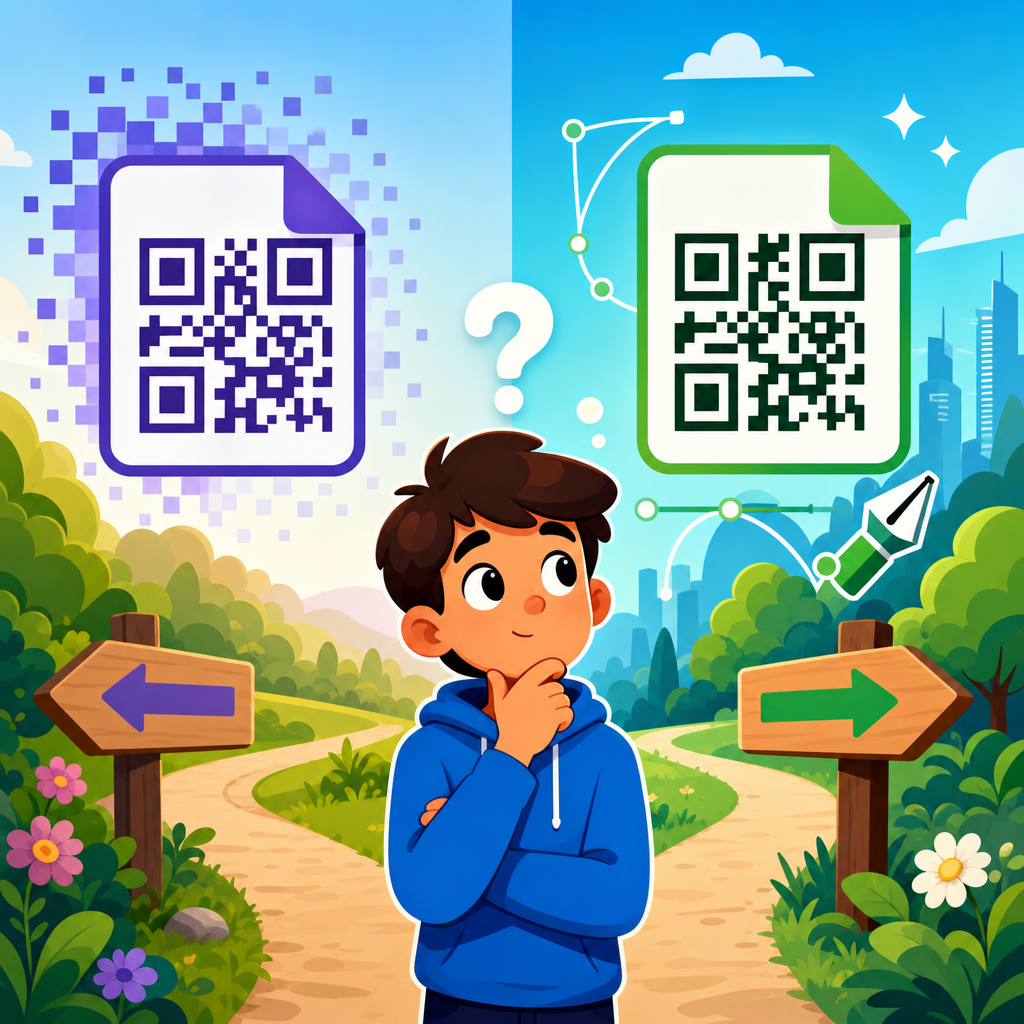
The shortest answer is this: PNG is pixel-based and best for fast digital use at a fixed size, while SVG is vector-based and best for scaling, printing, and editing. A PNG stores every visible square through a grid of pixels. If you enlarge it beyond its intended dimensions, those pixels become visible and edges soften. An SVG stores the geometry of the QR modules as paths, so the image remains sharp at almost any size. For a symbol that depends on clean corners and predictable spacing, that is a practical advantage, not just a design preference.
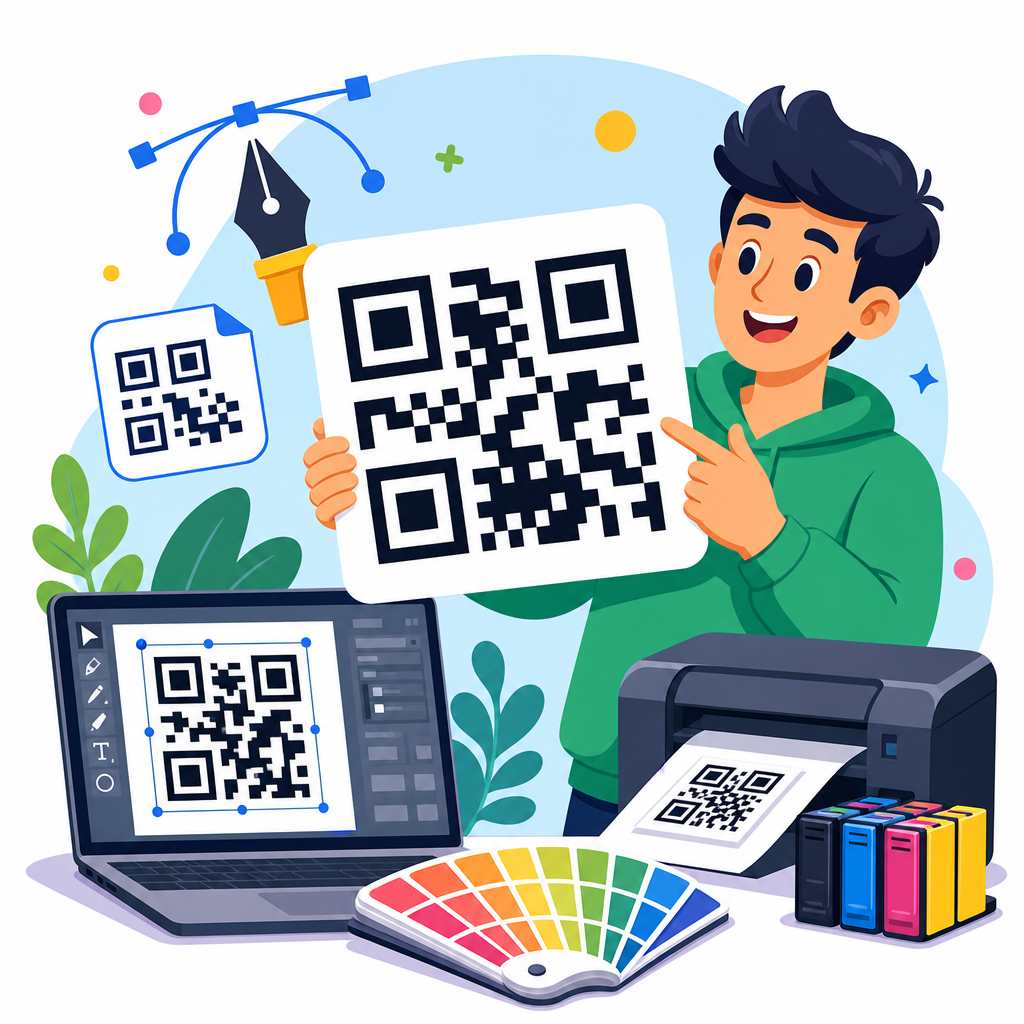
In day-to-day work, PNG is usually the easiest download for websites, presentations, internal docs, and quick sharing. Most CMS platforms, email builders, and office tools accept PNG without issue. SVG is stronger when a QR code will be placed in Adobe Illustrator, Figma, InDesign, or sent to a printer. If a designer needs to match brand colors, align the code within packaging artwork, or resize it repeatedly, SVG reduces friction. It also keeps linework crisp on high-resolution output devices because there is no baked-in pixel grid.
However, SVG is not automatically the best file in every case. Some older workflows, restricted email clients, or simple office software handle PNG more predictably. Some web teams also prefer PNG when they want exact rendering consistency and do not need post-export editing. The correct decision starts with the intended destination of the QR code asset.
When to Download a QR Code PNG File
Download a QR code PNG when the asset will appear at a known size on screens and you want broad compatibility with minimal setup. That includes website pages, blog posts, landing pages, help center articles, app store graphics, digital menus, event registration pages, and internal documents. PNG works well when the code is already generated at the right dimensions and no one needs to edit its structure later. For example, a 512 by 512 or 1024 by 1024 PNG is typically sufficient for a website CTA block or embedded PDF handout.
PNG is also useful for teams that do not use vector-capable design software. Marketing coordinators often place QR codes into Google Slides, Microsoft PowerPoint, Canva, or simple social graphics. In those environments, PNG is frictionless. It previews reliably, exports cleanly, and avoids the occasional compatibility issue that can arise when an imported SVG is flattened, misread, or blocked by a platform. If speed matters more than editability, PNG is often the practical choice.
Another advantage is predictable compression behavior. PNG is a lossless format, unlike JPEG, so it preserves hard edges better for QR codes. That means you should almost never download a QR code as JPG if PNG is available. JPEG compression introduces artifacts around module boundaries, especially after repeated saves, and those artifacts can interfere with scanning under poor lighting or at small sizes. PNG avoids that problem while remaining easy to distribute to non-design stakeholders.
When to Download a QR Code SVG File
Download a QR code SVG when you need scalability, print production quality, or design flexibility. SVG is the safest choice for posters, flyers, window clings, table tents, shipping inserts, packaging, retail signage, and trade show materials because the file can be resized without losing edge clarity. In print, that matters. A QR code that looks acceptable on a laptop screen can fail if a raster file is enlarged for a six-foot banner and the module edges blur or anti-aliasing becomes visible from the printer RIP.
SVG is also better when your downloadable assets need to become templates. If a creative team maintains a library of reusable QR code resources, vector files are more future-proof. A single SVG can be adapted across formats, locked into a brand system, recolored carefully, and integrated into layered documents. In Adobe Illustrator or Figma, designers can position the code precisely, maintain quiet-zone spacing, and export derivatives for print and web from one master asset. That is a more durable workflow than rebuilding separate large PNGs for every new campaign.
There is also a file-efficiency benefit in many cases. Simple black-and-white QR codes saved as SVG can be surprisingly lightweight because they describe shapes instead of storing large pixel grids. For logos, posters, and packaging proofs, that can make versioning easier. The caveat is that some SVG exports include unnecessary metadata or masks, so clean generation from a reputable QR tool matters.
PNG vs SVG: Best Format by Use Case
The easiest way to choose is to map the file type to the output environment. If the QR code lives primarily on screens at controlled dimensions, PNG is usually enough. If it may be resized, printed, or edited, SVG is safer. Teams that manage downloadable assets well often store both versions: an SVG master for production and a few standardized PNG exports for web and office use. That prevents ad hoc screenshots, which are one of the most common causes of unreadable QR codes.
| Use case | Best format | Why |
|---|---|---|
| Website buttons, blog posts, PDFs | PNG | Easy upload, broad support, fixed display size |
| Print flyers, posters, packaging | SVG | Scales cleanly and stays sharp in production |
| Brand templates in Figma or Illustrator | SVG | Editable vector asset with precise alignment |
| PowerPoint, Slides, quick internal docs | PNG | Fast placement with predictable rendering |
| Multi-channel asset libraries | Both | SVG as master, PNG as ready-to-use derivatives |
A real example illustrates the tradeoff. For a restaurant chain, we kept an SVG master for each dynamic menu QR code because store teams needed signage ranging from counter cards to exterior decals. We also exported standardized PNG files for the website and franchise PDF kit. That reduced support tickets because staff stopped dragging low-resolution screenshots into local marketing materials.
How File Type Affects Scan Reliability
Many people assume file format only affects appearance. In reality, it can affect whether the code scans consistently. QR scanning depends on finder patterns, timing patterns, data modules, contrast, and quiet zone integrity. A low-quality or improperly resized PNG can soften boundaries between modules, especially if scaled up from a small original. When that happens, smartphone cameras may still decode the code at close range, but performance worsens under glare, motion, low light, or distance.
SVG helps preserve shape fidelity because the module grid remains mathematically exact until final rendering. That makes it particularly valuable for print workflows where a RIP, PDF export, or large-format device must interpret the code cleanly. Still, SVG alone does not guarantee success. If a designer adds heavy gradients, distorts proportions, removes the quiet zone, or places the code over a busy image, scan performance can fail regardless of format. Standards-based QR tools typically build in error correction, but that is not a license to ignore legibility.
My working rule is simple: choose the cleanest source file possible, test at real output size, and scan with multiple devices before approval. Use black on white when possible, maintain strong contrast, and avoid inverting colors unless you have verified results in context. The format decision supports scanability, but it does not replace validation.
Design, Printing, and Brand Control Considerations
Brand teams often want QR codes to feel integrated rather than pasted onto the layout. That is reasonable, but customization must stay within technical limits. SVG gives designers more control over color, placement, and scaling, which is why it is favored in packaging and retail creative. If your brand uses a dark navy instead of pure black, or needs a code aligned with a dieline, SVG makes execution easier. It also simplifies export into press-ready PDFs where vectors remain crisp through prepress checks.
For print, size is not the only variable. Substrate, finish, viewing distance, and print process matter. A QR code on corrugated packaging behaves differently from one on coated brochure stock. Spot colors, varnish, embossing, and low-contrast brand palettes can reduce readability. In those conditions, SVG is the stronger starting point because it preserves clean structure while you test production proofs. Printers commonly recommend vector artwork for barcodes and machine-readable marks for exactly this reason.
PNG still has a role in branded systems, especially for digital kits. If your resource center offers downloadable QR code assets for sales teams or franchisees, pre-approved PNGs can protect brand consistency by limiting accidental edits. The best asset governance model usually combines locked SVG masters with clearly named PNG exports for common dimensions.
Best Practices for Managing Downloadable QR Code Assets
If this page serves as a hub for downloadable assets, the operational question is bigger than one export button. Teams need a consistent asset structure. Store each QR code with a clear naming convention, destination URL record, campaign owner, creation date, error-correction level if available, and approved output sizes. Keep the SVG as the source master when possible, then generate PNG derivatives such as 512, 1024, and 2048 pixels for common digital placements. This reduces duplicate files and prevents people from creating unofficial versions.
Use a trusted QR code generator that supports dynamic codes, analytics where needed, and clean vector exports. Reputable platforms typically include scan tracking, destination editing, bulk creation, and download options suitable for marketing operations. Before publishing assets, test them on iPhone and Android devices, in both native camera apps and common scanning contexts. Validate them in print proofs, on matte and glossy surfaces, and at realistic distances.
Finally, document usage rules inside your QR code resources library. State minimum print size, required quiet zone, approved colors, prohibited effects, and preferred file type by channel. A simple decision tree prevents expensive mistakes: use PNG for fixed-size digital placements, SVG for scalable or printed output, and keep both when the asset will travel across channels. If you manage QR code downloadable assets this way, your files stay organized, your codes scan reliably, and your team spends less time fixing avoidable production problems.
PNG and SVG are not competing in a winner-takes-all sense. They solve different problems inside the same QR code workflow. PNG is the dependable choice for fast digital publishing, office software, and fixed-size placements where compatibility matters most. SVG is the professional choice for print, scaling, and editable templates where sharp edges and flexibility are essential. If you remember only one rule, use PNG for convenience and SVG for longevity.
For teams building a QR code resources hub, the smartest approach is to treat SVG as the master asset and PNG as the most useful derivative. That structure supports websites, presentations, signage, packaging, and future redesigns without forcing anyone to recreate codes from scratch. It also improves governance because approved downloadable assets remain consistent across departments and vendors. Better file choices lead to better scanning outcomes, cleaner production, and fewer support issues.
Audit your current QR code library, identify where low-resolution PNGs or screenshots are still in use, and replace them with properly named master files and standardized exports. Then document your format rules so every new campaign starts with the right download.
Frequently Asked Questions
What is the main difference between a QR code PNG file and an SVG file?
The core difference is how each file stores the QR code image. A PNG is a raster file, which means it is made of fixed pixels. An SVG is a vector file, which means it is built from mathematical paths and shapes instead of a set pixel grid. In practical terms, a PNG works well when you already know the exact size you need and do not expect to scale the code much after downloading it. An SVG is more flexible because it can be enlarged or reduced without losing sharpness.
That difference matters more than many teams expect. A QR code is not just a graphic; it is a machine-readable pattern that depends on crisp edges, consistent spacing, and strong contrast. If a PNG is stretched too far, its modules can soften or blur, which can reduce scan performance, especially on printed materials. SVG files avoid that issue because the structure stays clean at almost any size. That is why SVG is often the safer choice for logos, posters, packaging, signage, and other assets that may need to be resized repeatedly.
There is also a workflow distinction. PNG files are usually simpler for everyday digital use because they are widely supported and easy to drop into websites, slide decks, email graphics, or social posts. SVG files are often better for professional design and production environments where editors may need to adjust size, color, or layout across many formats. So while both can contain the same QR code data, the right file type depends on how the asset will be used, scaled, and shared.
Which file type is better for printing QR codes on menus, flyers, packaging, or signs?
For most print applications, SVG is usually the better download choice. Print projects often change size during production, and a vector QR code can scale cleanly from a small label to a large storefront display without introducing fuzziness. That flexibility is extremely valuable when a design moves from proof to final production and dimensions shift slightly. With SVG, the QR code remains sharp, which helps preserve scan reliability and avoids last-minute artwork fixes.
This matters a great deal on items like restaurant menus, product packaging, brochures, event signage, and window decals. A QR code that looks acceptable on a screen can fail in print if it was exported as a low-resolution PNG and then enlarged by a designer or printer. Once a raster file exceeds its intended output size, the edges of the code’s squares can become soft. Even if the code is still technically visible, scanners may take longer to read it or fail under poor lighting, reflective surfaces, or awkward camera angles. Those real-world conditions are where file quality starts to matter.
PNG can still work for print if it is exported at a sufficiently high resolution for the final physical size and never enlarged afterward. For example, if you know the QR code will always appear at a fixed small size on a printed handout, a high-quality PNG may be perfectly fine. But if there is any chance the code will be resized, repurposed, or sent through multiple design hands, SVG is the safer and more future-proof option. It reduces the risk of print failure and gives the production team more room to work confidently.
Is PNG better for websites and digital use, or should I still use SVG?
PNG is often the easiest option for digital use, but it is not automatically the best one in every situation. For websites, landing pages, downloadable PDFs, presentation slides, and social media graphics, PNG is commonly used because it is simple, familiar, and broadly compatible. If the QR code will appear at a fixed size and you export it clearly enough for that use, a PNG can perform very well. It is especially convenient when teams want a straightforward asset that can be inserted into content without any special handling.
That said, SVG can still be an excellent choice for web and digital environments when scalability and design consistency matter. Responsive websites may display the same QR code at different sizes depending on screen width, layout changes, or device type. In that case, SVG helps keep the image sharp across breakpoints and high-density displays. It can also make life easier for design systems and reusable brand assets because one file can serve multiple placements without creating separate versions for each size.
The best decision comes down to implementation. If your website team wants maximum simplicity and the code will remain in a controlled size range, PNG is often sufficient. If the code may be resized dynamically, reused in multiple templates, or integrated into more advanced front-end workflows, SVG is often the stronger long-term asset. Either way, the file type alone does not guarantee success. You still need proper contrast, adequate quiet space around the code, and a final scan test on real devices before publishing.
Will using the wrong file type affect QR code scan reliability?
Yes, it can. The data inside the QR code stays the same, but the way the file renders can absolutely affect whether people can scan it quickly and reliably. Scan performance depends on sharp module edges, clean spacing, sufficient size, and clear contrast against the background. If a PNG is exported too small and later enlarged, it can become blurry or pixelated. That degradation may seem minor to the eye, but phone cameras and scanning apps are less forgiving than many people realize, especially in less-than-ideal lighting.
File choice becomes even more important when the QR code is printed on textured paper, glossy packaging, curved surfaces, or large-format signage viewed from a distance. Under those conditions, every bit of visual clarity helps. An SVG typically preserves edge definition better because it is resolution-independent, so it is less likely to degrade during resizing. That makes it a strong option when scan reliability is a top priority and the code may be adapted for different formats.
However, it is worth being precise here: the wrong file type does not always ruin a QR code, and the right file type does not fix every design problem. A perfectly sharp SVG can still scan poorly if it is too small, lacks adequate margin, uses weak color contrast, or is over-stylized. Likewise, a properly exported PNG at the correct dimensions can scan flawlessly. The safest approach is to match the file type to the use case, preserve the code’s visual integrity, and test the final asset in the exact context where it will appear.
How should teams decide which QR code format to download for reusable marketing assets?
A good rule is to think about future reuse, not just the immediate placement. If a QR code is likely to move across campaigns, channels, and design formats, SVG is usually the smartest master file to download and archive. It gives your team a flexible source asset that can scale from a small social graphic to a large print banner without needing to regenerate the code or worry about quality loss. That can save significant time when marketing, design, and production teams need to adapt the same QR code quickly.
Many teams run into problems because they download a PNG for a quick task and then keep reusing that one version everywhere. At first, it seems efficient. Later, someone enlarges it for packaging, places it into a high-resolution print layout, or sends it to a vendor who needs a different size. Suddenly the asset no longer holds up, and the team has to scramble for a cleaner version. Keeping an SVG as the primary source helps avoid those bottlenecks. From there, you can export PNGs at specific sizes for web, email, ads, presentations, or platform-specific creative.
The most efficient workflow is often a hybrid one: store the SVG as the master production file, then generate PNG derivatives for fixed digital placements where a raster format is more convenient. This approach gives you the best of both worlds: scalability for print and design flexibility, plus simple deployment for everyday digital use. It also improves brand consistency because everyone works from the same original code rather than passing around mismatched screenshots or outdated exports. If the goal is reliable scanning, clean production, and fewer last-minute asset problems, that workflow is hard to beat.