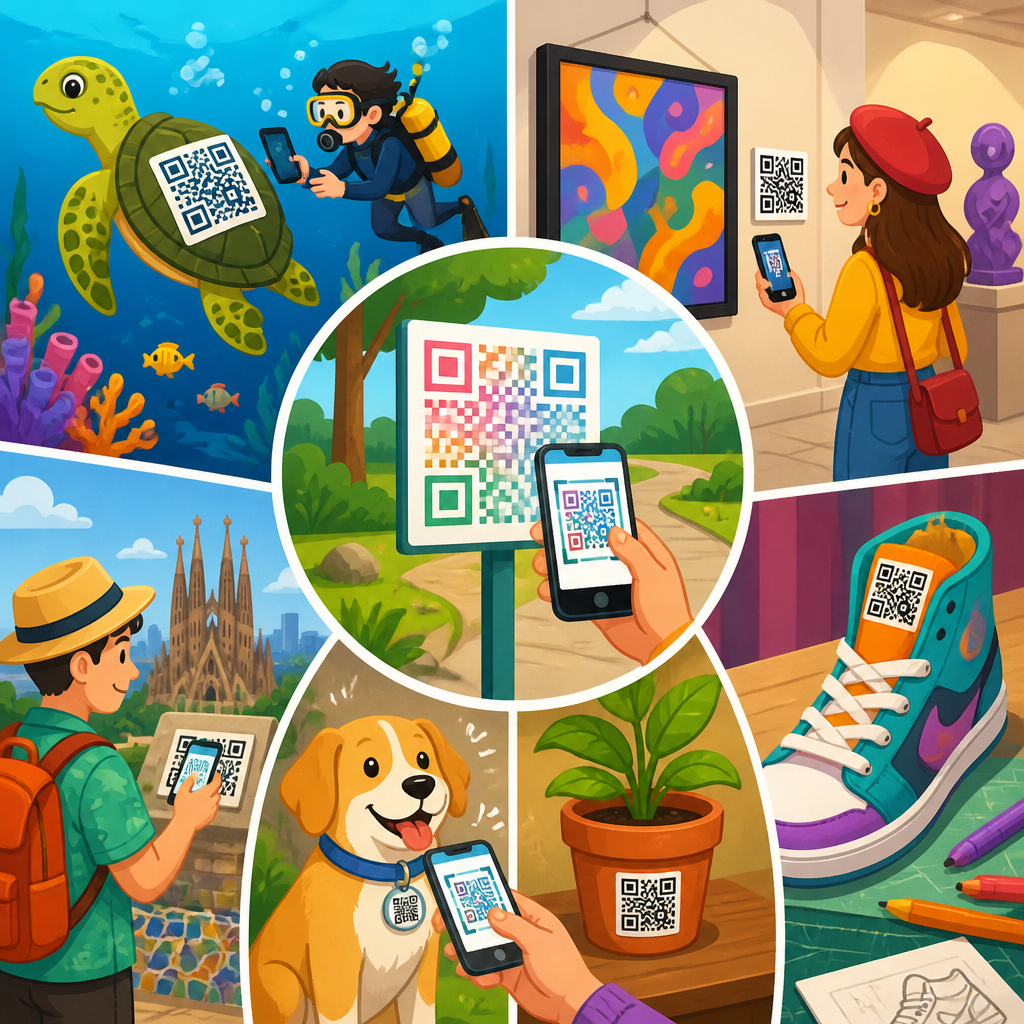
QR codes have moved far beyond restaurant menus and payment links, and the most interesting growth now sits in emerging use cases that blend physical objects, live data, and mobile behavior in ways many teams still overlook. A QR code is a two dimensional matrix barcode that stores a destination such as a URL, file, contact card, authentication token, or app action, and modern smartphones read it instantly through the native camera. In practice, that simple scan creates a bridge between offline attention and digital response, which is why QR code use cases matter to marketers, retailers, manufacturers, event operators, healthcare providers, and product teams building connected experiences. I have deployed QR programs for packaging, field service, museums, and retail displays, and the same lesson keeps repeating: the strongest results come from matching the code to a very specific user moment. This hub explores unique QR code use cases you’ve never seen, with a focus on emerging use cases that create measurable value, sharper attribution, and better customer experience across industries.
Why does this topic deserve a dedicated hub inside QR Code Trends and Innovations? Because most articles stop at familiar examples such as menus, Wi Fi access, or business cards, while the real innovation is happening in edge scenarios where codes trigger dynamic content, identity checks, post purchase education, and place based interactions. Dynamic QR codes, unlike static ones, let teams change the destination after printing, add UTM parameters, segment traffic by location, and monitor scans by device, time, and geography. That flexibility turns a printed square into an adaptable media channel. Emerging QR code use cases also intersect with serialization, Internet of Things workflows, zero party data collection, and authenticated product journeys. If your goal is to understand where QR strategy is heading next, this page provides the big picture and the practical examples needed to evaluate what fits your brand, operation, or product roadmap.
Smart packaging that keeps working after the sale
Product packaging is one of the most underused surfaces in digital strategy, especially after purchase. A unique QR code on packaging can route first time buyers to setup instructions, returning buyers to refill subscriptions, and service issues to troubleshooting flows without redesigning the box. I have seen consumer electronics brands reduce support tickets by linking each component tray to a short assembly video instead of relying on a thick printed manual. Beauty brands are using package level codes to connect buyers to ingredient sourcing pages, shade matching tools, and replenishment reminders. Food companies can point customers to freshness information, recipes, allergens, and localized recycling guidance based on the scan region.
The breakthrough is not merely convenience; it is lifecycle marketing tied to an object already in the customer’s home. With dynamic rules, the same code can change destination over time. During launch week it may support onboarding. Thirty days later it can invite a review. Ninety days later it can offer replacement parts or refill bundles. For serialized products, each unit can have its own code, which helps distinguish genuine items from counterfeit ones, confirm warranty registration, and track engagement by production batch. GS1 Digital Link standards are making this especially important as brands prepare for richer product identification at shelf and beyond. Packaging is no longer static print. It is an interactive interface.
Physical spaces that adapt to context
One of the most compelling emerging use cases is place aware QR deployment inside stores, hotels, campuses, and transit environments. Instead of a generic landing page, the code responds to the exact context of the scan. A hotel lobby sign can deliver express check in before arrival, late checkout requests in the evening, and local recommendations during the stay. In a large retail store, shelf edge QR codes can show stock in nearby branches, comparison charts, installation guidance, or accessibility information for shoppers who need larger text or audio descriptions. Museums and historic sites are expanding beyond simple exhibit labels by using QR layers for multilingual narratives, curatorial notes, and archival media that would never fit on a wall plaque.
Context based QR systems work best when each code maps to a clear intent. In a stadium, a seat specific code can open mobile ordering, instant replay clips, or wayfinding to the nearest restroom. At a university, building entrance codes can provide after hours access policies, emergency contacts, and room booking status. In manufacturing plants, machine mounted QR labels often lead technicians directly to maintenance logs, lockout procedures, and replacement part numbers. These applications reduce friction because they answer the most likely question at the exact place it occurs. That direct utility is why scan rates rise when teams design around location specific needs rather than broad promotional messaging.
QR codes as product identity and trust infrastructure
Counterfeit prevention and authenticated ownership are becoming major QR innovation areas, particularly in luxury goods, regulated products, collectibles, and resale markets. A unique QR code tied to a secure product record can help verify whether an item was produced by the brand, when it was activated, and whether ownership was transferred legitimately. This matters for sneakers, handbags, watches, wine, cosmetics, and even replacement parts in industrial supply chains. The code itself is not enough to stop fraud, but when linked to a protected backend, serialized inventory data, and anomaly monitoring, it becomes a practical customer facing trust layer.
Real world programs often combine visible QR codes with tamper evident labels, hidden markers, or cryptographic signatures. Scan behavior can reveal suspicious patterns, such as the same product ID being checked in multiple countries within hours. For resale, authenticated scans can unlock a digital certificate, care history, or service record that raises buyer confidence. In pharmaceuticals and healthcare, traceability expectations are stricter, and any implementation must align with regulatory requirements, privacy controls, and documented chain of custody procedures. Still, the principle is the same across sectors: QR codes can represent verified identity, not just navigation. That shift opens valuable new use cases where confidence and provenance affect conversion.
Events, media, and entertainment that continue after the moment
Events are fertile ground for unique QR code use cases because every physical touchpoint competes for attention and every attendee action has timing attached to it. A badge code can speed check in, but the more interesting applications happen after entry. Session room codes can distribute slides, speaker links, and CE credit forms only to the people who attended. Exhibit booth codes can route visitors differently depending on whether they want a demo, spec sheet, case study, or follow up meeting. Concert merchandise tags can unlock backstage content or a city specific digital collectible tied to the tour date. Printed posters, magazine ads, and out of home campaigns can also use dynamic codes to rotate destinations by daypart or weather conditions.
These ideas work because QR codes extend a temporary moment into a measurable digital journey. A film festival can place codes on seatbacks that open subtitles, director commentary, or voting interfaces. A sports venue can use concourse signage to balance crowd flow by showing shortest concession lines in real time. Publishers are experimenting with QR enhanced print that links articles to source documents, data visualizations, and audio narration, which deepens trust rather than treating print as isolated media. In each case, the code is not a novelty. It solves a time bound need and creates first party behavioral signals that organizers can use to improve programming, sponsorship reporting, and post event conversion.
Service, maintenance, and workforce enablement
Some of the highest ROI QR projects never face consumers at all. In field service, facilities management, and operations, QR codes can radically shorten the path between a problem and the right procedure. A technician scanning a code on a refrigeration unit can open the exact service manual, maintenance history, sensor dashboard, and spare parts list for that model. Custodial teams can scan restroom codes to log cleaning completion. Property managers can place asset tags on HVAC systems, fire panels, elevators, and water heaters, giving approved staff one scan access to inspection records and compliance checklists. Because the code sits on the asset, the system reduces search time and identification errors.
| Use case | What the QR code opens | Main operational benefit |
|---|---|---|
| Equipment maintenance | Manuals, parts lists, service history | Faster repairs and fewer mistakes |
| Facility inspections | Checklist, timestamped log, photo upload | Better compliance documentation |
| Training on the floor | Task video, SOP, safety instructions | Quicker onboarding |
| Customer self service | Troubleshooting flow, chat, warranty form | Lower support volume |
I have seen maintenance teams move from paper binders to QR linked digital SOPs and cut routine lookup time dramatically. The key is governance. Links must be version controlled, permissions must be role based, and offline fallback may be necessary in low connectivity environments. For training, QR codes placed at workstations can launch thirty second microlearning modules that show how to calibrate a device, package a shipment, or complete a safety check. This is especially effective for multilingual teams because one code can present language options immediately. When organizations talk about digital transformation, these grounded workflow applications deserve more attention than flashy campaigns because they produce direct labor savings and stronger process adherence.
Healthcare, accessibility, and public service innovation
Healthcare and public service settings are adopting QR codes in more nuanced ways than patient intake forms. Hospitals can place bedside or room entry codes that explain care team roles, visiting rules, discharge steps, and medication education in multiple languages. Clinics can use waiting room codes for previsit questionnaires that reduce clipboard friction while preserving staff time. For public health campaigns, posters in transit stations or community centers can connect people to vaccine eligibility, local clinic maps, or telehealth triage without requiring app installation. The strongest implementations are simple, privacy aware, and designed for people under stress.
Accessibility is another important frontier. QR codes can trigger audio descriptions, sign language video, simplified text, or high contrast content for users who need alternative formats. At parks, public art installations, and government buildings, this can turn static signage into inclusive information delivery. Emergency management teams are also testing QR use for evacuation maps, localized incident updates, and shelter instructions, though those systems must never rely on a code as the only communication method. The broader lesson is that emerging QR code use cases are not only commercial. They can improve comprehension, independence, and service equity when paired with clear content architecture and responsible implementation choices.
How to evaluate and launch the right emerging QR use case
If you want results, start with the user question at the moment of scan, not with the code design. Ask what someone needs here, now, on this object or in this place. Then decide whether the destination should be static, dynamic, personalized, authenticated, or integrated with CRM, analytics, or inventory systems. Tools such as Bitly, QR Code Generator, Beaconstac, Flowcode, and enterprise mobile engagement platforms support dynamic routing and scan reporting, while Google Analytics 4 can capture downstream behavior when links are tagged correctly. Good implementation also requires testing for glare, distance, print contrast, landing page speed, and mobile readability. ISO and error correction standards matter, but practical usability matters more: if people cannot scan quickly, the concept fails.
Measure beyond scan volume. Track completion rates, support deflection, repeat engagement, revenue per scan, or operational time saved depending on the use case. Use distinct codes by placement so you can compare shelf talkers versus packaging, lobby signs versus in room cards, or machine tags versus training posters. Maintain a destination inventory so broken links do not accumulate across long lived printed assets. Most of all, treat this hub as a starting point for experimentation. The best unique QR code use cases emerge when teams combine a real world object, a narrow intent, and a dynamic digital response. Review your customer journey, operations, and physical environments, then identify one overlooked moment where a scan could remove friction or add trust. Launch small, measure rigorously, and expand what proves useful.
Frequently Asked Questions
1. What makes a QR code use case truly “unique” today?
A unique QR code use case is not just about placing a code somewhere unexpected. What makes it stand out is the way it connects a physical moment to useful digital behavior in real time. Traditional QR code campaigns often stop at a static destination such as a homepage, menu, or download page. More inventive use cases go much further by adapting the scan experience based on context, product state, customer intent, location, or live data. That means the same printed code can unlock different outcomes depending on when it is scanned, where it is scanned, or who is scanning it.
For example, a QR code on product packaging can open a live authenticity record, a freshness log, refill instructions, warranty activation, or a personalized restock path instead of a generic landing page. A code on event signage might direct one person to navigation, another to a schedule update, and another to a private networking group. In industrial settings, a QR code can connect equipment to maintenance logs, video repair instructions, safety documentation, and parts ordering in seconds. These use cases feel unique because they solve a real-world friction point rather than simply adding a digital link for novelty.
The most overlooked factor is that QR codes now work especially well when paired with dynamic content systems. Businesses can update the destination without reprinting the code, track scan patterns, test different experiences, and use first-party behavioral data to improve the customer journey. In other words, the uniqueness does not come from the square itself. It comes from the intelligence behind the scan and how well it bridges offline objects with mobile actions that are timely, relevant, and genuinely useful.
2. How can QR codes be used on physical products in ways most brands still overlook?
Many brands still think of packaging QR codes as simple “learn more” tools, but physical products are one of the richest environments for advanced QR code applications. The biggest opportunity is turning products into ongoing digital touchpoints long after purchase. Instead of using a QR code only for pre-sale marketing, companies can use it to extend ownership, support, loyalty, education, and even resale.
One powerful example is digital product identity. A QR code attached to a product can link to manufacturing details, batch information, certification records, and provenance data. This is especially valuable for luxury goods, collectibles, wine, supplements, electronics, and sustainable products where customers care about authenticity and traceability. Another underused application is post-purchase onboarding. A scan can instantly open setup guides, care instructions, assembly videos, replacement part catalogs, or app pairing flows that remove support friction and reduce returns.
There is also strong potential in circular economy and reuse models. A reusable container, garment, or device can carry a QR code that tracks repair history, refill eligibility, ownership transfer, or recycling instructions. For subscription-based products, the code can support quick reordering or account-specific replenishment. For gifting and resale, it can transfer documentation, manuals, proof of ownership, or remaining warranty coverage. Even simple household goods can become smarter touchpoints when a QR code gives consumers a direct path to the next meaningful action instead of a generic website.
What brands often miss is that packaging and product surfaces are persistent media channels. Unlike ads that disappear, products stay in homes, workplaces, bags, kitchens, shelves, and vehicles. A well-designed QR code experience can create repeated engagement over weeks, months, or years. That makes the product itself one of the most valuable places to deploy a code if the destination is useful enough to justify scanning.
3. Are dynamic QR codes better than static QR codes for creative use cases?
In most cases, yes. Dynamic QR codes are usually the better choice when the goal is to support creative, evolving, or data-driven experiences. A static QR code points directly to one fixed destination, which means that once it is printed or published, changing the user experience often requires replacing the code entirely. That limitation makes static codes fine for permanent and simple use cases, but much less effective for campaigns or systems that need flexibility.
Dynamic QR codes work differently. They route scans through a managed short link or redirect layer, which allows the destination to be updated without changing the printed code. That single capability opens up a wide range of advanced use cases. A museum exhibit can change from a teaser page to an audio tour to a member donation flow over time. A code on retail signage can point to in-stock alternatives if a featured item sells out. A code on a product label can begin as an onboarding guide and later redirect to replenishment, support, or upgrade options. This kind of adaptability is what makes dynamic QR codes so useful in emerging and unexpected scenarios.
They also provide analytics that are essential for optimization. Businesses can measure scan volume, timing, device types, approximate location data, and campaign performance. That helps teams understand whether a specific object, display, package, or environment is actually generating engagement. It also supports A/B testing, segmented destinations, and lifecycle-based messaging. For example, the same code might send first-time scanners to an explainer page and returning users to a loyalty reward flow.
That said, dynamic QR codes require thoughtful management. Since they depend on the redirect layer, businesses should use reliable platforms, maintain link hygiene, and ensure long-term control of the destination infrastructure. If permanence, simplicity, and zero maintenance matter most, static can still be appropriate. But for unusual use cases involving live data, personalized experiences, or future updates, dynamic QR codes are almost always the smarter option.
4. What are some surprising industries or environments where QR codes are gaining traction?
QR codes are expanding well beyond hospitality, retail, and payments, and some of the most interesting adoption is happening in places people do not automatically associate with mobile scanning. One major area is manufacturing and field operations. Machines, tools, and service panels can carry QR codes that give technicians immediate access to service histories, diagnostic checklists, compliance documentation, and parts ordering workflows. This reduces downtime and removes the need to manually search for information in separate systems.
Healthcare and wellness are also seeing creative growth. QR codes can support patient education, medication guidance, check-in flows, device setup, care-plan access, and lab result navigation. In fitness spaces, codes placed on equipment can launch instructional videos, safety guidance, or personalized workout tracking. In education, schools and training centers can use QR codes for lab instructions, assignment resources, campus navigation, attendance systems, and interactive printed materials that connect textbooks or posters to live digital content.
Real estate is another strong example. Beyond listing pages, QR codes can connect physical signs and printed brochures to virtual walkthroughs, neighborhood insights, mortgage calculators, application forms, or agent messaging. In tourism and public spaces, QR codes on landmarks, transit points, trails, or exhibits can deliver multilingual information, accessibility support, audio interpretation, or live route updates. Even agriculture is adopting QR codes for equipment records, livestock tracking, crop treatment logs, and supply chain transparency.
The reason these environments matter is simple: they contain physical objects and decision points where people need fast information without downloading an app or typing a URL. That is exactly where QR codes excel. As smartphone camera scanning has become native and frictionless, industries with complex offline workflows are discovering that the humble QR code can act as a lightweight interface layer between real-world assets and digital systems.
5. How should businesses design a QR code experience so people actually want to scan it?
The success of a QR code depends less on the code itself and more on the clarity and value of the moment around it. People scan when they understand what they will get and why it is worth the effort. That means every QR code placement should answer a simple question immediately: what happens after the scan? If that benefit is vague, generic, or low-value, scan rates usually suffer. Strong examples include “See live inventory,” “Verify authenticity,” “Watch 30-second setup,” “Unlock care instructions,” or “Claim event resources.” Clear expectations make the interaction feel purposeful rather than experimental.
Placement and context matter just as much. A QR code should appear exactly where the need arises. On packaging, that might be near setup instructions or refill details. On machinery, it should be visible where service work begins. At events, it should be near entrances, schedules, booths, or networking prompts. The surrounding design should give the code enough contrast and space to scan easily, and the destination should be mobile-first, fast-loading, and immediately relevant to the physical object or moment. Sending users from a specific real-world context to a cluttered homepage is one of the most common mistakes.
Trust is another major factor. Users are more likely to scan when the branding is recognizable and the purpose feels legitimate. Businesses should use branded landing pages, secure destinations, and concise calls to action. Where appropriate, adding a short URL below the code can increase confidence. Accessibility also matters. Instructions should be readable, placement should be practical, and the experience should not assume perfect lighting, premium devices, or high bandwidth. If possible, the scan should reduce effort, not add a multi-step process.
Finally, the best QR code experiences are iterative. Teams should test placements, scan prompts, landing pages, and follow-up actions based on real analytics. Scan rates, bounce rates, conversions, and repeat use can reveal whether the use case is genuinely helpful