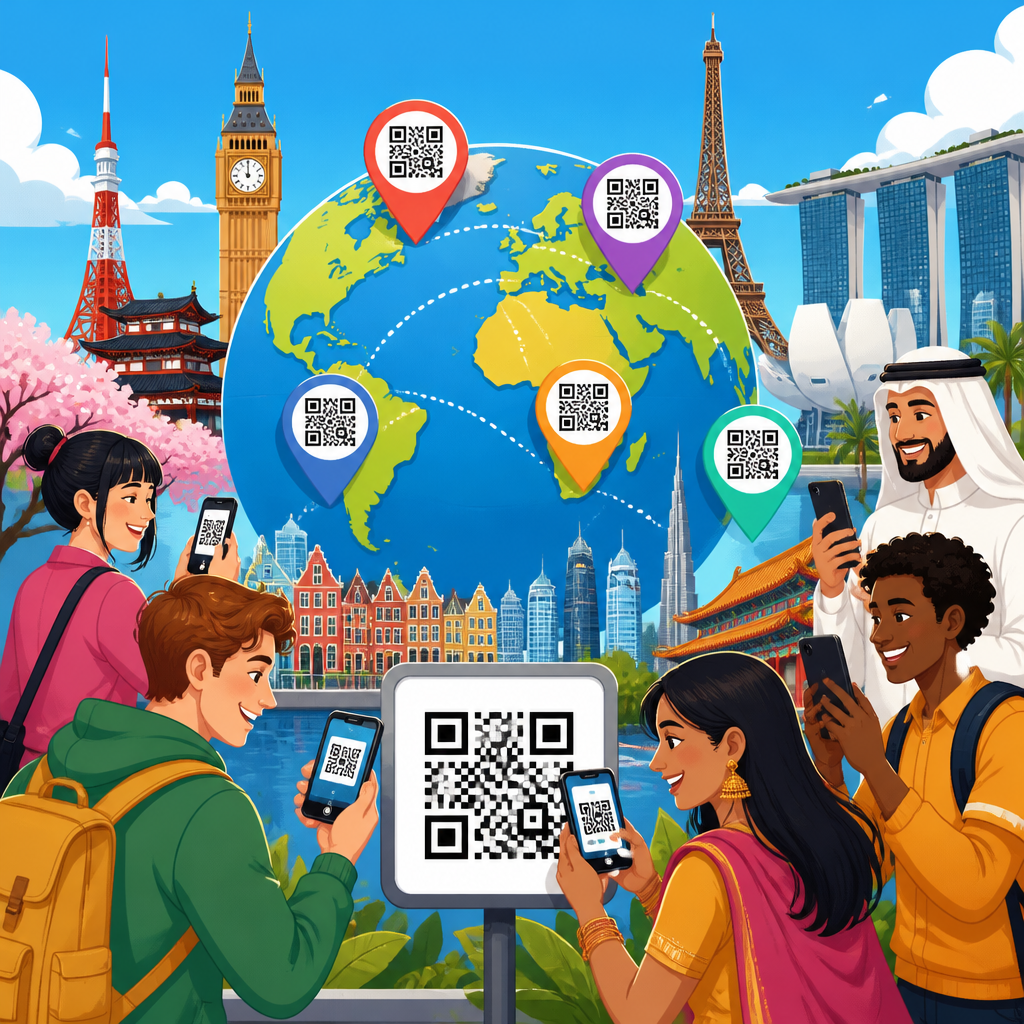
QR code adoption in 2026 is no longer a niche story about restaurant menus or contactless payments; it is a global infrastructure trend shaping commerce, identity, logistics, healthcare, and customer engagement. A QR code, short for Quick Response code, is a two-dimensional barcode that stores data such as URLs, payment credentials, product identifiers, event tickets, or authentication tokens. What matters in 2026 is not the code itself but the ecosystem around it: smartphone camera recognition, digital wallets, merchant systems, analytics platforms, and regulatory frameworks that make scanning fast, secure, and measurable. After working with QR-based campaigns, product labels, and payment rollouts across multiple markets, I have seen the same pattern repeatedly: adoption rises when scanning solves a clear friction point better than cards, printed instructions, or manual data entry.
Global QR code adoption trends matter because they reveal where customer behavior, mobile payments, and physical-to-digital journeys are headed next. Brands use QR codes to connect packaging to rich product data. Governments use them for transport tickets, tax receipts, and public services. Retailers use them for self-checkout, loyalty enrollment, and returns. Healthcare providers use them for patient intake and medicine tracking. For operators, the appeal is low cost, broad device compatibility, and easy deployment. For users, the appeal is speed. In practical terms, the strongest markets combine high smartphone penetration, strong wallet usage, merchant acceptance, and consumer trust. The weakest markets usually struggle with fragmented standards, poor education, or security concerns such as malicious redirects and payment fraud.
This hub article explains the main global QR code adoption trends in 2026, where growth is strongest, which industries are driving demand, what technical and regulatory shifts are changing implementation, and what businesses should do next. If you need a clear view of global QR code adoption trends, this guide covers the essential patterns, the market differences, and the operational realities behind the headlines.
The global market has moved from experimentation to embedded behavior
The biggest shift in 2026 is that QR codes have become embedded in routine behavior rather than treated as a temporary convenience. During the early pandemic years, many organizations deployed QR codes reactively for touchless menus and check-ins. In 2026, the leading use cases are more durable: payments, account access, product authentication, omnichannel retail, and post-purchase support. This matters because sustained adoption is different from novelty. When people scan out of habit, businesses can design journeys around QR entry points with far more confidence.
Several indicators explain this maturity. Native camera scanning is now standard across modern smartphones, reducing the need for dedicated apps. Digital wallets increasingly support QR-triggered actions, from adding tickets to approving payment requests. Retail and hospitality systems routinely generate dynamic QR codes tied to inventory, offers, or localized landing pages. In my own implementation work, dynamic codes consistently outperform static codes because they preserve print assets while allowing the destination, language, tracking parameters, or campaign logic to change without reprinting. That flexibility turns a simple code into a live operating layer for physical marketing and service delivery.
Another sign of maturity is executive ownership. QR initiatives are no longer managed only by marketing teams. Product, payments, IT, compliance, and operations leaders now influence deployment decisions. When a logistics provider places QR codes on shipping labels, or a bank uses them for secure onboarding, the code sits inside a wider process that demands uptime, governance, and fraud controls. That institutionalization is why global QR code adoption trends in 2026 point toward long-term infrastructure, not a passing tactic.
Regional adoption patterns are converging, but not at the same speed
Global adoption is widespread, yet regional differences remain significant. Asia-Pacific continues to set the pace, especially in markets where wallet-based payments and super apps normalized scanning years ago. China remains the classic example, with QR payments deeply integrated into daily life across urban and rural commerce. India has also reshaped the landscape through interoperable digital payments, making merchant acceptance practical even for microbusinesses. Southeast Asian markets continue expanding QR use in transport, tourism, and cross-border retail, supported by national payment rails and central-bank-backed interoperability efforts.
Europe is growing through a different model. Adoption there is strong in transport, ticketing, retail engagement, and digital product information, while payments growth varies by country. Markets with widespread contactless card habits sometimes see slower consumer migration to scan-to-pay, yet QR codes still win in use cases where a card tap cannot carry enough information, such as warranty activation, recycling instructions, or multilingual compliance content. I have seen European manufacturers adopt package QR codes less for checkout and more for traceability and regulatory communication, especially as sustainability disclosure expectations increase.
North America is broadening beyond restaurant tables and peer-to-peer interactions. Major retailers, sports venues, delivery firms, and healthcare systems now treat QR codes as standard customer interface tools. Payment behavior remains mixed because contactless cards are deeply entrenched, but QR codes are gaining ground in account linking, product education, returns, and loyalty. Latin America and Africa are also important growth regions, often because QR deployment lowers infrastructure barriers. Small merchants can accept digital payments or connect customers to services without expensive terminals, creating a practical path to financial inclusion and digital commerce.
| Region | Leading QR Use Cases in 2026 | Main Adoption Driver | Primary Constraint |
|---|---|---|---|
| Asia-Pacific | Payments, transport, super app services, retail | Wallet maturity and merchant acceptance | Fraud and platform concentration |
| Europe | Ticketing, traceability, product information, retail engagement | Compliance and omnichannel commerce | Fragmented payment behavior |
| North America | Loyalty, returns, healthcare access, venue experiences | Mobile convenience and analytics | Strong card-based habits |
| Latin America | Payments, bill pay, small merchant commerce | Low-cost digital acceptance | Trust and uneven connectivity |
| Africa | Payments, public services, retail onboarding | Mobile-first access and lower hardware needs | Infrastructure gaps and education |
Payments remain the headline trend, but nonpayment use cases are expanding faster
When people ask about global QR code adoption trends, they usually mean payments first. That is reasonable. Merchant-presented and consumer-presented QR payments continue to expand because they reduce hardware costs and support account-to-account models, wallet transactions, and low-friction acceptance for small sellers. National standards and interoperable payment schemes have been especially important, because they reduce the chaos of one-off closed loops. In markets where a single scan can reach many banks or wallets, merchant adoption accelerates materially.
Yet the more interesting story in 2026 is how fast nonpayment use cases are scaling. Consumer packaged goods brands now place QR codes on labels to deliver ingredient sourcing, allergy details, recycling guidance, authenticity checks, and recipe content. In field tests I have run, scans after purchase often exceed scans at shelf because buyers want support, setup instructions, or proof they bought a legitimate product. That post-sale engagement window is valuable because it connects physical goods to first-party data and service opportunities.
Events and mobility are another major growth lane. Airlines, rail operators, stadiums, and local transit systems rely on QR tickets because they are easy to issue, validate, and update. Healthcare continues to expand usage for appointment check-in, lab result access, device tracking, and medication verification. In B2B operations, QR codes improve maintenance logging, asset tagging, and warehouse workflows because staff can scan equipment to retrieve manuals, service history, or incident forms instantly. These deployments rarely attract headlines, but they are a large reason QR code adoption is deepening across the global economy.
Packaging, retail, and connected products are turning every scan into a data signal
One of the most important QR code trends in 2026 is the migration from isolated campaigns to connected product ecosystems. A package QR code can now function as a persistent digital gateway for discovery, conversion, support, and retention. For brands, that means every unit on a shelf can become measurable media. For customers, it means useful information is available at the exact moment of need. The strongest implementations are not generic homepage links; they are context-aware destinations based on market, SKU, language, and lifecycle stage.
Retailers increasingly use QR codes to bridge online and offline behavior. A shopper might scan in-store to compare product variants, read reviews, verify stock in another branch, join a loyalty program, or start a home delivery order when an item is unavailable. On the operations side, returns are becoming a standout use case. Instead of printing labels, customers receive a QR code that a carrier or drop-off location scans to generate the shipping record. That removes printer friction and cuts customer support workload.
Connected product strategy also depends on data discipline. Dynamic codes should be linked to campaign naming conventions, analytics events, and consent-aware data flows. Teams that treat QR scans as anonymous vanity metrics miss the point. The useful measures are completion rates, downstream conversions, repeat engagement, geographic patterns, device mix, and error rates. In practice, I advise clients to audit scan paths the same way they audit landing pages: page speed, language relevance, accessibility, and clear next actions all influence whether a scan becomes revenue or abandonment.
Security, standards, and regulation are shaping the next phase of adoption
QR growth is strong, but it is not frictionless. Security is the clearest constraint on wider trust. Attackers can place malicious stickers over legitimate codes, redirect users to phishing pages, or imitate payment requests. The defense is not avoiding QR deployment; it is deploying responsibly. Short, branded domains, visible destination previews, tamper-evident labeling, authenticated payment flows, and user education materially reduce risk. In enterprise settings, QR code management should include ownership controls, expiration logic, access logs, and periodic testing of live destinations.
Standards also matter more in 2026 than many marketers realize. Interoperable payment specifications, GS1-powered product identification frameworks, and wallet-compatible pass formats make QR systems scalable. Without standards, every deployment becomes a custom workaround. With standards, the same code can support supply chain visibility, point-of-sale integration, and customer-facing information across markets. Regulatory pressure is reinforcing this shift, especially where digital product passports, traceability expectations, or accessibility rules require more transparent product data delivery.
Privacy and measurement rules add another layer. If a scan leads to behavioral tracking, organizations need lawful collection practices, transparent consent where required, and retention policies aligned with local regulations. The practical lesson is straightforward: the technical ease of generating a code should not obscure the governance burden of operating one at scale. Businesses that build QR programs with security and compliance from the start will capture more value and face fewer disruptions.
What businesses should do now to benefit from global QR code adoption trends
The best response to 2026 QR code adoption trends is disciplined implementation. First, choose a clear use case with measurable value: payments, product information, onboarding, support, or returns all work well when tied to a defined business outcome. Second, use dynamic QR codes whenever the destination may change or performance needs to be tracked. Third, design the landing experience for mobile speed, clarity, and localization. A scan that opens a slow desktop page wastes the moment of intent.
Fourth, place codes where user motivation is strongest. On packaging, that usually means near ingredients, setup instructions, or authenticity claims. In stores, it means adjacent to price tags, shelves, or fitting-room prompts. In service settings, it means next to the task a user is already trying to complete. Fifth, label the value of scanning in plain language. “Scan for assembly video” outperforms a bare code because it answers the customer’s first question immediately.
Finally, treat this page as the starting hub for a wider QR Code Trends & Innovations strategy. Go deeper into payment interoperability, packaging use cases, scan analytics, security controls, and regional market differences through your related cluster content. The main benefit of understanding global QR code adoption trends is simple: you can build physical-to-digital journeys that customers already understand and increasingly expect. Audit your current touchpoints, identify one high-friction interaction, and launch a QR workflow that removes it this quarter.
Frequently Asked Questions
1. Why are QR codes seeing such widespread adoption in 2026?
QR code adoption in 2026 is accelerating because the technology has moved far beyond a convenience feature and become part of mainstream digital infrastructure. Businesses, governments, healthcare systems, logistics providers, and consumer brands are using QR codes because they offer a low-cost, highly scalable way to connect physical environments with digital services. A printed label, package, sign, badge, prescription, or product insert can instantly become an access point to payments, identity verification, tracking data, support content, promotions, or authentication workflows. That flexibility makes QR codes useful across nearly every industry.
Another major reason adoption is growing is that smartphone camera recognition is now deeply integrated into everyday behavior. Most consumers no longer need a separate scanning app, which removes friction and increases scan rates. At the same time, organizations can deploy QR systems quickly without expensive hardware rollouts. Instead of asking users to download software, learn a new interface, or carry specialized devices, they can simply point a phone camera and interact in seconds. That ease of use has helped QR codes become a practical bridge between offline and online experiences.
In 2026, the biggest story is not the black-and-white square itself, but the surrounding ecosystem. Dynamic QR code platforms, real-time analytics, secure authentication tools, mobile payment standards, and cloud-based content management have made QR programs more measurable, adaptable, and enterprise-ready. Businesses can update destinations without reprinting materials, localize experiences by geography, track engagement across campaigns, and integrate scans with CRM, inventory, and customer support systems. That operational value is why QR codes are no longer viewed as a temporary trend, but as a durable layer of global digital interaction.
2. Which industries are benefiting the most from QR code adoption in 2026?
Several industries are benefiting heavily, but commerce, healthcare, logistics, identity management, and customer engagement are leading the way. In retail and e-commerce, QR codes are used for product information, instant checkout, loyalty enrollment, post-purchase support, authenticity verification, and omnichannel marketing. A shopper can scan a code on packaging to see sourcing details, access setup instructions, register a warranty, or reorder with one tap. That creates a more connected buying experience while also helping brands gather useful first-party engagement data.
Healthcare is another major growth area. QR codes are being used on patient forms, prescriptions, lab workflows, hospital check-ins, telehealth access points, vaccination records, and device labeling. Their value in healthcare comes from speed, accuracy, and reduced manual input. A well-designed QR workflow can help patients access secure information quickly, reduce administrative bottlenecks, and support traceability across sensitive processes. In environments where timing and accuracy matter, QR-enabled systems can simplify operations while improving the user experience.
Logistics and supply chain management are also seeing strong gains. QR codes support parcel tracking, warehouse sorting, inventory visibility, proof of delivery, product serialization, and anti-counterfeit measures. Compared with static labels that offer minimal information, a QR code can connect each item to live data in a central system. That makes it easier to monitor movement, verify origin, update handling instructions, and improve transparency throughout the supply chain.
Identity and access use cases are also expanding in 2026. Event ticketing, visitor passes, employee credentials, transit access, and secure digital authentication increasingly rely on QR-based workflows. In many cases, QR codes act as temporary or tokenized credentials rather than simple links, allowing organizations to improve convenience without fully sacrificing control. Combined with encryption, expiration rules, and backend validation, they can play an important role in modern access management.
3. Are QR codes secure enough for payments, identity, and sensitive transactions?
QR codes themselves are neither inherently secure nor insecure; security depends on how the full system is designed and managed. A QR code is simply a machine-readable container for data or a pointer to a digital action. If it links to a trusted, validated, encrypted environment with proper backend controls, it can support highly secure use cases such as payments, authentication, account access, and document verification. If it points to an unverified destination or is used without safeguards, it can introduce phishing, fraud, or spoofing risk. In other words, the code is only one small part of the trust model.
For payment use cases, modern QR implementations often rely on tokenization, session-specific transaction data, merchant validation, and secure payment rails operating behind the scan. For identity-related uses, organizations increasingly deploy expiring QR codes, signed payloads, one-time tokens, and server-side verification so that a copied screenshot or altered image cannot be reused easily. These measures are especially important in environments such as ticketing, healthcare, enterprise access, and financial services, where static codes alone may not provide enough protection.
Consumer awareness also matters. As adoption rises, malicious actors may attempt to exploit QR trust through tactics like fraudulent stickers placed over legitimate codes, deceptive redirects, or fake login pages. That is why best practices in 2026 include branded landing pages, domain verification, HTTPS enforcement, app-based confirmation layers, and user education about previewing links before proceeding. Organizations that treat QR codes as part of a broader security strategy tend to get strong results. Those that treat them as simple images without governance expose themselves to unnecessary risk. The bottom line is that QR-powered systems can absolutely be secure, but only when backed by serious operational and cybersecurity standards.
4. How are businesses using QR codes to improve customer engagement in 2026?
Businesses are using QR codes in 2026 as direct-response engagement tools that connect customers to relevant digital experiences at the exact moment of interest. Instead of sending consumers through generic homepages or asking them to search for information manually, a QR code can take them to a highly specific destination: a product demo, personalized offer, loyalty signup, event registration, tutorial, review page, subscription form, or support portal. That immediacy reduces friction and improves conversion potential because it aligns the interaction with real-world context.
One of the biggest shifts is the use of dynamic QR codes tied to campaign intelligence. Brands can update the destination after materials are distributed, run A/B tests on landing pages, localize content by region or language, and analyze scan behavior by time, device, and channel. This transforms a static printed asset into an adaptable marketing touchpoint. For example, the same code on a product package can serve educational content in one market, promotional offers in another, and onboarding instructions for existing customers. That kind of flexibility helps businesses extend the value of packaging, signage, direct mail, in-store displays, and physical events.
QR codes are also supporting stronger post-purchase engagement. Companies are placing them on packaging, receipts, manuals, and inserts so customers can activate products, access troubleshooting help, join loyalty programs, register warranties, or discover complementary items. This is particularly valuable because customer engagement does not end at the point of sale. In fact, the period immediately after purchase is often when buyers are most receptive to support, upsell opportunities, and brand storytelling. In 2026, smart companies are using QR codes to make that follow-up simpler, faster, and more measurable.
5. What should organizations know before investing in QR code strategies in 2026?
Organizations should start by understanding that effective QR adoption is not about generating codes at scale; it is about designing useful, secure, trackable experiences around them. Before rollout, teams should define the purpose of each QR interaction clearly. Is the goal to enable payment, verify identity, provide product data, improve customer service, streamline logistics, or drive campaign conversions? Clear objectives shape everything else, including code type, landing page design, backend integration, analytics setup, and governance requirements.
It is also important to decide between static and dynamic QR codes. Static codes are simple and sometimes appropriate for fixed information, but dynamic QR codes are often more valuable in enterprise and marketing environments because they allow updates without reprinting. This is especially useful for long-term packaging, signage, documentation, and distributed assets. Dynamic systems also support better measurement, which matters if an organization wants to understand scan rates, user behavior, geographic trends, and downstream outcomes such as purchases, signups, or support resolutions.
Security, usability, and maintenance should be treated as core planning areas rather than afterthoughts. Organizations need clear policies for domain ownership, redirect management, access control, content updates, expiration rules, and fraud monitoring. Equally important is user experience: the destination must be mobile-friendly, fast-loading, relevant, and trustworthy. A QR code that leads to a confusing page, broken link, or generic homepage will underperform no matter how widely it is distributed. Testing in real-world conditions is essential, including different lighting environments, printing surfaces, camera types, and network speeds.
Finally, organizations should view QR strategy as part of a broader digital transformation effort. The strongest results come when QR codes are integrated into payment systems, CRM platforms, identity frameworks, supply chain software, analytics dashboards, and customer lifecycle programs. In 2026, QR codes are most valuable when they are not isolated tactics, but connected components of a larger infrastructure strategy. Companies that understand that distinction are the ones most likely to see meaningful operational and commercial returns.