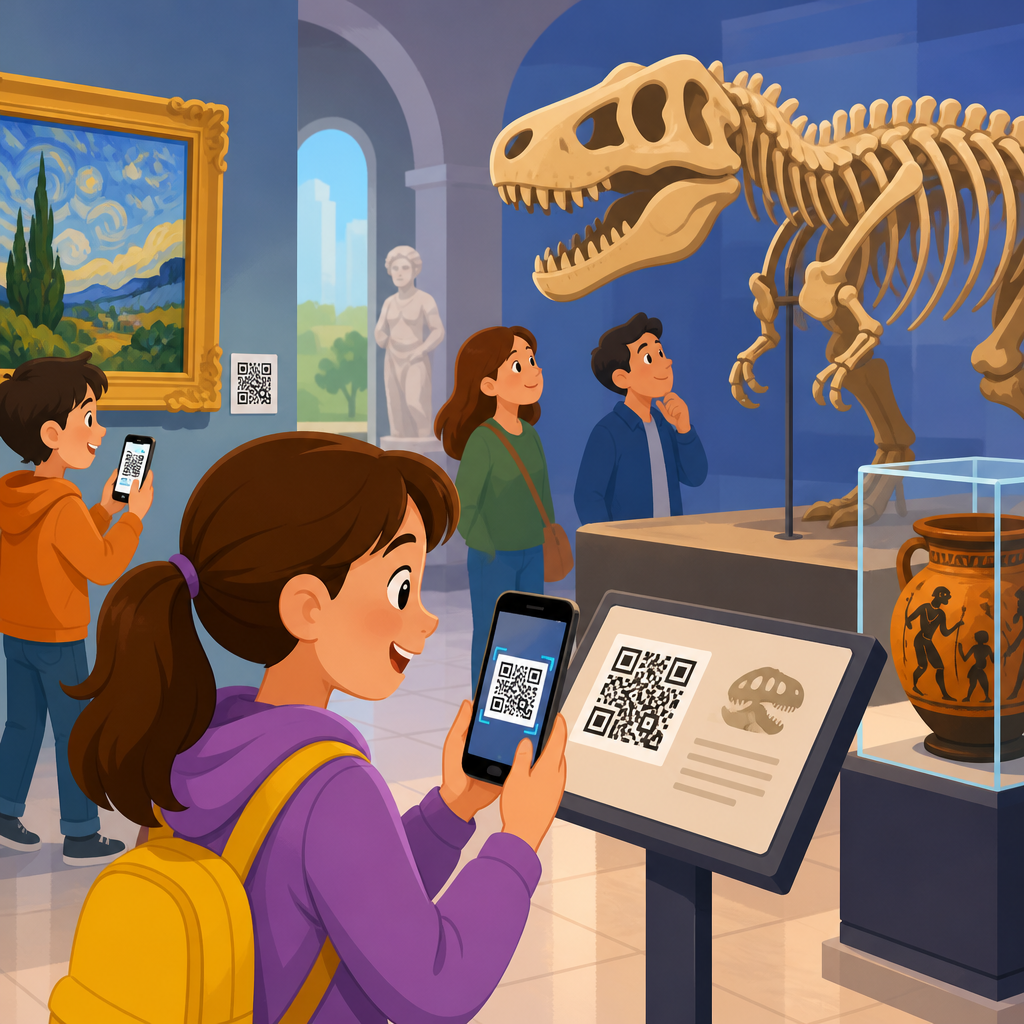
QR codes in museums and exhibits have moved from novelty labels to essential visitor infrastructure, connecting physical objects to digital stories, accessibility tools, ticketing systems, and measurable engagement data. In practice, a museum QR code is a scannable matrix barcode that opens a web page, audio guide, video, form, map, or app action on a visitor’s phone without requiring manual typing. For exhibit teams, that simple interaction solves a persistent problem: wall text and printed guides are limited by space, language, and update costs, while visitor expectations for personalization and mobile access keep rising. I have seen institutions use one small code beside a case object to deliver curator commentary, conservation images, captions in six languages, and a feedback form that would have required several separate touchpoints a decade ago.
The importance of QR codes in museums goes beyond convenience. Cultural organizations are under pressure to broaden access, document outcomes for funders, and refresh interpretation without reprinting entire galleries. A dynamic QR code can redirect to new content in minutes, allowing an exhibit team to correct a date, add a community voice, or feature a newly acquired artifact after labels are already installed. That flexibility matters for temporary exhibitions, touring shows, and institutions working with modest fabrication budgets. It also matters for visitors, who increasingly expect self-guided options, captioned media, and the ability to explore deeper layers of content at their own pace.
As a hub topic under emerging QR code use cases, this subject includes far more than audio tours. Museums now use codes for wayfinding, membership signup, multilingual interpretation, interactive scavenger hunts, donor recognition, retail conversion, timed-entry operations, collections discovery, and post-visit learning. The strongest programs do not treat the code itself as innovation; they treat it as a lightweight bridge between an object, a person, and a useful digital experience. That distinction is critical. A poorly placed code that leads to a generic homepage creates friction. A well-designed code tied to a fast mobile page, clear prompt, and specific visitor need becomes part of the exhibit’s interpretive design.
Understanding how these use cases work helps curators, educators, designers, and operations teams make better decisions. The central questions are practical: when does a QR code improve interpretation, what content formats perform best, how should codes be designed and maintained, and what limitations should institutions plan for? The answers determine whether QR deployment expands access and engagement or simply adds visual clutter. Museums that approach codes strategically can create richer experiences without compromising scholarship, aesthetics, or conservation requirements.
How Museums Use QR Codes Across the Visitor Journey
The most effective museum QR code programs map to the full visitor journey: before arrival, during the gallery experience, and after the visit. Before arrival, codes appear in posters, transit ads, direct mail, and event signage linking to ticket sales, exhibit previews, accessibility information, and visitor policies. During the visit, codes support orientation, object interpretation, multimedia, and participation. After the visit, they can extend learning with reading lists, teacher resources, donation pages, surveys, or online collection entries. This full-funnel approach is why QR codes have become operational tools as much as interpretive ones.
Inside galleries, the clearest use case remains object-level interpretation. A code placed near a fossil, painting, or historical artifact can open extended essays, provenance details, X-ray images, oral histories, or conservation timelines that would never fit on a standard label. Science centers use them to explain mechanisms behind hands-on exhibits. Art museums use them to offer curator talks and artist interviews. History museums use them to layer archival documents and community testimony onto a concise wall label. In each case, the code works because it answers a specific question the visitor is likely to ask right there: What am I looking at, why does it matter, and what else can I explore?
Codes also perform well where museums need flexibility. Temporary exhibitions often involve lender approvals, late object rotations, and changing interpretive material. Dynamic QR destinations let staff update content without replacing physical signage. For multilingual access, the same printed code can detect browser language or direct users to a selection page. For accessibility, codes can launch screen-reader-friendly pages, transcripts, large-type text, or audio description. Institutions that once relied on rented handheld guides can now deliver much of that value through mobile web experiences that are easier to deploy and maintain.
Another emerging pattern is program integration. Museums increasingly connect gallery QR codes to CRM, analytics, learning platforms, and e-commerce systems. A family trail may send visitors to a scavenger hunt form. An exhibition finale may invite email signup for related lectures. A donor wall code may link to campaign information. These are not isolated scans; they are connected interactions that help teams understand what audiences value and where drop-off occurs.
Emerging Use Cases Shaping the Next Generation of Exhibits
Several emerging use cases are expanding what QR codes in museums can do. One is layered storytelling. Instead of a single destination, museums create modular content paths for different audiences: a two-minute summary for casual visitors, a deeper scholarly essay for enthusiasts, and a child-friendly prompt for families. Another is community co-interpretation. Codes can open pages featuring responses from local residents, source communities, or contemporary artists, allowing institutions to present multiple perspectives without overcrowding labels. This approach is particularly valuable in exhibitions dealing with colonial history, living cultures, or contested narratives.
Immersive media is another growth area. QR codes increasingly trigger augmented reality overlays, 3D object viewers, and synchronized soundscapes. While not every museum needs high-production AR, simple browser-based 3D models can be transformative for fragile objects that cannot be handled or fully viewed in a case. A visitor scanning a code beside an ancient vessel can rotate a digital reconstruction, inspect painted details, and compare restored and unrestored states. Natural history museums use the same model to animate extinct species or show skeletal structures beneath surface form.
Operational use cases are growing just as quickly. Institutions use QR codes for contactless check-in, member verification, locker access, program registration, and gallery capacity management. In education settings, school groups can scan codes to receive grade-specific prompts aligned with curriculum standards. In retail and food service, exhibit-linked merchandise codes can drive conversions without interrupting the visitor experience. A fashion exhibition, for example, can use object labels that link not only to garment history but also to the shop’s catalog for exhibition books and replicas sold online after the visit.
Codes are also enabling data-informed exhibit design. When destinations are tagged correctly with analytics parameters, museums can see which objects attract scans, which languages are used, how long visitors stay on pages, and where they exit. That information helps teams revise labels, relocate signage, improve mobile pages, and identify underperforming areas. It does not replace observation studies or qualitative feedback, but it adds useful behavioral evidence that was previously hard to capture at object level.
| Use Case | What the Visitor Gets | Operational Benefit |
|---|---|---|
| Object interpretation | Audio, video, provenance, conservation images | Deeper content without larger labels |
| Multilingual access | Content in preferred language | Single printed sign serves diverse audiences |
| Accessibility support | Transcripts, audio description, large text | Improved compliance and inclusion |
| Wayfinding | Interactive maps and route guidance | Fewer staff interruptions for directions |
| Programs and education | Quizzes, trails, lesson prompts | Better engagement tracking for educators |
| Post-visit follow-up | Resources, donations, membership offers | Extended relationship beyond the gallery |
Designing QR Code Experiences That Visitors Actually Use
A museum QR code succeeds or fails on execution. Placement matters first. Codes should sit where visitors can scan comfortably without blocking circulation or leaning into cases. They need sufficient lighting, clear contrast, and an obvious call to action such as “Listen to the curator,” “See this object in 3D,” or “Read in Spanish.” Generic prompts produce lower engagement because visitors do not know what value they will get. Good interpretation design makes the reward explicit before the scan happens.
The landing experience matters even more. In my work, the biggest source of failure has rarely been the code itself; it has been the mobile page it opens. Pages must load quickly on museum Wi-Fi or cellular service, avoid forcing app downloads, and present the primary content immediately above the fold. If a visitor scans next to a dinosaur skeleton, they should not land on a cluttered homepage and hunt through menus. They should land on that exact specimen page with one clear action available. For this reason, responsive microsites and progressive web experiences often outperform native-app-only strategies.
Visual integration also requires care. Exhibition designers rightly worry that QR codes can disrupt aesthetics, especially in art galleries or historic interiors. The solution is not to hide them so well that nobody notices. It is to integrate them consistently using approved label templates, margin spacing, matte finishes to reduce glare, and concise copy that frames them as part of the interpretive system. Branded short URLs placed beneath the code provide a fallback for visitors whose devices or camera permissions fail.
Testing is nonnegotiable. Teams should test scan distance, phone compatibility, analytics firing, caption accuracy, language switching, and accessibility with real users before opening. Follow standards from the Web Content Accessibility Guidelines for readable contrast, keyboard navigation on landing pages, alt text, transcripts, and predictable structure. QR code error correction and minimum print size also matter; dense codes printed too small on textured material often fail under gallery lighting. A technically valid code is not necessarily a usable one.
Accessibility, Inclusion, and Interpretation Quality
QR codes can advance inclusion, but only when museums treat them as one access channel among several. They are excellent for offering multilingual text, sign language video, audio description, and transcripts without expanding physical label systems. They also help visitors control pace and format, which benefits many people with sensory, cognitive, or language-related needs. However, QR-only interpretation excludes visitors without smartphones, sufficient battery, data access, or comfort with scanning. Best practice is layered access: core interpretive information remains available physically, while codes extend and personalize the experience.
Content quality matters as much as access format. Museums should avoid using QR codes to dump unedited curatorial essays online. Mobile interpretation works best when structured in short sections, plain language, and media formats matched to context. A 45-second audio clip may outperform a seven-minute lecture beside a crowded case. A transcript should be easy to read. A map should show the visitor’s current location clearly. Inclusion is practical, not symbolic; it depends on reducing effort at each step.
There is also an interpretive ethics dimension. When museums invite community voices through QR-linked content, governance must be explicit. Who wrote the text, who approved translations, how are contested interpretations labeled, and how often is content reviewed? Digital layers can create a false sense that everything is provisional or unofficial. Institutions need editorial standards that preserve scholarship while making room for lived experience and evolving knowledge. The most trusted museum QR experiences identify speakers, cite sources where appropriate, and distinguish established facts from interpretation.
Measurement, Maintenance, and Long-Term Strategy
Launching museum QR codes is easy; maintaining them is where mature programs separate themselves. Every code should have an owner, a content review schedule, and a redirect strategy for exhibit closure. Broken links in galleries damage trust quickly. Dynamic QR platforms such as Bitly, Beaconstac, Flowcode, or enterprise campaign tools can simplify redirects and scan reporting, but governance is more important than software. Institutions need naming conventions, UTM standards, asset inventories, and documentation tying each physical code to its destination and purpose.
Measurement should combine quantitative and qualitative methods. Scan volume alone is not enough, because a low-scan object may be perfectly interpreted through physical labels, while a high-scan object may signal confusion rather than delight. Strong evaluation looks at scan-through rate by location, dwell time on landing pages, completion of audio or video, conversion to donations or memberships, and visitor feedback gathered through intercept interviews or surveys. Heat mapping and gallery observation add context that analytics cannot provide, especially when assessing crowding or physical placement.
Long-term strategy means deciding where QR codes fit in the institution’s digital ecosystem. For some museums, the best approach is a lightweight mobile web layer integrated with the collections management system and CMS. For others, especially campuses with membership, ticketing, and recurring program content, a broader platform approach may be justified. Either way, the principle remains the same: use QR codes where they remove friction, expand access, or deepen interpretation, and avoid them where a physical label, staffed interaction, or ambient media does the job better.
QR codes in museums and exhibits are most powerful when they are treated as service design, not decoration. They can make collections more legible, exhibitions more flexible, and visitor engagement more measurable. They can also support accessibility goals, multilingual outreach, educational programming, and post-visit relationships in ways that printed interpretation alone cannot. The institutions seeing the best results are not the ones placing codes everywhere. They are the ones matching each code to a clear visitor need, maintaining the content behind it, and evaluating performance with the same rigor they apply to any other public-facing system.
For teams planning the next phase of exhibit innovation, the path is straightforward: audit visitor questions, identify high-value scan moments, prototype mobile content, test with real users, and build governance before scale. Done well, a museum QR code becomes a small square with outsized impact, turning static displays into responsive experiences that inform, include, and endure. Start with one gallery, measure what visitors actually use, and expand from evidence.
Frequently Asked Questions
How are QR codes used in museums and exhibits?
QR codes in museums and exhibits act as a bridge between a physical display and a much richer digital experience. When a visitor scans a code with a smartphone camera, it can instantly open extended object information, curator notes, archival photos, conservation details, multilingual labels, audio narration, video interpretation, artist interviews, interactive timelines, or wayfinding maps. That makes them especially useful in environments where wall text must stay concise, readable, and visually unobtrusive.
They are also widely used beyond object interpretation. Museums place QR codes on tickets, membership materials, gallery signage, brochures, event posters, donor walls, and temporary exhibition graphics to connect visitors to schedules, registration forms, accessibility resources, scavenger hunts, surveys, and donation pages. In special exhibitions, a single scan can launch a themed trail, provide family-friendly content, or deliver educational resources aligned with school visits.
From an operational standpoint, QR codes solve a practical communication problem: printed labels are static, but visitor needs are not. A code can point to content that is easy to update without reprinting every panel. If a museum wants to revise interpretation, add a new language, swap in a better video, or adjust a map after a gallery change, the digital destination can be updated quickly. That flexibility is one of the main reasons QR codes have evolved from a novelty feature into core visitor infrastructure.
What are the main benefits of using QR codes in museum exhibits?
The biggest benefit is depth without clutter. Exhibition teams often face strict limits on available label space, reading level, design consistency, and visual hierarchy. QR codes let curators and educators keep the gallery presentation clean while still offering deeper layers of interpretation for visitors who want more. Instead of forcing every object label to carry full historical context, citations, translations, and multimedia references, the physical label can remain focused while the digital layer expands on demand.
Another major advantage is accessibility. QR codes can connect visitors to screen-reader-friendly pages, transcripts, captions, audio description, sign language videos, high-contrast content, and adjustable text sizes. They can also support multilingual interpretation much more efficiently than trying to print every translation in the gallery. For institutions working to make exhibits more inclusive, QR codes provide a practical delivery method for multiple access formats from a single physical touchpoint.
They also improve engagement measurement. Unlike static print alone, QR code interactions can be tracked to show which exhibits get scanned most often, what content formats visitors use, when traffic peaks, and which calls to action perform best. That data helps museums refine exhibit design, test interpretation strategies, justify funding, and understand visitor behavior in a more evidence-based way. In short, QR codes are not just a content tool; they are also a feedback mechanism for continuous improvement.
Do visitors need to download an app to scan museum QR codes?
In most cases, no app is required. Modern smartphones typically scan QR codes directly through the built-in camera, making the experience fast and familiar for visitors. This is one of the reasons QR codes are so effective in museum settings: they reduce friction. A visitor simply points a phone at the code, taps the prompt, and arrives at the content. There is no need to type a web address manually, which is especially helpful in galleries where object IDs, URLs, or accession references would otherwise be cumbersome to enter.
That said, the destination behind the code still matters. If the code opens a standard mobile-friendly web page, the process is usually seamless. If it launches an app-specific action, requires account creation, or sends visitors to a download page before they can access content, some of the convenience is lost. For this reason, many museums prioritize browser-based experiences for interpretive content, especially for first-time or casual visitors who may not want to install anything during their visit.
The best practice is to design for the lowest barrier to entry. Make sure the QR code opens quickly, works on both iPhone and Android devices, and leads to content that is clear, responsive, and easy to navigate on a small screen. If an app is available, it can be offered as an optional enhancement rather than a requirement. That approach preserves accessibility and encourages more scans across a broader visitor audience.
What should museums consider when creating effective QR code experiences?
Effective museum QR code use starts with purpose. Every code should answer a clear visitor need, such as “learn more,” “listen to this object,” “see related works,” “navigate to the next gallery,” or “share feedback.” If a code is added without a specific role, visitors are less likely to trust that scanning it will be worth their time. Clear call-to-action text is essential. Instead of placing a code with no explanation, museums should tell visitors exactly what they will get, such as “Scan for a 2-minute audio guide” or “Scan to read this label in Spanish.”
Placement and design are equally important. Codes should be easy to spot, large enough to scan comfortably, and positioned at a practical height with adequate lighting and contrast. They should not be placed on reflective surfaces, curved mounts, or locations that force visitors to block circulation or stand too close to sensitive objects. In crowded exhibitions, teams should test sightlines and scanning distance to make sure the experience works under real visitor conditions, not just in the design phase.
The linked content must also be strong. Fast load times, mobile optimization, concise page structure, accessible formatting, and reliable hosting are critical. If a visitor scans a code and lands on a slow, confusing, or broken page, confidence drops immediately. Many museums also choose dynamic QR codes so they can update destinations without reprinting signage. Combined with analytics, that flexibility allows institutions to improve content over time, fix outdated links, and adapt the experience based on actual visitor use.
Can QR codes help museums measure visitor engagement and improve exhibits?
Yes, and this is one of their most valuable advantages. Because QR codes connect visitors to digital destinations, museums can gather useful engagement data that traditional labels cannot provide on their own. Depending on the setup, teams may be able to see scan volume, time of day, device type, location-specific performance, completion rates for audio or video, clicks on related resources, and conversions such as newsletter signups, donations, or event registrations. This turns each code into a measurable touchpoint rather than a passive graphic element.
That information can directly inform exhibit strategy. If one object receives a high number of scans, it may indicate strong visitor curiosity, effective placement, or successful call-to-action wording. If another code is rarely used, the problem may be visibility, unclear messaging, weak content, or poor placement within visitor flow. Museums can use these findings to revise labels, improve storytelling, reorder interpretive priorities, or test different media formats such as short-form audio versus text-heavy pages.
QR code analytics are especially useful for temporary exhibitions, pilot programs, and educational initiatives where institutions need evidence of impact. They help teams move beyond assumptions and make more informed decisions about what visitors actually use. While scan data should be interpreted alongside broader evaluation methods such as observation, surveys, and audience research, it provides a practical and scalable way to measure digital engagement in the gallery and continuously improve the visitor experience.