QR codes have become a routine business tool for payments, menus, product authentication, ticketing, customer support, and warehouse operations, but their convenience hides a simple truth: a QR code is only as safe as the destination, workflow, and governance behind it. A QR code security checklist helps businesses reduce fraud, prevent phishing, protect customer data, and keep campaigns, transactions, and internal processes trustworthy. In practice, secure QR code practices cover far more than generating a square image. They include URL controls, domain governance, redirect management, print handling, access permissions, device security, employee training, and incident response.
When I audit QR deployments, I start by defining the risk surface in plain terms. A static QR code usually points directly to a fixed URL or payload. A dynamic QR code routes through a managed service that can change the destination later, often for analytics or campaign updates. Both can be safe, but each introduces distinct risks. Static codes are harder to update if compromised in the real world. Dynamic codes are easier to govern centrally, yet they add dependency on the provider, account security, and redirect integrity. Businesses need controls for both because attackers exploit whichever part is weakest.
Why does this matter now? QR-driven fraud has expanded alongside contactless payments and mobile-first customer journeys. Criminals place stickers over restaurant table codes, replace parking payment links, and send QR images in email to bypass legacy link filters. The FBI warned consumers about malicious QR codes tied to credential theft and payment diversion, while standards bodies such as NIST continue emphasizing phishing-resistant authentication, least privilege, and asset management principles that apply directly to QR programs. For a business, the downside is not abstract: a single tampered code can trigger chargebacks, support costs, brand damage, regulatory scrutiny, and loss of trust.
This article is a practical hub for secure QR code practices. It explains the core safeguards every business should implement, from creation to retirement, using terminology security, marketing, and operations teams can share. If you manage QR codes for storefronts, field teams, packaging, events, or internal assets, use this checklist as a policy baseline and an execution guide.
Start with asset inventory, ownership, and classification
The first control is knowing exactly which QR codes exist, what they do, and who owns them. In every mature program I have helped build, the inventory comes before redesigns, because you cannot secure what you cannot locate. Maintain a central register listing each QR code, its purpose, destination URL or payload type, campaign or process name, business owner, technical owner, creation date, expiration date, and physical or digital placement. Include whether the code is static or dynamic, whether it uses redirects, and which vendor generated it.
Classification matters because not all QR codes carry the same risk. A code opening a public marketing landing page is lower risk than a code initiating a payment, collecting personal data, configuring Wi-Fi, downloading an app, or linking to an internal system. Tag high-risk codes so they require stronger review, shorter validity periods, stricter change management, and more frequent inspection. For example, a retail chain should classify point-of-sale donation codes differently from poster codes used only to show store hours. This lets limited security resources focus on the highest-impact assets first.
Use trusted destinations, controlled redirects, and branded domains
The most important technical rule is straightforward: every business QR code should lead to a destination you control or have formally approved. Avoid linking directly to ad hoc third-party pages, personal cloud files, unmanaged form builders, or social profiles that can change ownership. Instead, route users through a branded company domain with HTTPS enabled and certificates managed correctly. Branded domains improve user trust and simplify monitoring because security teams can track a smaller set of known hosts.
Redirects deserve special attention. Dynamic QR platforms often use short links and redirect chains for analytics. That is acceptable only when redirect logic is documented, restricted, and monitored. Limit who can edit destinations. Require multifactor authentication on the QR management account. Review change logs regularly. If possible, configure allowlists so destinations can only resolve to approved corporate domains or vetted payment providers. I have seen organizations reduce phishing risk significantly by disabling open redirects and retiring generic link shorteners in favor of subdomains like go.company.com or scan.company.com.
| Checklist Item | Why It Matters | Good Business Practice |
|---|---|---|
| Branded destination domain | Improves trust and simplifies monitoring | Use a company-controlled HTTPS subdomain for QR campaigns |
| Redirect governance | Prevents silent destination swaps | Restrict edits, log changes, and review monthly |
| Account security | Stops takeover of QR platforms | Enable multifactor authentication and least privilege |
| Expiration dates | Reduces stale or abandoned links | Set sunset dates for temporary campaigns and events |
| Destination testing | Catches broken pages and unsafe behavior | Test on iOS, Android, managed devices, and public networks |
Protect the creation and publishing workflow
Secure QR code practices begin before a code reaches customers or employees. Standardize how codes are requested, approved, generated, tested, published, and retired. A documented workflow prevents shadow IT and one-off marketing shortcuts. In practical terms, use a simple intake form that captures purpose, data sensitivity, target audience, destination owner, publication channels, and planned end date. Require review from the process owner and, for sensitive use cases, security or compliance.
Generation should happen in approved tools only. Enterprise teams often use platforms such as Bitly Enterprise, Adobe Experience Manager integrations, or vendor-specific QR management suites with access controls and audit trails. Free generators may be fine for low-risk prototypes, but they are poor choices for production because they rarely provide change logs, role-based access, or contractual assurances. Keep original design files, version history, and release dates in a shared repository so teams can trace which exact code appeared on which asset.
Testing should cover more than whether the code scans. Validate the full experience on different devices, camera apps, and browsers. Confirm the previewed URL is readable and branded, forms use HTTPS, analytics tags do not expose personal data, and pages load without certificate or content warnings. For payment flows, verify the payee name, merchant identifier, and transaction amount logic. For app downloads, route users only to the official Apple App Store or Google Play listing, never to side-loaded APK files.
Secure physical placement and printed materials
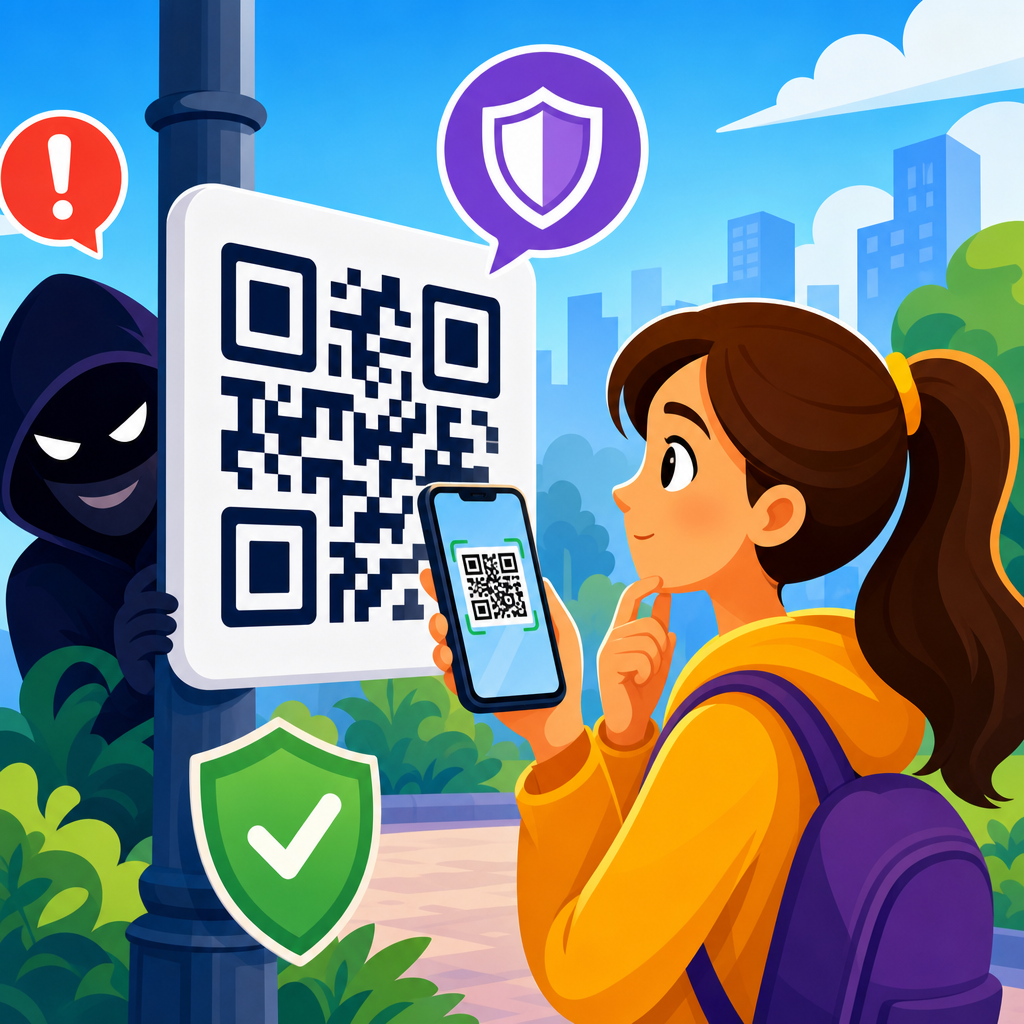
Many QR attacks are low-tech. Attackers place a new sticker over the original code, alter tabletop displays, or swap signage in public spaces. Businesses should treat printed QR materials as tamper-prone assets, especially in restaurants, parking areas, transit environments, event venues, and unattended kiosks. Choose materials and mounting methods that make substitution obvious. Tamper-evident labels, destructive adhesives, serialized stickers, and periodic photo verification all raise the cost of fraud.
Placement also affects user safety. Put codes where lighting is good and surrounding branding is clear so users can compare the code with expected business identity. Add human-readable instructions near the code, including the company domain, intended action, and a caution not to proceed if the previewed link looks unfamiliar. For example, a parking meter decal should state “Only pay at pay.company.com” so users know what to expect before they scan. That simple cue helps people detect impostor stickers faster.
Inspections should be scheduled, not informal. Site teams need a checklist for daily or weekly review depending on foot traffic and fraud exposure. In one hospitality rollout, table-service staff were trained to compare each code against a photo in the operations app during opening checks. That added less than two minutes per shift and sharply reduced the chance that a tampered code remained in place through a busy weekend.
Harden mobile endpoints and scanning behavior
A QR code is only one part of the transaction. The scanning device and the user’s behavior determine whether a suspicious prompt is caught or ignored. For employee-operated devices, use mobile device management such as Microsoft Intune, VMware Workspace ONE, or Jamf to enforce operating system updates, browser policies, approved apps, and web filtering. Disable installation from unknown sources on Android. Require screen locks and, where appropriate, device attestation or conditional access before internal resources open.
Train employees to pause at the preview stage. Most modern smartphone cameras show the destination before opening it. Staff should check the domain carefully, especially for misspellings, extra subdomains, or unfamiliar country-code top-level domains. They should also be taught that QR codes can trigger actions besides opening a webpage, including adding contacts, joining Wi-Fi, drafting emails, starting payments, or downloading files. In warehouse and field-service environments, this awareness is critical because workers scan quickly and repeatedly, which makes habit-based errors more likely.
For customer-facing use cases, reduce reliance on perfect user judgment. Display the destination domain in text, keep landing pages simple, and avoid chains that bounce through multiple unrelated domains. Good design is a security control because it makes abnormal behavior more visible.
Manage privacy, analytics, and data collection carefully
QR programs often collect more data than teams realize. A scan can reveal timestamp, approximate location, device type, campaign source, and subsequent form submissions. That creates privacy obligations under laws and standards such as the GDPR, CCPA, and sector-specific rules. Data minimization should be the default. Collect only what is necessary to measure performance or deliver the service. If a campaign does not need precise location, do not retain it. If a form does not need date of birth, do not request it.
Transparency is equally important. The landing page should make clear who is collecting data, for what purpose, and how long it will be retained. Cookie and consent mechanisms should match the jurisdiction and actual tracking technologies used. Marketing teams sometimes add multiple analytics scripts to QR landing pages without reassessing notices or vendor contracts. That is a preventable compliance gap. Review third-party tags, session replay tools, and pixels before launch, and ensure the privacy notice reflects the real data flow.
For internal QR uses, such as asset tracking or maintenance workflows, avoid encoding sensitive information directly in the QR payload. Use opaque identifiers that resolve to controlled records after authentication. Putting employee IDs, customer account numbers, or device credentials directly into a scannable code creates unnecessary exposure if the label is photographed or shared.
Prepare monitoring, response, and lifecycle controls
Even well-managed QR programs need monitoring because environments change. Set alerts for destination edits, unusual scan spikes, geographies outside expected patterns, certificate failures, and landing-page defacements. Security teams can integrate QR destination domains into existing logging and detection tools, including DNS monitoring, web application firewalls, and SIEM platforms such as Microsoft Sentinel, Splunk, or Google Security Operations. The goal is not a separate security island, but QR visibility inside the organization’s normal detection stack.
Incident response should answer a few direct questions: How do we disable or reroute a compromised code? Who investigates physical tampering? How do we notify affected customers or locations? How do we preserve logs and screenshots for fraud review? For dynamic codes, the quickest containment may be repointing the destination to a warning page while teams inspect the incident. For static codes in the field, response may require replacing printed materials and alerting frontline staff immediately. Time matters because fraudulent stickers can capture victims within minutes in high-traffic areas.
Finally, retire QR codes deliberately. Expired campaigns, closed forms, discontinued products, and old app promotions should not remain live indefinitely. Sunset dates, archival rules, and periodic recertification keep the attack surface small. A business that removes stale QR assets is easier to defend than one that leaves hundreds of forgotten codes active across posters, packaging, PDFs, and storefronts.
A strong QR code security checklist gives businesses a repeatable way to protect customers, employees, revenue, and brand trust. The essential controls are clear: inventory every code, classify risk, use branded and approved destinations, lock down redirects and management accounts, secure publishing workflows, protect physical placements, harden employee devices, minimize data collection, and monitor for abuse. None of these steps is exotic. They are disciplined operational habits applied to a technology that often looks deceptively simple.
The main benefit of secure QR code practices is confidence. Marketing can launch campaigns faster when governance is standardized. Operations can deploy codes in stores, warehouses, and field environments without guessing which safeguards matter. Security teams gain visibility into a channel that attackers increasingly target. Most importantly, customers are far less likely to be tricked into sharing credentials or sending payments to criminals.
Use this hub article as your baseline checklist, then turn it into policy, training, and audit steps for each QR use case in your business. Review your current QR inventory this week, identify the highest-risk codes, and close the biggest gaps first.
Frequently Asked Questions
1. What should be included in a QR code security checklist for businesses?
A strong QR code security checklist should cover the full lifecycle of the code, not just the image itself. Businesses need to verify where each QR code sends users, who approved it, how it was deployed, and how it will be monitored after launch. At a minimum, the checklist should include destination URL validation, use of HTTPS, domain ownership verification, redirect review, access controls for anyone generating or editing codes, and a documented approval process for publishing QR codes in customer-facing or internal environments. It should also address whether the QR code leads to a payment page, login portal, support form, app download, file, or internal system, because each use case carries different risks.
Good governance is just as important as technical setup. Businesses should maintain an inventory of active QR codes, assign ownership to a specific team or person, define expiration or review dates, and document where each code appears, such as packaging, posters, invoices, emails, kiosks, menus, or warehouse labels. If dynamic QR codes are used, the organization should control who can change the destination and require logs for all edits. If static QR codes are used, the checklist should include version control and replacement procedures in case a linked page changes or a code is misused. Together, these controls help reduce phishing, tampering, unauthorized redirects, and customer confusion.
2. How can businesses prevent QR code phishing and malicious redirects?
QR code phishing usually works by hiding a dangerous destination behind a simple scan. Because users cannot always see the full URL before opening it, attackers exploit trust and convenience. To reduce this risk, businesses should only publish QR codes that point to clearly branded, company-controlled domains and landing pages. Avoid using unfamiliar short links when possible, and if redirects are necessary, keep them limited, documented, and monitored. It also helps to use mobile landing pages that prominently display the company name, purpose, and next step so users can quickly recognize whether the experience is legitimate.
Operational controls matter too. Businesses should inspect physical QR code placements regularly to make sure no one has placed a fraudulent sticker over the original code. In digital channels, teams should verify that emailed, printed, and posted QR codes match approved assets from a central source. Security teams can add web filtering, threat monitoring, and domain alerts to detect suspicious changes or typosquatting attempts. Employee training is also essential, especially for customer support, retail, events, and operations teams who may be first to notice tampered signage or user complaints. A simple rule helps: if a QR code asks for login credentials, payment information, or app installation, the destination should be especially well controlled, authenticated, and continuously reviewed.
3. Are dynamic QR codes more secure than static QR codes?
Dynamic QR codes are not automatically more secure, but they can be safer to manage when proper controls are in place. The main advantage of a dynamic QR code is that the destination can be updated without replacing the printed or published code. That gives businesses flexibility to fix broken links, rotate campaigns, retire risky pages, and respond quickly to incidents. If a landing page is compromised or a campaign changes, the business can redirect traffic to a safe destination immediately. Dynamic QR platforms may also offer scan analytics, access logs, and administrative permissions, which can improve oversight.
However, that same flexibility introduces risk if change management is weak. If too many users can edit destinations, if accounts are not protected with strong authentication, or if there is no audit trail, a dynamic QR code can become an easy point of abuse. Static QR codes, by contrast, cannot be altered once created, which reduces one category of risk but makes remediation harder if the original destination becomes outdated, broken, or unsafe. For most businesses, the better question is not whether dynamic or static is inherently more secure, but whether the chosen option is supported by access control, approval workflows, logging, regular reviews, and incident response procedures. Security depends on governance, not just the code type.
4. How do QR codes affect customer data privacy and compliance?
QR codes can have significant privacy and compliance implications because they often act as an entry point to forms, payments, support requests, loyalty programs, authentication pages, or product verification systems. If the destination collects personal data, payment information, location details, device identifiers, or behavior analytics, the business must treat the full scan journey as part of its privacy and security program. That means disclosing what data is collected, limiting collection to what is necessary, securing transmissions with HTTPS, and ensuring any connected vendors or platforms meet the company’s compliance requirements. A QR code may look simple, but the data handling behind it can be complex.
Businesses should review QR-linked experiences for compliance with relevant standards and regulations such as GDPR, CCPA, PCI DSS, and internal data governance policies, depending on industry and geography. Landing pages should include appropriate notices, consent mechanisms where required, and secure session handling. If scans are tracked for analytics, companies should understand what is being logged and whether that data can identify individuals. They should also verify retention periods, vendor contracts, cookie behavior, and cross-border data transfers if applicable. In short, QR code privacy is not just about the image on a sign or package. It is about whether the underlying workflow protects user data from collection through storage, access, sharing, and deletion.
5. How often should businesses audit and monitor their QR codes?
Businesses should treat QR codes as active digital assets that require ongoing review, not one-time campaign materials. A practical baseline is to audit all customer-facing and operational QR codes on a scheduled basis, such as monthly or quarterly, with more frequent checks for high-risk use cases like payments, account access, event ticketing, and product authentication. Audits should confirm that each code still resolves to the correct destination, that the destination domain is secure and branded, that no unauthorized redirects have been added, and that the code has not been physically tampered with in stores, venues, warehouses, or public locations. Internal QR codes used in inventory, maintenance, support, or access workflows should also be reviewed because operational disruptions can carry real security and business continuity consequences.
Monitoring should include both technical and procedural elements. On the technical side, businesses can use uptime checks, certificate monitoring, web reputation tools, redirect testing, and admin activity logs for dynamic QR code platforms. On the procedural side, they should maintain an owner for every code, document review dates, retire unused codes, and create a clear escalation path for suspicious findings. It is also wise to test the user experience from a mobile device regularly, because problems often appear in the live scan flow rather than in desktop reviews. The most effective programs combine periodic audits with continuous monitoring for high-value QR code deployments, ensuring that convenience does not come at the cost of trust, security, or compliance.