QR code funnels turn a quick phone scan into a measurable customer journey, moving people from curiosity to conversion with far less friction than typing a URL, searching a brand name, or downloading an app first. In practical terms, a QR code funnel is the sequence of steps that begins when someone scans a code and ends with a defined business outcome such as a purchase, booked demo, form submission, store visit, or repeat order. The concept sits at the center of modern QR code marketing strategies because it connects offline attention to online action. I have used QR campaigns for retail launches, restaurant promotions, trade show lead capture, and direct mail reactivation, and the pattern is consistent: the businesses that win do not treat the code as the campaign. They treat it as the doorway to a carefully designed funnel.
That distinction matters because adoption is no longer the issue. Most smartphone cameras read QR codes natively, consumer familiarity rose sharply during the pandemic, and platforms from Shopify to HubSpot to Google Analytics now support campaign tracking with minimal setup. What still goes wrong is execution. Codes often point to homepages, load slowly, offer weak incentives, or fail to track outcomes beyond the initial scan. A high-performing QR code funnel solves those problems by pairing the right placement with a relevant landing page, a single clear action, and reliable measurement. For marketers building a hub around QR code marketing strategies, funnels provide the organizing principle. Every tactic, from packaging inserts to in-store signage, should be evaluated by one question: what happens after the scan, and how confidently can you improve it?
The strategic value is straightforward. QR codes compress the path between physical context and digital response, which reduces drop-off at the exact moment interest is highest. A diner can scan a table tent and join a loyalty program before the check arrives. A shopper can scan shelf signage and compare models without leaving the aisle. A conference attendee can scan a booth graphic and book a follow-up meeting while the conversation is fresh. When the destination matches the moment, conversion rates can outperform generic traffic sources because the user intent is narrower and the ask is clearer. That is why QR code marketing strategies deserve to be planned as full-funnel systems, not one-off design elements.
How a QR code funnel works from first scan to final conversion
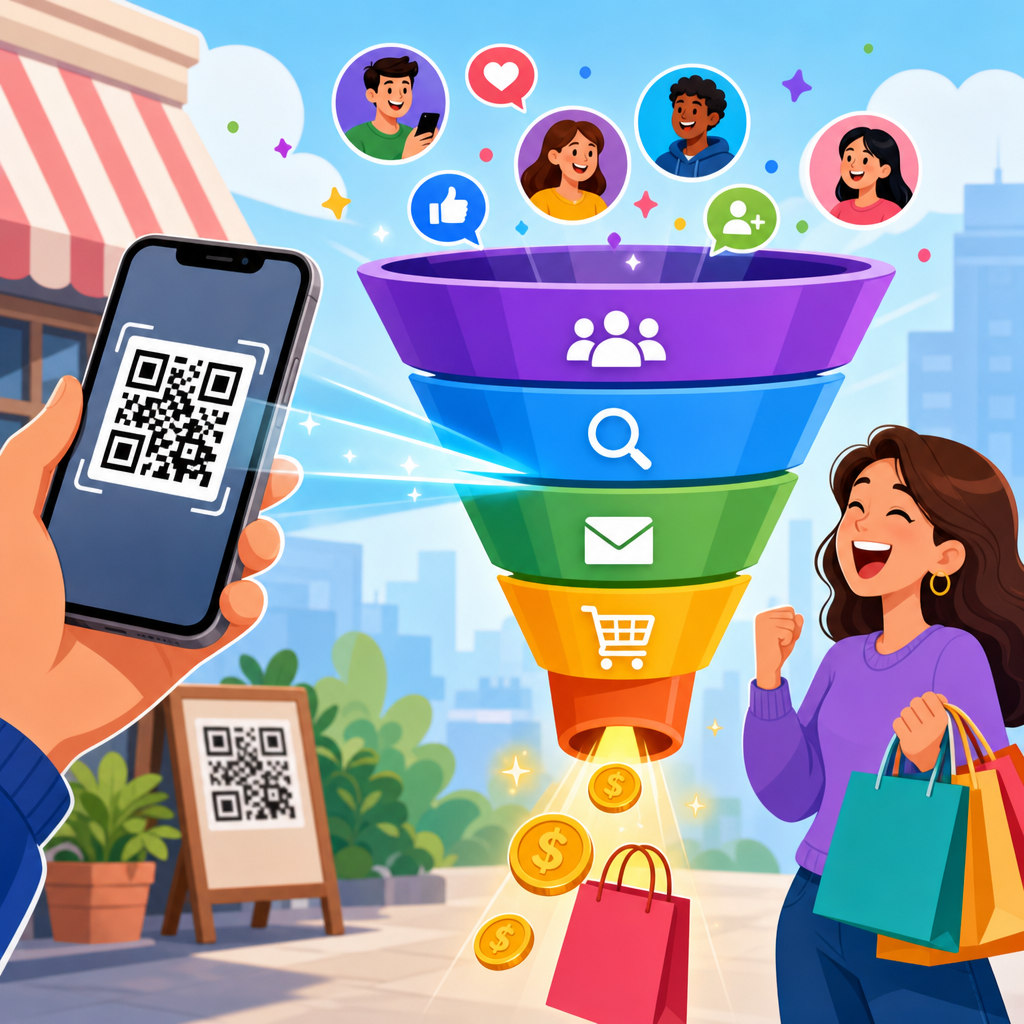
A QR code funnel has four core stages: scan, landing experience, conversion action, and follow-up. Each stage needs its own objective and metric. The scan stage is driven by visibility, trust, and motivation. People scan when the code is easy to notice, the value exchange is obvious, and the context feels safe. “Scan to see the menu” works because the benefit is immediate and expected. “Scan for something exciting” usually underperforms because it is vague. Once scanned, the landing experience must load fast, display correctly on mobile, and continue the promise made next to the code. If the sign says “Scan for 15% off today,” the page should instantly show the offer, explain any conditions, and make redemption easy.
The conversion action is the point where many campaigns lose momentum. A strong QR funnel asks for one primary action that matches the user’s readiness. Cold audiences at a bus stop may respond better to a store locator or product explainer than a checkout page. Warm audiences scanning product packaging after purchase may be ideal for warranty registration, reviews, or reorder subscriptions. Follow-up is what turns a successful scan campaign into a revenue engine. Email capture, SMS opt-in, remarketing audiences, loyalty enrollment, and CRM tagging allow you to continue the relationship after the first interaction. In one retail campaign I worked on, moving from a generic homepage to a campaign-specific page with one coupon redemption button increased attributable redemptions dramatically because every step after the scan was simplified.
The shortest definition is this: a QR code funnel is effective when each step removes uncertainty. Users should know why to scan, what they will get, what to do next, and what happens after they act. If any stage is unclear, the funnel leaks.
Core QR code marketing strategies that consistently drive results
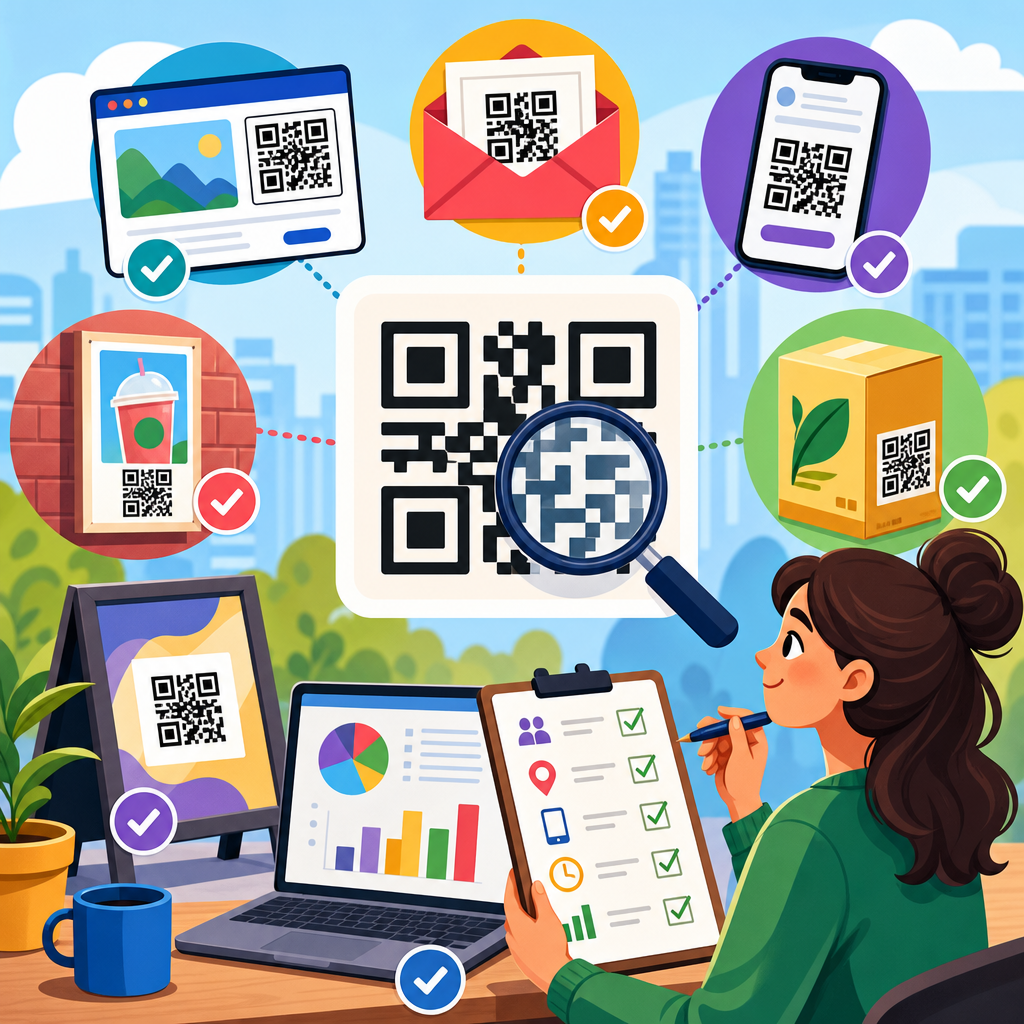
The most reliable QR code marketing strategies align placement, intent, and offer. Product packaging works well for onboarding, upsells, education, and replenishment because the customer already has the item in hand. A skincare brand can place a code on the box that leads to a routine guide, then recommend complementary products based on the exact SKU purchased. In-store displays support assisted selling. A hardware retailer can add codes to complex categories such as power tools, linking each one to buying guides, safety videos, and live inventory by location. Restaurants use table tents and receipts for reviews, loyalty sign-ups, and future order incentives. Event marketers use booth graphics, badge backs, brochures, and session slides to capture leads without manual data entry.
Direct mail is another underused channel. A postcard with a personalized QR code can send past customers to a tailored landing page that reflects previous purchases or lapsed account status. Real estate agents use yard signs to route scans to property pages with photos, financing calculators, and booking links. Healthcare providers use codes on discharge paperwork to deliver medication instructions, follow-up scheduling, and patient education, though those campaigns require careful privacy handling. Across these examples, the rule is consistent: QR code marketing strategies perform best when the destination resolves a question the user has at that exact moment.
Dynamic QR codes deserve special attention because they allow the destination URL to change without reprinting the code. That is operationally important for seasonal campaigns, inventory changes, A/B testing, and crisis response. If a product sells out, the code can redirect to alternatives. If a landing page underperforms, you can swap it quickly. Static codes still have a place when permanence and simplicity matter, but for most marketing use cases, dynamic codes give the control needed to optimize funnels over time.
Designing landing pages that convert scan traffic
Scan traffic is highly contextual, so the landing page must reflect the physical source. Someone scanning a code in a store aisle behaves differently from someone scanning a mailer at home. Effective QR landing pages use message match, mobile-first layout, and low-friction forms. Message match means the headline, offer, and imagery continue what the offline asset promised. Mobile-first means fast loading, tappable buttons, short copy blocks, compressed images, and minimal pop-ups. Low-friction forms mean asking only for information required to move the user forward. If the goal is a coupon, an email field may be enough. If the goal is a sales appointment, a short qualification form with scheduling may be justified.
I recommend building dedicated pages for major QR placements rather than reusing generic web pages. Tools such as Unbounce, Instapage, HubSpot, Shopify landing pages, and Webflow make that practical. Add proof elements near the call to action: review counts, delivery times, warranty terms, or a short privacy note for lead capture. If the campaign targets local intent, include maps, store hours, and click-to-call. If the campaign supports product evaluation, use comparison details, FAQs, and short demonstration video. Every extra second of confusion lowers conversions, especially because a scan often happens in a distracted setting like a retail floor, a sidewalk, or a crowded event hall.
| Placement | User intent at scan | Best landing page goal | Primary metric |
|---|---|---|---|
| Product packaging | Learn, activate, reorder | Setup guide or subscription offer | Registrations or repeat purchases |
| In-store signage | Compare or validate | Product explainer or coupon | Coupon redemptions or assisted sales |
| Direct mail | Respond to offer | Personalized promotion page | Leads or purchases |
| Trade show booth | Continue conversation | Demo booking or asset download | Qualified meetings |
Measuring scans, attribution, and return on investment
Measurement separates a decorative QR code from a dependable acquisition channel. At minimum, every campaign should use unique URLs with UTM parameters, a web analytics platform, and a clearly defined conversion event. Google Analytics 4 can track sessions, engaged visits, purchases, and form completions tied to campaign parameters. CRM systems such as HubSpot, Salesforce, and Klaviyo can capture lead source and support downstream revenue attribution. For ecommerce, connect scans to add-to-cart rate, checkout completion, average order value, and repeat purchase behavior. For lead generation, track qualified lead rate, meeting booked rate, and pipeline created, not just raw form fills.
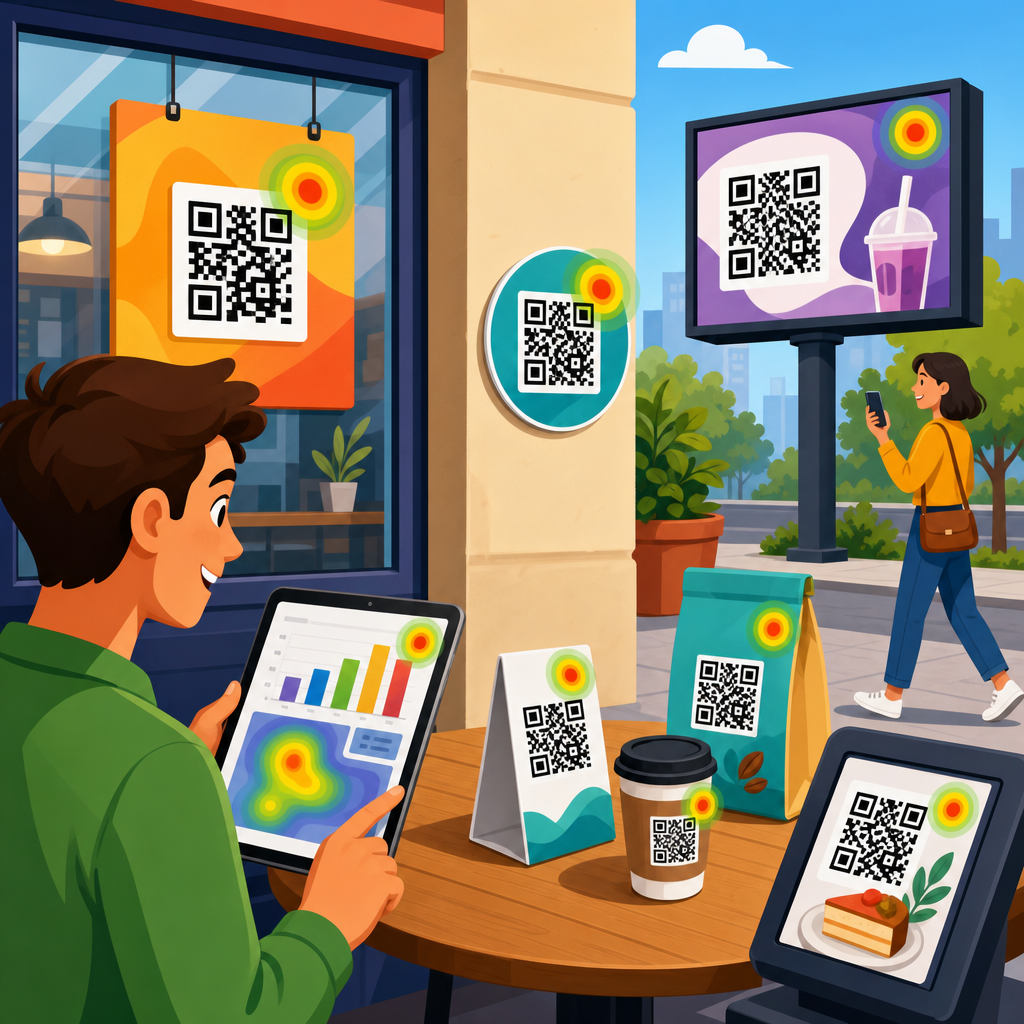
Marketers should also distinguish scans from visits. Some QR platforms report total scans, unique scans, device type, time of day, and rough location, while analytics tools report landing-page sessions and conversions. A gap between scans and sessions can indicate weak connectivity, slow page speed, or privacy restrictions. Attribution is rarely perfect in offline-to-online journeys, so use a consistent framework. Assign each physical asset its own code, separate campaigns by channel and location, and compare performance against baseline periods or control groups where possible. In a restaurant chain test, codes printed on receipts produced many scans but fewer sign-ups than codes on table tents because the table tent reached guests earlier in the visit, before attention shifted to payment.
ROI is best calculated by channel-level economics. Include design, printing, platform fees, incentives, paid amplification if used, and staff training. Then compare those costs to attributable revenue, cost per lead, or lifetime value uplift. The practical advantage of QR code marketing strategies is that they often reuse existing physical touchpoints, which keeps distribution costs low. But low distribution cost does not guarantee profit. A poor offer, weak page, or inaccurate measurement can still waste budget.
Common mistakes that weaken QR code funnels
The most common mistake is sending scans to a homepage. Homepages serve many audiences and usually force visitors to hunt for the promised information. The second mistake is failing to explain why someone should scan. A code without nearby copy depends on curiosity, and curiosity is unreliable in busy environments. The third mistake is weak mobile performance. Large images, intrusive cookie banners, or forms with too many fields cause immediate abandonment. Another frequent issue is poor placement. Codes mounted too high, printed too small, placed behind reflective glass, or shown where connectivity is weak will lose scans regardless of creative quality.
Trust issues matter too. People hesitate when a QR code could lead anywhere. Brand the asset clearly, use recognizable domains, and state the destination benefit in plain language. Security-conscious sectors should avoid collecting unnecessary data and should communicate privacy practices. Accessibility is also overlooked. Provide short fallback URLs, ensure sufficient contrast, and avoid color combinations that reduce scannability. Finally, many teams skip testing. Before launch, test across iPhone and Android devices, different lighting conditions, and both strong and weak connections. Check that redirects work, forms submit, analytics fire, and staff understand the offer. In my experience, disciplined preflight testing prevents most costly failures.
Building a hub strategy for long-term QR code marketing growth
As a sub-pillar within QR Code Marketing & Strategy, this page should anchor a broader content system around intent-based use cases. Supporting articles can go deeper into dynamic versus static codes, QR code design best practices, restaurant QR campaigns, retail QR promotions, direct mail QR tracking, QR code analytics setup, event lead capture, packaging QR strategies, and compliance considerations. Internally, each article should link back to this hub and to adjacent tactical guides. That structure helps readers move from strategy to execution and signals topical depth across the subject.
Operationally, build a reusable workflow. Start with one business objective, one audience, and one placement. Define the offer, create a dedicated landing page, generate a dynamic code, add tracking, and establish a reporting cadence. Then test variables one at a time: headline, incentive, form length, placement height, print size, and follow-up sequence. Over several campaigns, patterns emerge. Retailers may learn that educational scans assist higher-ticket items, while restaurants may find that bounce-back offers on receipts drive weekday repeat visits. These learnings become strategic assets because they apply to future launches, store openings, and cross-channel promotions.
QR code funnels succeed when marketers respect context. The scan is not the goal; the next meaningful action is. If you want stronger offline attribution, faster customer response, and simpler paths to sale, build every QR campaign like a funnel, measure it rigorously, and keep refining the steps that follow the scan. Audit your current codes, replace generic destinations with focused landing pages, and turn every scan into a sales opportunity.
Frequently Asked Questions
What is a QR code funnel, and how is it different from simply linking to a website?
A QR code funnel is a structured customer journey that starts the moment someone scans a code and continues through a series of intentional steps designed to lead toward a measurable business outcome. That outcome might be a product purchase, a booked consultation, an email signup, a coupon redemption, a store visit, or even a repeat order. Unlike a basic website link, a QR code funnel is not just about sending traffic somewhere. It is about guiding that traffic with purpose, reducing friction at every stage, and tracking what happens after the scan.
The key difference is strategy. A standard website link often drops users onto a homepage or generic landing page and leaves them to figure out what to do next. A QR code funnel, by contrast, connects the scan to a specific intent. For example, a code on product packaging might open a page with a limited-time reorder offer, customer reviews, and a one-click checkout option. A code on an event banner might lead directly to a demo booking form with prefilled campaign attribution. Each step is designed to move the user forward rather than simply expose them to a brand.
QR code funnels also stand out because they capture measurable behavior in a real-world context. Businesses can see where scans happen, what devices are used, which offers convert best, and where users drop off. That makes the funnel far more actionable than a static link printed on a flyer or displayed in a storefront. In short, a QR code funnel transforms a quick scan into a deliberate, trackable path from interest to action.
Why are QR code funnels so effective at turning curiosity into conversions?
QR code funnels work well because they remove unnecessary steps between initial interest and the desired action. When a person sees something compelling in the physical world, such as packaging, signage, direct mail, a menu, or an in-store display, their attention is immediate but often short-lived. Typing a URL, searching for a brand, or downloading an app introduces friction and gives people more chances to abandon the process. A QR code closes that gap by turning curiosity into a direct response in seconds.
That speed matters because user intent is usually highest at the moment of scan. Someone scanning a code is already engaged enough to take action, which means the business has a valuable opportunity to deliver a highly relevant next step. If the landing experience matches the context, conversion rates can improve significantly. For instance, a shopper scanning a shelf tag might respond well to a comparison chart, customer testimonials, and a buy-now button. A diner scanning a tabletop code may be more likely to join a loyalty program if the offer is immediate and the signup is simple.
Another reason these funnels perform well is that they connect offline and online behavior. Traditional marketing channels like posters, packaging, brochures, and storefronts often struggle to prove direct impact. QR code funnels create a bridge between physical exposure and digital action, making campaign performance easier to measure. Businesses can test offers, optimize landing pages, personalize by location or source, and improve each stage of the funnel over time. The result is a marketing system that is both convenient for customers and highly practical for brands focused on measurable growth.
What are the essential stages of a high-converting QR code funnel?
A strong QR code funnel usually begins with the scan trigger itself. This includes the placement of the code, the surrounding design, and the call to action that explains why someone should scan. A QR code without context often underperforms, while one paired with a clear value proposition such as “Get 15% off,” “See it in action,” “Book your free demo,” or “Reorder in seconds” gives users a reason to engage. The first stage is less about the code alone and more about the motivation attached to it.
The second stage is the landing experience. This is where many funnels succeed or fail. The destination page should load quickly, work flawlessly on mobile, match the promise that appeared next to the code, and focus on a single primary action. Confusing navigation, slow page speed, too much text above the fold, or a mismatch between the scan context and the page content can cause users to leave immediately. The best landing pages are concise, visually clear, and designed around one next step, whether that is purchasing, submitting a form, redeeming an offer, or calling a location.
The third stage is conversion completion. This is where forms, checkout flows, booking tools, or signups must be as simple as possible. Every extra field or unnecessary click creates drop-off risk. If a business asks for too much information too early, it weakens the funnel. After conversion, there is often a fourth stage that many brands overlook: follow-up and retention. A confirmation page, email sequence, SMS reminder, loyalty offer, or reorder prompt can extend the value of the original scan and turn a one-time action into an ongoing customer relationship. The highest-performing QR code funnels do not stop at the first conversion; they build momentum after it.
How can businesses track and optimize QR code funnel performance?
Tracking starts with using dynamic QR codes and campaign-specific landing URLs rather than static, unmeasured destinations. Dynamic codes allow businesses to update destination links without reprinting materials and often include analytics such as scan volume, time of day, device type, and location data. When paired with web analytics platforms, UTM parameters, CRM systems, and conversion tracking tools, businesses can follow users from the initial scan all the way to revenue-generating actions.
Important metrics depend on funnel goals, but most businesses should monitor scan rate, landing page engagement, click-through rate, form completion rate, checkout conversion rate, and post-conversion actions such as repeat purchases or booked follow-ups. It is also useful to compare performance by placement. A code on packaging may attract different behavior than one on a window decal, product insert, or event booth. That insight helps marketers understand which offline touchpoints are creating the strongest intent.
Optimization comes from systematic testing. Businesses can experiment with call-to-action wording, offer type, page layout, incentive level, form length, page speed improvements, and even QR code placement or size. Small adjustments can produce meaningful gains. For example, changing a CTA from a vague “Scan here” to a benefit-driven “Scan for instant pricing” may increase scan volume, while shortening a lead form from six fields to three may raise completions. The most effective approach is to treat the QR code funnel like any other conversion funnel: measure each step, find the points of friction, and improve them continuously based on real user behavior rather than assumptions.
What are the biggest mistakes to avoid when building a QR code funnel?
One of the most common mistakes is sending every scan to a generic homepage. This wastes the intent behind the scan because it forces users to navigate on their own. A person who scans from a product label, trade show sign, direct mail piece, or restaurant table has a specific context and expectation. The destination should reflect that context immediately. When it does not, people leave. A focused landing page almost always performs better than a broad one.
Another major issue is poor mobile experience. Since QR code traffic is overwhelmingly mobile, the funnel must be designed for smartphones first. Slow-loading pages, awkward pop-ups, tiny buttons, complicated forms, and cluttered layouts can destroy conversion potential. Businesses also make the mistake of asking for action before earning trust. If a landing page lacks clear benefits, proof elements such as reviews or testimonials, transparent pricing, or reassurance around privacy and security, users may hesitate to proceed.
A third mistake is failing to provide a compelling reason to scan in the first place. QR codes are now familiar, but familiarity does not guarantee engagement. People still need a clear incentive, whether that is convenience, exclusive content, savings, instant access, or a faster way to complete a task. Finally, many businesses overlook measurement. If scans are not tracked and downstream outcomes are not connected to campaigns, it becomes difficult to know what is working. Avoiding these mistakes means designing the funnel around user intent, minimizing friction, matching the destination to the source, and treating every scan as the start of a measurable sales journey rather than a simple traffic source.