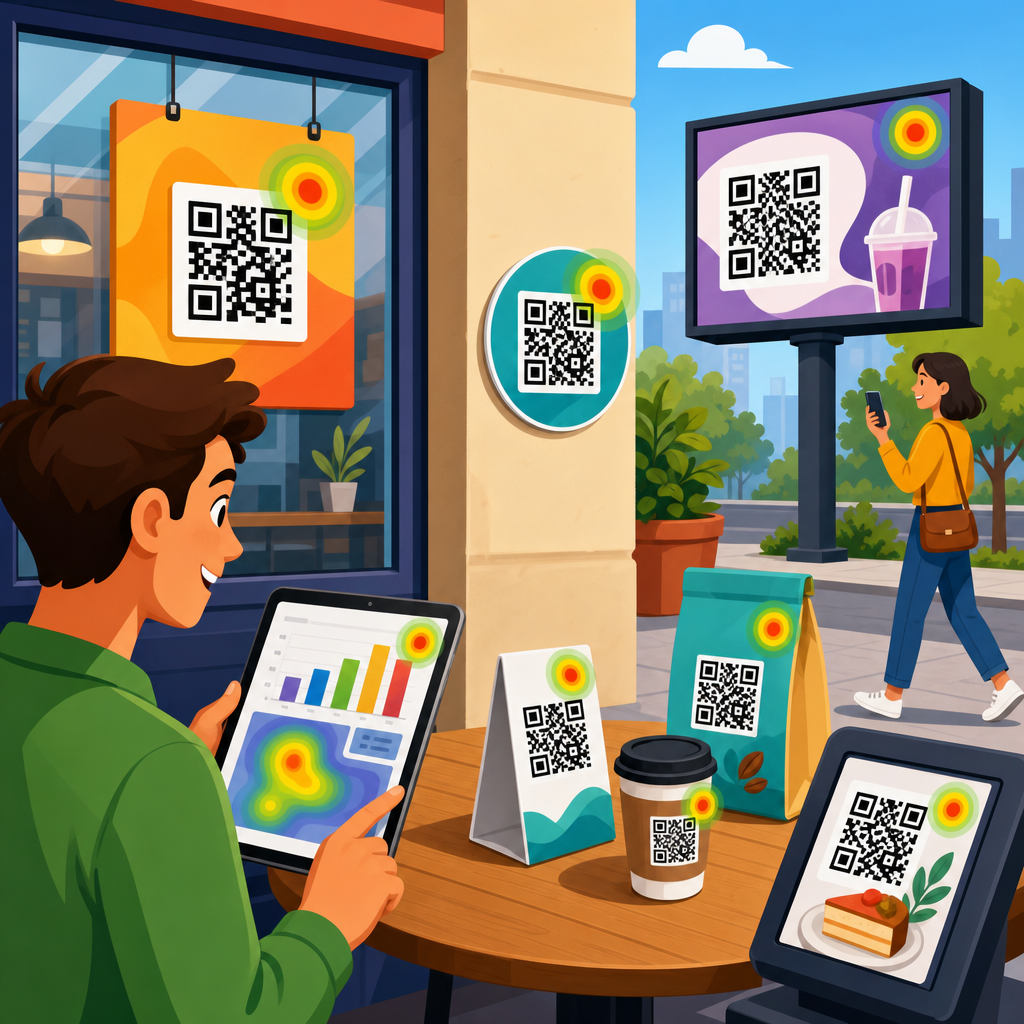
QR code split testing turns a static square into a measurable marketing asset by comparing two or more versions of a code campaign to see which one drives more scans, conversions, and revenue. In practice, A/B testing QR codes means changing one variable at a time, such as placement, size, call to action, landing page, offer, or design treatment, and then measuring the effect on scan rate and downstream behavior. This matters because QR codes now sit at the intersection of offline media and digital analytics. A poster, product label, direct mail piece, restaurant table tent, event badge, or packaging insert can all trigger a mobile journey, but only disciplined testing shows why one execution works better than another.
I have run QR campaigns on retail packaging, sales collateral, and out-of-home signage, and the biggest lesson is simple: most underperforming QR codes do not fail because people dislike the technology. They fail because teams skip hypothesis design, route traffic to weak mobile pages, or change too many variables at once. The goal of this hub article is to give you a complete framework for A/B testing QR codes so you can improve scan performance systematically, attribute results correctly, and build a repeatable optimization program across channels. If you need one definition to anchor the topic, use this: QR code split testing is the controlled comparison of alternative QR experiences to identify the version that produces the best measurable business outcome.
A strong test starts before the code is generated. You need a clear objective, such as increasing scans per thousand impressions, improving lead form completion, lifting coupon redemption, or reducing bounce rate after scan. You also need dynamic QR codes rather than static codes in most serious marketing programs, because dynamic codes let you change destinations, append tracking parameters, and collect analytics without reprinting materials. When teams ask what to test first, I usually recommend starting with the highest-friction points in the user journey: visibility of the code, clarity of the scan prompt, relevance of the destination page, and page speed on mobile. These four factors routinely explain more variance than cosmetic styling alone.
As the hub page for this subtopic, this article covers the strategic foundations, common test variables, measurement methods, sample-size thinking, execution workflows, and mistakes to avoid. The examples focus on real-world environments where QR codes compete for attention: packaging, print, retail displays, events, direct mail, and menus. The main benefit of structured QR code split testing is not just a higher scan rate. It is better decision-making. Instead of relying on opinions about whether a black code looks more premium than a branded one or whether a short coupon headline is stronger than a detailed offer, you can let controlled evidence show which version earns action from actual users.
Build the right testing framework before you print anything
The most important discipline in A/B testing QR codes is isolating variables. If version A has a larger code, a different headline, and a different landing page than version B, you cannot tell which change created the lift. I advise teams to document each test with five fields: hypothesis, variable, audience, success metric, and run conditions. For example: “Adding a direct benefit statement above the QR code on shelf talkers will increase scan rate by 15% among grocery shoppers over a two-week period, measured as scans per store per day.” That framing keeps the test operational instead of subjective.
Audience consistency matters just as much as variable control. A code placed in a high-traffic flagship store should not be compared directly against a code in a low-traffic suburban location unless you normalize for exposure. The same rule applies to direct mail tests sent to different customer segments or event badges scanned on different days of a conference. In my campaigns, I usually create matched cohorts by store type, region, list quality, or time window so performance differences are not caused by uneven audience intent. Good QR split testing is closer to disciplined field experimentation than to casual creative review.
Technical setup is another make-or-break factor. Use dynamic QR platforms that support redirects, UTM tagging, timestamped scan logs, device data, and geographic reporting. Common tools include Bitly, Beaconstac, QR Code Generator Pro, Flowcode, and enterprise attribution stacks connected to Google Analytics 4, Adobe Analytics, HubSpot, or Salesforce. If you need to compare landing pages, use server-side redirects or dedicated URLs so each variant preserves clean attribution. Also confirm that your destination pages are indexable where appropriate, mobile optimized, and fast enough to load on cellular connections. A winning code design cannot rescue a page that takes six seconds to become interactive.
What variables to test in QR code campaigns
The highest-value QR code tests usually involve discoverability, motivation, and post-scan relevance. Discoverability includes placement, size, whitespace, contrast, and distance from the viewer. Motivation includes the words near the code, the offered incentive, and the perceived payoff from scanning. Post-scan relevance includes the landing page message match, form length, checkout friction, and content format. If your campaign is new, prioritize variables in that order. Marketers often start by changing the pattern color or adding a logo in the center, but message clarity and destination quality almost always outperform decorative changes in impact.
Placement tests are especially powerful because context influences scan intent. A QR code on the front of product packaging may get fewer but more curiosity-driven scans, while a code on the side panel near usage instructions can drive practical, higher-quality engagement. On restaurant tables, codes placed upright at eye level usually outperform flat placements next to condiments because they remain visible throughout the meal. In print ads, moving the code closer to the primary headline and benefit statement often improves response because users process the value proposition before deciding to scan. The code should feel like the next logical action, not an isolated graphic element.
Call-to-action testing is equally important. “Scan me” is rarely the best prompt because it describes the action but not the reward. Better prompts specify the benefit: “Scan for 15% off,” “Scan to watch the setup video,” “Scan to see today’s menu,” or “Scan to book a demo in 30 seconds.” In one packaging program I worked on, changing the line above the code from “Learn more” to “See the two-minute installation guide” increased scans because the destination became concrete and low risk. Users respond when the outcome is specific, immediate, and clearly useful.
| Variable | Version A | Version B | Primary Metric | Typical Use Case |
|---|---|---|---|---|
| CTA copy | Scan to learn more | Scan for 15% off today | Scan-through rate | Retail signage, packaging |
| Placement | Bottom-right corner | Near headline and product image | Scans per impression | Print ads, posters |
| Destination | Homepage | Dedicated mobile landing page | Conversion rate | Direct mail, events |
| Code size | 1.5 cm square | 3 cm square | Successful scans | Packaging, labels |
| Incentive | No offer | Free guide or coupon | Lead or redemption rate | B2B collateral, coupons |
How to measure QR code test results correctly
Measuring scans alone is not enough. The core question is not “Which QR code was scanned more?” but “Which variant created more business value per exposure?” Start with a primary metric that matches the campaign objective. For awareness programs, that may be scans per thousand impressions. For ecommerce, it may be revenue per scan or checkout conversion rate. For lead generation, it may be qualified form completions. Secondary metrics should include scan success rate, bounce rate, time on landing page, button click-through rate, and assisted conversions where your analytics stack supports them.
Exposure estimation is often the hardest part of offline QR measurement. If you are testing posters in transit stations, foot traffic data from venue operators can provide directional denominators. In retail, store traffic counters, unit sales, or display compliance audits can help normalize results. For direct mail, the denominator is cleaner because delivered volume is known. I prefer reporting a measurement stack with three layers: exposure, scans, and outcomes. That lets you distinguish between a code that attracts many scans but converts poorly and a code that attracts fewer scans but converts at a much higher rate. Without this funnel view, teams can optimize for curiosity instead of value.
Statistical discipline matters, even for practical marketing tests. You do not need a full data science team to improve decision quality, but you should avoid calling winners too early. Small differences over a short period may be noise caused by daypart, weather, store staffing, or event timing. When possible, run tests long enough to capture a representative sample and stable operating conditions. For low-volume environments, Bayesian testing tools or confidence interval reporting can be more useful than simplistic percentage comparisons. At minimum, define the stopping rule before launch, such as a minimum number of scans, a fixed campaign duration, or a preset confidence threshold.
Real-world strategies for packaging, print, retail, and events
On packaging, the best QR code split testing strategy is usually sequential. First test whether the code belongs on the front, side, or back panel. Then test the purpose: product education, warranty registration, recipe content, user guide, review request, or loyalty enrollment. Finally test the CTA wording and page format. Consumer packaged goods brands often discover that utility beats promotion after purchase. A code that says “Scan for recipes using this sauce” can outperform “Scan to join our newsletter” because the customer is already in a usage mindset. The conversion may later be an email signup, but the first click must match the moment.
For print and direct mail, response quality depends heavily on continuity between the printed message and the landing page. If the postcard promises a rate quote in one minute, the landing page should open with exactly that promise, not a generic homepage hero. I have seen direct mail QR campaigns improve form completion simply by reducing the destination choices. A printed piece is already doing the segmentation work; after the scan, the page should complete the task with minimal navigation. Personalized URLs, prefilled forms where consent allows, and tightly matched copy routinely raise conversion rates in insurance, home services, and B2B lead generation.
Retail and event environments demand speed and visibility. In stores, customers often scan while standing, carrying products, or moving through an aisle, so larger codes, strong contrast, and concise benefits matter. At trade shows, attendees scan between conversations, making badge inserts, booth graphics, and product demo signage ideal testing surfaces. One useful event strategy is to compare intent levels by CTA: “Scan for the slide deck” versus “Scan to book a meeting.” The first usually produces more scans, but the second often yields better-qualified leads. The right winner depends on whether your goal is audience growth, sales pipeline, or post-event nurture performance.
Common mistakes that ruin QR code experiments
The most common mistake is sending all variants to the same generic page and hoping scan totals will tell the story. If the post-scan experience is not aligned to the tested message, you create a broken experiment. Another frequent error is changing creative mid-campaign without resetting the test window, which contaminates results. Teams also underestimate physical production variables. A matte finish may scan differently from a glossy one under store lighting. Curved packaging can distort readability. Quiet zones around the code get trimmed by designers trying to save space. These details are operational, not cosmetic, and they directly affect validity.
A second cluster of mistakes involves mobile usability. Some QR campaigns produce plenty of scans but weak conversions because the destination asks too much on a phone. Long forms, intrusive pop-ups, cookie banners that cover the CTA, and slow video autoloads can erase the gains from a stronger code treatment. Always test on multiple devices and lighting conditions before launch. Use native camera apps on iPhone and Android, not only one scanning app. Verify that redirects preserve UTM parameters and that analytics tools do not double count sessions. A split test is only as trustworthy as the instrumentation beneath it.
Finally, avoid overlearning from one environment. A CTA that wins on event signage may lose on product packaging because the user’s intent is different. Build a testing library, but tag results by channel, audience, traffic level, and campaign objective. Over time, patterns emerge. Utility-driven prompts tend to win after purchase. Incentive-driven prompts often win in acquisition settings. Dedicated mobile pages almost always beat homepages. Those are useful heuristics, not laws. The strength of QR code split testing is that it lets you replace generic best practices with evidence from your own customers.
QR code split testing works best when treated as an ongoing optimization program rather than a one-off campaign task. Start with a clear business goal, use dynamic codes, isolate one variable at a time, and measure the full path from exposure to scan to conversion. Prioritize tests that affect visibility, clarity, and landing-page relevance before spending energy on minor design tweaks. In most cases, better placement, stronger benefit-led copy, and a dedicated mobile destination will produce larger gains than decorative changes to the code itself. That is the practical foundation of effective A/B testing QR codes.
As this hub page under QR Code Marketing and Strategy, the article should guide your next steps across the entire subtopic. From here, build deeper workflows for packaging tests, print attribution, event lead capture, landing-page optimization, and QR analytics governance. The payoff is measurable: lower wasted media spend, better customer experience, and more reliable offline-to-online attribution. If you manage any channel that uses scannable media, audit your current QR placements, choose one high-impact variable, and launch a controlled test this month. The fastest way to improve QR performance is to stop guessing and start learning from real scans.
Frequently Asked Questions
What is QR code split testing, and why is it important for marketing performance?
QR code split testing is the process of comparing two or more versions of a QR-driven campaign to determine which one produces better results. Instead of treating a QR code like a fixed design element, marketers use it as a measurable conversion tool. A test might compare different code placements on packaging, alternate calls to action on a poster, different landing pages, incentives, sizes, colors, or surrounding design elements. The goal is to identify which variation generates more scans and, more importantly, which one leads to stronger downstream outcomes such as form submissions, purchases, bookings, app installs, or revenue.
This matters because QR codes bridge the physical and digital worlds. A flyer, direct mail piece, retail display, event sign, or product label may be the first touchpoint, but the actual business outcome happens after the scan. Without testing, teams often rely on assumptions about what will motivate people to scan. Split testing replaces assumptions with data. It reveals whether a larger code improves scan rate, whether a stronger benefit-driven CTA increases engagement, or whether a different mobile landing experience converts better. Over time, these findings help marketers improve campaign efficiency, lower wasted spend in print and media, and turn offline channels into continuously optimizable acquisition and conversion assets.
Which elements should you test first in a QR code campaign?
The best place to start is with variables most likely to influence user behavior in a meaningful way. In many campaigns, the first priorities are placement, call to action, landing page experience, and offer. Placement affects visibility and convenience. A code at eye level on in-store signage may perform very differently from one placed low on packaging or buried in the corner of a brochure. The CTA is equally important because people need a clear reason to scan. Language such as “Scan to get 20% off,” “Scan to watch the demo,” or “Scan to claim your free sample” usually performs better than a generic instruction like “Scan me.”
After those foundational elements, marketers often test code size, visual treatment, surrounding copy, incentive structure, and destination format. For example, one version may send traffic to a short-form landing page while another opens a product configurator or app download page. Design adjustments can also matter, but they should be tested carefully. Branded QR codes can improve attention and trust, but readability must remain intact. A practical rule is to test high-impact variables first and isolate one major change at a time. That makes it much easier to determine what actually caused the lift or decline in scan and conversion performance.
How do you run a clean A/B test for QR codes without skewing the results?
A clean QR code A/B test starts with a clear hypothesis and a disciplined test structure. First, define the single variable you want to evaluate. For example, you may believe that a value-focused CTA will outperform a curiosity-based CTA, or that placing the QR code on the front of a package will drive more scans than placing it on the back. Once you choose the variable, keep everything else as consistent as possible. That includes the audience, timing, geographic exposure, print quality, destination tracking setup, and measurement period. If multiple elements change at once, it becomes difficult to know which change drove the result.
Next, use unique tracking for each variation so scans and post-scan behavior can be attributed accurately. Dynamic QR codes are especially useful here because they allow marketers to route traffic to different destinations while collecting analytics such as scan volume, location, device type, time of scan, and conversion behavior. It is also important to split traffic or exposure fairly. If one QR code version appears in a high-traffic store entrance and another appears in a low-traffic corner, the test is not balanced. The same issue applies to print runs, event placements, or direct mail segmentation. Finally, run the test long enough to gather a meaningful sample size and evaluate both top-of-funnel and bottom-of-funnel metrics. A variation that wins on scans but loses on conversion quality is not necessarily the better business outcome.
What metrics should marketers track when evaluating QR code test results?
The most obvious metric is scan rate, but that should never be the only measure of success. Scan rate tells you how effectively the QR code and its presentation motivate action, yet it does not show whether that action created business value. Strong QR code split testing looks at the full path from exposure to outcome. At the top of the funnel, marketers should track impressions or estimated exposure, total scans, unique scans, scan-through rate, repeat scans, device type, geography, and time-based scan patterns. These metrics help explain when, where, and how people engage with each variation.
Equally important are downstream conversion metrics. Depending on the campaign, that may include landing page engagement, bounce rate, time on page, add-to-cart rate, lead form completion, coupon redemption, appointment booking, app installs, subscription signups, or completed purchases. Revenue per scan and conversion rate by variation are especially valuable because they connect QR code performance to actual business outcomes. In some cases, a version with fewer scans produces higher-quality traffic and more revenue, making it the stronger winner. The best evaluation framework aligns metrics with the campaign’s purpose and avoids overemphasizing vanity numbers at the expense of profitability or customer quality.
What are the most common mistakes in QR code split testing, and how can you avoid them?
One of the most common mistakes is testing too many variables at once. If the QR code design, CTA, placement, and landing page all change between Version A and Version B, the result may show which package performed better overall, but it will not tell you why. Another frequent problem is focusing only on scan volume. A high scan count may look encouraging, but if those users bounce immediately or fail to convert, the campaign is not truly winning. Marketers also run into trouble when they use static QR codes with limited tracking, launch tests without enough traffic to reach meaningful conclusions, or compare versions across unequal conditions such as different stores, audiences, times, or media formats.
To avoid these issues, begin with a specific hypothesis, test one major variable at a time, and make sure each variation has comparable exposure. Use dynamic QR codes and analytics tools that capture both scan behavior and post-scan outcomes. Ensure the landing page is mobile-friendly, fast, and aligned with the promise made next to the code. It is also wise to document each test, including the objective, setup, timeline, audience, metrics, and final outcome. That creates a learning library your team can use across future campaigns. The most successful marketers treat QR code split testing as an ongoing optimization program rather than a one-time experiment. Consistency, accurate attribution, and disciplined interpretation are what turn QR codes from a novelty into a reliable performance channel.