QR code acronyms and definitions matter because the language around two dimensional barcodes is dense, technical, and often used inconsistently by software vendors, printers, and marketers. A glossary page that defines the core terms in plain language helps teams buy the right tools, configure campaigns correctly, and avoid expensive production errors. In my work with QR code generators, print vendors, analytics dashboards, and mobile onboarding flows, the biggest problems rarely come from scanning itself. They come from misunderstandings: dynamic versus static, module size versus image size, masking versus branding, or error correction versus scan tolerance. This hub article clarifies the vocabulary that appears across QR code resources, templates, and tools so readers can move between beginner guides and advanced implementation documents without losing context.
A QR code, short for Quick Response code, is a matrix barcode invented by Denso Wave in 1994 for high speed component tracking. Today it is used for payments, menus, authentication, packaging, event check in, product information, and app links. Unlike one dimensional barcodes, a QR code stores data in both horizontal and vertical patterns, which increases capacity and supports built in error correction. Acronyms surround every stage of deployment: image formats such as SVG and PNG, security standards such as MFA and TOTP, campaign metrics such as CTR and UTM, and print terms such as DPI and bleed. Definitions also matter because one term can have a precise technical meaning. A module is not the same thing as a pixel. Quiet zone does not mean blank white background everywhere. Version does not mean software release.
This glossary and reference guide is designed as a hub for the broader QR Code Resources, Templates & Tools topic. It introduces the essential language, explains why each term matters in real use, and points to the practical decisions behind the jargon. If you are creating print assets, managing a QR campaign, integrating scans into a CRM, or evaluating enterprise QR code platforms, these definitions will save time. They also support better accessibility, stronger analytics, cleaner design, and more reliable scanning across Android and iPhone devices. Use this page as the baseline reference before moving into template libraries, generator comparisons, analytics setups, packaging workflows, and security documentation.
Core QR code acronyms and structural terms
The most important definition is QR itself: Quick Response. The name reflects how quickly the symbol can be read compared with older systems. A matrix barcode is a barcode arranged in a grid of small squares, not a set of single parallel lines. Those small squares are called modules. The scanner interprets the pattern of dark and light modules as encoded data. When teams confuse module count with image dimensions, print quality suffers. A 29 by 29 module symbol printed poorly may fail even if the file is large in pixels, while a properly exported vector file scans cleanly at many sizes.
Version refers to the grid dimensions of the QR code, from Version 1 at 21 by 21 modules up to Version 40 at 177 by 177 modules. Higher versions hold more data but become denser and harder to scan at small physical sizes. Format information stores details such as error correction level and mask pattern. Finder patterns are the three large squares at the corners that help scanners locate orientation. Alignment patterns improve reading, especially on curved surfaces. Timing patterns are alternating modules that help determine the grid. The quiet zone is the empty margin around the code, typically four modules wide. Without a proper quiet zone, many cameras struggle to separate the symbol from nearby design elements.
Error correction is another foundational term. QR codes use Reed-Solomon error correction, allowing partial recovery when a code is damaged, dirty, or partly obscured. The common levels are L, M, Q, and H, which recover about 7 percent, 15 percent, 25 percent, and 30 percent of codewords respectively. Higher error correction is useful when adding a logo or expecting wear on packaging, but it also increases density. In practice, I recommend treating high error correction as support for resilience, not permission to overdesign the symbol. Good contrast, sufficient size, and a clean quiet zone still determine most real world scan success.
Data, encoding, and content destination definitions
Payload means the actual data stored in the QR code. That payload might be a URL, plain text, vCard contact data, Wi-Fi credentials, an email action, an SMS template, or a payment string. Encoding is the method used to represent that payload in a machine readable form. Common data modes include numeric, alphanumeric, byte, and Kanji. Numeric mode is the most efficient for digits only; byte mode is more flexible and common for URLs. Character set matters because unusual symbols, line breaks, and non Latin scripts can affect size and compatibility. UTF-8 support is common in modern tools, but testing is still necessary when multilingual content is involved.
Static QR code and dynamic QR code are probably the two most misunderstood terms in the industry. A static QR code stores the final destination directly in the symbol. Once printed, it cannot be changed. A dynamic QR code stores a short redirect URL that points to a managed destination. The destination can be edited later without changing the printed code. Dynamic codes also enable scan analytics, link routing, device targeting, and expiration rules. They are ideal for campaigns, packaging, menus, and signage where content may change. Static codes are still useful for permanent data such as Wi-Fi login on office walls or contact sharing where no redirect service is needed.
URL stands for Uniform Resource Locator, the address that opens a webpage or deep link destination. URI, Uniform Resource Identifier, is the broader concept that includes URLs and other identifiers. Deep link usually means a link that opens a specific screen in a mobile app rather than just the website home page. App Clip on iPhone and Android App Links or Intent links are examples of mobile destination strategies that may appear in QR code documentation. UTM stands for Urchin Tracking Module, a set of query parameters like utm_source and utm_campaign used by analytics platforms to attribute traffic. When a marketer asks why two QR codes that look identical report different results, the answer is often hidden in the payload, redirect chain, or tracking parameters.
File formats, print specifications, and production terms
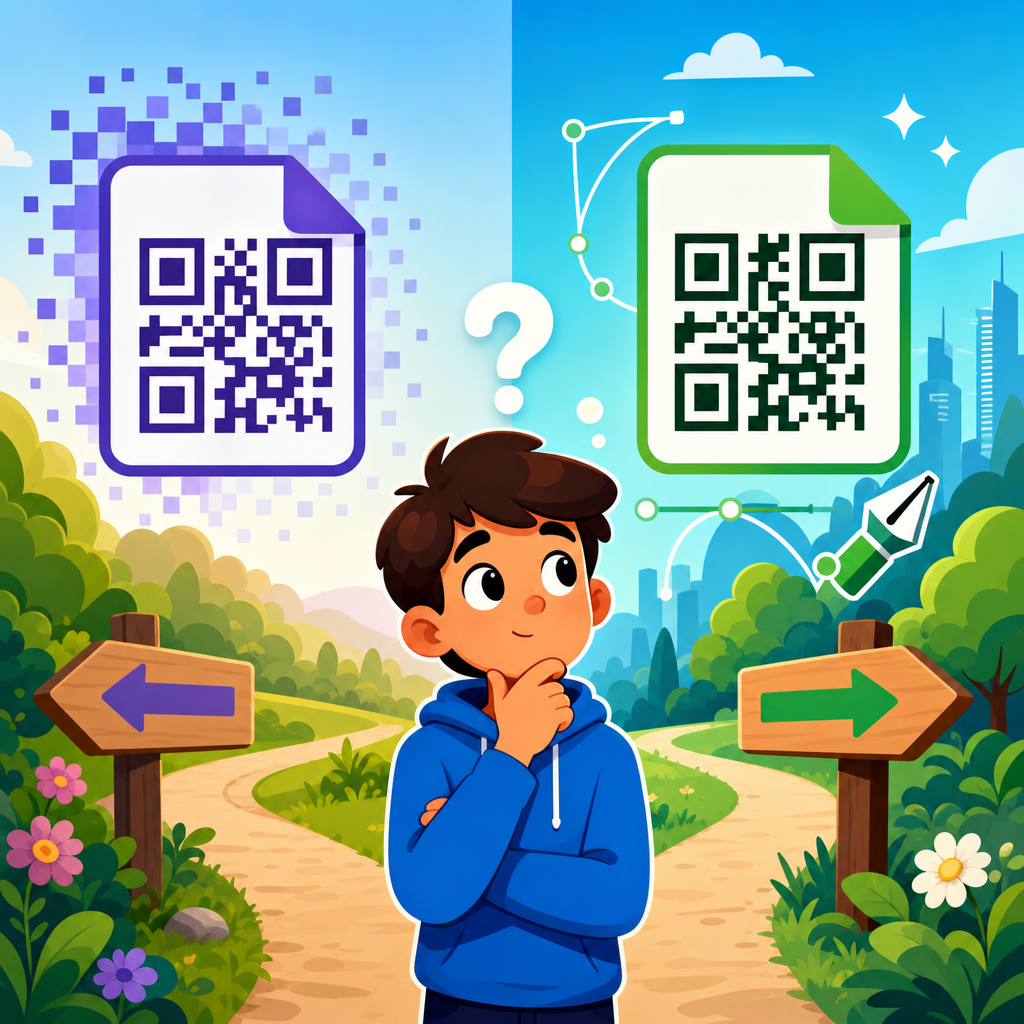
Many QR failures start in artwork preparation, so print and file acronyms deserve careful definition. PNG stands for Portable Network Graphics and is a raster image format. SVG stands for Scalable Vector Graphics and is a vector format that scales cleanly without pixelation. EPS and PDF can also preserve vector data for print workflows. For most professional use, SVG is the safest export for designers because it stays sharp across sizes and allows controlled placement in layouts. PNG is fine for web use, slides, and simple documents, but it should be exported at adequate resolution for the final display size.
DPI means dots per inch and PPI means pixels per inch. They are often used interchangeably in casual discussion, but they refer to different contexts: print output versus digital image density. Minimum physical size matters more than file size alone. For a standard marketing QR code viewed at close range, around 2 by 2 centimeters can work with short URLs, but practical production often starts larger, especially for dense codes or low quality print surfaces. On posters, packaging, and retail signage, size should be matched to scan distance. A useful field rule is roughly ten to one viewing distance to symbol width, then validate through testing on multiple phones.
| Term | Definition | Why it matters |
|---|---|---|
| SVG | Vector image format that scales without losing clarity | Best for professional print and design systems |
| PNG | Raster image made of pixels | Good for web, weaker for large print enlargement |
| DPI | Dots per inch in print output | Affects printed sharpness and edge definition |
| Quiet zone | Blank margin around the QR symbol | Essential for scanner recognition |
| Bleed | Extra artwork extending past trim edge | Prevents cutting issues from touching the code |
Bleed is the extra artwork extending beyond the final trim edge of a printed piece. The QR code itself should never enter the bleed area because trimming variation can clip the quiet zone. Contrast ratio is another practical concept. Dark foreground on a light background performs best, with black on white remaining the most reliable. Inverted codes, gradients, metallic inks, varnishes, and low contrast brand palettes can work, but only after device testing in realistic lighting. CMYK and RGB describe color models for print and screens. A code that appears high contrast on a monitor can print muddy on uncoated stock, so proofing matters. Lamination, curvature, and reflective packaging films also change scan behavior significantly.
Analytics, management, and marketing measurement language
Once a QR code is live, the conversation shifts from symbol construction to performance measurement. CTR means click-through rate, though with QR codes the first action is a scan, not a click. Many dashboards therefore emphasize scan rate, unique scans, total scans, repeat scans, and conversion rate. A unique scan attempts to estimate distinct users or devices; a total scan count includes repeat activity. Definitions vary by platform, which is why comparing vendor reports requires checking methodology. Some systems use cookies, some use device fingerprints, and some count every redirect request. If you need defensible reporting, ask how bots, prefetching, and privacy restrictions are handled.
CRM stands for customer relationship management, systems like Salesforce or HubSpot where QR generated leads may be stored. CMS means content management system, such as WordPress, where landing pages live. CDP stands for customer data platform, which unifies data from multiple channels. API means application programming interface, the mechanism used to generate codes in bulk, update destinations, or pull analytics programmatically. SSO, single sign-on, matters in enterprise deployments where multiple teams access a QR platform. RBAC, role-based access control, defines who can create, edit, or publish codes. These management terms become important fast when a brand runs thousands of codes across regions, stores, product lines, and agencies.
Attribution is the practice of connecting scans to outcomes such as signups, purchases, downloads, or support actions. Last click attribution gives credit to the final touchpoint before conversion, while multi-touch models distribute credit across interactions. Geolocation reporting estimates where scans happened based on IP address, which is useful but imperfect. Time series analysis shows how scans change by hour, day, or campaign period. Cohort analysis groups users by shared characteristics, such as event date or product batch. These are not just analyst buzzwords. They determine whether a QR poster in a subway station drove incremental sales or merely captured demand that would have converted anyway.
Security, authentication, accessibility, and compliance terms
Security terms appear more often as QR codes are used for login, payments, and identity workflows. MFA means multi-factor authentication, requiring more than one proof of identity. TOTP, time-based one-time password, is the rolling code generated by authenticator apps. Some login systems use a QR code to transfer a session from desktop to mobile securely. Tokenization refers to replacing sensitive data with a non sensitive token. TLS, transport layer security, protects data sent over HTTPS. Phishing is the major risk users associate with QR codes, especially when the destination URL is hidden until after a scan. Brands reduce risk by using recognizable domains, secure redirects, and clear callouts about what the user should expect next.
Payment QR terminology varies by region. EMVCo is the global technical body behind widely used payment specifications. In merchant payments, static presented codes differ from dynamic transaction specific codes that embed amount or invoice data. KYC, know your customer, and AML, anti-money laundering, may appear when payment flows connect to wallets or regulated financial services. None of these acronyms change the visual appearance much, but they affect interoperability, compliance, and customer trust. If a payment QR works only in one banking app, the issue is usually standards support, not scan quality.
Accessibility deserves equal attention. Alt text helps describe an image online, but a QR code alone is not accessible instruction. Users need nearby plain language that states the destination or action, such as “Scan to download the setup guide” plus a short fallback URL. WCAG, the Web Content Accessibility Guidelines, does not ban QR codes; it requires equivalent access. ADA is the U.S. legal framework often discussed in relation to accessible customer experiences. In physical environments, placement height, glare, and line of sight matter as much as digital markup. A well designed QR touchpoint always includes a non scan alternative.
How to use this glossary hub across QR code resources, templates, and tools
The best way to use a glossary hub is as a decision support tool, not just a dictionary. When comparing QR code generators, review terms such as dynamic code, custom domain, API, bulk generation, and export format. When working from templates, validate size, quiet zone, bleed safety, and destination labeling before approval. When reading setup guides, slow down at words like redirect, deep link, or error correction because those terms usually signal a tradeoff between flexibility, design, and reliability. In client reviews, I often ask teams to define three words before launch. If stakeholders cannot explain static versus dynamic, scan tracking, and quiet zone, the campaign is not ready.
This page also serves as the central reference point for glossary and reference guides within a larger QR code resource library. From here, related articles can go deeper into dynamic QR code use cases, print specifications, analytics implementation, payment standards, security best practices, and troubleshooting scan failures. That structure helps readers progress logically: first learn the language, then apply it in templates and tools. If you manage QR codes across packaging, retail, events, operations, or product documentation, bookmark this hub and share it with designers, marketers, developers, and vendors. A common vocabulary prevents rework, improves scan performance, and makes every downstream QR code decision faster and more accurate.
Frequently Asked Questions
What does “QR” stand for, and how is a QR code different from a standard barcode?
“QR” stands for “Quick Response.” The name comes from the code’s ability to be read quickly by imaging devices such as smartphone cameras, industrial scanners, and point-of-sale hardware. A QR code is a type of two-dimensional barcode, which means it stores information across both horizontal and vertical axes. By contrast, a traditional one-dimensional barcode, such as a UPC, stores data primarily in a single direction using a pattern of vertical lines and spaces.
That difference matters because QR codes can hold much more information in a smaller footprint. A standard barcode is ideal for short identifiers, like a product number that points to a record in a database. A QR code can do that too, but it can also store URLs, contact data, Wi-Fi credentials, app deep links, serial numbers, and other structured content directly in the symbol. In practical terms, when teams confuse “barcode” and “QR code” as interchangeable terms, they can end up selecting the wrong scanner, print method, software platform, or campaign setup. Understanding the acronym is simple, but understanding the capabilities behind it is what helps prevent implementation mistakes.
What is the difference between a static QR code and a dynamic QR code?
A static QR code contains the final destination or content directly in the code itself. Once it is created and printed, that information cannot be changed without generating an entirely new code. For example, if a static QR code points to a website URL and that URL later changes, the original code will continue sending users to the old address or fail altogether if the page is removed. Static codes are often fine for permanent content that will not change, such as a stable homepage, a fixed product ID, or long-term reference material.
A dynamic QR code works differently. Instead of storing the final destination, it typically stores a short redirect URL or unique ID managed by a QR code platform. That platform then forwards the user to the current destination you choose. This setup allows the destination to be edited after printing, which is one of the biggest reasons businesses prefer dynamic codes for marketing, packaging, signage, onboarding, and customer support flows. Dynamic codes also commonly support analytics such as scan counts, device types, timestamps, and location approximations.
From a terminology standpoint, this is one of the most important definitions in the QR space because software vendors do not always describe these options consistently. Some call them “editable” versus “non-editable,” while others emphasize “trackable” versus “non-trackable.” The underlying distinction is whether the code stores the end content directly or points to a managed redirect layer. If a team misunderstands that difference, they may print thousands of labels or brochures only to discover they cannot update a broken link, localize a campaign, or measure performance after launch.
What do terms like error correction, quiet zone, and module mean in QR code design?
These are core technical definitions that directly affect whether a QR code scans reliably in the real world. A “module” is the smallest square unit in a QR code grid. When you look at a QR code, what you are really seeing is an arrangement of dark and light modules that encode the data. The number of modules increases as more data is stored, which is why higher-capacity QR codes often look denser and more complex.
The “quiet zone” is the blank margin around the outside of the code. It may seem unimportant, but it is essential for scanning. Cameras and decoding software need that clear border to distinguish the QR code from the surrounding design, text, packaging graphics, or background pattern. If the quiet zone is too small or missing entirely, scan performance can drop sharply, especially in poor lighting, on curved surfaces, or at small print sizes.
“Error correction” refers to the QR code’s built-in ability to remain readable even if part of the symbol is damaged, dirty, obscured, or distorted. QR codes support several error correction levels, commonly labeled L, M, Q, and H. Higher levels allow more of the code to be restored during decoding, which can be useful when adding a logo, printing on rough materials, or expecting wear and tear. The tradeoff is that higher error correction also increases symbol density, which can make the code harder to scan if it becomes too small.
These terms are not just technical trivia. They are the language behind many avoidable production failures. A beautifully branded code may fail because the quiet zone was reduced. A tiny code on a label may be unreadable because the data payload created too many modules. A logo treatment may work in one test but fail at scale because the chosen error correction level was misunderstood. For anyone working with designers, print vendors, or QR software tools, knowing these definitions makes it much easier to approve artwork confidently and avoid expensive reprints.
What is meant by payload, encoding, and data capacity in a QR code?
The “payload” is the actual information being stored or referenced by the QR code. That could be a web address, plain text, a phone number, a vCard, an SMS template, Wi-Fi login details, or an internal identifier used by a software system. In simple terms, the payload is the content the code is meant to deliver when scanned.
“Encoding” is the method used to convert that information into a machine-readable pattern inside the QR code. Different types of content may be encoded in different ways depending on the character set and structure involved. This matters because the same message can sometimes produce a simpler or more complex QR code depending on how the data is formatted. For instance, an unnecessarily long URL with tracking parameters can increase the complexity of the code, while a shortened or redirected URL can reduce density and improve scan reliability.
“Data capacity” refers to how much information a QR code can store. Capacity is affected by several factors, including the QR version, the encoding mode, and the level of error correction selected. In theory, QR codes can hold a large amount of data, but in practice, just because a code can store a lot does not mean it should. Large payloads create denser codes, and denser codes are generally harder to scan when printed small, placed on textured materials, or used in fast-moving consumer environments.
This is a crucial area where plain-language definitions help teams make better decisions. Marketers may assume they can paste any long destination URL into a generator. Designers may assume all QR codes scan the same regardless of density. Developers may optimize for data completeness without considering physical print constraints. A shared understanding of payload, encoding, and capacity helps everyone recognize the tradeoff between information richness and scan performance. In many cases, the smartest approach is not to maximize what the code contains, but to optimize what the user experience requires.
Why do QR code acronyms and definitions matter so much when choosing tools, vendors, and campaign setups?
They matter because QR code projects often fail at the handoff points between teams. A marketer may ask for a “trackable QR code” without realizing that requires a dynamic setup. A printer may receive artwork with an inadequate quiet zone because the design team was not familiar with the term. A software buyer may compare vendors using inconsistent language, assuming that “editable,” “redirectable,” and “dynamic” are different features when they are often describing closely related capabilities. In other words, many problems come less from scanning technology itself and more from terminology gaps that cause bad decisions upstream.
When acronyms and definitions are clearly understood, teams can ask better questions before they commit budget or go to print. They can confirm whether analytics are included, whether redirects can be changed after launch, whether the platform supports bulk generation, whether expiration rules apply, whether first-party domains are available, and whether export files meet print requirements. They can also evaluate whether a vendor’s dashboard language reflects genuine technical capability or just marketing wording layered on top of standard QR functions.
A solid glossary creates alignment across marketing, operations, design, IT, and production. It reduces ambiguity, speeds up approvals, and helps everyone spot risks earlier. That is especially important in packaging, retail displays, direct mail, event signage, product onboarding, and regulated industries where replacing printed assets can be slow and expensive. Put simply, understanding the language of QR codes is not academic. It is operational. The clearer the definitions, the easier it is to choose the right tool, configure the right experience, and avoid preventable errors that only show up after thousands of codes are already in circulation.