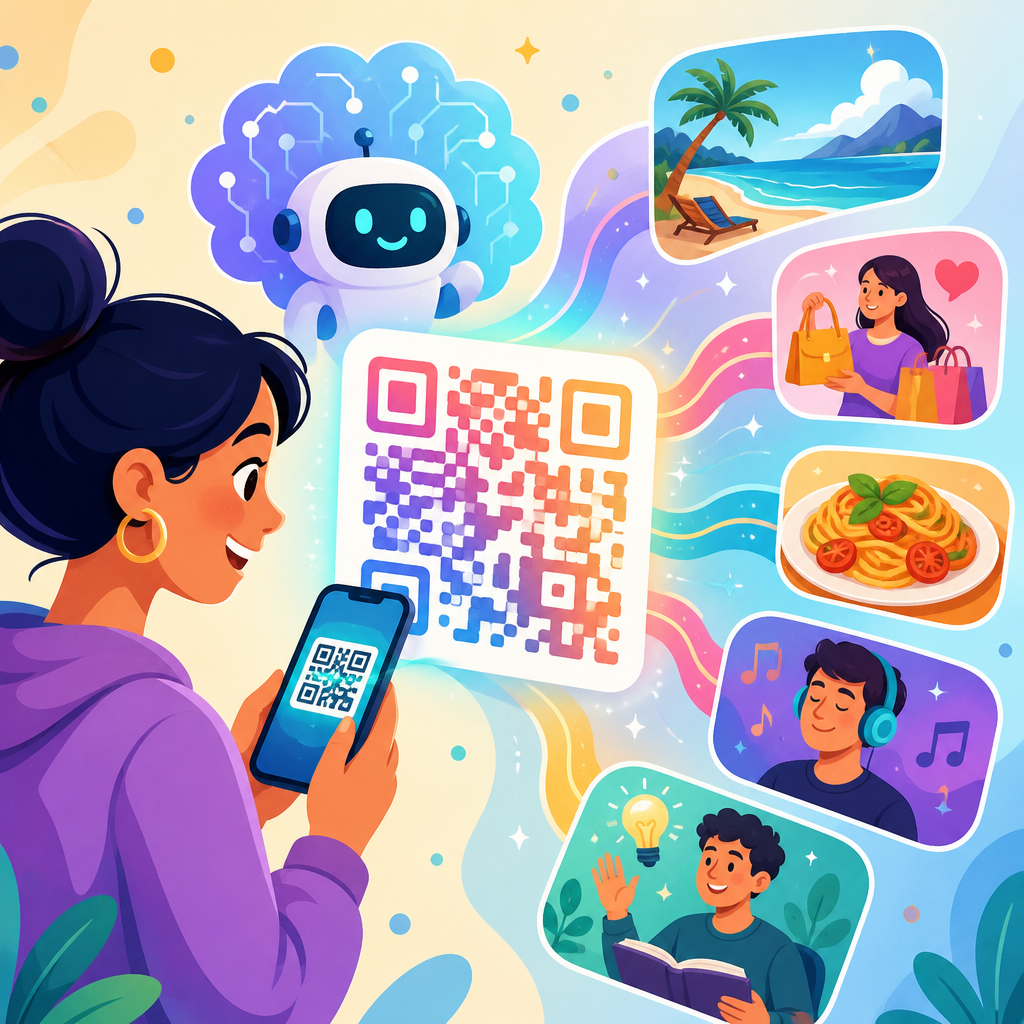
Personalized QR code experiences using AI are changing the way brands, venues, educators, and service teams connect printed objects to digital journeys. A QR code is a machine-readable matrix barcode that opens a destination such as a landing page, menu, app screen, file, payment prompt, or form when scanned with a smartphone camera. Personalization means that the destination, message, offer, or interface adapts to the individual scanner, their device, their location, their past behavior, or the context of the scan. AI adds the prediction, automation, and decisioning layer that makes those adaptations useful at scale rather than manually managed one by one.
I have worked on QR deployments for retail promotions, event registration, product packaging, and field service documentation, and the pattern is consistent: static QR codes are easy to launch, but intelligent QR code experiences produce stronger engagement because they answer the next question a person has in the moment. Instead of sending every user to the same page, AI can infer intent, recommend content, translate language, summarize choices, prioritize support paths, and optimize timing. This matters because QR codes sit at the intersection of physical touchpoints and digital conversion. They turn shelves, posters, direct mail, receipts, tables, labels, and kiosks into measurable entry points.
The practical value is threefold. First, AI improves relevance, which usually improves scan-to-action conversion. Second, it reduces operational effort by automating segmentation, testing, and content selection. Third, it creates a feedback loop: every scan, click, dwell session, and downstream action can train better recommendations and better routing. When teams ask what “QR codes plus AI” really means, the clearest answer is this: a printed code stays visually simple, while the destination behind it becomes adaptive, predictive, and continuously optimized based on data and business rules.
What Personalized QR Code Experiences Using AI Actually Include
Personalized QR code experiences using AI include far more than swapping a user’s first name onto a landing page. In practice, the stack usually combines dynamic QR codes, a destination management layer, analytics, consent-aware identity resolution, and one or more AI services. The dynamic code is essential because it points to a short URL that can be changed without reprinting the code. Once a scan occurs, the platform can evaluate signals such as device type, operating system, language settings, time of day, referral source, approximate location, campaign ID, and known customer profile before deciding what the user should see next.
Common use cases are already mature. In retail, product packaging QR codes can route first-time scanners to educational content and returning customers to replenishment offers. In hospitality, a hotel room QR code can open a concierge page that recommends different services for a family, a business traveler, or a loyalty member. In healthcare administration, a clinic QR code can direct a patient to check-in forms in their preferred language and answer routine intake questions through an AI assistant before arrival. At events, the same printed QR on badges or signage can provide agenda recommendations based on role, attendance history, or stated interests.
Generative AI expands the experience further by changing not only the route but the content itself. A product manual can be summarized into plain-language troubleshooting steps after a scan. A museum exhibit code can open a guided explanation tuned to a child, a student, or a specialist. A restaurant table code can surface menu recommendations tied to dietary preferences. These are not gimmicks. They are examples of adaptive interfaces built on real user signals, constrained prompts, retrieval from approved content, and business logic that keeps the outcome useful and accurate.
How the Technology Stack Works From Scan to Response
A successful QR plus AI deployment follows a predictable sequence. The user scans a code. The code resolves to a dynamic URL controlled by a QR management platform such as Bitly, Uniqode, Flowcode, QR TIGER, or a custom redirect service. That platform logs the scan event and passes context to a decision engine. The decision engine may be a customer data platform like Segment, mParticle, Adobe Experience Platform, or Twilio Segment, combined with business rules inside a marketing automation tool or application backend. AI models then score intent, classify the user, generate content, or recommend the next best action.
In plain terms, the printed code is only the front door. The real intelligence sits behind the redirect. If the scanner is anonymous, the system can still use contextual signals. If the user is known and has consented, the system can pull profile data, order history, loyalty status, or support records. A recommendation model can then select the right offer or content block. A large language model can personalize copy, summarize instructions, or power a chatbot, but only if it is grounded in approved content sources such as a knowledge base, CMS, product catalog, or support documentation.
Measurement is equally important. Every step should be tagged with event taxonomy that distinguishes scans, unique users, redirects, sessions, conversions, assisted conversions, and retention actions. I recommend defining the funnel before launch: scan rate by placement, destination load speed, interaction depth, completion rate, revenue per scan, and repeat scans. Without that structure, teams often overvalue raw scan volume and miss whether the AI layer improved outcomes. The goal is not simply more scans; it is more useful scans that lead to measurable business actions.
Core Personalization Patterns and Where They Fit Best
Not every QR code experience needs the same type of intelligence. The strongest programs choose a personalization pattern based on user intent and operational constraints. In my projects, five patterns repeatedly outperform generic landing pages: contextual routing, profile-based content, recommendation engines, conversational assistance, and lifecycle follow-up. Contextual routing uses current conditions such as language, device, location, or venue zone. Profile-based content uses known data such as membership tier or prior purchases. Recommendation engines propose products, sessions, or actions. Conversational assistance handles ambiguity through questions. Lifecycle follow-up connects the scan to email, SMS, CRM, or loyalty workflows.
| Pattern | Best Use Case | AI Role | Example |
|---|---|---|---|
| Contextual routing | Signage, packaging, out-of-home | Classifies likely intent from context | Airport poster sends domestic and international travelers to different guidance pages |
| Profile-based content | Loyalty, membership, account access | Selects content blocks by customer attributes | Retail insert shows VIP restock offers to high-value buyers |
| Recommendations | Menus, catalogs, exhibits, events | Ranks options using preference and behavior data | Conference badge QR suggests sessions by job role |
| Conversational help | Support, onboarding, troubleshooting | Answers questions using approved knowledge sources | Appliance label QR opens guided setup chat |
| Lifecycle follow-up | Lead generation and retention | Predicts next best message or timing | Gym flyer QR triggers personalized class reminders |
Choosing among these patterns depends on friction tolerance. For a bus shelter ad, users need instant relevance with almost no typing, so contextual routing is best. For an authenticated service app, profile-based content is appropriate because users expect recognition. For products with setup complexity, conversational assistance reduces abandonment better than static FAQs. The point is to match the decisioning method to the moment of scan. Good personalization is not flashy. It removes the step the user would otherwise have to take themselves.
High-Value Industry Applications of QR Codes and AI
Retail and consumer packaged goods are leading adopters because packaging is always present at the point of consideration. A cereal box QR code can open recipes for one household, sustainability sourcing details for another, and a replenishment subscription offer for a third. Beauty brands use QR codes on displays to power shade finders and routine builders. Beverage brands use them for age-gated promotions, cocktail pairings, and regional campaigns. The AI benefit is not the code itself; it is the ability to use one printed asset across many customer states without rebuilding physical inventory for each variant.
Events and venues also benefit because attendee intent changes quickly. A QR code on event signage can direct newcomers to navigation, returning attendees to schedule recommendations, and sponsors to lead-capture tools. Stadiums can route fans to seat-specific food ordering, accessibility help, or merch offers. Museums can create layered interpretation where the same exhibit code serves basic summaries, expert commentary, and multilingual audio guides. In all three settings, AI reduces content overload by selecting what is most relevant before the visitor asks for it.
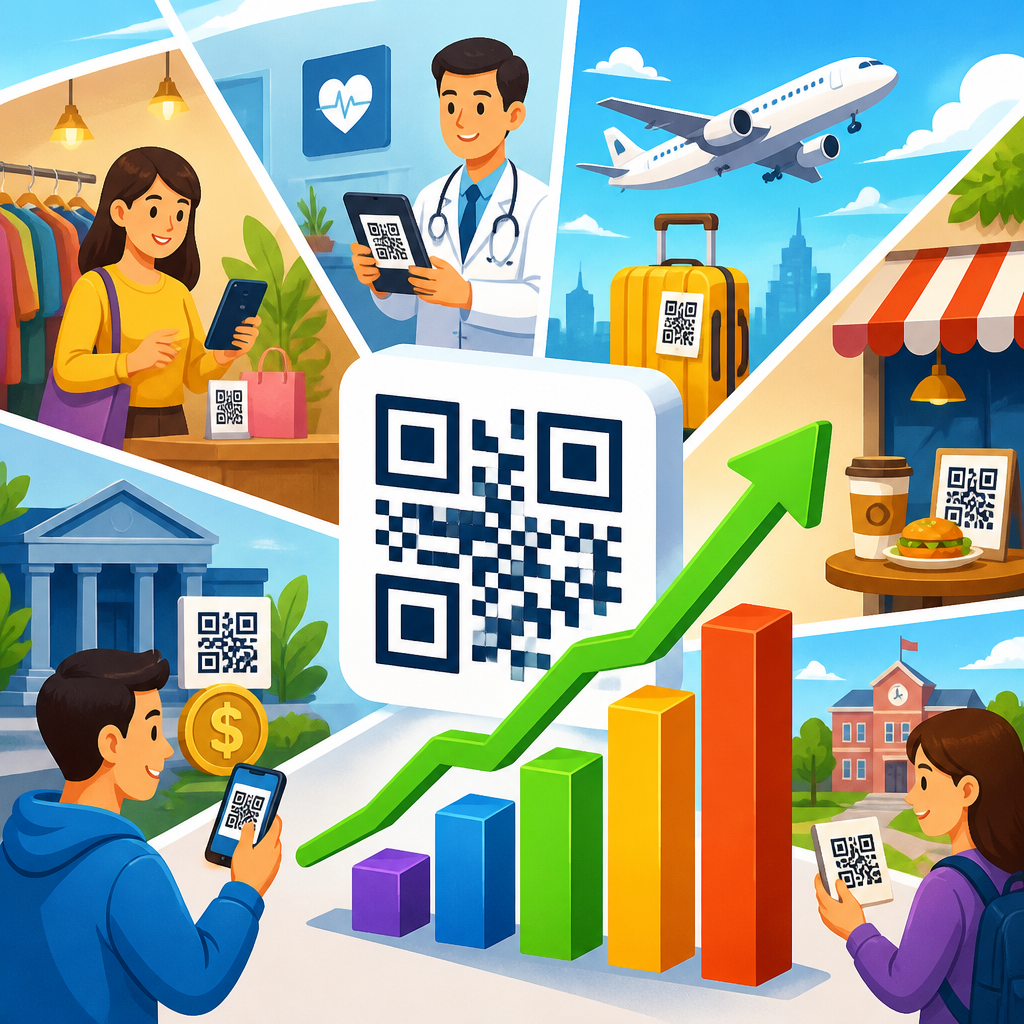
Healthcare, education, travel, and field service have equally strong cases. Clinics use QR intake flows to reduce front-desk bottlenecks and improve language access. Universities place QR codes on campus signs, labs, and course materials to provide adaptive guidance, office hours booking, and study support. Airlines and hotels use QR touchpoints for check-in, disruption communication, and concierge service. Manufacturers place QR codes on equipment for parts lookup, maintenance history, and troubleshooting workflows. In these industries, the strongest value often comes from accuracy and speed, not promotion. AI helps route people to the right answer with fewer dead ends.
Data, Privacy, and Governance Requirements You Cannot Ignore
Personalization depends on data, and that makes governance nonnegotiable. QR code scans can collect device information, timestamps, campaign identifiers, approximate geolocation, and behavioral events. If the destination connects to customer profiles, the system may process personal data under laws such as the GDPR, CCPA, and other regional privacy frameworks. The safest approach is data minimization: collect only what is needed, disclose it clearly, and separate anonymous scan analytics from identified customer records until there is a lawful basis or explicit consent to join them.
From experience, the operational risk is rarely the QR code image. It is the hidden complexity behind redirects, cookies, model inputs, and third-party integrations. Teams should document what data is captured at scan, what enrichment occurs, where it is stored, how long it is retained, and which vendors process it. Consent banners may be required on destination pages, but transparency should begin earlier with signage or campaign terms when personalization is material. For healthcare, finance, and education, regulated data must be isolated from general-purpose AI services unless contractual and technical safeguards are in place.
Governance also means controlling model behavior. If a language model powers the destination, use retrieval from approved knowledge sources, prompt constraints, moderation layers, and human-reviewed fallback copy for critical tasks. Keep immutable logs of model versions and prompts for high-impact workflows. Establish escalation rules when confidence is low. AI should not invent instructions for medications, financial obligations, or equipment safety. In those scenarios, personalization should focus on routing, summarization, and explanation while authoritative instructions remain locked to validated source content.
Implementation, Testing, and Measurement Best Practices
Start with a narrow, measurable use case rather than a broad promise of “smart QR codes everywhere.” The best pilot has a clear audience, a high-volume touchpoint, and an obvious success metric. For example, a retailer might test AI-personalized post-purchase QR inserts to increase repeat orders within thirty days. Build the experience on dynamic QR infrastructure, connect it to analytics and approved data sources, and create controlled variants. One variant can be a standard landing page, another can use rule-based personalization, and a third can add AI recommendations. This structure reveals whether the extra complexity creates incremental value.
Testing should cover both marketing performance and technical reliability. Measure scan success under different lighting, print sizes, and distances. Validate that redirects resolve quickly; every additional second reduces completion rates, especially on mobile networks. Audit destination pages for Core Web Vitals, accessibility, and multilingual rendering. For the AI layer, evaluate answer accuracy, recommendation relevance, and refusal behavior on unsupported questions. Manual QA is essential because analytics alone will not reveal subtle failures, such as a model recommending products that are out of stock or summarizing policy text too aggressively.
Finally, tie results to business outcomes. Useful KPIs include unique scans per placement, authenticated-user rate, conversion rate by segment, assisted revenue, support deflection, average resolution time, and repeat scan frequency. Compare lifetime value where possible, not just first-click revenue. If a QR code on packaging reduces customer support calls by guiding setup correctly, that operational savings belongs in the business case. Once the pilot proves value, expand through templates, reusable decision rules, content governance, and a shared taxonomy so different teams can scale without fragmenting data or brand standards.
Personalized QR code experiences using AI work because they make physical touchpoints responsive instead of static. The printed code stays simple, but the experience behind it can adapt to context, profile, intent, and timing. That capability helps organizations answer user needs faster, reduce unnecessary friction, and learn from every scan. Across retail, events, healthcare, education, travel, and service operations, the pattern is the same: dynamic QR infrastructure provides flexibility, AI provides decisioning and content intelligence, and strong measurement proves whether personalization improved real outcomes.
The most effective programs are disciplined. They start with a clear use case, choose the right personalization pattern, connect to governed data, and keep authoritative content at the center of the experience. They do not treat AI as decoration. They use it to route, recommend, summarize, translate, and support in moments where relevance changes conversion. They also respect privacy, document data flows, and set boundaries for model behavior. That balance is what turns a promising QR experiment into a dependable operating capability.
If you are building a hub for QR codes and AI, use this page as the foundation: define the use cases, map the stack, prioritize governance, and test one high-value journey first. Then expand into deeper topics such as dynamic QR code platforms, AI chat interfaces, packaging experiences, event workflows, and measurement frameworks. The opportunity is real, but the advantage goes to teams that execute with precision. Start with one scan point that matters, make it genuinely useful, and optimize from there.
Frequently Asked Questions
What does “personalized QR code experiences using AI” actually mean?
Personalized QR code experiences using AI refer to QR-driven digital journeys that change based on who is scanning, when they are scanning, where they are scanning, and what is already known about their preferences or behavior. A standard QR code typically sends every person to the same static destination, such as one web page or PDF. In a personalized setup, the scan can trigger a smarter experience that adapts in real time. For example, a restaurant might show a lunch menu at noon and a dinner menu later in the day, while a retailer might display different product recommendations based on a shopper’s location, device type, loyalty status, or prior engagement.
AI adds the intelligence layer that makes this adaptation more useful and scalable. It can analyze scan context, audience segments, historical interactions, and predicted intent to choose the most relevant page, message, product, offer, or workflow. That means a single printed QR code on packaging, signage, event materials, direct mail, or classroom resources can support many possible outcomes without needing to be reprinted. Brands can use this to guide customers toward the next best action, venues can streamline visitor experiences, educators can tailor learning materials, and service teams can route people to the right support option faster.
In practice, personalization may include language localization, region-specific offers, dynamic product content, AI-generated summaries, adaptive onboarding steps, or role-based interfaces. A student scanning a code on a worksheet could see support content aligned to their level, while a conference attendee scanning a badge or poster could receive a schedule, networking suggestions, or follow-up resources relevant to their interests. The core idea is simple: the printed code stays easy to scan, but the digital experience behind it becomes responsive, context-aware, and significantly more relevant to each individual.
How does AI decide what content or destination to show after someone scans a QR code?
AI-powered QR personalization typically works by combining scan-time signals with business rules and predictive models. When someone scans a QR code, the system can evaluate inputs such as device type, operating system, time of day, referral source, approximate location, language settings, previous visits, purchase history, campaign metadata, and whether the user is new or returning. AI models use that information to estimate what content is most likely to help that person complete a desired action, such as making a purchase, signing up, getting directions, viewing instructions, or requesting support.
For example, if a consumer scans a code on product packaging, the system may first identify the product line and then use AI to determine whether that person is more likely to need setup instructions, promotional incentives, reorder options, warranty details, or educational content. If the scanner has interacted before, the destination may emphasize continuity, such as “continue where you left off” or “recommended for you.” If the person is scanning from a mobile device in a specific region, the experience may automatically display localized pricing, available inventory, nearest locations, or regionally compliant messaging.
Many implementations also combine AI with conditional logic to preserve control and consistency. That means marketers or administrators can set guardrails, such as always showing compliance information first in regulated industries, always routing support-related scans to help content, or restricting certain offers by geography. AI then optimizes within those constraints. This balance is important because effective personalization is not just about prediction; it is about delivering relevance while maintaining brand standards, privacy practices, operational accuracy, and a smooth user experience.
What are the biggest benefits of using personalized AI QR codes for brands and organizations?
The biggest advantage is relevance. When people scan a QR code, they usually expect speed, convenience, and immediate value. Personalized AI experiences help deliver that by reducing friction and presenting the most useful next step instead of a one-size-fits-all page. For brands, that can lead to higher engagement, stronger conversions, better retention, and improved customer satisfaction. For organizations such as schools, hospitals, venues, and service teams, it can make information more accessible, workflows more efficient, and interactions more responsive to individual needs.
Another major benefit is flexibility. Because the intelligence is applied at the destination layer rather than the printed code itself, the same QR code can remain in use while the digital experience evolves over time. A business can update messaging, test different offers, personalize by audience segment, and optimize journeys without replacing physical materials. That is especially valuable for packaging, posters, menus, brochures, product labels, in-store signage, event displays, equipment instructions, and mailed campaigns where reprinting can be expensive or impractical.
AI-driven QR personalization also improves measurement and optimization. Organizations can learn which scan contexts produce the highest engagement, which content paths lead to conversion, and where users drop off. This data supports better decision-making across marketing, sales, customer success, and operations. For example, a venue may discover that first-time visitors respond best to wayfinding and schedule prompts, while repeat visitors are more interested in premium upgrades or loyalty offers. A university might learn that students scanning orientation materials need different content than parents scanning the same printed piece. By connecting physical touchpoints to adaptive digital journeys, organizations turn static materials into measurable, improvable, and far more effective engagement channels.
What privacy and data considerations should be addressed when creating AI-powered QR code experiences?
Privacy should be treated as a foundational design requirement, not an afterthought. Personalized QR experiences often rely on contextual and behavioral signals, and in some cases they may connect with customer profiles, CRM records, or authenticated sessions. Organizations should be clear about what data is being collected, why it is being used, how long it is being retained, and whether it is being shared with third parties. If the experience uses identifiable personal information, explicit consent and transparent notices may be necessary depending on the jurisdiction, industry, and use case.
Data minimization is one of the most important best practices. In many scenarios, effective personalization does not require collecting more information than necessary. Approximate location, device type, language preference, or campaign source may be enough to improve relevance without overreaching. If more advanced personalization is used, such as purchase history, account status, or prior behavior, the organization should ensure that the data is accurate, securely stored, and processed in compliance with applicable privacy laws and platform policies. This is especially important in sensitive sectors like healthcare, education, financial services, and services involving minors.
It is also wise to build clear user controls into the experience. People should be able to understand when content is being personalized and, where appropriate, manage their preferences or opt out. Security matters as well, because QR codes can be used in public settings and may become entry points to high-traffic workflows. Secure redirects, validated destinations, fraud monitoring, access controls, and careful vendor review all help reduce risk. The most effective AI QR strategies are not just technically impressive; they are trustworthy, transparent, and designed in a way that respects users while still delivering convenience and relevance.
What are some practical examples of personalized QR code experiences using AI across different industries?
In retail and e-commerce, personalized QR codes can connect packaging, shelf tags, displays, and direct mail to dynamic product journeys. A shopper scanning a code on a cosmetic product might see tutorials tailored to their skin concerns, complementary product recommendations, nearby availability, and a personalized offer based on loyalty status. In food service, a QR code on a table tent or takeout bag could show menu suggestions based on time of day, dietary preferences, previous orders, or local promotions. In hospitality, guests scanning in-room materials might receive personalized service options, amenity recommendations, checkout assistance, or multilingual support.
In events and venues, AI can make QR interactions much more context-aware. A code on signage at a convention center could direct first-time attendees to maps and schedules, while returning attendees receive session recommendations based on previous scans or registered interests. Museums and cultural institutions can use QR codes to offer exhibit interpretations that adapt to age group, language, attention span, or topic preferences. Sports and entertainment venues can personalize seat upgrades, food ordering prompts, transportation information, and post-event engagement based on timing and visitor behavior.
Education and service environments are also strong use cases. In schools and training programs, a QR code on printed material can lead learners to resources matched to skill level, course progress, or accessibility needs. In customer support, a code placed on equipment, receipts, manuals, or packaging can guide users to troubleshooting steps specific to the exact product model, warranty state, and issue type, potentially escalating to chat or human support only when needed. In healthcare-adjacent administrative settings, non-clinical QR workflows can assist with forms, directions, language support, and appointment preparation. Across industries, the pattern is the same: one simple scan becomes a gateway to a more relevant, efficient, and individualized digital experience powered by AI.