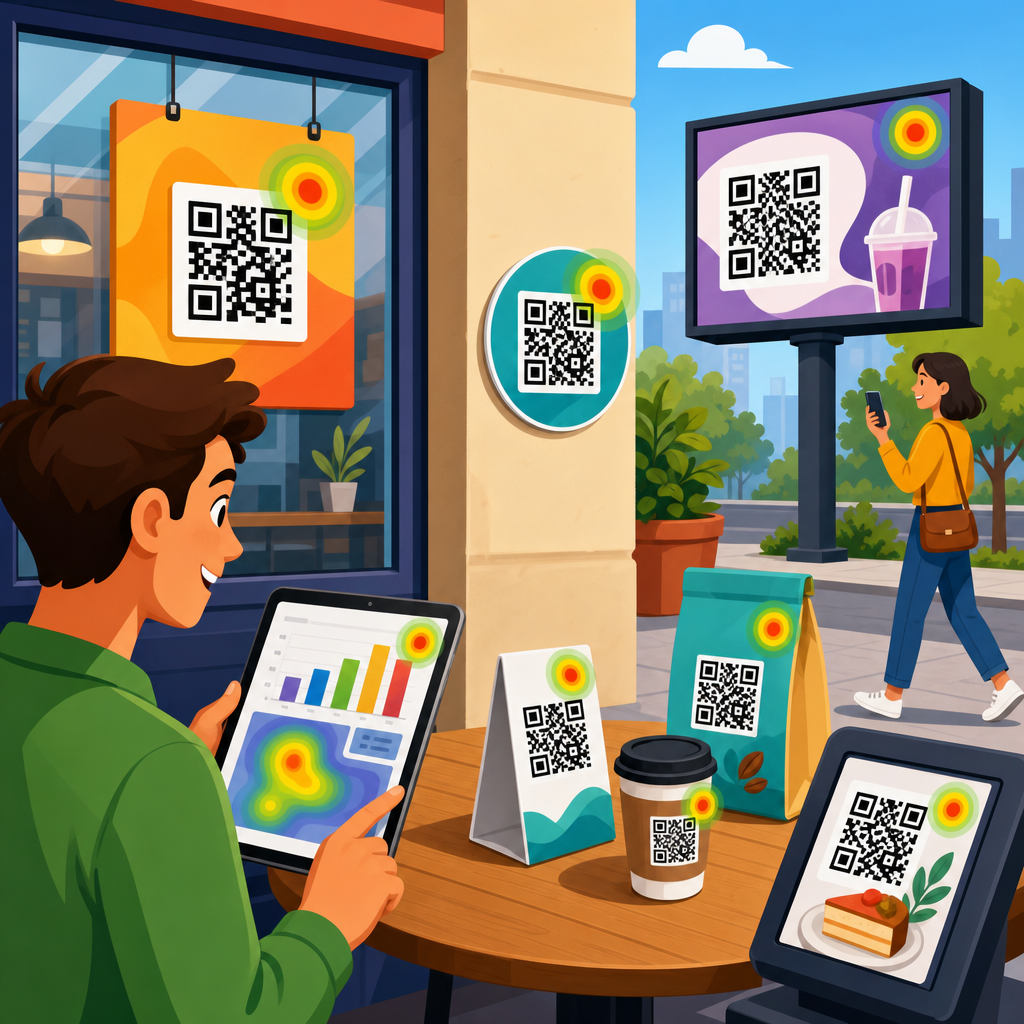
QR code experiments are no longer a niche tactic for print marketers; they are now a measurable growth channel that can be tested with the same discipline applied to landing pages, paid ads, and email campaigns. When I run QR code programs across packaging, direct mail, retail signage, events, and out-of-home placements, the difference between a static deployment and a structured testing program is usually stark: one produces scans, while the other produces insight, lift, and repeatable gains. A/B testing QR codes means changing one deliberate variable at a time, then comparing scan behavior and downstream conversion performance against a control. Running those experiments at scale requires clear hypotheses, reliable tracking, operational consistency, and enough traffic to separate real effects from noise.
This matters because QR codes sit at the intersection of physical and digital behavior. A customer sees a printed prompt in a store aisle, on a product label, at a trade show booth, or on a postcard, then makes a split-second decision to scan or ignore it. That decision is influenced by size, placement, contrast, CTA copy, destination page relevance, incentive strength, and environmental context such as distance, lighting, and motion. If marketers treat all those factors as fixed, they miss one of the fastest feedback loops available in offline marketing. If they test systematically, they can improve scan rate, reduce bounce rate, increase lead capture, and attribute results back to specific creative and channel decisions.
At a practical level, a scalable QR code testing program needs a few definitions. The scan rate is the percentage of exposures that lead to scans, often estimated from footfall, circulation, impressions, or units sold. The landing-page conversion rate measures what happens after the scan, such as signups, purchases, app installs, form completions, or coupon redemptions. A dynamic QR code points to a short redirect URL that can be updated without reprinting the code, making it essential for controlled experiments. A variant is the tested version, while the control is the baseline. Statistical significance matters, but so does business significance: a result can be mathematically valid and still too small to justify production changes. The goal is not to test endlessly. The goal is to create a reliable operating system for learning what actually improves performance in the real world.
Build the Measurement Framework Before You Print
The most common failure in A/B testing QR codes is not creative; it is measurement. Before I approve a single variant, I define what counts as success, where data will be collected, and how traffic sources will be separated. Every QR experiment should connect scan data to web analytics, campaign metadata, and final conversion outcomes. That usually means using dynamic QR platforms such as Bitly, QR Code Generator PRO, Uniqode, or Flowcode paired with GA4, server-side events, and a CRM or commerce platform. If the QR code redirects through a managed short link, each variant can carry UTM parameters, campaign IDs, and placement labels that make analysis straightforward.
For example, a retail brand testing shelf talkers might create one control code and two variants, each linked to a dedicated redirect path with consistent destination content. In GA4, the team can compare sessions, engaged sessions, conversion events, and revenue by variant. In the QR platform, they can review unique scans, repeat scans, scan time, device type, and geography. In the CRM, they can check whether the scans produced qualified leads or low-intent coupon hunters. Without this full chain, teams often celebrate higher scans from a variant that actually lowered qualified conversions because the landing page promise did not match the in-store context.
A scalable framework also requires exposure estimates. For direct mail, exposure may be piece count adjusted for delivery and response windows. For packaging, it may be units distributed. For in-store signage, use store traffic, dwell-zone traffic, or camera-based impression estimates when available. Perfect impression measurement is rare offline, but directional consistency matters more than theoretical precision. If every variant has a different level of physical exposure, the test is compromised before it starts.
Choose Test Variables That Affect Behavior
Not every QR code change is worth testing. The highest-value variables usually fall into five groups: code design, call-to-action, physical placement, destination experience, and offer structure. I prioritize variables based on where friction appears in the funnel. If scans are low, test visibility and motivation first. If scans are healthy but conversions are weak, focus on landing-page alignment and post-scan experience.
Code design includes size, error correction level, quiet zone, color contrast, frame treatment, and logo insertion. Branded codes can lift attention, but aggressive styling can hurt readability, especially under poor lighting or at longer viewing distances. CTA tests often produce large effects because they answer the user’s immediate question: why should I scan this now? “Scan to learn more” is vague. “Scan for 15% off today” or “Scan to compare models” gives a concrete reason. Placement variables include height, distance, angle, nearby clutter, and whether the code appears beside a product claim, a price sign, or a checkout prompt. Destination experience covers page speed, form length, mobile usability, and message match between print asset and landing page.
The best test plans isolate one major variable at a time. If a postcard variant changes the code size, CTA, and offer simultaneously, results become uninterpretable. There are exceptions. Multivariate testing can work with large sample sizes, but most offline programs do not have enough clean traffic. In practice, disciplined sequential tests outperform ambitious but messy designs.
| Test variable | What to change | Primary metric | Common mistake |
|---|---|---|---|
| CTA copy | Benefit-led versus generic text | Scan rate | Changing offer and copy together |
| Code size | Small, medium, large based on viewing distance | Scan rate | Ignoring real-world distance and lighting |
| Placement | Eye level, checkout, packaging panel, mailer panel | Scan rate | Unequal exposure across placements |
| Landing page | Short form versus long form, fast page versus heavy page | Conversion rate | Sending all variants to one page |
| Offer | Discount, guide, demo, loyalty reward | Qualified conversions | Optimizing for scans instead of value |
Design Experiments for Physical Environments
QR code testing is different from website testing because the physical environment introduces constraints digital teams often overlook. A code on a bus shelter has a short attention window and must work from several feet away. A code on product packaging may be scanned at home under warm indoor lighting, long after purchase. A code on a menu competes with ordering urgency. These context shifts change what should be tested and how long a test should run.
When I design experiments, I start with environment-specific heuristics. For long-distance scans, increase code size, preserve a strong quiet zone, and keep contrast high, ideally dark code on a light background. For low-light placements such as bars or event venues, avoid glossy materials and dense logo treatments that reduce decoding reliability. For moving environments like transit ads, simplify the CTA and use short, immediate-value landing pages. ISO/IEC 18004 remains the key technical reference for QR code symbology, but real-world readability depends just as much on print production quality, substrate texture, and camera behavior across iOS and Android devices.
Operational discipline matters here. If one set of posters is installed in flagship locations and another in low-traffic secondary sites, the result says more about media quality than QR code performance. The cleanest field tests randomize variants across comparable stores, regions, or placements. If randomization is impossible, use matched-market logic: pair locations with similar traffic, demographics, and sales patterns, then assign control and variant intentionally. This is the same principle used in retail media and direct mail holdout testing, and it makes QR results far more credible.
Use Dynamic Routing and Metadata to Scale
Scaling A/B testing QR codes across many channels requires centralized governance. Dynamic routing is the foundation because it separates the printed asset from the destination URL. Once the code resolves through a managed redirect, teams can swap landing pages, append campaign parameters, pause broken destinations, and preserve continuity if a product page changes. This also supports regionalization, language routing, and device-aware experiences without reprinting materials.
Metadata is what turns a pile of scans into a usable dataset. Every variant should have a naming convention that captures campaign, channel, market, asset type, version, date, and intended audience. A label like “springmailerA” is not enough. A scalable taxonomy looks more like “2026_Q2_DM_Catalog_US_NE_A_Control_Offer10.” With that structure, analysts can group tests by channel, compare similar placements over time, and feed data into dashboards. I typically mirror this taxonomy in the QR platform, analytics properties, and CRM fields to avoid reconciliation problems later.
Governance also includes version control and print approvals. Teams often break tests by regenerating codes late in production or by letting local markets create untracked variants. A simple change log fixes this. Record the code ID, destination rule, print file version, install date, and any exceptions in one source of truth. At scale, this process prevents false reads and wasted spend.
Analyze for Incremental Lift, Not Vanity Metrics
Good QR testing analysis asks two questions: did the variant increase the target behavior, and was that increase meaningful after accounting for channel economics? Scan totals alone are rarely enough. A larger code with a louder discount may generate more scans but lower average order value, weaker lead quality, or more existing customers claiming an offer they would have used anyway. That is why incremental lift matters.
For commerce programs, evaluate scans, landing-page conversion rate, revenue per scan, average order value, and contribution margin. For lead generation, compare qualified lead rate, sales acceptance, pipeline creation, and close rate by variant. For retail activation, coupon redemption and basket attachment often matter more than pure traffic. Confidence intervals, chi-square tests for proportions, or Bayesian approaches can all work, but the method must fit the sample size and decision speed. Small tests need caution. If the result swings wildly week to week, do not force certainty where the data do not support it.
I also look for interaction effects. A CTA that works on direct mail may underperform on packaging because the user intent is different. A branded frame may help scans in premium cosmetics but hurt them in industrial environments where contrast is more important than aesthetics. The value of a hub-level testing program is that it accumulates these cross-channel patterns. Over time, teams can build priors about what usually works, then use experiments to validate rather than guess.
Avoid Common Failure Modes in A/B Testing QR Codes
Most failed QR experiments collapse for predictable reasons. The first is low sample volume. If only a few hundred people plausibly saw the asset, the test may never reach a reliable conclusion. The second is poor print quality. I have seen beautiful creative fail because the quiet zone was trimmed, the code sat on a reflective laminate, or the contrast ratio was too low for older smartphone cameras. The third is changing too much at once, which makes the outcome impossible to diagnose.
Other common problems include weak destination pages, broken redirects, and delayed analytics implementation. A code can be perfectly scannable and still fail if it opens a slow page, an app deep link that breaks on some devices, or a form that asks for too much too early. Privacy and compliance also matter. If the destination collects personal data, consent language and data handling must align with applicable rules such as GDPR or CCPA requirements. That is not just legal housekeeping; it affects conversion behavior and user trust.
Finally, teams often stop after one win. The scalable approach is to operationalize learning. Document the hypothesis, test setup, result, confidence, business impact, and next recommendation. Then feed that insight into future packaging runs, in-store materials, event collateral, and lifecycle campaigns. This article serves as the hub because effective QR experimentation is cumulative. The more consistently you test code design, CTA copy, placement, landing pages, and offers, the faster your organization develops reliable patterns that outperform one-off guesses. Start with a measurable framework, use dynamic QR infrastructure, protect test integrity in the field, and optimize for incremental business value rather than raw scans. If you want stronger QR code marketing performance, build a testing roadmap, launch one controlled experiment in your highest-volume channel, and let the data guide every print decision after that.
Frequently Asked Questions
1. What does it really mean to run QR code experiments at scale?
Running QR code experiments at scale means treating QR placements as a systematic performance channel rather than a one-off creative add-on. Instead of putting a single code on packaging, signage, direct mail, or event materials and simply counting scans, you create a structured testing framework across multiple placements, audiences, offers, destinations, and creative variations. The goal is not just to generate activity, but to learn which variables consistently improve scan rate, engagement, conversion rate, and downstream business outcomes.
At scale, this usually involves standardizing how codes are generated, tagged, routed, measured, and reported. Each QR code should be tied to a specific hypothesis, such as whether a stronger call to action increases scans on retail signage, whether a shorter mobile landing page improves conversion from packaging, or whether different incentives change response rates in direct mail. Once those hypotheses are defined, the experiments can be deployed across many assets without losing the ability to isolate performance by channel, geography, store, campaign, or audience segment.
The real difference between basic deployment and scaled experimentation is operational discipline. Scaled programs use naming conventions, UTM governance, dynamic QR infrastructure, testing calendars, and clear success metrics. They also account for real-world variables such as foot traffic, print run timing, store compliance, device mix, and landing page speed. When that discipline is in place, QR codes become a measurable growth lever that can be optimized repeatedly, much like paid media or conversion rate optimization programs.
2. Which variables should I test first in a QR code experimentation program?
The best place to start is with the variables most likely to influence user behavior before and after the scan. In practice, that typically means testing the call to action near the code, the incentive or value proposition, the visual treatment of the placement, and the landing page experience. Many teams focus too heavily on the QR code itself, but the code is only one part of a broader response system. People do not scan because a code exists; they scan because the surrounding context gives them a clear reason to act.
For example, on packaging you might test whether “Scan for setup help” outperforms “Scan to learn more,” or whether “Scan for 15% off your next order” drives more action than educational messaging. On direct mail, you could compare personalized versus generic offers. In retail signage, you may test placement height, contrast, and proximity to product information. At events, variables such as booth staff prompting, line-of-sight visibility, or time-sensitive messaging can have a major effect on engagement.
After the scan, the landing experience often becomes the biggest driver of outcome quality. That means testing page load time, content length, form friction, mobile design, message match, and next-step clarity. A QR code can produce strong scan volume and still underperform if the destination is slow, cluttered, or disconnected from the promise made at the point of scan. Start with high-impact variables, keep the test design clean, and avoid changing too many things at once if your sample sizes are limited. The most scalable programs prioritize tests that are easy to deploy repeatedly across channels and that reveal insight you can reuse elsewhere.
3. How do I measure QR code experiments accurately across packaging, direct mail, retail, events, and out-of-home?
Accurate measurement starts with separating scans from meaningful outcomes. A scan is an engagement signal, not the end goal. Depending on the campaign, the KPI may be product registration, coupon redemption, email capture, purchase, appointment booking, app install, or assisted revenue. To measure properly, you need a tracking setup that connects the physical placement to digital behavior and, ideally, to business impact downstream.
In practical terms, each QR code variant should have a unique identifier tied to campaign metadata such as channel, asset, placement, location, audience, creative version, and date range. Dynamic QR codes are usually the best option because they let you preserve the printed code while changing destinations, fixing errors, and collecting scan-level analytics. UTM parameters, first-party analytics events, CRM attribution, promo codes, store-level reporting, and redemption tracking all help create a fuller view of performance. If you are running tests across many markets or assets, consistent taxonomy becomes essential; without it, reporting quickly becomes fragmented and difficult to trust.
You also need to account for environmental and operational noise. A code on packaging may be scanned days or weeks after purchase, while event scans happen in a compressed time window. Retail signage performance can vary based on store traffic and execution quality. Out-of-home placements may drive scans influenced by time of day, weather, or commuter patterns. Because of that, performance should be interpreted in context, not just as raw scan totals. Good analysis looks at scan rate, unique users, engagement depth, conversion rate, conversion efficiency by placement, and the incremental lift of one variant over another. The stronger your instrumentation and normalization methods, the easier it becomes to identify what is actually working instead of reacting to surface-level activity.
4. What are the biggest mistakes brands make when trying to scale QR code testing?
The most common mistake is deploying QR codes without a clear hypothesis. When brands place codes everywhere but do not define what they are testing, they collect activity but not insight. Another major mistake is measuring success only by total scans. High scan volume can look impressive, yet still fail to generate qualified traffic, conversions, or revenue. If the destination experience is weak or the offer lacks relevance, scans alone can create a false sense of momentum.
A second category of mistakes is operational. Teams often use inconsistent tracking parameters, static URLs that cannot be updated, or ad hoc reporting that makes comparison impossible across channels. In scaled programs, these issues become expensive because they prevent fast learning and slow down decision-making. There is also a tendency to underestimate execution realities in physical environments. Print lead times, store compliance, damaged signage, poor lighting, awkward placement height, and small code sizes can all distort test results if they are not monitored carefully.
Another frequent problem is testing too many variables at once with too little traffic. If the sample is thin and the experiment changes the call to action, code size, offer, design, and landing page simultaneously, it becomes nearly impossible to determine what caused the outcome. Finally, many brands fail to close the loop between experimentation and rollout. They identify a winning variation but do not operationalize it across future print runs, store kits, event playbooks, or packaging updates. The best programs do not stop at learning; they turn learning into repeatable standards that improve every subsequent deployment.
5. How can I build a repeatable framework for QR code experiments that keeps improving over time?
A repeatable framework starts with governance. Define a standard process for briefing, hypothesis creation, QR generation, tagging, quality assurance, launch, reporting, and post-test review. Every experiment should answer a simple question: what specific change are we making, why do we expect it to improve performance, and which metric will determine success? Once that structure is in place, teams can move faster without sacrificing measurement quality.
From there, create a test library organized by channel and use case. Packaging, direct mail, retail signage, events, and out-of-home all behave differently, so it helps to document what has already been tested, what won, what lost, and under what conditions. Over time, this becomes an institutional knowledge base that prevents teams from rerunning low-value tests and helps them prioritize the next highest-impact opportunities. It is also useful to classify tests by funnel stage, such as scan initiation, landing page engagement, conversion completion, and post-conversion value. That makes it easier to identify where performance is breaking down.
To keep improving, build regular review cycles into the program. Look beyond individual winners and search for patterns across environments: which calls to action consistently lift scans, which offers drive high-intent users, which landing page formats convert best on mobile, and which placements produce the strongest return by channel. Then feed those insights back into creative guidelines, media planning, packaging updates, field execution, and analytics dashboards. A mature QR experimentation program is not a series of isolated tests; it is a continuous optimization system. When managed that way, QR codes can evolve from a tactical convenience into a durable source of measurable growth.