QR code campaigns can produce exceptional returns, but only when every scan is treated as the start of a measurable conversion path rather than a vanity interaction. Return on investment, or ROI, in QR code marketing is the revenue or business value generated from a campaign compared with the total cost of creating, distributing, and optimizing it. Conversion optimization is the discipline of increasing the percentage of scanners who complete a desired action, such as making a purchase, booking a demo, downloading an app, joining a loyalty program, or visiting a store. When marketers ask how to improve ROI from QR code campaigns, the real question is broader: how do you increase scan quality, reduce friction after the scan, and connect outcomes back to channel spend with confidence?
I have worked on QR campaigns tied to packaging, direct mail, retail displays, event signage, restaurant tables, and out-of-home placements, and the same pattern appears every time. The code itself rarely causes poor performance. ROI rises or falls based on the offer, context, destination page, tracking setup, and speed of follow-up. A beautiful code on a poster will still underperform if it leads to a slow page, asks for too much information, or fails to match the intent created by the physical environment. Conversely, modest creative can outperform premium print if the landing experience is fast, relevant, and easy to complete.
This matters because QR has moved from novelty to mainstream utility. Smartphone cameras now scan natively, consumers recognize the behavior instantly, and offline media can now be tied to digital analytics with far more precision than before. That makes QR codes powerful for marketers who need measurable performance across physical and digital touchpoints. It also makes mistakes more expensive. If a campaign drives thousands of scans but only a handful of conversions, the issue is not awareness; it is conversion architecture. Improving ROI from QR code campaigns therefore means designing the full system: audience, placement, incentive, mobile experience, attribution, testing, and post-scan nurturing.
As the hub for conversion optimization within QR Code Marketing & Strategy, this guide explains the practical levers that improve results. It covers how to set conversion goals, choose metrics that reflect business value, build high-converting landing pages, use dynamic QR codes for iteration, segment campaigns by context, and measure incremental impact. If you want more revenue, more leads, and clearer attribution from every printed code, start here and optimize from the scan outward.
Start with ROI math and a single conversion goal
The fastest way to waste QR budget is to launch without defining the primary conversion. Every QR campaign should have one main action and, at most, a small set of secondary actions. If the code appears on product packaging, the goal might be subscription sign-up or repeat purchase. If it appears on a trade show banner, the goal might be demo booking. If it appears on a restaurant table, the goal might be order completion or loyalty enrollment. The mistake I see most often is sending scanners to a generic homepage with several competing paths. That increases cognitive load and lowers completion rates.
Use a simple ROI formula from the beginning: ROI = (campaign value minus campaign cost) divided by campaign cost. Campaign value should be tied to actual business outcomes, not just scans. For ecommerce, value can be attributed revenue. For lead generation, it can be pipeline value multiplied by close rate, or a qualified lead value accepted by sales and finance. For store traffic, it can be verified visits or redeemed offers tied to average order value. Costs should include design, print, media placement, incentive discounts, landing page development, analytics setup, and optimization labor. Once that framework exists, decisions become clearer. A campaign with a high scan rate but weak average order value may be less profitable than one with fewer scans and better buyer intent.
Establish benchmark metrics at each stage: view-to-scan rate where measurable, scan-to-landing load rate, landing-to-click-through rate, form completion rate, checkout conversion rate, and downstream retention or repeat purchase. This turns a vague performance problem into a diagnosable funnel. If scans are low, fix visibility and motivation. If landing visits are high but conversions are low, fix post-scan friction. If conversions occur but revenue is weak, improve offer quality or audience targeting.
Match the QR code, message, and destination to user intent
High ROI comes from intent matching. People scan QR codes for a reason that is shaped by time, place, and device context. A commuter scanning a transit ad wants speed. A shopper scanning shelf signage wants proof, price, or convenience. An event attendee scanning a booth graphic expects immediate value, not a long nurture sequence. If the destination does not satisfy that implied need within seconds, conversion rates drop.
The best-performing campaigns use message continuity from physical asset to mobile page. The call to action on the printed piece should tell users exactly what they will get: “Scan for 15% off today,” “Scan to see real customer reviews,” “Scan to book a fitting,” or “Scan to reorder in two taps.” Then the landing page headline should repeat that promise nearly verbatim. This message match is foundational in conversion optimization because it reassures users they are in the right place and reduces abandonment.
Context also determines format. On packaging, a code can link to tutorials, warranty registration, refill subscriptions, or ingredient transparency. On direct mail, personalized URLs behind a dynamic QR can open tailored offers by segment. In-store, a code next to a complex product can bridge the information gap with comparison charts, financing options, or social proof. At conferences, codes should usually route to calendar booking, lead capture with minimal fields, or an asset download that triggers immediate follow-up. One code strategy does not fit all placements, and trying to reuse the same generic landing page across environments usually depresses ROI.
Reduce mobile friction after the scan
Most QR conversions succeed or fail on the mobile landing experience. Google research has long shown that mobile speed affects abandonment, and the pattern is obvious in QR traffic because the audience arrives with immediate intent and little patience. Compress images, minimize scripts, use fast hosting, and test pages on real phones over cellular connections. A landing page that loads in under two seconds consistently outperforms one that takes five or six, especially for time-sensitive retail and event campaigns.
Friction reduction is broader than speed. Keep forms short. Use autofill where possible. Remove unnecessary navigation. Put the primary action above the fold. Support digital wallets such as Apple Pay and Google Pay when purchases are involved. If account creation is required, let users check out as guests first. If the offer is location-specific, detect or ask for location once, then streamline the next step. Every extra tap costs conversions.
I have seen simple changes lift QR conversion rates dramatically. Replacing a seven-field lead form with name, work email, and company often increases completion without materially hurting lead quality when follow-up is strong. Switching from a dense product page to a dedicated campaign page with one offer, three proof points, and one button often improves revenue per scan. The key principle is that QR users are not browsing casually; they are taking a deliberate action in a physical setting. Respect that intent with a focused mobile path.
Use dynamic QR codes and rigorous tracking
Static QR codes have their place, but dynamic QR codes are usually better for ROI because they can be edited without reprinting the asset. That flexibility lets you refine landing pages, rotate offers, correct errors, and redirect traffic based on inventory, geography, or campaign timing. It also improves measurement. Platforms such as Bitly, QR Code Generator PRO, Beaconstac, Flowcode, and Uniqode provide scan analytics, device data, time-of-day patterns, and destination management. Those platform metrics should then be paired with web analytics and CRM data to measure actual conversion value.
UTM parameters remain essential. Every QR placement should use structured campaign tagging that identifies source, medium, campaign, content, and if relevant, audience segment or location. For example, a retailer can distinguish scans from window signage, shelf talkers, receipts, and packaging inserts instead of lumping all traffic together. In GA4, define events for critical post-scan behaviors and map key conversions clearly. If leads are involved, pass campaign data into HubSpot, Salesforce, or another CRM so revenue can be attributed beyond the initial scan.
When comparing options or diagnosing performance, a standardized measurement table helps teams avoid subjective debates.
| Metric | What it shows | Common problem if low | Optimization action |
|---|---|---|---|
| Scan rate | How compelling and visible the code placement is | Weak call to action or poor placement | Increase size, contrast, and benefit-led copy |
| Landing load rate | How often scans become usable visits | Slow page or connectivity issues | Improve page speed and simplify redirects |
| Conversion rate | How well the page turns visitors into action | Offer mismatch or too much friction | Tighten message match and reduce form fields |
| Revenue per scan | Financial value of each scan | Low-intent audience or weak offer | Segment placements and strengthen incentives |
| Cost per acquisition | Efficiency of total campaign spend | High media or production cost | Shift budget to better-performing placements |
Good tracking also means planning for offline realities. Some users scan in store and convert later on desktop. Others save the offer and return days later. First-party data capture, promo codes, coupon redemption tracking, and CRM stitching are critical if you want a realistic picture of ROI rather than a narrow last-click view.
Design offers that justify the scan
A QR code is not a value proposition by itself. People scan when the reward is clear enough to interrupt what they are doing. The offer must answer a simple question: why should I scan right now? Discounts work, but they are not always the best lever. Depending on the product and audience, stronger incentives may include exclusive content, easier reordering, product configuration, limited-edition access, appointment booking, loyalty points, free samples, warranty activation, or entry into a useful service flow such as installation support.
Offer design should reflect customer awareness stage. Cold audiences in public spaces usually need immediate, low-commitment value. Existing customers on packaging may respond better to account-linked actions like replenishment, tutorials, or rewards. B2B audiences often prefer utility over gimmicks: benchmarking reports, ROI calculators, implementation guides, or direct access to a specialist. In each case, specificity beats generic copy. “Scan to learn more” is weaker than “Scan to compare plans in 30 seconds” because it sets a clear expectation.
Urgency can help, but only if it is credible. Time-limited redemption windows, event-only bonuses, or inventory-based messaging can lift conversion rates. Fake scarcity erodes trust and reduces long-term performance. The best campaigns also align offer economics with margin. If your discount wipes out contribution profit, the campaign may show strong conversion rates and still produce weak ROI. Improving ROI sometimes means lowering raw conversion volume while increasing profit per conversion.
Test placements, creative, and audience segments continuously
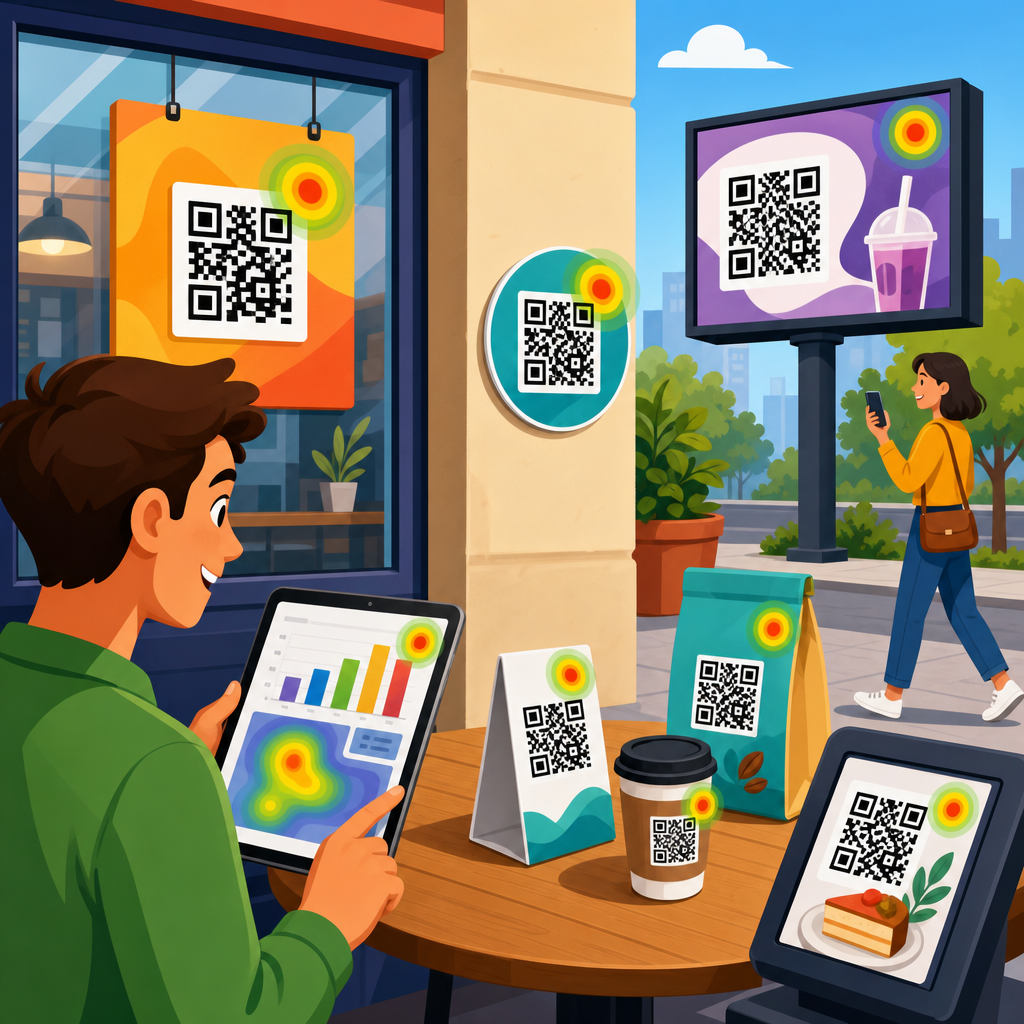
Optimization is rarely one dramatic change; it is a compounding series of tests. Placement matters more than many teams expect. A QR code on lower packaging panels, glossy surfaces with glare, or signs placed outside natural pause points will usually underperform. In retail, eye-level shelf signage near decision points often beats large general branding displays. In direct mail, placing the code beside a strong headline and one primary benefit often works better than burying it near legal copy. At events, codes visible from queue lines can outperform codes inside dense booth graphics because attendees have waiting time to act.
Run controlled experiments whenever possible. Test one variable at a time: CTA wording, incentive type, page layout, form length, button color, image choice, or follow-up sequence. Use dynamic QR routing to split traffic between variants without changing print assets. Segment by location, store type, audience cohort, or traffic source. A code on premium packaging may convert differently from the same code on an in-box insert because the user mindset differs. The goal is not just a higher overall rate, but a map of where profitability is strongest.
Do not ignore downstream quality. I have seen campaigns generate cheaper leads from sweepstakes-style offers, only to discover that sales acceptance rates collapse. Better ROI usually comes from balancing volume with fit. That is why conversion optimization for QR campaigns must include qualified conversion definitions, not just surface metrics.
Build follow-up flows that recover and compound value
Many QR campaigns understate their own potential because they treat the first session as the only chance to convert. In practice, a large share of value comes from follow-up. If a user scans packaging and begins warranty registration but stops halfway, a reminder email or SMS can recover the conversion. If someone scans a catalog and browses products without purchasing, remarketing and cart recovery can lift revenue substantially. If a trade show visitor downloads a guide, a fast sales development follow-up often determines whether the lead becomes pipeline.
This is where first-party data strategy matters. Capture consent properly, store source details, and trigger automations based on campaign context. Klaviyo, HubSpot, Braze, Mailchimp, and Salesforce Marketing Cloud can all support post-scan journeys when integrated correctly. The follow-up should reflect the original promise. A user who scanned for setup instructions should not receive a generic newsletter first. They should receive the instructions, then a relevant upsell, review request, or reorder prompt once the initial need is satisfied.
To improve ROI, measure lagging outcomes as carefully as immediate ones: repeat purchase rate, customer lifetime value, appointment attendance, sales-qualified lead rate, and redemption by cohort. Sometimes the best QR campaign is not the one with the highest same-day conversion rate, but the one that brings in customers who buy again. Review your current QR funnels, identify the biggest point of friction, and test one improvement this week.
Frequently Asked Questions
What is ROI in a QR code campaign, and how should it actually be measured?
ROI in a QR code campaign is the business value generated from scans compared with the full cost of building, launching, and improving the campaign. In simple terms, it answers one question: did the campaign produce more revenue or meaningful business outcomes than it cost to execute? The key is not to treat scans as the final success metric. A scan is only the entry point. What matters is what happens after the user lands on the destination page, such as making a purchase, submitting a form, booking an appointment, downloading an app, or joining an email list.
To measure ROI accurately, start by calculating total campaign cost. That should include creative development, QR code generation, landing page design, printing or media placement, distribution, paid promotion if applicable, technology tools, and ongoing optimization work. Then define the value side of the equation. For ecommerce, that may be direct sales revenue. For lead generation, it may be the average value of a qualified lead or the downstream revenue from converted customers. For service businesses, it could be bookings, consultations, or estimated customer lifetime value.
From there, track the full conversion path: scans, landing page visits, engagement, form starts, completed actions, and revenue. This makes it possible to calculate not only ROI, but also supporting metrics such as cost per scan, conversion rate, cost per acquisition, and revenue per scan. The strongest QR code campaigns are measured end to end, with analytics tied to real outcomes. That is what separates a campaign that looks busy from one that produces measurable returns.
How can I improve conversion rates after someone scans my QR code?
The biggest ROI gains usually happen after the scan, not before it. Many campaigns focus heavily on getting people to scan but neglect the experience that follows. If you want better returns, optimize the post-scan journey so it feels immediate, relevant, and frictionless. The landing page should match the promise or context of the QR code exactly. If someone scans a code on product packaging, a retail sign, a direct mail piece, or an event display, the destination should continue that specific message rather than drop them onto a generic homepage.
Speed is critical. A slow-loading page can destroy conversion intent in seconds, especially on mobile. Use mobile-first design, compressed images, short forms, clear headlines, and one obvious call to action. Remove distractions that compete with the primary goal. If the goal is a purchase, make checkout simple. If the goal is lead generation, ask only for the information you truly need. If the goal is booking, reduce the number of steps between landing and confirmation.
Trust also affects conversion rate. Include recognizable branding, social proof, pricing clarity, privacy reassurance, and any details needed for a user to feel confident taking the next step. In addition, align the offer with user intent. A discount, limited-time incentive, exclusive content, free consultation, or loyalty reward can significantly increase action rates when it is relevant and valuable. The more closely the destination experience matches the scanner’s expectations and reduces friction, the more likely that scan becomes revenue.
What are the most common mistakes that reduce ROI from QR code campaigns?
One of the most common mistakes is using QR codes without a defined conversion goal. If a campaign is launched simply to “increase engagement,” it becomes difficult to judge performance and almost impossible to optimize ROI. Every QR code should be tied to a specific action and a measurable business objective, whether that is product sales, appointment bookings, lead submissions, app installs, or in-store visits.
Another major mistake is sending users to a generic or poorly optimized destination. A homepage is rarely the best landing page for a QR scan. People respond best when the page is tailored to the message, audience, and context of the placement. Low-performing campaigns also often suffer from weak mobile usability, long forms, confusing layouts, poor page speed, or calls to action that are too vague. These issues cause drop-off before the user ever converts.
Tracking gaps are equally damaging. If scans are measured but conversions are not, marketers can end up celebrating volume while missing poor business performance. Failing to use campaign parameters, event tracking, conversion attribution, and segmented analytics makes it difficult to know which placements, creative variations, and audience segments are actually profitable. There is also the offline execution side: bad placement, low visibility, tiny code size, poor contrast, or lack of a clear reason to scan can reduce response rates from the start. In most cases, weak ROI is not caused by the QR code itself. It is caused by a breakdown somewhere in strategy, user experience, or measurement.
What tracking and analytics setup is needed to prove that a QR code campaign is profitable?
To prove profitability, you need analytics that connect the physical scan to a digital outcome and ultimately to revenue or business value. At minimum, each campaign should use a unique QR code destination or a distinct URL structure so traffic can be separated by source, location, audience, or creative version. Adding campaign parameters allows you to identify exactly where scans came from, whether that is packaging, direct mail, posters, menus, event booths, or in-store signage.
Beyond visit tracking, set up conversion events for the actions that matter. That might include purchases, checkout completions, quote requests, form submissions, phone calls, booked appointments, coupon redemptions, or downloads. If multiple steps exist in the funnel, track those as well so you can identify drop-off points. For example, knowing that many users scan and view a page but few complete a form tells you the problem is likely the page experience, not the QR placement itself.
Revenue attribution is the final layer. Ecommerce brands can connect QR sessions directly to transaction values. Lead-generation businesses may need CRM integration to track whether a scan-generated lead became a customer and what that customer was worth. Service businesses can assign average booking value or lifetime value estimates. Once this data is in place, you can compare revenue by campaign segment against total cost and see which channels, offers, and placements generate the strongest return. That level of tracking turns QR codes from a novelty into a performance channel that can be scaled intelligently.
What strategies consistently increase ROI from QR code campaigns over time?
The most effective long-term strategy is continuous optimization. High-ROI QR code campaigns are rarely built in one attempt. They improve through testing, measurement, and refinement. Start by testing the variables most likely to affect performance: the call to action near the code, the offer itself, the landing page headline, the number of form fields, the page layout, and the placement of the QR code in the physical environment. Even small changes can produce meaningful gains when applied across a large campaign.
Segmentation is another powerful lever. Different audiences respond to different motivations, so a single QR destination for every use case often leaves money on the table. A code on product packaging may need education or upsell messaging, while a code in a storefront window may need urgency and a first-time customer offer. A code used at an event might perform best with a fast lead capture form and a follow-up sequence. Matching the destination experience to the audience and context improves both conversion rate and return.
It also helps to think beyond the first conversion. Some of the best-performing campaigns build remarketing and retention into the path from the start. If a scanner does not buy immediately, you may still capture an email address, encourage SMS opt-in, promote an app download, or trigger retargeting audiences. This increases the total value of each scan over time. Finally, review campaign economics regularly. Look at revenue per scan, cost per acquisition, conversion rate by placement, and customer value by segment. The campaigns that generate the strongest ROI are the ones managed with the same discipline as any other serious marketing channel: clear objectives, strong tracking, ongoing testing, and decisions based on performance data.