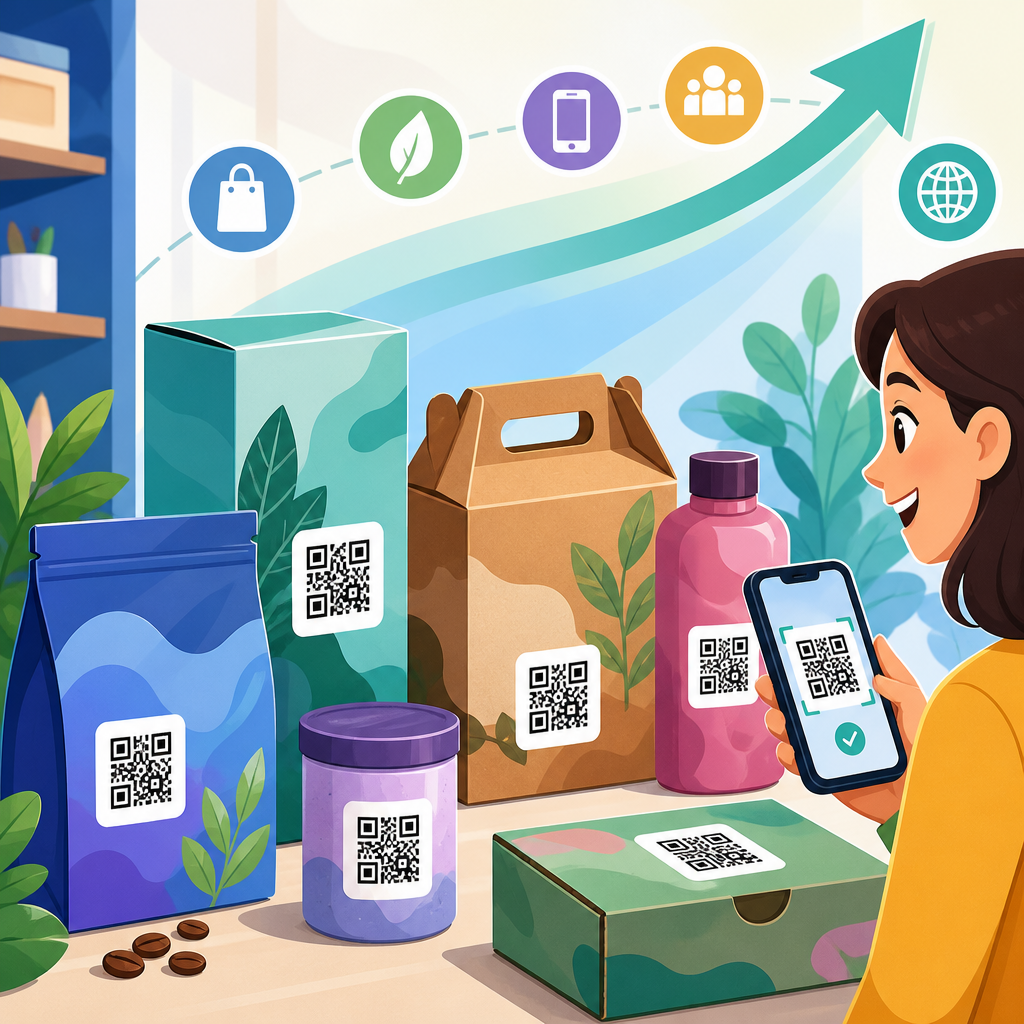
Packaging has become a digital touchpoint, and that shift explains why QR codes now sit at the center of smart packaging strategies. A decade ago, packaging was mostly a physical job: protect the product, communicate the brand, meet labeling rules, and survive shipping. Today it also carries a digital workload. Brands expect the pack to authenticate goods, trigger product education, support recycling, collect first-party data, and continue the customer relationship after purchase. In that environment, the simple QR code has evolved from a clunky mobile shortcut into a flexible bridge between printed materials and live digital content.
Smart packaging refers to packaging enhanced with technologies that add traceability, interactivity, sensing, or dynamic information beyond static print. It includes connected packaging, intelligent labeling, digital product passports, near-field communication tags, serialized barcodes, and QR codes linked to cloud content. Among these options, QR codes have gained unusual momentum because they are cheap to print, easy to scan with native smartphone cameras, compatible with GS1 standards, and adaptable across industries from food and beverage to pharmaceuticals, cosmetics, apparel, and consumer electronics. When clients ask me where to start with smart packaging, QR codes are usually the lowest-friction answer.
The topic matters because several market forces are converging at once. Regulators want better traceability and clearer disposal guidance. Retailers want cleaner packaging layouts and more scannable data. Consumers want proof of origin, ingredient transparency, how-to information, and personalized experiences without downloading an app. Brand teams want measurable engagement from physical products, especially as third-party cookies fade. Operations teams want one package to serve many markets by shifting details from print to digital landing pages. QR codes answer all of those needs better than most alternatives, which is why packaging trends are directly shaping how they are used, where they are placed, and what experiences they launch.
This hub article explains how smart packaging is driving QR code adoption, what use cases are growing fastest, how implementation decisions affect scan rates, and where the biggest opportunities and limits sit. It also frames the subtopic in practical terms: not every QR code creates value, but the right code, tied to a clear consumer task and a reliable data system, can turn a package into a service channel. That is the core change smart packaging has introduced.
Why smart packaging is accelerating QR code adoption
Smart packaging is pushing QR code usage because it solves a stubborn packaging problem: limited space. On-pack real estate is finite, yet brands keep needing to say more. They need multilingual instructions, allergen details, sustainability claims, sourcing data, product registration pathways, warranty information, recalls, and campaign content. A QR code lets one printed symbol open a much larger, updateable information layer without redesigning the carton every time content changes. That makes it attractive not just to marketers, but to packaging engineers and regulatory teams.
Another reason is smartphone behavior. Camera-based QR scanning is now native on iPhone and Android devices, which removed the old friction of needing a separate app. In field audits I have run on retail packaging, scan performance increases sharply when consumers understand the immediate benefit. “Scan for recipes,” “Scan to verify authenticity,” and “Scan for refill instructions” outperform generic prompts like “Learn more.” Packaging trends are therefore shaping usage toward utility-first calls to action instead of novelty scans.
Industry standardization is also a major driver. GS1 Digital Link has given brands a framework for connecting product identifiers to web-based experiences using 2D codes. This matters because companies do not want packaging technology that sits outside existing supply chain systems. With GS1-compatible approaches, the same code can support retail scanning, inventory logic, and consumer-facing content. That alignment reduces internal resistance and makes QR programs more scalable across SKUs, plants, and markets.
How packaging design trends influence QR code placement and performance
Minimalist packaging design has had an unexpected effect on QR code strategy. As brands strip front panels down to cleaner visual systems, every element must justify its presence. The QR code can no longer look like an afterthought tucked beside legal copy. It needs deliberate integration through size, contrast, quiet zone protection, and a nearby prompt that explains value. The best-performing packs I have reviewed treat the code like a functional interface element, not a compliance stamp.
Sustainable materials also affect performance. Recycled board, kraft substrates, textured labels, metallic foils, shrink sleeves, and matte varnishes can reduce scannability if print contrast is poor or distortion occurs around curved surfaces. Dark modules on a light background remain the safest choice. For cylindrical packaging, avoiding seams and extreme curvature helps. On flexible packs, designers should test scan reliability after filling, because wrinkles can break finder patterns. Smart packaging succeeds only when the printed code works in real conditions, not just on press sheets.
Package architecture matters too. A code on the outer shipper may support warehouse workflows, while a code on the consumer unit serves education or loyalty. A tamper-evident seal can carry an authentication code, while the primary label carries a general information code. These are different jobs. One mistake I often see is trying to make one QR code satisfy manufacturing, retail, and consumer engagement without considering scan context. Smart packaging works better when each touchpoint has a distinct purpose, owner, and success metric.
| Packaging trend | Effect on QR code usage | Practical implication |
|---|---|---|
| Minimalist design | Fewer elements compete for attention | Use stronger CTA copy and intentional placement |
| Sustainable materials | Textured or darker surfaces can reduce readability | Increase contrast and test scans after production |
| Smaller pack formats | Less room for instructions and claims | Move extended content to mobile landing pages |
| Globalized SKUs | One pack serves multiple markets | Deliver localized content by language or geography |
| Traceability demands | Need for serialized data on pack | Link each code to batch or unit-level records |
Core smart packaging use cases for QR codes
The most important smart packaging use case is product transparency. Food brands use QR codes to show ingredient sourcing, nutrition details, certifications, recipes, and allergen guidance beyond what fits on pack. Coffee roasters link scans to farm stories, roast dates, brew instructions, and flavor notes. Beauty brands use codes for ingredient dictionaries, clinical study summaries, shade matching, and refill guidance. In each case, the package becomes a gateway to context that would be impossible to print fully.
Authentication is another major use case, especially in categories hit by counterfeiting such as luxury goods, pharmaceuticals, supplements, and cosmetics. A serialized QR code can connect to a verification page showing whether the item is genuine, activated, or already scanned elsewhere. This is not foolproof on its own; determined counterfeiters can copy visible codes. But when combined with serialization controls, anomaly monitoring, tamper features, or covert markers, QR-based authentication becomes materially stronger. The value is not just fraud reduction. It also reassures customers and protects channel integrity.
After-sales support is growing quickly. Consumer electronics brands place QR codes on boxes or inserts to launch setup guides, troubleshooting flows, warranty registration, spare part ordering, and firmware instructions. Home care and cleaning products link to dilution instructions and safety sheets. Nutraceutical brands use QR codes for dosage guidance and subscription reorders. This reduces call center burden and lets printed packaging stay current even when digital instructions change.
Packaging is also becoming a data collection surface. When customers scan to access a benefit such as a tutorial, recipe, rewards program, or exclusive content, brands can capture first-party signals including time, location, device type, repeat engagement, and conversion pathways, subject to applicable privacy rules. In my experience, the best programs ask for personal data only after delivering immediate value. A code that gates everything behind a form depresses completion rates. Utility first, registration second is the better sequence.
Traceability, compliance, and digital product information
One of the strongest forces shaping QR code usage is compliance. Industries facing strict labeling, safety, or traceability obligations increasingly need a digital layer that can carry changing information without forcing constant print revisions. QR codes support that layer well. In pharmaceuticals, 2D data carriers have long been tied to serialization and verification systems. In food, traceability expectations have expanded as recalls, contamination events, and supply chain disruptions have drawn scrutiny. In consumer goods, environmental policy is pushing brands toward clearer material and disposal information.
Digital product information is especially relevant in regions where policymakers are promoting more transparent lifecycle data. A package may soon need to communicate not only what the product is, but where it came from, what it contains, how to repair it, and how to dispose of it correctly. QR codes help because they can route users to market-specific pages without changing the printed symbol. That flexibility is valuable when legal text, recycling rules, or certification claims differ across jurisdictions.
For traceability, serialized QR codes are more powerful than generic ones. A static code takes every scanner to the same destination. A serialized code ties each unit, case, or batch to a unique record. That enables targeted recalls, anti-diversion checks, supply chain event logging, and post-purchase verification. The tradeoff is complexity. Serialization requires data governance, print quality controls, repository management, and clear ownership across packaging, IT, operations, and regulatory functions. The companies that do this well treat QR codes as part of enterprise data architecture, not a marketing add-on.
Consumer experience: what makes people actually scan
Consumers scan packaging QR codes when the reward is immediate, concrete, and relevant to the product in hand. That sounds obvious, yet many brands still launch vague destinations full of brand messaging and no practical help. Scan motivation rises when the package answers a real question: Is this authentic? How do I use it? What is in it? How do I recycle it? Can I reorder it? Can I see recipes, setup steps, or care instructions? Smart packaging performs best when the mobile experience mirrors that decision moment.
Speed matters. Landing pages should load quickly, work without an app, and present the primary action above the fold. If a customer scans pasta sauce for recipe ideas, the first screen should not be a brand video. If a parent scans infant formula for preparation guidance, the answer must be immediate and unambiguous. Accessibility matters too: readable type, language options, captioned video, and touch targets sized for mobile users. These details are not cosmetic. They determine whether packaging interaction becomes helpful or frustrating.
Trust signals also shape scan rates. Consumers are more willing to scan when the destination is clearly branded, secure, and consistent with the product. Suspicion increases when codes look like stickers added later or route to obscure domains. Good programs use recognizable URLs, visible explanations, and packaging copy that states the benefit plainly. In-store testing often shows that a two- or three-word verb-led prompt, such as “Scan for setup” or “Scan to verify,” outperforms longer promotional text.
Implementation mistakes and best practices for brands
The biggest mistake is launching a QR code because competitors have one, without defining the job it needs to perform. Every packaging code should answer three operational questions: who is expected to scan it, what problem does it solve, and how will success be measured. From there, brands can choose static versus dynamic routing, generic versus serialized identifiers, and whether the experience should vary by market, channel, or lifecycle stage. Without that planning, the code becomes decoration.
Testing is nonnegotiable. Teams should test codes across iOS and Android devices, under retail lighting, on curved and damaged packages, and after transport abrasion. They should review analytics for bounce rates, repeat scans, and path completion, then adjust call-to-action copy and landing page structure. Governance is equally important. Someone must own redirects, page maintenance, regulatory approvals, and sunsetting rules. Dead links on packaging destroy trust quickly because the physical pack stays in circulation long after campaigns end.
The strongest smart packaging programs start small, prove value, and scale systematically. Begin with one use case, such as product education or recycling guidance, on a defined product line. Build the content, analytics, and print controls correctly. Then expand into authentication, loyalty, or serialization where justified. Packaging trends are clearly shaping QR code usage toward deeper utility, richer data, and tighter operational integration. Brands that treat the package as an active digital channel, rather than a silent container, will get more value from every unit they ship. Audit your current packaging, identify one high-intent scan moment, and build from there.
Frequently Asked Questions
Why are QR codes becoming so important in modern packaging?
QR codes have become important because packaging is no longer limited to its traditional physical role. It still has to protect the product, display required information, and represent the brand on the shelf, but it now also serves as a digital access point. A simple scan can connect a customer to product instructions, ingredient details, how-to videos, warranty registration, loyalty programs, promotional campaigns, recycling guidance, or authentication tools. That makes the package far more useful after it leaves the store.
Brands are also under pressure to do more with less space. Labels cannot keep expanding forever, especially on small or highly regulated products. QR codes solve that problem by moving detailed content off-pack and into a digital experience that can be updated over time. Instead of printing every possible detail on the package, companies can provide a cleaner design while still giving customers access to rich, current information whenever they need it.
Another reason QR codes matter more now is that brands want direct customer relationships. Retail shelves and marketplaces are crowded, and many companies are trying to build first-party data strategies rather than relying only on intermediaries. A QR code on packaging can create that connection at the moment of purchase or use, turning the package into a measurable engagement channel. In short, packaging trends are making QR codes central because they help one package perform physical, informational, and digital functions all at once.
How do packaging trends influence the way brands use QR codes?
Current packaging trends push brands toward QR code adoption in several practical ways. One of the biggest shifts is the move toward smart packaging, where the package does more than carry a product. It becomes interactive, traceable, and data-enabled. In that environment, QR codes act as the simplest bridge between the physical package and digital content. They are inexpensive to print, familiar to consumers, and easy to integrate into both premium and mass-market packaging strategies.
Sustainability trends also play a major role. Many brands want to reduce excess packaging, avoid large inserts, and simplify label design, but they still need to explain disposal instructions, material composition, refill systems, and environmental claims. QR codes allow brands to provide that depth without overcrowding the package. This is especially useful in markets where recycling rules vary by region and where digital updates are more practical than reprinting entire packaging runs.
Personalization and post-purchase engagement trends are influencing usage as well. Brands increasingly want the package to continue working after checkout, whether that means offering setup guidance, tailored recommendations, rewards, or replenishment reminders. QR codes support those goals because they can lead customers into experiences designed around ownership, not just purchase. As packaging evolves from a static container into an active communication channel, QR codes are becoming one of the most flexible tools brands can use.
What kinds of experiences can brands deliver through QR codes on packaging?
The range of experiences is broad, and that flexibility is one reason QR codes fit so well into modern packaging strategies. On a basic level, a code can link to product details such as instructions, specifications, ingredients, safety information, or FAQs. That alone improves usability and reduces customer friction, especially for products that require setup, assembly, care, or repeat use. It also helps brands serve different markets and languages without crowding the package with too much printed content.
More advanced use cases go well beyond information delivery. Brands can use QR codes to verify authenticity, which is particularly valuable in industries affected by counterfeiting such as cosmetics, pharmaceuticals, electronics, and luxury goods. A scan can confirm that an item is genuine, show its origin, or provide batch-level traceability. In other cases, the code can unlock loyalty rewards, personalized offers, refill subscriptions, recipe ideas, tutorials, or augmented reality experiences that deepen customer engagement and keep the brand relationship active after purchase.
QR codes are also useful for operational and sustainability-focused experiences. A package can guide users on how to recycle each component correctly, explain material choices, or show the environmental impact of the product journey. For brands focused on data and optimization, scans can reveal when, where, and how consumers interact with the package. That insight can inform packaging design, messaging, campaign timing, and customer support strategy. The most effective QR experiences are not added as gimmicks; they are designed to solve a real customer need while supporting a measurable business goal.
How do QR codes support sustainability and compliance on product packaging?
QR codes are increasingly valuable because they help brands meet both sustainability objectives and growing compliance demands without overwhelming the package design. From a sustainability perspective, they reduce the need for extra printed materials such as instruction booklets, promotional inserts, or multi-language leaflets. Important details can be delivered digitally, which supports packaging simplification and can help reduce waste over time. They also give brands a better way to explain recycling, reuse, refill, and disposal processes, which is critical when consumers often struggle to interpret packaging materials correctly.
On the compliance side, QR codes help companies manage the reality that regulatory information is becoming more complex. Depending on the product category and region, brands may need to provide safety warnings, allergen details, traceability records, sourcing information, or batch-specific updates. A digital destination linked by a QR code can host expanded information that would be difficult to fit on-pack, especially for smaller formats. It also offers more flexibility when product details change, reducing the need to redesign packaging every time there is an update.
That said, QR codes work best as part of a thoughtful compliance strategy, not as a shortcut that replaces legally required printed information where physical disclosure is still mandatory. Brands need to understand the rules in each market and use QR codes to enhance clarity, accessibility, and transparency. When used correctly, they allow packaging to stay clean and consumer-friendly while still supporting the detailed information demands of modern sustainability and labeling expectations.
What should brands consider when adding QR codes to packaging?
Brands should start with purpose, not technology. A QR code should lead to something genuinely useful for the customer, whether that is product education, authentication, recycling guidance, registration, loyalty, or customer support. If the destination is vague, outdated, or purely promotional, scan rates will suffer and the packaging opportunity will be wasted. The best implementations answer a clear question the customer is likely to have at the moment they see or use the product.
Design and usability are just as important. The code needs to be easy to find, easy to scan, and supported by a clear call to action that tells people why they should engage. Placement, size, contrast, print quality, curvature of the packaging, and surface finish all affect scan performance. A code hidden in a seam, printed too small, or placed on reflective material can undermine the entire experience. The landing page also needs to be mobile-friendly, fast, and relevant, because most scans happen on smartphones and customers will abandon slow or confusing pages quickly.
Finally, brands should think strategically about data, maintenance, and long-term value. A QR code is not a one-time design element; it is an ongoing digital touchpoint that should be monitored and optimized. Companies should decide what metrics matter, how content will be updated, whether dynamic codes are needed, and how customer data will be handled responsibly. They should also make sure the experience aligns with broader packaging, CRM, and commerce goals. When those elements come together, QR codes become far more than a trend. They become a durable part of how packaging informs, engages, and extends the customer relationship.