QR codes in pharmaceutical packaging have moved from a niche labeling feature to a central element of smart packaging, helping drug manufacturers improve traceability, patient education, authentication, and post-sale engagement. In this context, smart packaging means packaging that carries digital functionality beyond containment and compliance, usually by linking a physical carton, blister pack, bottle, or leaflet to dynamic information through a scannable code. For pharmaceutical brands, that functionality matters because packaging now has to do more than display a lot number and dosage instructions. It must support serialization, anti-counterfeiting measures, changing regulatory demands, and the practical realities of patient behavior.
I have worked on packaging programs where a single printed code had to satisfy manufacturing, regulatory, commercial, and patient-support teams at once. That is why this topic deserves a hub-level view. A QR code on a medicine box can route a pharmacist to verification data, a patient to a multilingual dosing video, a caregiver to refill instructions, or a supply-chain partner to track-and-trace records. Unlike static printed text, the digital destination can evolve without redesigning the carton. That flexibility is especially valuable in pharmaceuticals, where product information changes, recalls happen, and adherence remains a major challenge.
Smart pharmaceutical packaging sits at the intersection of packaging engineering, data governance, healthcare communication, and brand protection. This article explains how QR codes fit into that system, where they create measurable value, what technical and regulatory constraints shape deployment, and which implementation decisions separate useful programs from decorative ones. As a hub page, it covers the main smart packaging use cases and the strategic considerations that connect them, so readers can understand both the immediate applications and the broader innovation roadmap.
At a practical level, a pharmaceutical QR code is a two-dimensional barcode that stores or points to data accessible through a scanner or smartphone camera. It may encode a serial number, a web address, product identifiers, or authentication logic. In packaging, the code can be printed directly on folding cartons, labels, sachets, inserts, tamper-evident seals, and even unit-dose formats, provided print quality and quiet-zone requirements are met. The difference between a basic QR code and a smart packaging system is not the symbol itself; it is the connected infrastructure behind it, including content management, serialization databases, analytics, and access controls.
What smart packaging means in pharmaceuticals
In pharmaceuticals, smart packaging uses digital layers to extend the role of the pack across the product lifecycle. The package still protects the medicine and carries mandatory labeling, but it also becomes a digital touchpoint. QR codes are the most widely deployable gateway because they work with standard printing processes and are already familiar to consumers. A printed NFC inlay or temperature sensor may add deeper functionality, but QR codes usually provide the first scalable step because they are inexpensive, highly flexible, and compatible with mass-market smartphones.
The smart packaging model in pharma usually covers four functions. First, identification: connecting a product unit, batch, or SKU to a database. Second, information delivery: linking users to instructions for use, storage guidance, safety updates, or support services. Third, verification: helping a user confirm whether a pack is legitimate through serialization checks or approved channels. Fourth, interaction: enabling refill reminders, adverse-event reporting, support enrollment, and education. When these functions are designed well, the package becomes a service layer rather than a passive container.
Real-world need drives adoption. Counterfeit medicines remain a global problem, especially in high-value categories such as oncology, weight management, sexual health, and specialty injectables. At the same time, patients increasingly expect immediate digital support. A printed insert in six-point text is legally necessary, but it is not sufficient for many users, particularly older adults, patients managing multiple therapies, or consumers in multilingual markets. QR-enabled smart packaging gives manufacturers a way to bridge compliance content and usable guidance without overcrowding the label.
Core use cases for QR codes on medicine packaging
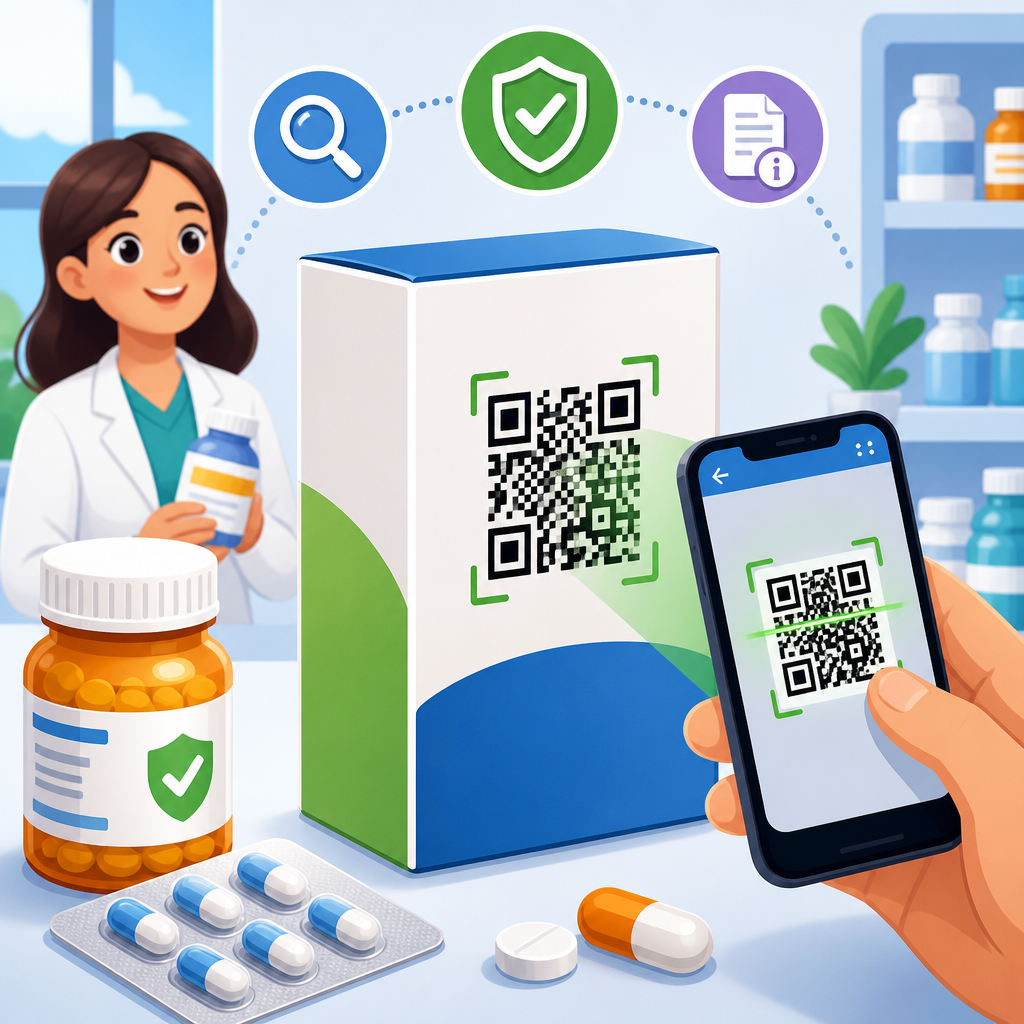
The strongest pharmaceutical QR code programs solve specific operational or patient problems. Authentication is one of the clearest examples. A serialized QR code can connect to a verification service that confirms whether the unique identifier exists, has been commissioned properly, and has not already been dispensed, recalled, or flagged. This does not eliminate counterfeit risk by itself, but it raises the barrier for bad actors and gives wholesalers, pharmacists, and patients a practical verification path.
Patient information delivery is another major use case. Instead of relying only on a folded paper leaflet, manufacturers can use QR codes to host updated instructions, dosage videos, inhaler technique demonstrations, injection training, storage advice, and accessibility features such as larger text, screen-reader-friendly content, and multiple languages. In my experience, this is where smart packaging delivers the fastest visible value, because support teams can answer common questions before they turn into nonadherence or product complaints.
Supply-chain visibility also benefits. Packaging codes can support internal workflows from packaging line aggregation to warehouse scanning and returns processing. While many enterprises already use Data Matrix codes for regulated serialization, QR codes can complement those systems when external stakeholders need a consumer-friendly scan experience. A practical example is a cold-chain biologic shipped through specialty distribution: the outer shipper may carry logistics identifiers, while the patient-facing carton QR directs the user to storage and administration guidance after dispensing.
Marketing and patient support should be handled carefully in pharma, but they are still legitimate smart packaging functions when governed properly. A QR code can connect a patient to co-pay support, nurse educator scheduling, refill enrollment, or disease-state education. The rule is simple: the landing experience must respect promotional boundaries, privacy requirements, and country-specific restrictions. In heavily regulated categories, the most effective programs prioritize utility over persuasion.
How QR codes support compliance, serialization, and recalls
Regulatory frameworks vary by market, but the direction is consistent: better traceability, stronger verification, and clearer information access. In the United States, drug supply chain requirements have pushed manufacturers toward interoperable tracing and serialized product identification. In Europe, the Falsified Medicines Directive established safety features and verification mechanisms for many prescription medicines. These systems often center on GS1 standards and 2D codes, especially Data Matrix, yet QR codes still play an important supporting role when a broader smart packaging experience is needed.
That distinction matters. A compliance code exists to satisfy a defined technical and legal requirement. A smart packaging QR code usually exists to extend value to users while staying aligned with those requirements. Sometimes one code can do both, but often the better approach is deliberate separation: a regulated serialization mark for mandated workflows and a consumer-facing QR for education or services. The right architecture depends on pack size, print space, market rules, scanning environment, and risk tolerance.
Recall management is a strong example of why connected packaging matters. If a batch issue emerges, a QR-linked system can rapidly update the destination page with lot-specific guidance, return instructions, and patient safety information. The code printed on the package does not change, but the content behind it can. That dynamic capability is far more practical than waiting for patients to find a static webpage or call a support line without product details in hand. It also reduces confusion when different markets or lots require different actions.
Serialization data must be governed carefully. Every smart packaging team should define who owns identifier generation, how scan events are logged, how long data is retained, and how exception handling works when a code cannot be verified. In regulated industries, poor governance creates operational risk quickly. The code on the box may look simple, but the data model behind it is not.
Design and implementation choices that determine success
Most QR code failures in pharmaceutical packaging come from execution details, not from the concept. Print quality is the first checkpoint. Pharmaceutical lines run fast, substrates vary, and small cartons leave limited room for quiet zones. A code that scans perfectly on a design proof may fail after varnish, curvature, or low-contrast printing on an actual production run. ISO and GS1 print quality guidance should be treated as operational requirements, not optional references.
Landing-page design matters just as much as symbol quality. If a patient scans a medicine box and reaches a cluttered homepage, trust drops immediately. The destination should identify the product clearly, state why the page exists, and answer the user’s first question within seconds. For most products, that means dosage support, storage guidance, authenticity checks, and contact pathways. Mobile-first design is mandatory because the overwhelming majority of scans come from phones.
Content governance is another decisive factor. Medical, regulatory, pharmacovigilance, legal, packaging, IT, and brand teams all influence what appears behind a pharmaceutical QR code. Without a formal review workflow, updates stall or noncompliant content goes live. The strongest programs use modular content, version control, approval logs, and market-specific publishing rules. They also prepare escalation paths for safety updates and adverse-event submissions.
| Implementation area | Best practice | Common failure |
|---|---|---|
| Code printing | Validate contrast, size, quiet zone, and line-speed readability on final substrate | Approving only digital artwork without production-line testing |
| Data structure | Use standardized identifiers and documented redirect logic | Creating ad hoc URLs that break during SKU or market changes |
| Landing experience | Provide product-specific mobile content within one scan | Sending all users to a generic corporate page |
| Compliance workflow | Route medical, legal, and regulatory review through controlled publishing | Letting marketing update content without formal approval |
| Analytics | Track scan source, geography, device type, and completion actions responsibly | Collecting data without a clear use case or privacy basis |
Testing should include real conditions. I recommend scan tests under pharmacy lighting, home lighting, and glare conditions, across older smartphone cameras as well as current models. If the package may be refrigerated, test condensation effects. If the code sits on a curved bottle, test from multiple angles. These are small details, but they determine whether a smart packaging strategy works outside a presentation deck.
Patient engagement, adherence, and accessibility benefits
QR codes can improve medication adherence when the experience is designed around patient tasks rather than brand objectives. Patients often need help at the moment of use: how to prime an inhaler, when to take a second dose, whether a product must be refrigerated after opening, or what to do after a missed dose. A scannable package can answer those questions at the point of need. For therapies with complicated administration, that convenience can reduce avoidable errors.
Accessibility is a major advantage. Printed leaflets are difficult for many patients to use because of small type, dense language, and limited translation options. A QR destination can offer large-text mode, audio narration, subtitles, plain-language summaries, and region-specific languages. For visually impaired users, compatibility with screen readers is essential. For elderly populations, clean page layouts and short video demonstrations often outperform long text blocks.
Adherence support can go further through opt-in services. After scanning, a patient might register for refill reminders, calendar prompts, injection-day alerts, or nurse support. This should always be transparent and permission-based. Trust depends on making it clear what data is collected, why it is needed, and how patients can opt out. The package is an entry point, not a license for broad data collection.
One useful model is condition-specific support. For example, a self-administered biologic can use a QR code to link to injection-site rotation guidance, sharps disposal instructions, travel storage rules, and a nurse helpline. That single package touchpoint reduces friction at home, where patients are often managing treatment without direct clinician supervision.
The future of smart pharmaceutical packaging
The next phase of QR codes in pharmaceutical packaging is not merely more codes; it is better orchestration of connected data, packaging identifiers, and patient services. Dynamic QR platforms will increasingly integrate with serialization repositories, enterprise content systems, pharmacovigilance workflows, and customer-support tools. Instead of treating packaging as the end of manufacturing, companies will treat it as the start of a managed digital relationship with the product in market.
Several trends are worth watching. First, richer digital product information is gaining momentum as regulators and industry groups look for ways to supplement or modernize paper documentation. Second, smartphone scanning behavior is now normalized, lowering adoption barriers across age groups and markets. Third, AI-driven support experiences can make QR destinations more useful by answering common product questions in approved language, provided the underlying content is tightly controlled. Fourth, sustainability pressure may eventually reduce reliance on bulky printed inserts where regulations allow digital supplementation, although paper will remain important for many products and populations.
There are limits. Not every patient wants a digital experience, and not every market permits the same type of connected packaging workflow. Hospital products, low-cost generics, and very small packs may justify different levels of investment. Counterfeit prevention also requires layered controls, including secure distribution, tamper evidence, serialization integrity, and market surveillance. A QR code is powerful, but it is never a standalone security strategy.
For pharmaceutical companies building a smart packaging roadmap, the best starting point is a clear use case tied to measurable outcomes: fewer support calls, faster verification, better patient comprehension, stronger recall communication, or improved refill enrollment. QR codes in pharmaceutical packaging work best when they solve a real problem, fit the regulatory environment, and connect physical packs to trustworthy digital experiences. If you are planning your smart packaging program, map the patient, pharmacy, and supply-chain journeys first, then design the code strategy around those moments.
Frequently Asked Questions
1. Why are QR codes becoming so important in pharmaceutical packaging?
QR codes are becoming a core feature of pharmaceutical packaging because they help brands connect a physical product to digital information in a way that is fast, scalable, and easy for patients, pharmacists, healthcare providers, and supply chain partners to use. In pharmaceutical settings, packaging is no longer expected to do only one job. It still needs to protect the product, support labeling compliance, and communicate essential instructions, but it is also increasingly expected to provide traceability, authentication, patient education, and even ongoing engagement after the product has been dispensed. A QR code makes that possible by acting as a bridge between the package and a dynamic digital experience.
For manufacturers, one of the biggest advantages is improved traceability across the supply chain. A printed QR code can be linked to batch information, serialization data, expiry dates, product references, and distribution records, helping companies monitor how products move from production to wholesalers, pharmacies, hospitals, and ultimately patients. This can strengthen visibility and support faster responses in the event of recalls, investigations, or suspected diversion.
QR codes also improve communication. Traditional packaging has limited space, especially on small cartons, labels, blister packs, or bottles. By scanning a code, users can access far more information than could ever fit on the physical pack, including dosage guidance, storage instructions, multilingual leaflets, safety updates, administration videos, and patient support resources. This is particularly valuable in pharmaceutical markets where products may serve diverse patient populations with different language, accessibility, and educational needs.
Another major reason for their growing importance is product authentication. Counterfeit medicines remain a serious global issue, and QR codes can support anti-counterfeiting strategies by helping users verify that a product comes from a legitimate source. When integrated with secure backend systems, a code can confirm whether a package identifier is valid, already scanned, expired, or potentially suspicious. While a QR code alone is not a complete anti-counterfeiting solution, it can play an important role within a broader packaging security framework.
Finally, QR codes support the broader shift toward smart packaging. Instead of treating packaging as a static container, pharmaceutical companies can use it as a live information channel that can be updated over time without changing the printed pack. That flexibility is valuable in a regulated industry where accurate, current information matters. As digital health, connected patient services, and supply chain transparency continue to grow, QR codes are increasingly seen not as an optional extra, but as practical infrastructure for modern pharmaceutical packaging.
2. How do QR codes improve pharmaceutical traceability and supply chain visibility?
QR codes improve traceability by giving every package, carton, or unit a scannable digital reference that can be tied to specific product data and movement history. In pharmaceutical supply chains, traceability is essential because manufacturers need to know where products were made, how they were distributed, which batch they belong to, when they expire, and whether they reached the intended channels. A QR code can serve as a simple access point to that information, especially when connected to serialization and track-and-trace systems.
In practice, a QR code may link to data such as the product identifier, lot number, manufacturing date, expiry date, destination market, and transaction events recorded at various points in the supply chain. As the product moves through packaging lines, warehouses, logistics providers, wholesalers, hospitals, and pharmacies, scans can create a more complete digital history. That visibility helps manufacturers identify delays, discrepancies, or suspicious movements much earlier than they could with paper-based or isolated systems.
This enhanced visibility becomes especially important during recalls and quality investigations. If a specific batch must be withdrawn, QR-enabled traceability can help companies quickly determine where affected units were shipped and whether they are still in distribution or already dispensed. That can lead to faster, more targeted recall execution, reducing risk to patients and limiting unnecessary disruption to unaffected products. It also supports stronger documentation for regulatory reporting and internal quality control.
QR codes can also assist in detecting diversion and gray-market activity. If a package intended for one geography is scanned in an unexpected market, or if the same identifier appears repeatedly in ways that do not match the known distribution path, the manufacturer may be alerted to possible irregularities. While that requires strong data governance and backend monitoring, the QR code is often the visible interface that makes the data capture possible.
Just as importantly, QR codes can support coordination across supply chain stakeholders. Pharmacies, hospitals, and distributors often need quick access to product details without manually keying in long codes or searching separate databases. A scan can simplify workflows, improve accuracy, and reduce human error. In an industry where product integrity, patient safety, and compliance are non-negotiable, that combination of speed, visibility, and data accuracy is a major reason QR-based traceability is gaining momentum.
3. Can QR codes help fight counterfeit medicines and improve product authentication?
Yes, QR codes can play a meaningful role in anti-counterfeiting and product authentication, especially when they are integrated into a larger security and verification strategy. Counterfeit pharmaceuticals present serious risks to patient health, brand trust, and regulatory compliance. A well-designed QR code system can make it easier for pharmacists, healthcare professionals, distributors, and even patients to check whether a product appears legitimate and whether its digital identity matches what the manufacturer issued.
The most effective use of QR codes for authentication happens when each code is connected to unique, product-specific data rather than only a generic product webpage. For example, a code may be linked to a serialized identifier associated with a particular saleable unit, batch, or shipment. When that code is scanned, the system can confirm whether the identifier is valid, whether it has been previously authenticated, whether it belongs to the correct market, and whether it is expired, recalled, or flagged for investigation. If something does not match expected records, the system can trigger a warning or direct the user to report the issue.
That said, it is important to be realistic: a QR code by itself does not stop counterfeiting. A counterfeit pack can also display a printed code, and fraudulent actors may try to copy or clone visible identifiers. This is why QR codes are most valuable when supported by secure serialization, tamper-evident packaging, controlled data systems, scan analytics, and, where appropriate, additional overt or covert security features. The code should be treated as one layer in a multi-layer defense model, not a standalone solution.
One of the biggest strengths of QR-based authentication is accessibility. Unlike specialized forensic tools, QR codes can often be scanned using a standard smartphone, making verification more practical at scale. This can extend the reach of authentication beyond manufacturers and regulators to pharmacies, clinicians, and end users. In markets where counterfeit risk is high, that added accessibility can significantly strengthen awareness and reporting.
QR codes also create opportunities for real-time intelligence. If a code that should only be scanned once is suddenly scanned many times in multiple locations, or if scans occur in regions where the product was never distributed, the manufacturer may detect possible cloning or diversion. Those usage patterns can provide valuable signals for security teams. In short, QR codes are not a complete anti-counterfeiting answer on their own, but they are an increasingly important tool for authentication, monitoring, and rapid response within pharmaceutical packaging programs.
4. What kind of patient information and support can pharmaceutical companies deliver through QR codes?
QR codes can deliver a wide range of patient-facing content that goes well beyond what can reasonably fit on a carton, bottle, blister pack, or folded leaflet. This is one of their greatest advantages in pharmaceutical packaging. Instead of relying only on static printed instructions, companies can provide dynamic, detailed, and potentially more accessible information that helps patients understand the medication, use it correctly, and stay engaged with their treatment.
Common examples include digital patient information leaflets, dosage instructions, administration guidance, storage requirements, contraindications, safety warnings, refill support, and frequently asked questions. For products that require more complex use, such as injectables, inhalers, specialty therapies, or pediatric medications, the QR code can lead to step-by-step videos, illustrated instructions, or interactive support tools. That can improve confidence and reduce avoidable errors, particularly for first-time users or caregivers.
QR codes can also improve accessibility and inclusivity. Printed inserts are often difficult for some patients to read due to font size, language limitations, or visual complexity. A digital destination can offer larger text, audio content, screen-reader compatibility, translations, and clearer content organization. In multilingual or international markets, this is especially useful because the same package can point different users to information tailored to their region or language preferences without requiring multiple print versions of every asset.
From a patient support perspective, QR codes can connect users to services that help after the point of sale. This may include adherence reminders, onboarding programs, nurse support, reimbursement guidance, side-effect education, co-pay assistance information, or links to official brand support portals. For chronic therapies, ongoing engagement can be particularly valuable because treatment success often depends on sustained adherence and proper use over time, not just the initial prescription.
Importantly, pharmaceutical companies need to manage this carefully within regulatory and privacy requirements. The information provided through QR codes must be accurate, approved where necessary, and clearly distinguished between mandatory medical information and optional support or educational content. When implemented properly, though, QR codes can turn packaging into a trusted