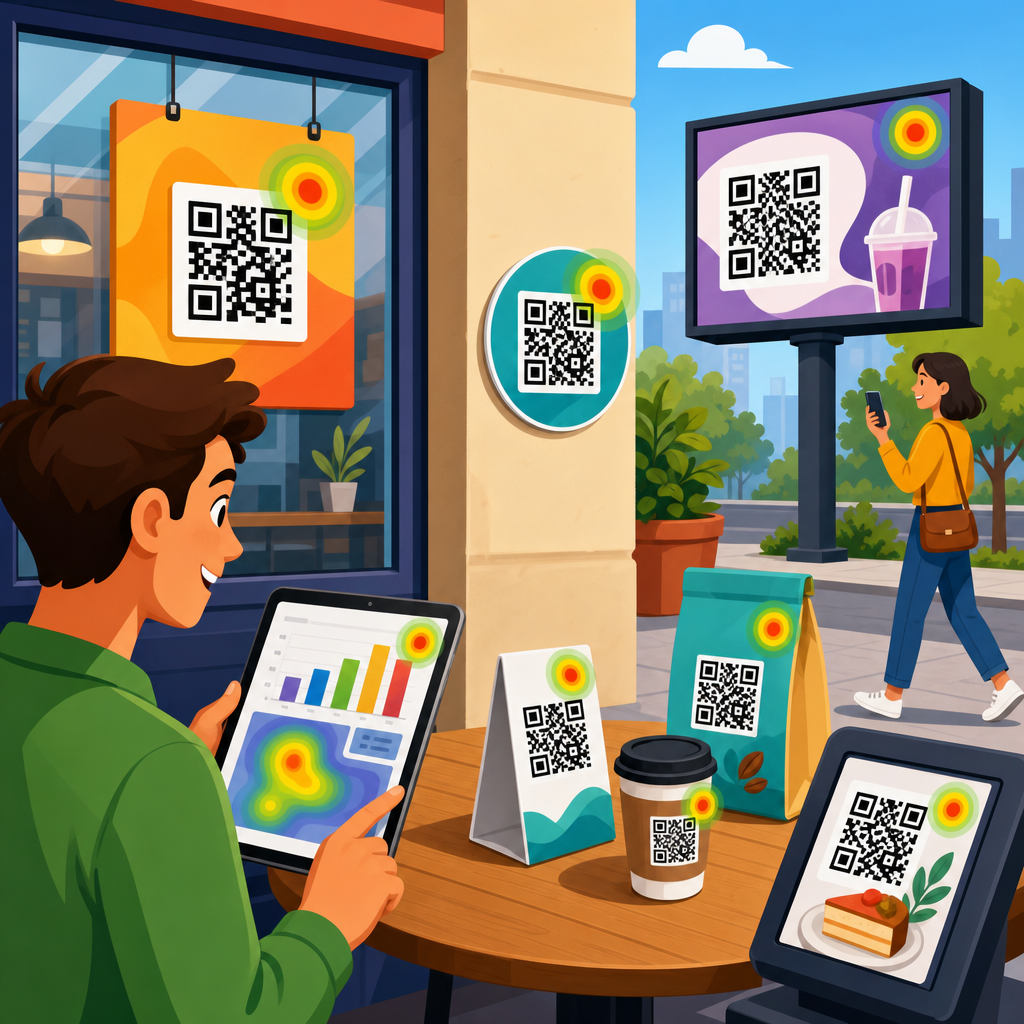
QR code testing frameworks give marketers a repeatable way to improve scan rates, landing page conversions, and campaign attribution instead of guessing which design or placement will work. In practice, A/B testing QR codes means showing two or more controlled variations to similar audiences, measuring a defined outcome, and choosing the winner based on evidence rather than opinion. That sounds simple, but QR campaigns add layers that ordinary web tests do not: print placement, camera quality, ambient lighting, scan distance, redirect speed, app handoff, and offline-to-online attribution all affect performance. I have seen attractive codes fail because the quiet zone was too tight on packaging, and I have seen plain black codes outperform branded versions because they scanned faster on older phones. For marketers responsible for budgets, retail traffic, event response, direct mail ROI, or product education, a structured testing framework matters because small improvements compound. A code that lifts scans by 15 percent and landing page conversion by 10 percent can materially change cost per acquisition. This article explains how to build an A/B testing QR code framework, what variables to test, how to measure results, and how to avoid the common mistakes that distort conclusions.
Start with a clear testing model and one primary metric
The best QR code testing framework begins with a plain question: what exactly are you trying to improve? For some campaigns, the primary metric is scan-through rate, usually calculated as scans divided by impressions or estimated exposures. For others, it is conversion rate after the scan, such as email signups, coupon redemptions, app installs, appointment bookings, or completed purchases. I advise teams to choose one primary metric, two or three secondary metrics, and a fixed decision rule before launch. If you change success criteria midway through the campaign, you turn an experiment into a story-telling exercise.
A practical model is hypothesis, variable, control, audience, duration, and outcome. Example: “Adding a benefit-led call to action next to the QR code on an in-store display will increase scans by 20 percent compared with a code shown without supporting text.” The variable is the call to action. The control is the current display. The audience is shoppers in matched store locations. The duration might be four weeks, long enough to smooth day-of-week effects. The outcome is unique scans per 1,000 store visitors. This structure keeps the test focused and makes results easier to trust.
Marketers often ask whether QR code A/B testing should happen on the code itself or on the destination page. The answer is both, but not at the same time in the same experiment. If you alter the code design and the landing page together, you cannot know which change caused the lift or decline. Separate top-of-funnel scan tests from post-scan conversion tests. That discipline prevents false winners and gives your team a cleaner backlog for future optimization.
Choose variables that materially affect scan behavior
Not every difference is worth testing. The strongest variables are those that change visibility, trust, comprehension, or scannability. In retail, placement height, surrounding whitespace, and directional copy usually matter more than subtle color tweaks. In direct mail, envelope teaser text and the perceived value of the offer often outweigh decorative code frames. In packaging, panel location and the code’s printed size can determine whether customers scan in the aisle, at home, or not at all.
From campaigns I have run, the highest-impact variables usually fall into six groups: code design, call to action, placement, incentive, destination, and context. Code design includes size, contrast, error correction level, logo integration, and quiet zone. Call to action covers phrasing such as “Scan for setup video,” “Scan to claim 15% off,” or “Scan for ingredient sourcing.” Placement includes shelf talkers, endcaps, menus, shipping inserts, receipts, product labels, out-of-home posters, and event badges. Incentive refers to the value exchange. Destination covers deep links, mobile web pages, app store pages, or progressive web apps. Context includes time of day, store traffic, audience segment, and channel source.
A useful rule is to test the variable closest to the friction point. If the problem is low scans despite high exposure, test visibility, trust signals, and CTA wording. If scans are healthy but conversions are weak, test message match and landing page relevance. If both are weak, audit the full path first. Many underperforming QR campaigns are not creative failures; they are mechanics failures caused by slow redirects, broken UTMs, poor mobile layouts, or pages blocked by app interstitials.
Build a measurement stack that connects offline exposure to online action
Measurement is where QR code testing frameworks either become decision tools or vanity dashboards. At minimum, use dynamic QR codes so each variant resolves through a distinct tracked URL that can be updated without reprinting. Append UTM parameters consistently, and standardize naming conventions across channels, creative versions, and dates. In analytics platforms such as Google Analytics 4 or Adobe Analytics, define events for scan session start, engaged session, form completion, purchase, coupon save, or any downstream action that reflects campaign value.
Because QR codes bridge physical and digital environments, impression data is often imperfect. Store footfall, event attendance, mail volume delivered, and poster traffic estimates are proxies, not exact counts. That does not make testing impossible; it means you should use matched comparisons. Compare variant A and B in similar stores, on similar dates, with similar inventory and staffing. For direct mail, split the mailing list randomly and hold creative constant except for the test variable. For events, rotate signage positions at fixed intervals so one placement is not unfairly advantaged by entrance traffic.
| Test Element | Primary Metric | Best Use Case | Common Pitfall |
|---|---|---|---|
| Code size and contrast | Unique scans per exposure | Packaging, posters, menus | Testing too many visual changes at once |
| CTA wording | Scan-through rate | Retail displays, direct mail, events | Using vague copy with no clear value |
| Offer or incentive | Scans and conversions | Coupons, lead generation, loyalty | Attributing lift only to code design |
| Landing page version | Conversion rate after scan | Product education, app installs, signups | Ignoring page speed and message mismatch |
| Placement location | Scans per location visitor | In-store, trade shows, out-of-home | Comparing unmatched environments |
Use a redirect platform or QR management tool that logs timestamp, device type, operating system, location at a privacy-safe granularity, and first scan versus repeat scan behavior. Bitly, QR Code Generator PRO, Beaconstac, Flowcode, and enterprise mobile attribution stacks can support this depending on complexity. When app installs matter, combine QR tracking with mobile measurement partners such as AppsFlyer or Adjust so you can see not only the scan but also downstream install and retention outcomes.
Design experiments that are valid in real marketing conditions
A/B testing QR codes in the field is harder than testing button colors on a website because you cannot fully control environment. The framework should therefore reduce bias wherever possible. Randomization is the starting point. If you are testing on printed inserts in e-commerce shipments, assign versions randomly within the fulfillment process. If you are testing store signage, match stores by traffic, region, and format, then randomize which version each store receives. If you are testing restaurant table tents, rotate variants by table zones and meal periods.
Duration also matters. Run long enough to capture weekday and weekend patterns, promotions, inventory shifts, and weather effects where relevant. I generally avoid calling tests early unless one version is clearly broken. Short tests often reward novelty instead of sustained performance. Seasonality can distort outcomes too. A holiday offer on a QR code may spike scans regardless of design quality, while a back-to-school product explainer may draw more engaged scans during a narrow buying window. Document campaign context so future readers of the results do not overgeneralize.
Sample size should be estimated before launch. The exact threshold depends on baseline scan rate and the minimum detectable lift that would justify change. If a poster campaign currently gets a 2 percent scan rate and you need to detect a 15 percent relative lift, you may need far more exposure than a team expects. This is why marketers should reserve A/B testing QR codes for placements with enough traffic or for campaigns with enough printed volume to generate meaningful data. When volume is low, qualitative observation and scan audits may be more useful than statistical claims.
Optimize the full scan journey, not just the symbol
Many teams focus so heavily on the square pattern that they ignore the experience after the camera recognizes it. A code can be perfectly scannable and still underperform because the next step is slow, confusing, or irrelevant. The strongest QR code testing frameworks therefore map the entire journey from first glance to final action. The sequence usually includes noticing the code, understanding why to scan, trusting the destination, scanning successfully, waiting for the page to load, and completing a task on mobile.
Each stage can be tested. To improve noticing, test contrast, size, placement, and directional cues. To improve understanding, test concrete benefit language: “Scan for 30-second setup” usually beats “Learn more.” To improve trust, add recognizable branding, a short branded URL, or privacy reassurance where appropriate. To improve landing performance, prioritize mobile Core Web Vitals, compressed media, simple forms, autofill support, and above-the-fold relevance. For product packaging, I have seen dramatic gains when the landing page opens directly to the exact SKU’s tutorial instead of a generic help center.
Deep linking deserves special attention. If the ideal destination is in an app, use deferred deep linking so users without the app still land in the right place after install. If the goal is menu browsing, reservation booking, or support content, avoid sending scanners to a bloated homepage. Match intent precisely. QR users are high-intent but impatient. Every unnecessary tap lowers conversion. The best test result is often not the prettiest code but the path with the least friction.
Learn from channel-specific QR testing patterns
Different channels produce different winners, so a hub on A/B testing QR codes must treat context seriously. In direct mail, I have repeatedly found that the surrounding copy does more work than the code styling. A personalized headline and a single, explicit benefit can lift scans more than adding a logo to the code. In packaging, utility beats promotion; setup guides, care instructions, authenticity checks, and ingredient details often outperform generic brand storytelling because the customer already has the product in hand.
In retail environments, physical constraints dominate. Codes placed below waist height or near reflective surfaces scan poorly. Shelf-edge labels need larger modules than many brands expect because shoppers scan at awkward angles. At trade shows, badge scans and booth signage perform best when the next step is immediate and lightweight, such as downloading a one-page comparison guide instead of filling a long form on a crowded floor. In restaurants, table tents and menus benefit from concise labels that tell diners exactly what follows: allergen details, ordering, loyalty enrollment, or payment.
Out-of-home placements require the most discipline. Distance, speed of movement, and lighting make many attractive executions unusable. If a commuter cannot scan from a few feet away in one attempt, the design has failed regardless of creative approval. For these campaigns, test larger size, higher contrast, shorter redirect chains, and backup short URLs. Include a plain-language promise of value. “Scan to get route updates” is stronger than “Engage with our experience.” Clear utility consistently wins.
Avoid the mistakes that make results unreliable
The most common QR testing errors are easy to prevent. First, do not test static QR codes when you need flexibility. Static codes lock the destination forever and create operational risk if URLs change. Second, do not let designers reduce the quiet zone or over-customize finder patterns until scan reliability drops. Brand expression matters, but function comes first. ISO/IEC 18004 exists for a reason: it defines the technical requirements that keep QR codes readable across devices and conditions.
Third, do not compare variants placed in obviously different environments and then call it an A/B test. A code near a store entrance will almost always beat one beside a low-traffic aisle display. Fourth, do not rely on raw scan counts alone. Unique scans, engaged visits, and conversion quality matter more. Fifth, do not ignore privacy and consent obligations. If the destination collects personal data, the landing page must present disclosures and consent mechanisms appropriate to the region and use case.
Finally, document what you learn in a reusable playbook. A strong hub page on QR code marketing strategy should feed future campaigns with channel benchmarks, design rules, CTA libraries, redirect standards, and measurement templates. That institutional memory is what turns one successful test into a dependable framework.
QR code testing frameworks help marketers replace creative guesswork with a disciplined system for improving offline-to-online performance. The core method is straightforward: define a single primary goal, isolate one meaningful variable, measure with dynamic links and consistent analytics, and run the test in matched real-world conditions. The practical edge comes from understanding what actually influences outcomes. Scan rates respond to visibility, clarity, trust, and technical scannability. Conversion rates respond to message match, page speed, deep linking, and friction after the scan. Across retail, direct mail, packaging, events, restaurants, and out-of-home media, the same principle holds: the best-performing QR experience is the one that makes value obvious and action easy.
If you are building a broader QR code marketing strategy, treat this article as your hub for A/B testing QR codes and connect it to campaign planning, landing page optimization, attribution, and design governance. Start with one high-volume placement, create a clean control and challenger, and record the outcome in a shared testing library. Over time, those disciplined iterations will improve scan efficiency, conversion quality, and reporting confidence far more than one-off redesigns ever will.
Frequently Asked Questions
What is a QR code testing framework, and why do marketers need one?
A QR code testing framework is a structured process for planning, launching, measuring, and improving QR code campaigns. Instead of changing code design, placement, call to action, or landing page elements based on instinct, marketers use a repeatable system to compare controlled variations and determine which version performs better. In other words, it brings the discipline of experimentation to QR campaigns, where small differences in creative execution can have a major effect on scan rate, completion rate, and downstream conversions.
Marketers need a framework because QR performance is influenced by more than the code itself. A campaign may succeed or fail based on print size, distance from the viewer, lighting conditions, surrounding visual clutter, audience context, device camera quality, mobile connection speed, and the relevance of the destination page. Without a framework, teams often misread results and credit the wrong factor. For example, a redesigned QR code may appear to outperform the original when the real reason was a stronger call to action or a better in-store placement.
A sound testing framework helps define the objective before launch, such as increasing scans, improving landing page engagement, or boosting attributed purchases. It also clarifies what will be tested, how success will be measured, what audience segments are included, and how long the test should run. That makes results more trustworthy and easier to act on across future campaigns. For marketers under pressure to prove ROI, a framework turns QR codes from a tactical add-on into a measurable performance channel.
What should marketers test in a QR code campaign?
Marketers should test the variables most likely to affect user behavior from first exposure to final conversion. At the top of the funnel, that includes physical and visual factors such as QR code size, contrast, quiet zone spacing, placement on packaging or signage, surrounding copy, and the clarity of the scan prompt. A code that is easy to notice but hard to scan will underperform, and a code that scans perfectly but gives no reason to engage may be ignored. Testing both discoverability and usability is essential.
Creative elements are another major category. Marketers can compare different calls to action, such as “Scan to Save 20%” versus “Scan for Today’s Offer,” or test whether branded QR codes increase trust without hurting scan reliability. They can also evaluate whether adding directional cues, icons, or benefit-driven messaging improves response. In many campaigns, the words next to the QR code matter as much as the code itself because they reduce hesitation and set clear expectations.
The destination experience should always be part of the test. Landing page speed, mobile layout, form length, checkout friction, and message match between the printed asset and the page all influence campaign outcomes. If one QR variation links to a faster, more relevant mobile page, it may win even if both codes are equally scannable. That is why experienced marketers think of QR testing as a full journey optimization exercise, not simply a code design test. The strongest framework isolates one major variable at a time whenever possible so teams can identify the true cause of performance differences.
How is A/B testing for QR codes different from standard website testing?
QR code A/B testing shares the same basic principle as website testing: present controlled variations, measure a predefined outcome, and select the winner based on data. The difference is that QR campaigns begin in the physical world, which introduces variables that traditional web experiments often do not face. With a web test, exposure and interaction usually happen on the same device in a controlled digital environment. With QR campaigns, attention starts offline and the user must decide to scan, often while standing in a store, reading direct mail, passing a poster, or interacting with product packaging.
That physical-to-digital handoff creates additional points of failure. Placement height, viewing angle, glare, print quality, environmental lighting, and the customer’s distance from the code all affect whether a scan happens at all. Then device-related issues enter the picture: camera focus speed, operating system behavior, and network connectivity can influence the user experience before the landing page even loads. This means a QR test must account for scannability, context, and transition quality, not just post-click behavior.
Measurement is also more complex. Website tests often use built-in analytics platforms with relatively clean traffic assignment. QR campaigns may rely on unique URLs, redirect logic, UTM parameters, dynamic QR platforms, or campaign-specific destination pages to distinguish variants and attribute results correctly. If a marketer changes too many conditions at once, such as moving one version to a better shelf location while also changing the creative, the data becomes hard to interpret. A strong QR testing framework addresses those offline variables upfront so the team can separate environmental effects from actual marketing improvements.
Which metrics matter most when evaluating QR code test results?
The most important metrics depend on the campaign goal, but marketers should usually track performance across multiple stages rather than relying on scan count alone. Scan rate is an obvious starting point because it reveals how effective the QR code, placement, and call to action are at generating initial engagement. However, scans by themselves can be misleading. A version that produces more scans but fewer qualified leads or purchases may not be the true winner from a business perspective.
That is why marketers should also measure landing page engagement and conversion outcomes. Useful indicators include page load speed, bounce rate, time on page, form completion rate, coupon redemption, add-to-cart rate, purchase rate, and revenue per scan. For lead generation campaigns, qualified submissions may matter more than total form starts. For retail promotions, offer redemptions and incremental sales may be the key metric. The framework should identify one primary success metric before the test begins, along with secondary metrics that help explain user behavior.
Attribution quality matters as well. Marketers should confirm that each variation is tagged properly so scans, sessions, and conversions are assigned to the right source. If offline campaigns feed into broader digital journeys, teams should look at assisted conversions and multi-touch impact instead of only last-click reporting. It is also wise to examine segment-level results, such as location, device type, time of day, or traffic source behavior after the scan. A rigorous evaluation process does not just ask which version got more activity; it asks which version delivered more meaningful business value with reliable, interpretable data.
What are the most common mistakes marketers make when testing QR codes?
One of the most common mistakes is testing too many variables at once. If a marketer changes the QR design, the message, the offer, the placement, and the landing page simultaneously, there is no clear way to know what caused the result. That often leads teams to adopt the wrong “winning” tactic and repeat ineffective decisions in later campaigns. Good testing discipline means narrowing the experiment to a single major variable or a tightly controlled set of variables so the outcome is actionable.
Another frequent mistake is focusing on aesthetics over functionality. Branded QR codes can be effective, but if customization reduces contrast, shrinks the quiet zone, or makes scanning less reliable, performance will suffer. Many teams also underestimate the importance of real-world validation. A code that works perfectly on a desktop preview or internal proof may fail under store lighting, on curved packaging, or at a distance on outdoor signage. Marketers should test scans across multiple devices, environments, and user conditions before declaring a variation ready for a live audience.
Poor measurement setup is another major issue. If URL tracking is inconsistent, redirects are broken, or campaign tags are missing, the test may generate traffic without producing trustworthy insight. Marketers also sometimes end tests too early, declare winners based on small sample sizes, or ignore downstream conversion data in favor of scan volume. The best way to avoid these errors is to use a documented framework: define the hypothesis, choose the primary metric, keep variables controlled, validate scannability in the field, run the test long enough to gather meaningful data, and review both scan behavior and business outcomes before making a final decision.