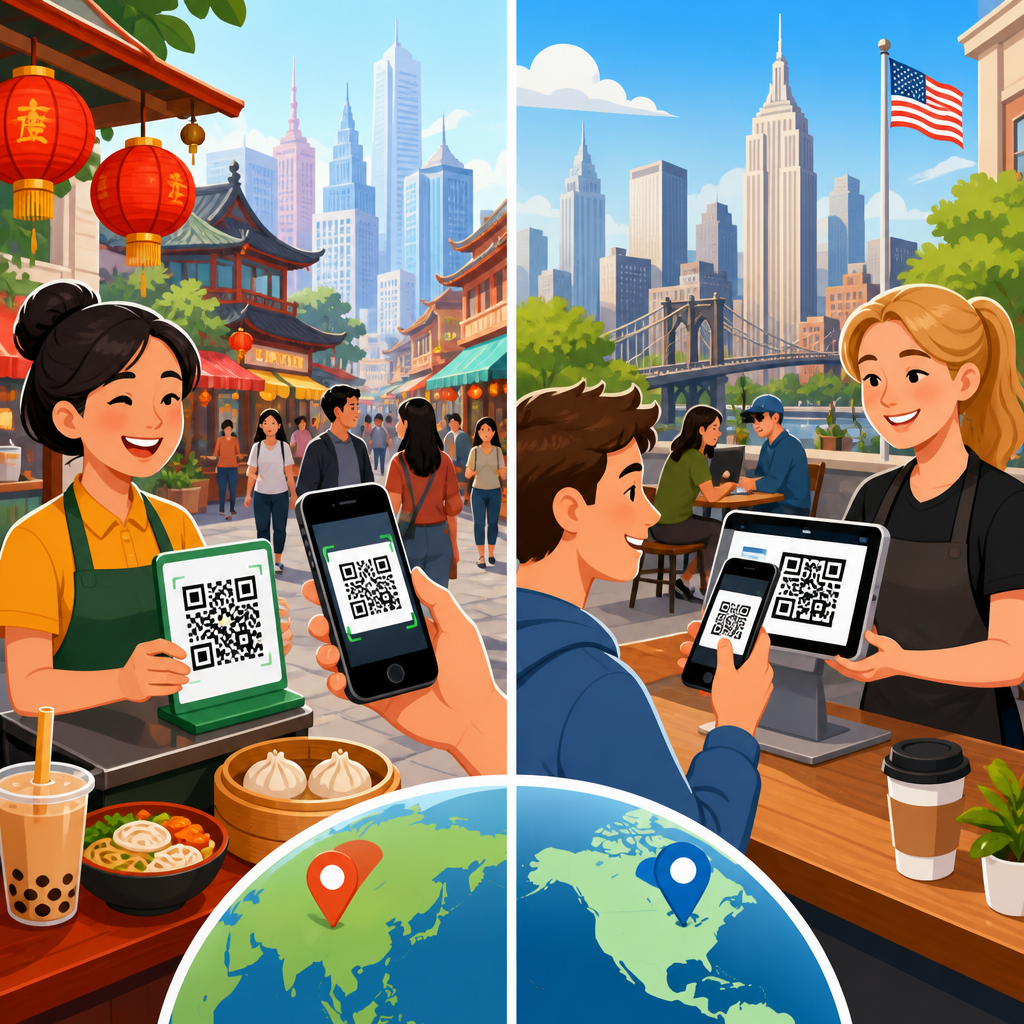
QR code payments have moved from a niche convenience to a core part of modern commerce, but adoption has not happened evenly across regions. In Asia, scanning a code to pay for street food, groceries, transit, rent, or utility bills is routine. In the United States, QR code payment adoption is growing, yet cards, mobile wallets tied to card rails, and contactless tap-to-pay still dominate daily transactions. Understanding why these paths diverged matters for merchants, fintech teams, payment strategists, and marketers building around QR code trends and innovations.
A QR code payment is a transaction initiated when a customer or merchant scans a Quick Response code that contains payment data. In practice, the flow usually follows one of two models: merchant-presented QR codes, where a buyer scans a code displayed at checkout, or customer-presented QR codes, where the buyer shows a code generated in a banking or wallet app and the merchant scans it. These models can run on bank transfer rails, stored-value wallets, real-time payment systems, card networks, or hybrid schemes that link several methods behind one interface.
I have worked with retailers and software teams rolling out QR-based checkout, and the biggest lesson is simple: technology alone does not determine uptake. Adoption depends on merchant economics, bank interoperability, consumer habit, smartphone behavior, regulation, and whether the payment method solves a clear friction point better than cards or cash. Asia offers strong examples of QR codes reducing acceptance costs and expanding financial access. The U.S. shows how hard it is for a new payment behavior to displace entrenched card infrastructure, even when the user experience is familiar and technically sound.
As the hub page for QR codes in payments, this article explains the major trends shaping Asia and the U.S., where each market stands today, what merchants should expect next, and which implementation choices matter most. It also helps connect related topics such as digital wallets, point-of-sale systems, fraud controls, interoperability standards, and customer experience design, because QR code payments are not one product category. They are an access layer that can sit on top of many payment systems, and that distinction explains much of the regional difference.
Why Asia became the global leader in QR code payments
Asia leads QR code payments because the method matched local market needs at the right time. In China, the rapid rise of Alipay and WeChat Pay gave consumers a wallet-first payment experience before card usage reached U.S. levels. Merchants, including microbusinesses, could accept digital payments without paying for traditional point-of-sale terminals. India followed a different path, driven by the Unified Payments Interface, or UPI, which enabled instant account-to-account payments through interoperable apps. Southeast Asian markets such as Thailand, Indonesia, Singapore, Vietnam, Malaysia, and the Philippines also accelerated usage through national QR standards, central bank involvement, and widespread smartphone adoption.
The economics are decisive. A printed QR placard costs almost nothing compared with card terminal procurement, maintenance, and connectivity. For small merchants with thin margins, that matters. In India, UPI changed consumer expectations because transfers were fast, widely accepted, and often free or extremely low cost. In China, wallet ecosystems tied payments to messaging, commerce, coupons, loyalty, and peer-to-peer transfers. In Thailand, PromptPay and the national Thai QR Payment framework normalized bank-linked scanning for everyday purchases. Singapore’s SGQR simplified acceptance by combining multiple payment schemes into one label, reducing checkout clutter for merchants.
Another reason for Asian success is that QR payments often solved inclusion challenges. They worked for consumers without credit cards and for merchants operating informally or semi-formally. A street vendor, taxi driver, or market stall could begin accepting digital payments in minutes. The payment credential lived in the app people already used. That reduced onboarding friction and accelerated network effects. Once enough people could send and receive money this way, QR payments spread from peer transfers into retail, bill pay, government disbursements, donations, and transport.
Government and regulator support also played a central role. Central banks in India, Thailand, Singapore, Malaysia, and Indonesia pushed standards that favored interoperability rather than closed, merchant-specific silos. That policy choice matters. Closed-loop wallets can grow quickly, but interoperable QR frameworks scale better across banks, apps, and merchants. In several Asian markets, regulators explicitly viewed low-cost digital payments as infrastructure, not merely a private convenience feature. That mindset encouraged broader merchant acceptance and clearer technical standards.
Why the U.S. adopted QR code payments more slowly
The United States did not lack smartphones or software talent. It lacked a compelling reason to replace cards at scale. Consumers already had widespread access to credit and debit cards, robust card rewards, mature acceptance infrastructure, and increasing availability of NFC tap-to-pay through contactless cards and mobile wallets like Apple Pay and Google Pay. From a consumer standpoint, tapping a card or phone is fast, familiar, and often more rewarding than scanning a QR code. That made behavior change difficult.
Merchant incentives were also mixed. Large merchants already owned sophisticated POS systems connected to card processors. Card acceptance was expensive, but it was integrated into inventory, receipts, refunds, loyalty programs, and accounting workflows. Switching to QR did not automatically lower total operating costs, especially if the QR method still settled through card rails or required a separate operational process. For smaller merchants, peer-to-peer acceptance through apps such as Venmo, Cash App, or PayPal QR gained some traction, but those experiences were not always presented as universal in-store payment standards.
The U.S. market is also structurally fragmented. Thousands of banks, multiple acquirers, competing wallets, card network dominance, and a patchwork of merchant software create a harder environment for one QR standard to become ubiquitous. During the pandemic, restaurants used QR codes heavily for menus and some ordering flows, which familiarized consumers with scanning at the table. Yet menu QR codes did not automatically produce long-term payment habit change. In many cases, the final checkout still ran through a card-on-file page or a traditional card terminal.
Security perception influenced adoption too. U.S. consumers became more aware of “quishing,” where malicious QR codes redirect users to phishing sites. The risk is manageable with app-based scanning, merchant verification, and staff controls, but perception matters. When tap-to-pay is already trusted and effortless, any extra uncertainty can slow QR payment uptake. As a result, U.S. growth has been strongest in specific use cases rather than across all retail payments.
Key differences between Asia and the U.S. payment ecosystems
The gap between Asia and the U.S. is best understood by comparing the underlying rails, incentives, and habits. In Asia, QR payments often connect directly to bank transfers or dominant wallets. In the U.S., QR flows more often overlay card-based experiences or wallet balances. That changes cost, speed, and merchant motivation.
| Factor | Asia | United States |
|---|---|---|
| Primary driver | Low-cost digital inclusion and wallet growth | Supplement to mature card ecosystem |
| Common rail | Bank transfer, real-time payments, super apps | Cards, stored balance, mixed wallet flows |
| Merchant setup | Very low cost, often static or dynamic QR | Integrated POS usually already supports cards |
| Consumer habit | Scan-first behavior common in daily life | Tap-first or card-first behavior dominates |
| Interoperability | Often encouraged by regulators or national standards | More fragmented across providers and banks |
These differences have practical implications. A merchant in India may treat QR as the default acceptance method because customer demand is universal and transaction costs are favorable. A merchant in the U.S. may add QR payments only when they support a broader commerce goal, such as self-ordering, bill splitting, faster line busting, social selling, or lower-friction invoices. The same visible square code represents very different economics underneath.
It is also important to distinguish static and dynamic QR codes. Static codes usually point to a fixed payee account or wallet and are cheap to deploy, but they require the payer to enter or confirm the amount. Dynamic codes are generated per transaction and can include amount, invoice reference, merchant ID, tax details, or expiry time. Dynamic QR is better for reconciliation, fraud reduction, and customer support. Asian markets adopted both models extensively. In the U.S., dynamic QR tends to fit enterprise systems better because merchants expect transaction-level reporting.
Where QR code payments are winning in the U.S.
Although the U.S. is not an all-purpose QR payment market on the scale of China or India, QR codes are performing well in defined categories. Restaurants are the clearest example. Table-service venues use QR codes for order-and-pay flows, especially where labor efficiency matters. A diner scans, reviews the menu, starts a tab, splits the check, adds a tip, and pays without waiting for a server to bring a terminal. The payment may still use card credentials, but the QR code improves service speed and throughput.
Event ticketing and concessions offer another strong use case. Stadiums, festivals, and cinemas use QR codes to connect ticket identity, food orders, and stored payment methods inside one customer journey. Parking is similar. A driver scans signage, enters a zone, and pays remotely. For municipalities and parking operators, QR codes reduce hardware dependence and support extensions without returning to a meter. Small businesses also use QR invoices for service payments, especially in home services, tutoring, beauty, and creator commerce.
Peer-to-peer and social commerce are meaningful channels as well. Venmo and PayPal popularized person-to-person transfers through QR profiles, and many micro-merchants accept payment the same way. Farmers markets, pop-up stores, nonprofit fundraisers, and local vendors often display account-linked QR codes because setup is simple and customers already know the apps. In these settings, QR succeeds not because it beats tap-to-pay on speed, but because it lowers onboarding friction and works with lightweight operations.
The next area to watch is account-to-account payments tied to instant payment infrastructure. As FedNow and RTP connectivity broadens and user experiences improve, the U.S. could support more bank-linked QR payment flows with better settlement speed and lower merchant costs. That does not guarantee mass retail conversion, but it creates a credible path for sectors where margins are tight and payment acceptance expense is a strategic concern.
Merchant strategy, customer experience, and the next phase of growth
For merchants evaluating QR code payments, the right question is not whether QR will replace cards. It is where QR creates measurable advantage. I have seen the best results when businesses define one operational goal first: reduce queue times, lower acceptance costs, enable self-service, improve bill collection, or connect offline checkout to loyalty and CRM data. Once the goal is clear, the payment architecture becomes easier to choose.
Customer experience design is critical. A good QR payment flow must answer immediate questions without forcing the user to think: What am I paying for? Is the merchant verified? Does the amount appear automatically? Which apps can I use? Will I receive a receipt? Poor labeling, dead links, weak mobile pages, or unclear totals can destroy conversion. Dynamic QR codes tied to itemized carts generally perform better than static codes for mainstream retail because they reduce ambiguity.
Security controls should be built into deployment, not added later. Merchants should prevent code tampering, use authenticated domains, monitor unusual transaction patterns, and train staff to spot replaced stickers or social engineering attempts. Where possible, app-to-app handoffs and wallet-native scanners are safer than generic camera scanning because they provide stronger merchant verification. Compliance also matters. Depending on the flow, merchants may need to account for PCI DSS obligations, NACHA considerations for account debits, data retention policies, and state privacy requirements.
Looking ahead, the most important QR code payment trends are interoperability, real-time settlement, richer post-payment data, and convergence with identity and loyalty. In Asia, cross-border QR initiatives are expanding tourism and regional commerce by allowing travelers to pay through familiar banking apps. In the U.S., growth will likely come through vertical solutions and embedded commerce rather than one universal national behavior shift. Retailers, restaurants, healthcare providers, schools, service businesses, and public agencies will each adopt QR differently based on economics and trust.
For anyone building under the broader QR Code Trends & Innovations umbrella, this hub should frame the rest of the subtopic clearly. QR codes in payments are not a passing novelty. They are a flexible payment interface whose success depends on local infrastructure, incentives, and execution quality. Asia demonstrates what happens when interoperability, low-cost acceptance, and mobile-first habits align. The U.S. demonstrates that strong incumbents, especially cards and contactless wallets, slow change unless QR solves a very specific problem better.
The main takeaway is practical. If you want to understand QR code payment trends in Asia vs the U.S., start with the rails, not the code itself. Then evaluate merchant economics, consumer habit, and the use case at the point of payment. Businesses that treat QR as a strategic tool rather than a novelty are the ones most likely to improve conversion, expand acceptance, and create a smoother checkout experience. Review your payment journey, identify one friction point, and test the QR model that best fits it.
Frequently Asked Questions
1. Why are QR code payments far more common in many Asian markets than in the United States?
QR code payment adoption grew faster in many parts of Asia because the market conditions were unusually favorable for a leapfrog moment in payments. In countries such as China, India, and across Southeast Asia, large segments of consumers and merchants adopted smartphones quickly while card acceptance infrastructure was still fragmented, expensive, or less deeply entrenched than in the U.S. That made QR codes an efficient, low-cost alternative. A merchant could print a static code and begin accepting digital payments without investing in traditional point-of-sale hardware, card terminals, or complex acquiring relationships. For small businesses, street vendors, and micro-merchants, that simplicity was transformative.
Another major reason is ecosystem design. In many Asian markets, super apps, bank-led instant payment systems, and mobile-first fintech platforms created seamless person-to-merchant and person-to-person payment experiences in one place. Consumers were not just using QR codes to buy retail goods; they were using them for food delivery, transportation, utility bills, rent, government services, and peer transfers. That repeated daily usage helped build habit very quickly. Once people were already opening the same app to chat, shop, send money, and pay merchants, QR payments became a natural extension rather than a separate behavior to learn.
In the United States, by contrast, the card ecosystem was already highly mature before QR payments gained momentum. Consumers were comfortable with debit and credit cards, merchants had invested in card acceptance, and card rewards programs reinforced existing payment habits. More recently, contactless cards and tap-to-pay mobile wallets added even more convenience without requiring consumers to scan a code. As a result, QR codes in the U.S. have often been introduced into a market where an easy and familiar payment method already exists, making the value proposition less dramatic than it was in many Asian markets.
2. What role do payment infrastructure and regulation play in the regional differences between Asia and the U.S.?
Infrastructure and regulation are central to the story. In several Asian markets, governments, central banks, and domestic payment networks actively supported interoperable, low-cost digital payment rails. Real-time payment systems and standardized QR frameworks helped reduce friction between banks, wallets, and merchants. In some countries, national initiatives made it easier for consumers from different financial institutions to scan a single QR code and pay instantly. That interoperability matters because it prevents the market from splintering into isolated closed-loop systems and gives merchants confidence that one visible code can serve many customers.
Regulation also influenced merchant economics. Where policymakers encouraged financial inclusion, formalization of cash-heavy sectors, and lower-cost acceptance methods, QR systems often benefited. Lower setup costs, minimal hardware requirements, and direct account-to-account or wallet-to-wallet transfers allowed merchants to accept digital payments with less overhead than card-based models. In emerging and fast-digitizing economies, that can accelerate adoption dramatically because the barriers to entry are much lower.
In the U.S., infrastructure evolved differently. Card networks have long provided nationwide reach, fraud management, dispute processes, and strong merchant acceptance. That system is deeply embedded in commerce, even if it can be more expensive for merchants than account-based alternatives. Real-time payments and bank-led alternatives are growing in the U.S., but they have not yet reshaped consumer payment behavior at the same scale. In addition, the U.S. payments market is highly decentralized, with many stakeholders including issuers, acquirers, card networks, processors, wallet providers, and merchants. That complexity can slow the rollout of universal QR experiences compared with markets where payment modernization was driven by a more coordinated regulatory or national infrastructure strategy.
3. How do consumer behavior and merchant incentives differ when it comes to QR code payments in Asia versus the U.S.?
Consumer behavior differs because the surrounding payment culture differs. In many Asian markets, QR payments are woven into everyday life across both formal and informal commerce. Consumers are used to scanning codes not only in stores but also in taxis, kiosks, open-air markets, restaurants, and for bill payments. That breadth of use creates a strong habit loop. When a payment method works nearly everywhere and across many transaction types, it becomes intuitive. Younger consumers may drive early adoption, but once QR becomes normalized across generations, usage spreads quickly.
Merchant incentives are equally important. For small and medium-sized merchants in Asia, QR acceptance often offers a lower-cost, lower-friction on-ramp to digital payments. A printed code can be enough to start accepting payment, which is especially compelling for businesses that operate on thin margins or in environments where full point-of-sale setups are impractical. Merchants may also benefit from faster settlement, better record-keeping, easier reconciliation, and access to digital financial services such as lending or cash-flow tools tied to transaction history.
In the U.S., consumers generally have several highly convenient options already: physical cards, card-on-file checkout, Apple Pay, Google Pay, and contactless tap-to-pay. That means QR payments need a clearer reason to exist. They tend to gain traction in specific scenarios, such as restaurants, peer payments, parking, ticketing, invoices, and e-commerce-to-offline links, rather than replacing mainstream in-store card behavior across the board. For merchants, the incentive often depends on whether QR can reduce fees, improve speed of checkout, connect loyalty and offers, or shift transactions toward lower-cost payment rails. Without a strong economic or customer-experience advantage, many U.S. merchants are unlikely to push QR payments aggressively.
4. Are QR code payments likely to catch up in the U.S., or will they remain a secondary payment method?
QR code payments in the U.S. are likely to grow, but growth does not necessarily mean they will overtake cards or contactless tap-to-pay in the near future. The more realistic outlook is that QR will expand in targeted use cases where it solves a specific problem better than existing methods. For example, QR can work well in merchant-presented payment flows, table-service restaurants, unattended environments, invoice payments, donation experiences, parking, event venues, and cross-channel experiences that connect physical locations with digital checkout journeys. In these contexts, QR is not just a payment method; it can also act as a bridge into loyalty, order-ahead, account creation, and personalized promotions.
That said, several factors could strengthen QR adoption in the U.S. over time. If account-to-account payment options become more consumer-friendly, if merchants see meaningful cost savings, or if fintech platforms create simpler and more trusted user experiences, QR payments could become much more common. Consumer familiarity has also improved because people are now accustomed to scanning QR codes for menus, tickets, product information, and promotions. That broader comfort lowers one behavioral barrier.
Still, the U.S. market has powerful incumbents. Contactless cards and mobile wallets offer a faster perceived experience for many in-store transactions, and credit card rewards remain a strong behavioral anchor. That means QR is likely to coexist with other payment methods rather than fully replace them. Its success will depend less on novelty and more on where it can deliver clear advantages in cost, convenience, integration, or customer engagement.
5. What should merchants, fintech teams, and payment strategists take away from the Asia vs. U.S. QR payment comparison?
The biggest takeaway is that payment adoption is rarely about the technology alone. It depends on ecosystem fit. In Asia, QR codes succeeded at scale because they aligned with smartphone behavior, merchant needs, instant payment infrastructure, and in many cases government-backed or platform-driven digital ecosystems. In the U.S., the same technology enters a market already optimized around cards and increasingly around tap-to-pay. That means companies should avoid assuming that a model that scaled quickly in one region will automatically translate to another without adaptation.
For merchants, the practical lesson is to evaluate QR payments by use case and economics. If QR helps lower acceptance costs, streamline ordering, reduce queue times, connect loyalty data, or improve payment conversion in specific channels, it can be highly valuable even without becoming the dominant payment method. For fintech teams, the opportunity may lie in designing QR experiences that feel deeply integrated rather than bolted on. That includes fast authentication, transparent settlement, strong security messaging, and compatibility with broader commerce workflows such as invoicing, subscriptions, refunds, and customer engagement.
For payment strategists, the comparison highlights the importance of infrastructure and interoperability. The regions where QR payments have become routine are often the ones where consumers and merchants can rely on simple, widely accepted, low-friction experiences. The strategic question is not merely whether QR will grow, but where it creates measurable value relative to cards, wallets, and bank-transfer alternatives. Companies that understand regional payment behavior, merchant margin pressures, and the policy environment will be in the best position to deploy QR in ways that support real adoption rather than superficial experimentation.