Businesses use QR code data to measure campaigns, personalize customer journeys, and improve operations, but the same data practices can create serious privacy risks if they are not designed with clear limits and safeguards. QR codes are machine-readable patterns that send a user to a website, app screen, payment flow, file, menu, support page, or authentication step. Static codes point to one fixed destination. Dynamic codes route through a managed link, which lets a business change the destination later and collect scan analytics such as time, device type, approximate location, referral context, and conversion events. That flexibility makes dynamic QR codes valuable for marketing, retail, hospitality, healthcare, logistics, and product packaging.
In practice, QR code data is rarely just “scan counts.” It often sits inside a larger measurement stack that includes web analytics, customer relationship management software, point-of-sale records, marketing automation tools, and fraud monitoring systems. A restaurant can track scans from table tents to compare lunch and dinner demand. A retailer can measure how many shoppers scan an in-store code and then redeem a mobile coupon. A manufacturer can place a code on packaging so buyers can verify authenticity, register a warranty, or access product instructions. Each use case generates data points that can be linked, segmented, retained, and analyzed.
This matters because QR interactions usually happen in physical spaces where people do not expect the same level of tracking they associate with online advertising. A quick scan on a poster, receipt, menu, medicine box, or event badge can reveal intent, place, time, and sometimes identity. If the landing page sets cookies, requests permissions, captures form data, or shares information with third-party analytics vendors, the privacy impact grows quickly. For companies building a QR program under a broader QR Code Security & Privacy strategy, the core challenge is not whether to use QR code data. It is how to collect only what is needed, explain it clearly, protect it properly, and avoid turning a convenient scan into opaque surveillance.
When I audit QR campaigns, I start with one simple question: what data is created at the moment of scan, and what happens to it next? That question exposes the real privacy model. Some programs only log aggregate scan counts. Others create detailed event records tied to identifiers, cookies, loyalty accounts, or payment histories. The difference determines legal obligations, user trust, breach exposure, and reputational risk. Businesses that treat QR codes as a data collection channel rather than just a graphic tend to make better decisions about notice, consent, retention, vendor controls, and security architecture from the beginning.
What QR code data businesses collect and why it creates privacy concerns
QR code data usually falls into four categories: technical metadata, interaction data, user-submitted data, and linked downstream data. Technical metadata includes IP address, browser type, operating system, timestamp, and coarse geolocation derived from the network. Interaction data includes the code scanned, campaign source, number of repeat scans, session length, click-through behavior, and conversion actions. User-submitted data appears when the landing page asks for a name, email, phone number, shipping address, age, health details, or payment information. Linked downstream data emerges when the scan is connected to a CRM profile, loyalty ID, support ticket, order number, or ad audience.
Each layer changes the privacy stakes. An aggregate count of scans by day is low risk when it cannot reasonably identify anyone. A dynamic QR code that logs exact time, precise destination, and a persistent identifier tied to a customer profile is much more sensitive. If the code appears on a medicine package, clinic form, or employment document, the surrounding context can turn even ordinary analytics into sensitive personal data. In Europe, that may trigger stricter duties under the General Data Protection Regulation. In California, the California Consumer Privacy Act and California Privacy Rights Act can apply if the business shares or sells personal information or uses it for cross-context behavioral advertising.
Context matters as much as the fields in the database. A scan from a museum poster tells a different story than a scan from a domestic violence resource card, an HIV testing brochure, or an employee disciplinary notice. The code itself may not encode personal information, but the landing flow and placement often reveal intimate facts. That is why privacy reviews should map not only the data collected but also the audience, location, purpose, and likely expectations of the person scanning.
How businesses use QR code data across marketing, operations, and customer experience
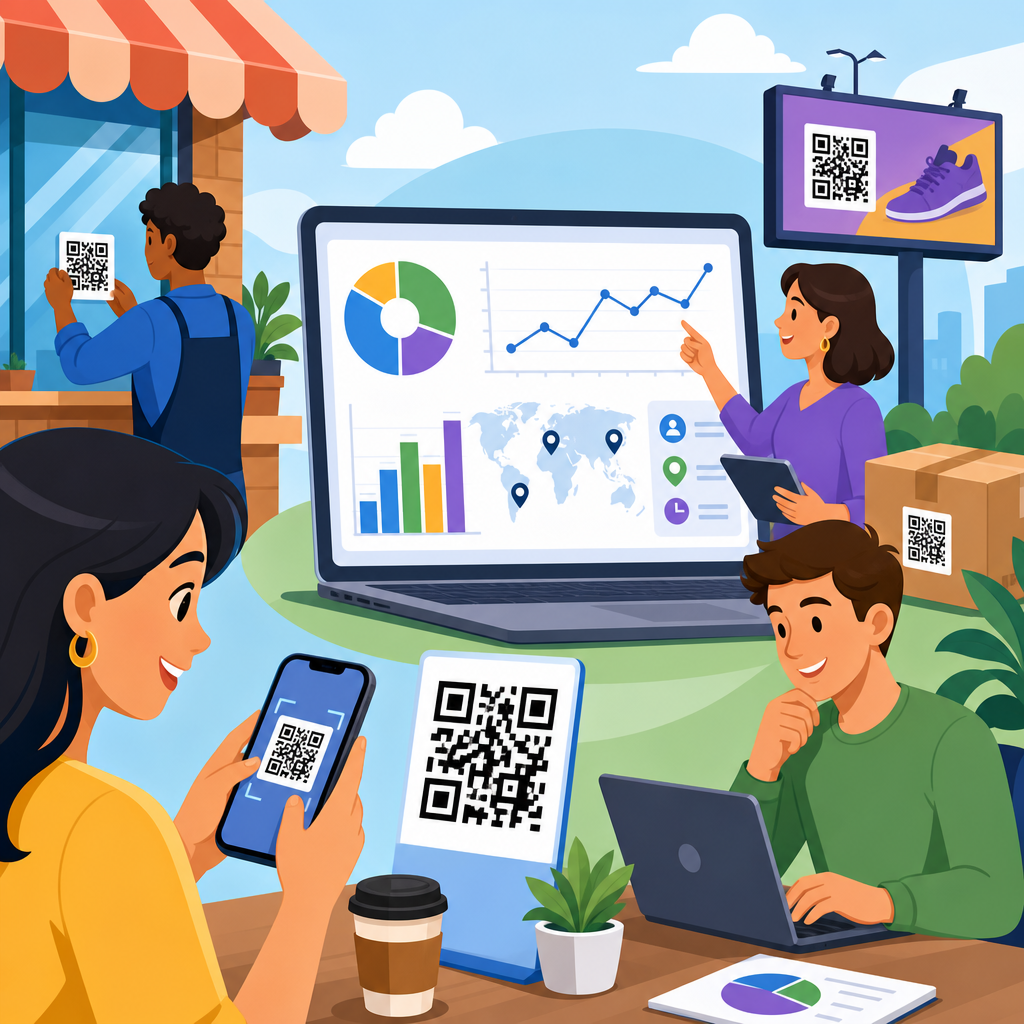
Most business uses fall into a small set of patterns. Marketing teams use QR code analytics to attribute offline campaigns. Retailers put different codes on window displays, shelf talkers, packaging inserts, and direct mail so they can compare response rates. Event teams use codes on badges and booths to capture leads and measure session attendance. Restaurants use QR menus to understand table turnover and peak ordering times. Logistics teams place codes on parcels, pallets, and workstations to confirm handoffs and reduce manual entry. Support teams use codes on products so customers can reach model-specific troubleshooting pages without searching manually.
The value is operational clarity. A regional grocery chain, for example, can test whether recipe QR codes on endcaps drive more basket additions than codes printed in weekly circulars. A hotel can measure how many guests scan an in-room code to request housekeeping instead of calling the front desk. A utility company can place codes on bills to speed digital payment adoption and see which reminders work best. These are legitimate business objectives. They become problematic when the data pipeline grows beyond the original purpose and begins feeding profile enrichment, retargeting, or data sharing that users did not expect from the scan.
| Business use | Typical data captured | Main privacy risk | Practical safeguard |
|---|---|---|---|
| Offline campaign attribution | Timestamp, device, referral, conversions | Linking scans to ad profiles without clear notice | Use aggregate reporting and short retention |
| QR menus and ordering | Session data, table number, order history | Combining dining behavior with loyalty records | Separate analytics from identity unless necessary |
| Product registration | Name, email, serial number, purchase date | Collecting excessive fields for a simple warranty | Limit forms to minimum required data |
| Healthcare information access | Scan logs, form entries, appointment actions | Sensitive context revealing health interests | Avoid third-party trackers on health pages |
| Employee operations | Worker ID, location, task completion time | Continuous monitoring and unfair performance inferences | Define labor policy, purpose, and access controls |
Well-run teams decide in advance whether a QR code is for measurement, service, or identity. Mixing all three without governance is where trouble starts. I have seen campaigns built for simple print attribution later repurposed for customer profiling because the analytics vendor offered an easy integration. The technology made that move frictionless, but privacy principles did not. Purpose limitation is a business discipline, not a software feature.
Where privacy risks emerge in the QR code data lifecycle
Privacy risk appears at every stage: creation, transmission, storage, sharing, and reuse. At creation, the biggest problem is over-collection. Teams often enable full analytics by default even when they only need rough scan totals. During transmission, redirects can expose data to multiple parties, including the QR platform, the website host, content delivery networks, and embedded scripts. At storage, weak retention practices leave old scan logs and form submissions sitting in dashboards long after the campaign ends. In sharing, data may flow to agencies, franchisees, ad networks, or customer data platforms. In reuse, information collected for one purpose can quietly support another, such as targeted advertising or employee monitoring.
Third-party tooling is a major blind spot. Many dynamic QR code platforms promise easy analytics, but businesses do not always review how those vendors process logs, where servers are located, what sub-processors are involved, whether data is used to improve the vendor’s own services, or how deletion requests are handled. A landing page can also carry pixels from Google Analytics, Meta, TikTok, LinkedIn, Hotjar, or session replay tools. If a person scans a code on a medical brochure and lands on a page with aggressive trackers, the privacy exposure can exceed what the company intended.
Security failures intensify privacy harm. QR code tampering, malicious overlays, and open redirect weaknesses can send users to phishing pages that capture credentials or payment details. Even when the business is not directly responsible for the attacker’s site, poor physical controls and weak monitoring can damage trust. Security and privacy are inseparable here: if users cannot trust the scan destination, they cannot make informed choices about what data to share.
Compliance expectations, consent, and transparency
Businesses should treat QR code programs as a governed data collection channel subject to the same standards as websites, apps, and forms. The legal basis depends on jurisdiction and use case. For basic service delivery, a company may rely on contract or legitimate interests if the data is necessary and impacts are limited. For analytics, advertising cookies, location tracking, or sensitive data processing, consent may be required. The safest approach is to evaluate the scan flow as a sequence: the code, the redirect, the landing page, the tags that load, the form fields shown, and the downstream systems receiving data.
Transparency must be immediate and specific. Users should not need to hunt through a long privacy policy to understand what a scan will trigger. Good practice is to place a short notice near the code when feasible, then provide layered disclosure on the landing page. For example: “Scanning opens our product registration page. We collect scan analytics and registration details as described here.” If cookies or advertising trackers are present, consent mechanisms should appear before non-essential tracking starts, especially in jurisdictions governed by the ePrivacy Directive and GDPR.
Documentation matters. Maintain records of processing activities, vendor agreements, retention schedules, and data protection impact assessments for higher-risk deployments. If the QR program touches children, health data, precise location, or employee monitoring, formal review is essential. Compliance is not just about avoiding penalties from regulators like the ICO, CNIL, or state attorneys general. It is about proving that the business understands why it is collecting data, who can access it, and when it will be deleted.
Privacy-by-design practices that reduce risk without losing business value
The best QR code privacy programs are intentionally boring. They use minimal data, clear disclosures, conservative defaults, and strong operational controls. Start by deciding the smallest unit of insight that still supports the business goal. If you only need to compare poster A to poster B, aggregate counts by campaign may be enough. If you need regional performance, city-level reporting may work without precise coordinates. Avoid persistent identifiers unless there is a clear necessity such as authenticated account access or fraud prevention.
Separate analytics from identity whenever possible. One pattern I recommend is to keep scan logs in an analytics environment with short retention while storing customer-submitted registration data in a separate system under stricter access controls. Tokenization, pseudonymization, and hashed identifiers can reduce exposure, though they are not magic; if the business can reasonably relink the data, privacy obligations still apply. Use HTTPS everywhere, disable unnecessary parameters in URLs, review SDKs and tags, and monitor for code replacement in the physical environment.
Governance should include vendor due diligence, least-privilege access, deletion workflows, and incident response playbooks specific to QR campaigns. Test physical placements so users can verify legitimacy, such as branded frames, anti-tamper labels, or destination previews. Make opt-outs meaningful. If a person scans a code only to read instructions, they should not be forced into account creation or marketing enrollment. Businesses can still learn from QR code data, but the strongest programs learn just enough and no more.
QR code data can help businesses understand demand, streamline service, and connect offline experiences to digital outcomes, yet every scan also creates a privacy decision point. The central lesson is simple: a QR code is not merely a shortcut; it is an entry into a data ecosystem that can reveal intent, location, identity, and sensitive context. Companies that succeed in this area define purpose before deployment, collect only necessary information, explain tracking clearly, secure every redirect and landing page, and limit retention and sharing. Those choices reduce legal exposure and preserve customer trust.
For a QR Code Security & Privacy program, this hub topic connects directly to deeper questions about consent, third-party analytics, employee monitoring, healthcare use, children’s data, retention, vendor contracts, and scan-related phishing risks. As you build out those policies, use QR code data maps, privacy impact assessments, and vendor reviews as standard operating tools, not afterthoughts. The business benefit is better measurement with fewer surprises. Audit your current QR journeys, remove unnecessary tracking, and make every scan understandable before you scale.
Frequently Asked Questions
1. What kind of data can businesses collect from QR code scans?
Businesses can collect a surprisingly wide range of information from QR code interactions, especially when they use dynamic QR codes instead of static ones. At the most basic level, a scan can reveal when the code was used, roughly where the user was located, what type of device or operating system was involved, and which campaign, product, sign, package, or placement generated the interaction. If the QR code routes through a managed link first, the business can also track the destination that was served, measure repeat scans, compare performance across locations, and test which version of a landing page or offer performs best.
In more advanced setups, QR code data may be connected to website analytics, app analytics, customer accounts, loyalty programs, support systems, payment flows, or CRM records. That means a simple scan could become part of a broader customer journey map that shows how someone moved from a physical touchpoint to a digital action, such as viewing a product page, downloading a file, joining a rewards program, completing a purchase, or requesting support. However, it is important to distinguish between data collected automatically from the scan event and personal data collected after the user reaches the destination. A QR code itself does not magically reveal a person’s identity, but the linked destination can request or infer more data if the business has built the experience that way.
Because of that, businesses should treat QR code data carefully. Even seemingly routine information like timestamps, device details, and location estimates can become sensitive when combined with other datasets. Strong governance starts with collecting only what is necessary, clearly explaining what is being tracked, and separating operational measurement from unnecessary profiling. The more connected the QR code system is to other business platforms, the more important it becomes to define limits, retention periods, and access controls.
2. How do businesses use QR code data to measure marketing and campaign performance?
QR code data is valuable because it helps businesses connect offline activity to digital results. A company can place different QR codes on posters, packaging, direct mail, event signage, receipts, product displays, or in-store materials, then compare which placements generate the most scans, the highest engagement, or the strongest downstream conversions. This gives marketers a practical way to evaluate how real-world campaigns perform without relying only on estimates or broad attribution models.
Dynamic QR codes are especially useful for campaign measurement because they route through a managed link before sending the user to the final destination. That routing step allows a business to log the scan, assign it to a campaign source, and sometimes adjust the destination based on business rules. For example, a retailer might use one QR code on product packaging and another in a social promotion, then compare scan volume, landing page engagement, coupon redemptions, and purchases from each source. A restaurant might test whether table tents, takeout bags, or window signage produce more menu views or loyalty signups. A B2B company might track how many event attendees scanned a booth code and later downloaded a white paper or booked a demo.
Used well, this data supports better decisions about placement, creative design, timing, geography, and audience response. It can also help businesses reduce wasted spending by showing which campaigns drive action and which do not. But the measurement should still be designed responsibly. Businesses should avoid collecting more information than they need, and they should be careful not to use QR analytics as a back door for excessive surveillance. Good campaign measurement focuses on meaningful outcomes, not unlimited tracking.
3. How can QR code data help personalize customer journeys?
Businesses often use QR code data to make the next step more relevant for the customer. Instead of sending every scanner to the same generic page, a dynamic QR code system can direct users to content based on context such as product type, store location, language preference, time of day, device type, or campaign source. That can create a smoother and more useful experience. For example, a customer scanning a code on electronics packaging could be sent directly to setup instructions and warranty registration, while someone scanning a code in a retail display could see product comparisons, reviews, or a limited-time offer.
Personalization can also become more sophisticated when QR interactions are tied to first-party systems such as loyalty accounts, mobile apps, support histories, or previous purchases. A hotel might use QR code data to guide guests to property-specific services. A manufacturer might route a returning customer to replacement parts and maintenance resources. A healthcare provider or insurer might use a code to lead members to a plan-specific support flow. In each case, the business is using the scan as a signal that helps tailor the experience, reduce friction, and increase the chances that the person finds what they need quickly.
That said, personalization is where privacy concerns can intensify. The line between helpful relevance and intrusive profiling can become thin if businesses combine scan behavior with identity, precise location, purchase history, or sensitive account data without clear notice and limits. The best practice is to personalize in proportion to the user’s expectations and the context of the scan. If a customer scans a code for a menu, support page, or product manual, the response should feel appropriate to that purpose. Responsible personalization depends on transparency, consent where required, data minimization, and a willingness to avoid highly invasive uses even when the technology makes them possible.
4. What are the privacy risks of collecting and using QR code data?
The biggest privacy risk is not the black-and-white square itself but the data infrastructure behind it. When a business uses dynamic QR codes, the scan often passes through a managed system that can log technical and behavioral data before the user reaches the final destination. If that data is then linked with web analytics, advertising systems, customer databases, or app identifiers, the business may be able to build detailed profiles of individuals across physical and digital environments. This can happen quietly, without users fully understanding that a quick scan on a sign, package, table, or receipt may trigger a broader chain of data collection.
Location-related data is a particular concern. Even if a business is only collecting approximate location from scan metadata, repeated scans over time can reveal patterns about movement, habits, workplace visits, store visits, or attendance at specific venues or events. The risk becomes even greater when scans relate to potentially sensitive topics such as health services, financial services, employee systems, or identity verification. In those settings, metadata alone may reveal more than businesses intend. Another issue is over-retention. Companies sometimes keep scan logs indefinitely because storage is cheap and analytics tools make retention easy, but holding detailed interaction histories longer than necessary increases exposure in the event of misuse, internal overreach, or a security breach.
There are also user trust risks. If people feel that QR codes are being used to monitor them rather than help them, they may avoid interacting altogether. That is why privacy-by-design matters. Businesses should define a legitimate purpose for every category of data collected, limit the scope of tracking, provide clear disclosures, secure the underlying systems, and delete data on a schedule that matches the business need. In short, QR code data can be useful, but without thoughtful limits it can create compliance, ethical, reputational, and security problems that outweigh the benefits.
5. What safeguards should businesses put in place when using QR code data?
Businesses should start with purpose limitation and data minimization. Before launching a QR code campaign or operational workflow, they should decide exactly what they need to measure and why. If scan counts by location are enough, there may be no reason to tie scans to named customer profiles. If a code simply leads to a digital menu or user guide, the business should question whether detailed behavioral tracking is necessary at all. This discipline helps prevent systems from expanding into excessive data collection just because the technology allows it.
Clear notice is another essential safeguard. Users should have an understandable explanation of what happens when they scan, especially if the destination or routing system collects analytics, sets identifiers, requests personal information, or connects the interaction to other platforms. The level of disclosure should match the sensitivity of the context. Businesses should also apply strong access controls so that only authorized teams can view scan data, and they should protect the infrastructure with secure redirects, monitoring, encryption, and routine reviews of vendors and third-party tools involved in the QR workflow.
Retention and governance are equally important. QR code data should not sit forever in dashboards, analytics systems, spreadsheets, or campaign archives. Businesses should establish deletion timelines, document who is responsible for the data, and regularly audit whether the original purpose still justifies ongoing collection. If the business uses QR data for personalization, it should build in safeguards around consent, preference management, and use restrictions. The most effective approach is to treat QR code data as part of a broader privacy and security program rather than as a harmless marketing detail. When businesses combine practical measurement with clear boundaries and strong controls, they can use QR codes to improve customer experience and operations without creating unnecessary privacy risk.