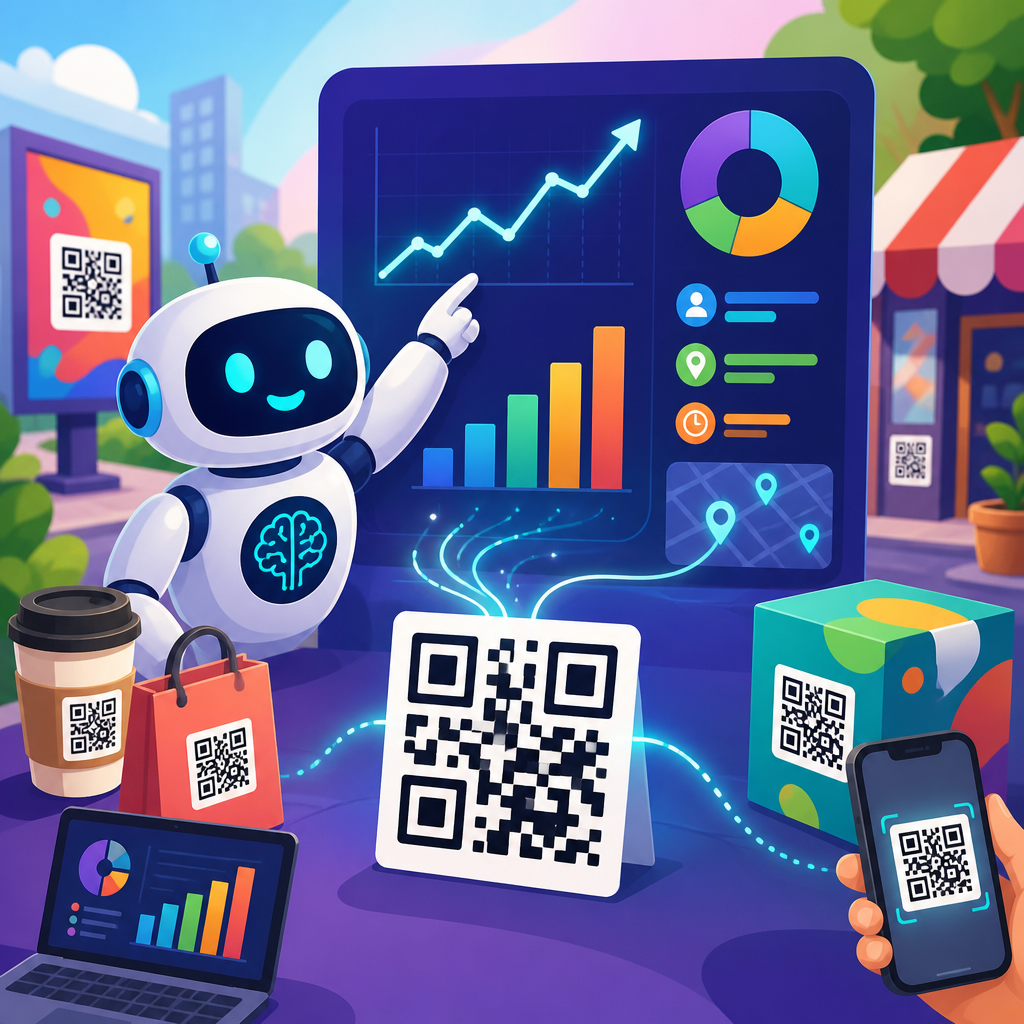
AI predicts QR code campaign performance by combining historical scan data, audience behavior, creative variables, and channel context into models that estimate scans, conversions, revenue, and dropout risk before a campaign launches. In practical terms, that means marketers can move beyond guessing whether a QR code on packaging, signage, direct mail, or in-store displays will work. They can forecast likely outcomes, compare scenarios, and adjust placement, landing pages, incentives, and timing before budget is committed. Within the broader QR Code Trends & Innovations landscape, the intersection of QR codes and AI matters because QR deployments now span retail, events, restaurants, healthcare, manufacturing, and omnichannel commerce, creating enough data for pattern recognition to become useful, measurable, and operationally significant.
A QR code campaign is any effort that uses a scannable code to trigger a digital action, such as opening a menu, joining a loyalty program, downloading an app, viewing product information, registering for an event, or completing a purchase. Campaign performance usually includes top-of-funnel metrics like scan rate and unique users, mid-funnel metrics like session depth and form completion, and bottom-funnel metrics like conversion rate, average order value, repeat purchase, and lifetime value. AI, in this context, usually refers to machine learning models that identify relationships between inputs and outcomes. Those inputs can include code design, call-to-action wording, traffic source, device type, time of day, geography, weather, promotion type, and landing page speed. The result is not magic. It is structured prediction built on data quality, disciplined measurement, and constant retraining.
I have seen the difference this makes when teams stop treating QR codes as static print assets and start managing them like performance channels. A restaurant chain I worked with assumed table-tent scans depended mostly on code size. After modeling scan behavior across locations, it became clear that lighting conditions, menu page load time, and the exact call-to-action drove more variance than dimensions alone. Another retail campaign showed that product-package scans rose sharply when the landing page matched the package claim within the first viewport. These are the kinds of patterns AI surfaces quickly. For marketers responsible for forecast accuracy, faster optimization, and better customer journeys, understanding how AI predicts QR code campaign performance is now a practical advantage, not a future trend.
What AI Actually Measures in a QR Code Campaign
AI predicts campaign performance by learning from variables that influence scanning behavior and downstream action. The most obvious signal is scan volume, but good models go further. They separate total scans from unique scans, distinguish first-time from repeat engagement, and map the path from scan to session, click, conversion, and retention. In many deployments, the model target is not just scans but qualified scans, meaning visits that meet criteria like time on page, product views, account creation, or completed payment. This matters because campaigns with high scan counts can still underperform if the audience bounces immediately or fails to find relevant content.
Inputs usually fall into five categories. First is code-level design data: size, contrast, quiet zone, error correction level, logo overlay, and destination type. Second is context: where the code appears, such as shelf wobblers, packaging, receipts, billboards, TV, email, kiosks, or event badges. Third is audience and channel data: store traffic, demographic mix, campaign source, referrer patterns, and prior engagement history. Fourth is landing experience: page speed, mobile usability, content match, form length, and payment friction. Fifth is environmental context: hour, day, seasonality, weather, and even competitive promotion periods. When these variables are tracked consistently, machine learning can estimate which combinations correlate with stronger results.
Named methods commonly used include regression models for forecast ranges, gradient boosting for nonlinear relationships, time-series forecasting for seasonality, clustering for audience segmentation, and propensity models for conversion likelihood. In practice, tools such as Google Analytics 4, BigQuery, Adobe Analytics, Mixpanel, Snowflake, and CRM platforms feed data into dashboards and models. Dynamic QR code platforms add scan timestamps, device information, and geolocation approximations. A reliable prediction workflow joins those sources, removes noise, defines targets clearly, and validates the model against holdout data. Without that discipline, predictions look precise but fail under real conditions.
The Data Foundation That Makes Prediction Reliable
Accurate prediction starts with instrumentation, not algorithms. Every QR code should resolve through a trackable redirect, usually with campaign parameters, so scans can be attributed consistently. Teams need naming conventions that distinguish creative version, placement, product line, audience segment, and market. They also need event schemas that capture page view, scroll depth, button click, add to cart, form start, form completion, purchase, and return visit. If one market defines a conversion as an email signup while another defines it as a sale, the model learns confusion instead of insight.
Data quality problems are common in QR campaigns because physical media outlasts digital assumptions. A code printed for one promotion may remain visible after the offer changes. A retail display may be moved to a new location without anyone updating the campaign metadata. Offline placements also create attribution blind spots, especially when scans lead to mobile browsers that later convert in app or on desktop. To address this, mature teams use server-side tagging where possible, identity stitching through CRM or loyalty IDs, and controlled redirect logic that preserves campaign context across sessions. They also document sunset dates and governance for every dynamic destination.
Privacy and regulation must be part of the foundation. Predictions improve with richer data, but campaign design has to respect consent requirements and minimize unnecessary collection. Regulations such as GDPR and CCPA affect how personal data is stored and activated. For many QR campaigns, aggregated behavioral features are enough to predict performance without storing sensitive identifiers. In my experience, models built on clean aggregate features often outperform overly ambitious customer-level models because they are easier to govern, easier to explain, and less vulnerable to compliance risk or sparse data.
How Models Forecast Scans, Conversions, and Revenue
Most prediction systems begin with a baseline forecast: given placement type, traffic expectations, historical benchmarks, and seasonality, how many scans should this campaign generate? From there, the model estimates conditional probabilities. Of those scans, how many become engaged sessions? Of those sessions, how many complete the target action? Revenue forecasts then combine predicted conversions with average order value or expected downstream lifetime value. This staged approach mirrors the funnel and makes it easier to diagnose weak points. If scans look strong but revenue looks weak, the landing page or offer is usually the issue, not the code itself.
Feature engineering is where much of the practical value appears. For instance, a model can encode whether the call-to-action uses urgency language, whether the landing page mirrors the exact offer promised on the physical asset, whether the code sits above or below average eye-line, and whether scan intent is informational or transactional. External features can matter too. Event campaigns often spike at check-in and between session breaks. Restaurant scans rise during ordering windows. Tourism scans shift with weather and foot traffic. AI can absorb these patterns faster than manual spreadsheet analysis because it tests combinations at scale.
Forecasts should be presented as ranges, not single-point promises. A 10,000-scan estimate with a confidence interval is more honest and more useful than an exact prediction without uncertainty. The same applies to conversion and revenue. I advise teams to ask three operational questions of every model output: what is the expected result, what variables most influenced that result, and what changes would move the forecast materially? The third question is the bridge from prediction to action. A model that only predicts is interesting. A model that recommends changes to improve outcomes is commercially valuable.
Variables That Most Influence QR Code Campaign Performance
Across campaigns, a small set of variables repeatedly explains performance variance. Placement visibility is first. Codes that appear where the audience has time and motivation to scan consistently outperform codes placed in rushed or awkward contexts. Message clarity is second. People scan when the immediate benefit is obvious, such as “View ingredients,” “Get 15% off,” or “See setup video.” Relevance between the physical prompt and the destination is third. If the package says sustainability details but the landing page opens on a generic homepage, conversions drop. Technical experience is fourth. Slow mobile pages, intrusive pop-ups, and long forms suppress results more than many teams expect.
The table below summarizes the variables I see matter most and how AI typically interprets them.
| Variable | Why it matters | Typical AI signal | Example optimization |
|---|---|---|---|
| Placement context | Determines attention and scan opportunity | Higher lift in dwell-time environments | Move from checkout clutter to product display |
| CTA wording | Sets user expectation and motivation | Benefit-led language predicts higher scan rate | Replace “Scan here” with “Scan for assembly guide” |
| Landing page speed | Affects bounce and abandonment | Load times above three seconds reduce conversion odds | Compress assets and simplify scripts |
| Offer-message match | Builds trust after the scan | High semantic match predicts deeper sessions | Mirror headline from print asset on landing page |
| Audience segment | Different groups scan for different reasons | Models assign different propensities by segment | Send loyalty members to account-linked content |
| Timing and seasonality | Demand changes by hour, day, and season | Recurring peaks improve forecast precision | Launch retail codes around peak weekend traffic |
Code aesthetics matter, but less than many marketers assume. Contrast, quiet zone, and print quality are essential because unreadable codes fail completely. Beyond that threshold, the best-performing campaigns usually win on motivation and experience, not decoration. Branded codes can help trust, especially on packaging and premium products, but logo overlays and stylized modules should be tested carefully because scanning reliability remains the first requirement.
Real-World Use Cases Across Industries
Retail brands use AI to predict which packaging, shelf, and window-display QR placements will create the highest assisted revenue. A skincare brand might compare product-level educational codes against offer-led codes. Historical modeling often shows that first-time buyers respond better to ingredient explainers, while repeat buyers respond better to replenishment offers. That difference lets the brand route traffic dynamically based on loyalty recognition or product line. In-store, heatmap data and point-of-sale traffic counts can be joined with scan behavior to forecast which fixtures justify premium placement.
Restaurants use QR codes for menus, ordering, feedback, and loyalty enrollment. AI helps separate operational scans from revenue-driving scans. For example, a quick-service chain may discover that lunch-hour menu scans are plentiful but low value unless the destination emphasizes combo upgrades. A full-service chain may find that dessert-menu prompts outperform generic table prompts late in the dining experience. Models can then recommend not just where to place codes, but when to swap destination content based on daypart, inventory, or staffing pressure.
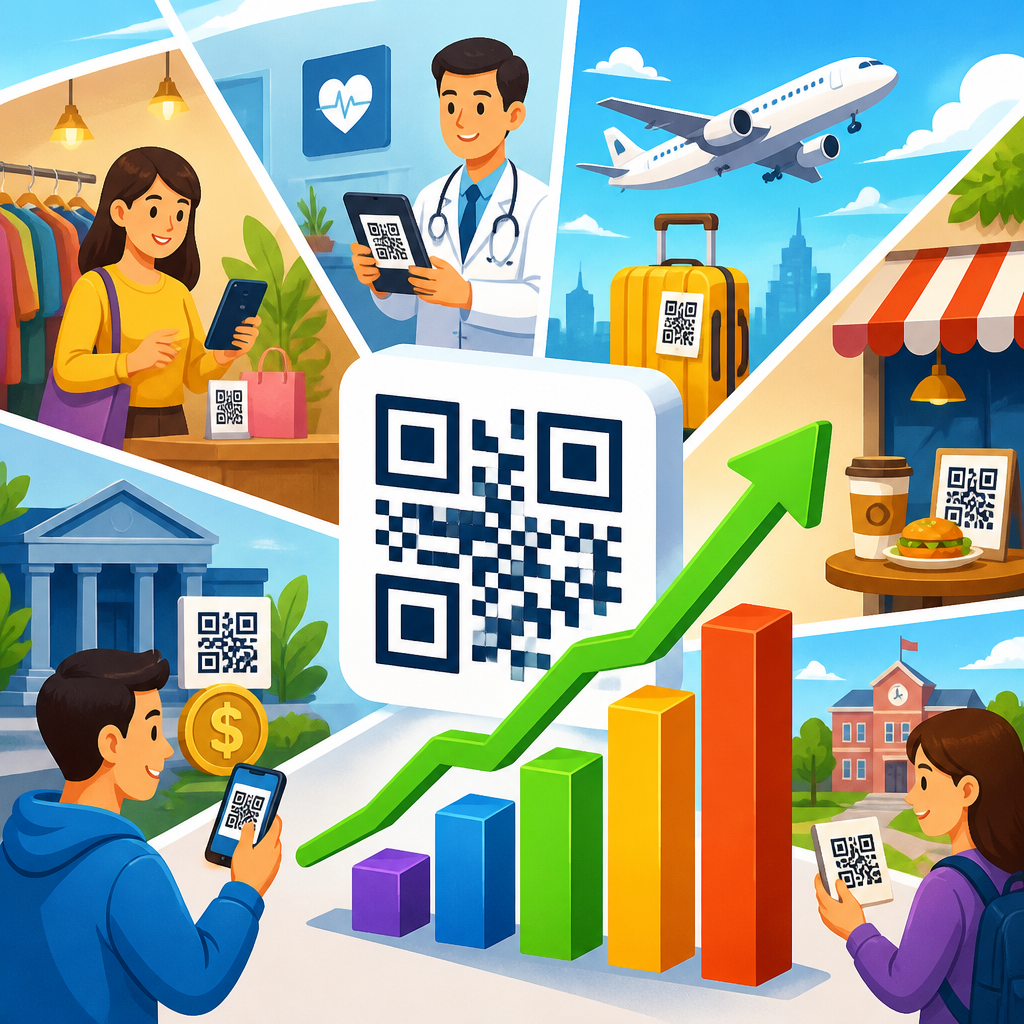
Events, healthcare, and manufacturing each bring different goals. Event organizers predict badge-scan and signage-scan engagement to optimize sponsor value, breakout attendance, and app adoption. Healthcare providers use QR codes for appointment check-in, post-discharge instructions, and patient education, where prediction focuses on completion and adherence rather than direct sales. Manufacturers place codes on equipment and packaging for manuals, safety protocols, authenticity checks, and reorder journeys. In each case, AI works best when the target metric reflects the real business outcome, not just curiosity scans.
Optimization Loops: From Prediction to Better Performance
The strongest programs treat AI prediction as part of an optimization loop. Step one is forecasting: estimate performance by scenario before launch. Step two is experimentation: run controlled tests on CTA, placement, design, destination, and offer. Step three is monitoring: compare actuals against predictions in near real time. Step four is retraining: update the model with the latest outcomes and adjust feature importance. This loop turns QR codes into a managed channel rather than a static asset.
A useful example is direct mail. Suppose a home services brand predicts that a seasonal postcard QR code will generate a 3.5 percent scan rate and a 12 percent quote-request rate from scans. If actual scan rate is close to forecast but quote requests lag, the model has already narrowed the problem. The next action is to test the landing page, not the print format. If both scans and quote requests miss, the issue may be creative, audience selection, or mailing list quality. This diagnostic value is one reason AI improves campaign efficiency even when forecasts are not perfect.
Dynamic QR codes make these loops even more powerful because the destination can be changed without reprinting. Teams can route users to localized content, inventory-aware pages, language-specific pages, or personalized experiences based on context. Combined with multivariate testing, AI can recommend the best next destination for each segment or setting. The practical limit is organizational discipline: creative, analytics, web, CRM, and operations must share data definitions and decision rights. Prediction systems fail less from model weakness than from fragmented execution.
Limits, Risks, and What Marketers Should Do Next
AI prediction has limits. New campaigns with little historical data face a cold-start problem, so early forecasts rely more on analog campaigns and broader benchmarks. Offline exposure is also messy; not every person who sees a code scans it, and not every scan leads directly to a measurable outcome. External shocks such as stockouts, app outages, severe weather, or sudden news events can break patterns the model expects. Bias is another risk. If historical campaigns underinvested in certain locations or audiences, the model may incorrectly rank them as low potential. That is why human review and experimentation remain essential.
Marketers should also resist vanity metrics. A QR code with a strong scan rate but weak downstream action is not a success. The goal is business impact: completed orders, qualified leads, lower service costs, stronger retention, better patient compliance, or improved event participation. Start with one clear objective, instrument the funnel completely, and build prediction from there. Use dynamic codes, enforce naming standards, connect scan data to analytics and CRM, and report results as funnel stages with confidence ranges. Then test the factors that models repeatedly flag: placement, CTA clarity, destination relevance, and mobile speed.
The main benefit of using AI to predict QR code campaign performance is simple: better decisions before and during launch. Instead of printing, posting, and hoping, teams can estimate outcomes, understand the drivers, and improve the customer journey with evidence. As QR codes continue to expand across packaging, retail, hospitality, healthcare, and field operations, the brands that win will be the ones that treat each scan as measurable intent and each campaign as a learnable system. Audit your current QR tracking, identify the outcomes that matter most, and build the data foundation that lets prediction become profitable action.
Frequently Asked Questions
1. How does AI predict QR code campaign performance before a campaign even launches?
AI predicts QR code campaign performance by learning from patterns in past campaign data and applying those patterns to a new campaign scenario before it goes live. The model typically evaluates historical scan volume, conversion rates, landing page engagement, offer type, traffic source, device behavior, time of day, location, and audience response across similar campaigns. It also considers the context of where the QR code will appear, such as packaging, shelf displays, direct mail, event signage, or outdoor ads, because the environment strongly influences whether people notice the code and take action.
In practice, the system takes campaign inputs like creative format, call-to-action wording, placement, timing, audience segment, and incentive structure, then estimates outcomes such as expected scans, conversion probability, revenue potential, and dropout risk. Instead of relying on assumptions like “this placement should do well,” marketers get a model-based forecast grounded in real performance data. That forecast can be used to compare alternatives before budget is committed, making AI especially valuable for reducing uncertainty and improving campaign planning.
2. What data does AI need to accurately forecast QR code campaign results?
Accurate forecasting depends on having a broad and relevant dataset rather than just raw scan counts. AI models work best when they can analyze historical campaign performance together with audience and channel behavior. That often includes scan data by source, conversion outcomes, landing page bounce rates, session duration, form completion rates, purchase value, repeat visits, device type, geography, and daypart trends. It may also include creative variables such as QR code size, color contrast, placement on the asset, surrounding copy, offer visibility, and the strength of the call to action.
Channel context is equally important. A QR code on product packaging behaves differently from one on a restaurant table tent, a trade show banner, or a piece of direct mail. AI improves its predictions when it understands these environmental differences along with audience intent. For example, someone scanning in-store may be comparison shopping, while someone scanning from a mailed offer may already be closer to conversion. The more consistently this data is collected and labeled, the more reliable the forecast becomes. Clean data, enough historical volume, and clear campaign objectives are usually the biggest drivers of useful predictive accuracy.
3. What campaign elements can marketers improve using AI-based QR code performance predictions?
AI-based predictions are most useful when they lead to decisions before launch, not just reports after the fact. Marketers can use forecasting to refine QR code placement, adjust creative design, test different calls to action, choose stronger offers, and optimize the landing page experience. If the model predicts high scan interest but low conversion intent, that may indicate a mismatch between the code’s promise and the destination page. If it predicts low scan volume, the issue may be visibility, placement, weak incentive language, or poor context within the channel.
These insights make scenario planning much more practical. A team can compare whether a discount performs better than exclusive content, whether packaging outperforms in-store signage, or whether a shorter form increases completion rates enough to justify the change. AI can also help with timing by identifying windows when audiences are more likely to scan and convert. Instead of making one broad campaign decision and hoping for the best, marketers can fine-tune multiple variables in advance and launch with a stronger probability of success.
4. Can AI estimate more than scans, such as conversions, revenue, and dropout risk?
Yes. One of the biggest advantages of AI in QR code marketing is that it can model performance across the full funnel, not just top-of-funnel scan activity. A campaign with a high predicted scan rate is not automatically a successful campaign if those users abandon the landing page or fail to complete the next step. AI can estimate likely conversion rates, average order value, revenue contribution, lead quality, and dropout points by analyzing how similar users behaved in past campaigns under similar conditions.
This broader forecasting gives marketers a much more realistic picture of campaign value. For example, two placements may generate similar scan volume, but one may bring in users with stronger purchase intent and lower abandonment. AI helps surface that difference early. It can also flag friction areas, such as mobile pages that load slowly, forms that are too long, or offer structures that attract curiosity but not commitment. By predicting outcomes deeper in the journey, marketers can prioritize changes that improve business impact rather than focusing only on scan counts.
5. How reliable are AI predictions for QR code campaigns, and what are the limitations?
AI predictions can be highly useful, but they are not guarantees. Their reliability depends on the quality of the underlying data, the relevance of historical examples, and how similar the new campaign is to what the model has seen before. If a brand has run many QR campaigns across channels and tracked scans, conversions, and post-scan behavior consistently, the model can usually produce more dependable estimates. If the campaign is entering a brand-new market, using a novel creative concept, or targeting an audience with little prior data, forecasts may be directional rather than precise.
It is also important to remember that external factors can change outcomes quickly. Store traffic, seasonality, competitor activity, economic conditions, product availability, and even weather can affect QR engagement. For that reason, AI should be used as a decision-support tool rather than a replacement for testing and human judgment. The most effective approach is to combine AI forecasting with controlled experiments, ongoing measurement, and iterative optimization. Used that way, AI becomes a practical advantage: it helps marketers make smarter pre-launch decisions, identify likely risks earlier, and improve campaign performance with far less guesswork.