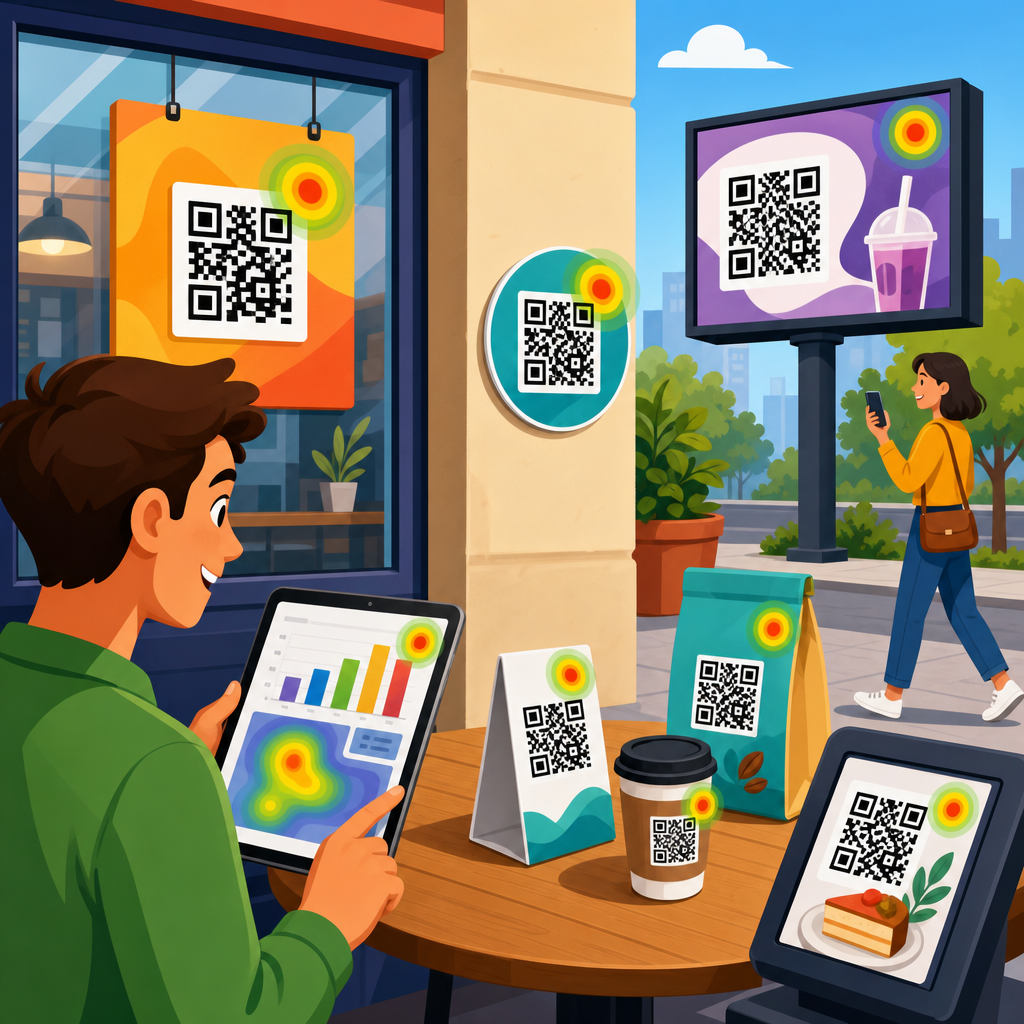
How to test QR code placement for maximum scans starts with treating placement as a measurable variable, not a design afterthought. In QR code marketing, placement means the exact physical or digital position where a code appears, the context around it, the distance from the viewer, and the moment when someone encounters it. A/B testing QR codes means presenting different placement versions to comparable audiences, then measuring which version produces more scans, better conversion rates, and stronger downstream outcomes such as leads, sales, signups, or app downloads.
This matters because QR code performance is highly sensitive to context. I have seen beautifully designed campaigns fail because the code sat too low on retail shelving, too high on restaurant windows, or too close to competing calls to action on packaging. The reverse is also true: small changes in placement routinely lift scans without changing the offer, creative, or destination page. A code moved from the bottom right of a poster to eye level beside a product benefit can outperform the original version by a wide margin because it becomes easier to notice, understand, and trust.
Testing placement is also one of the fastest ways to improve QR code ROI. Unlike a full creative redesign, placement tests can often be executed with controlled print runs, alternate in-store signage, segmented direct mail drops, event materials, or digital placements across channels. The goal is not simply to generate scans. The goal is to generate qualified scans from people who can act immediately. That is why this hub article covers A/B testing QR codes as a complete discipline, including hypothesis design, measurement, sample control, environmental variables, scan intent, and the practical setups that produce defensible results.
For marketers managing posters, packaging, menus, product displays, brochures, out-of-home media, email, social assets, or point-of-sale materials, the core principle is straightforward: the best QR code placement reduces friction between attention and action. Every effective test asks the same essential question: where should the code appear so the right person can notice it, understand why it matters, and scan it with minimal effort? When you answer that question with structured experiments instead of guesswork, scan volume and conversion quality both improve.
What QR code placement testing actually measures
QR code placement testing measures more than scan count. The primary metric is usually scan rate, defined as scans divided by impressions, footfall, recipients, or estimated views depending on the channel. A stronger framework adds unique scanners, repeat scans, landing-page conversion rate, bounce rate, time to scan, and completion rate for the intended action. In physical environments, placement also influences whether people can stop safely, whether lighting supports camera detection, and whether they can hold the phone at a workable angle. These factors affect observed scan behavior even when the code itself is technically readable.
In practice, I separate performance into three layers. First is visibility: did people notice the QR code at all? Second is comprehension: did they understand what they would get by scanning? Third is usability: could they scan it quickly from their actual position? A poor placement can break any of those layers. For example, a code on transit shelter glass may be visible but unreadable in glare. A code on product packaging may be readable but ignored if it sits near legal copy with no clear value proposition. A code on a trade show banner may attract attention but underperform if attendees must step back into traffic to scan.
That is why placement testing should isolate location as the independent variable while keeping other elements stable. If the headline, color treatment, incentive, and destination URL all change at once, the result is not a placement test. It is a mixed-variable creative test. Useful placement experiments compare one controlled position against another under similar conditions and identical scan incentives. Only then can you confidently say the lift came from where the code appeared rather than from a better offer or stronger visual design.
How to build a clean A/B testing plan for QR codes
A/B testing QR codes works best when the hypothesis is specific and tied to user behavior. A weak hypothesis says, “Version B will do better.” A strong hypothesis says, “Moving the QR code from the lower footer area of the poster to eye level beside the product image will increase scan rate because viewers see the benefit statement and code in the same visual path.” That statement identifies the variable, the expected behavioral mechanism, and the success metric.
Next, define the testing unit. On packaging, the unit may be a print batch distributed by region or retailer. In stores, it may be alternating display locations across matched locations. In direct mail, it may be randomized recipient groups. At events, it may be entrance signage versus booth signage with distinct tracking URLs. Use dynamic QR codes so each placement variant resolves through a unique short URL, UTM structure, or campaign identifier. Platforms such as Bitly, QR Code Generator PRO, Beaconstac, Flowcode, and Uniqode can support variant tracking, scan timestamps, device data, and destination changes without reprinting the code logic.
Establish a minimum test duration that captures normal variation. A restaurant tabletop QR code test run only on a quiet Tuesday afternoon is not reliable if weekend traffic behaves differently. Likewise, retail placements should span enough days to include typical store rhythms and staffing patterns. Keep the call to action identical across variants whenever possible. If Version A says “Scan for 15% off” and Version B says “Scan to see ingredients,” the result tells you little about placement because incentive and intent differ.
Before launch, create a test sheet listing placement coordinates, display dimensions, viewing distance, lighting conditions, line of sight, expected dwell time, and adjacent visual elements. This prevents operational drift. I have seen store teams unknowingly move signage a few inches, angle tabletop displays differently, or tape materials behind reflective surfaces. Those small deviations can invalidate the comparison. A disciplined setup is what turns a QR code experiment into actionable evidence.
The placement variables that most affect scan performance
Several placement variables consistently influence maximum scans. Height is one of the strongest. Eye-level placements usually outperform low or high placements because they reduce the need for people to crouch, stretch, or tilt the phone. Distance is equally important. A code intended to be scanned from six feet away needs larger modules, more quiet zone, and a simpler visual field than a code printed on handouts. Angle matters because smartphone cameras struggle when users must scan from oblique positions. Surface matters too. Glossy packaging, curved bottles, window decals, and backlit screens can all create scan friction.
Surrounding context often determines whether the code gets attention. Place a QR code near the key value proposition, and scans typically rise because users understand the reward instantly. Place it near clutter, disclaimers, or multiple competing prompts, and scans fall. White space around the code is not just a design preference; it helps camera recognition and visual focus. Industry guidance from ISO/IEC 18004 and practical scanner app behavior both support maintaining a clear quiet zone and adequate contrast between the code and its background.
Timing and intent also shape ideal placement. On packaging, the best location depends on when the consumer is most motivated: at shelf, at unboxing, during product use, or at replenishment. On a menu, a code near the top can support fast ordering, while a code near specialty items may support upsells. On out-of-home ads, the best placement is often where the viewer has a natural pause, such as near a platform wait area, not where they pass at speed. Testing must reflect the actual moment of use, because maximum scans come from meeting intent at the right stage.
| Placement variable | What to test | Common impact on scans |
|---|---|---|
| Height | Eye level vs lower third vs upper corner | Eye-level placement usually improves noticeability and ease of scanning |
| Distance | Near-field handout vs mid-range poster vs far-view signage | Mismatch between code size and scan distance sharply reduces readability |
| Context | Beside benefit copy vs isolated footer placement | Codes near clear value propositions produce stronger scan intent |
| Surface | Matte print vs glossy label vs glass decal | Reflective surfaces often lower successful scan rate |
| Environment | Indoor lighting vs sunlight vs nighttime display | Glare and low light affect camera recognition and user confidence |
| Traffic flow | Dwell zones vs pass-through zones | People scan more where they can stop safely and comfortably |
Testing frameworks by channel: packaging, retail, events, print, and digital
Different channels demand different test designs. For packaging, compare placements such as front panel, side panel, inside flap, or back label. Front-panel codes may win on visibility, but side-panel or inside-flap placements can outperform on completion if they align with post-purchase intent, such as setup instructions or loyalty enrollment. Consumer packaged goods brands often discover that the highest scan rate is not always the highest value outcome. A back label might get fewer scans than the front, yet deliver more recipe views or product registration because the audience is already engaged.
In retail environments, test endcap signage against shelf talkers, counter mats, cooler doors, or fitting-room prompts. Match stores by size, traffic, and demographic profile, then rotate variants to reduce location bias. For events, separate entry, booth, stage screen, and take-home collateral. I have repeatedly found that stage-screen QR codes generate bursts of scans but lower completion when people are rushed, whereas booth-side placements produce fewer scans but stronger lead quality because staff can reinforce the value exchange.
For print, direct mail, catalogs, flyers, and brochures support highly controlled tests. Randomize recipients, keep the offer constant, and vary only position. Test above the fold versus lower right, near product imagery versus near response devices, or front cover versus interior spread. In digital assets, QR codes embedded in presentations, display screens, social graphics, or email footers should be tested for on-screen dwell time, competing links, and mobile redundancy. Never place a QR code in a mobile email intended to be opened on the same phone unless the use case is explicitly cross-device.
How to measure results and avoid false winners
The cleanest way to measure placement performance is to assign each placement variant a unique dynamic QR code and campaign taxonomy. Track scans, unique users, device type, geography, timestamp, landing-page events, and final conversions in analytics platforms such as GA4, Adobe Analytics, or your CRM. For physical placements, pair scan data with estimated exposure data: store traffic, event attendance, mail quantity, or impression counts. Raw scans alone can mislead. A sign with more scans may simply have had more exposure.
Statistical caution matters. Do not declare a winner after the first spike. Early scan surges are common when a placement first appears in a high-traffic window or when staff actively point people to the code. Watch for regression over time. Compare rates, not totals, and segment by context. A placement may win overall but lose among high-value segments such as returning customers or in-store purchasers. If possible, run significance testing or use Bayesian tools to estimate confidence before changing an entire campaign.
Also watch for operational noise. Wi-Fi outages, broken landing pages, slow mobile experiences, and poor cellular reception can suppress scan success and make a placement look weaker than it is. I always test the full journey on multiple devices before launch and spot-check scans during the experiment. Placement optimization fails when the destination experience is neglected. The winning placement is the one that generates successful scans and meaningful outcomes, not just camera opens.
Common mistakes that reduce maximum scans
The most common mistake is testing too many variables at once. Another is ignoring the user’s physical reality. If people have bags in hand, are walking quickly, or cannot stop safely, the placement is wrong regardless of creative quality. Marketers also underestimate code size. A small code placed far away almost always underperforms. So does a code on a busy background, on a curved seam, or behind reflective plastic. Quiet zone violations and low contrast remain frequent causes of failed scans.
Another mistake is offering no reason to scan. Placement and call to action work together. Even the best-placed code needs a clear benefit such as “Scan for setup,” “Scan to compare models,” or “Scan for today’s coupon.” Teams also misread repeated scans from staff, vendors, or internal reviewers as real engagement. Filter internal traffic where possible and annotate campaigns carefully. Finally, many brands stop at scan metrics and never connect placement to revenue or customer value. That misses the real purpose of A/B testing QR codes.
Building a repeatable optimization program
The most effective teams build a testing library. Document each placement tested, the environment, audience, creative context, scan rate, conversion rate, and lessons learned. Over time, patterns emerge: eye-level codes outperform on wayfinding, countertop placements work best with short dwell, packaging side panels win for education, and event booth placements deliver better lead quality than large ambient screens. Those patterns let you launch future campaigns with stronger priors and fewer wasted prints.
As this hub within QR Code Marketing & Strategy, the practical takeaway is simple. Treat placement as a controllable growth lever. Test one variable at a time, use dynamic QR codes, measure scans against exposure, and evaluate downstream conversions before choosing a winner. The best placement is the one that aligns visibility, intent, and ease of action in the real environment where customers encounter the code. Start with your highest-traffic asset, set up a clean A/B test, and let real scan behavior show you where the QR code belongs.
Frequently Asked Questions
1. What does QR code placement actually include when you are testing for maximum scans?
QR code placement includes much more than simply choosing a spot on a page, sign, package, or screen. In practical testing, placement refers to the exact position of the code, the surrounding visual context, the distance between the viewer and the code, the angle at which the code is seen, the lighting conditions, the size of the code relative to the environment, and the moment in the user journey when someone encounters it. A code at eye level near a store entrance will perform differently from the same code placed lower on a poster, and a code placed at the end of a video may behave differently from one shown earlier when attention is highest.
For testing purposes, it helps to treat placement as a measurable variable rather than a creative guess. That means isolating one placement factor at a time whenever possible. For example, you might compare top-right versus center placement on a flyer, checkout counter versus front door placement in a retail setting, or above-the-fold versus below-the-fold placement on a landing page. By doing this, you can connect scan behavior to a specific placement decision instead of making broad assumptions based on design preference.
Strong QR code placement testing also considers intent and context. Ask what the viewer is doing at the exact moment they see the code. Are they waiting, browsing, moving quickly, comparing products, or ready to buy? The best-performing position is often the one that aligns with user attention and convenience. If the code appears when someone has both motivation and enough time to scan, performance usually improves. That is why effective placement testing combines visibility, accessibility, and timing, not just aesthetics.
2. How do you A/B test QR code placement correctly?
To A/B test QR code placement correctly, start by defining a single clear goal. In most cases, that goal is not just total scans, but meaningful scans that lead to conversions such as form submissions, purchases, downloads, bookings, or signups. Once you know what success looks like, create two or more versions of the same asset where the placement changes but the offer, design style, destination, and call to action remain as consistent as possible. This helps ensure that differences in performance come from placement rather than unrelated variables.
Next, expose each version to comparable audiences. If you are testing printed materials, distribute versions in similar locations, at similar times, and to similar traffic levels. If you are testing digital placements, split traffic evenly between versions or rotate them under the same campaign conditions. Each QR code variation should use its own trackable URL or campaign parameters so you can identify which placement generated each scan and what happened afterward. Without separate tracking, it is difficult to know which version truly won.
The most reliable tests measure both scan rate and post-scan behavior. A placement might generate a high number of scans simply because it is highly visible, but if those users bounce immediately, the placement may be attracting low-intent traffic. On the other hand, a slightly less obvious placement may produce fewer scans but far better conversion quality. Review metrics such as total scans, unique scans, conversion rate, time on page, completion rate, and even location or device data if relevant. Run the test long enough to gather a meaningful sample size, then use the findings to guide the next iteration. Good QR code testing is a repeated optimization process, not a one-time experiment.
3. What are the most important factors that affect whether a QR code placement gets scanned?
The biggest factors are visibility, accessibility, relevance, and friction. Visibility means the QR code can be noticed quickly without effort. If a code is too small, buried in clutter, placed in a low-contrast area, or positioned where people are unlikely to look, scan rates usually suffer. Accessibility means the user can physically and practically scan it. A code placed too high, too low, too far away, or on a moving surface creates unnecessary difficulty. Even a well-designed code will underperform if people cannot comfortably align their phone camera with it.
Relevance is equally important. People scan QR codes when they understand what they will get and why it matters in that moment. Placement works best when it supports the user’s current intent. For example, placing a QR code next to product details may work well because the viewer is already evaluating a purchase. Placing the same code in an unrelated corner of a display may reduce trust and curiosity. The surrounding context should answer the unspoken question: “Why should I scan this right now?”
Friction includes every small obstacle between seeing the code and completing the scan. Poor lighting, glare, awkward placement, weak internet access, lack of a clear call to action, or forcing the user to stop walking can all reduce performance. Testing should look at the full real-world experience, not just the visual layout. The most successful placements tend to be easy to spot, easy to scan, easy to understand, and directly connected to a relevant next step. When those conditions are present, scan rates and downstream conversions typically improve together.
4. Where should you place a QR code in print, retail, packaging, or digital environments?
The best placement depends on the environment, but the general rule is to position the code where attention and opportunity naturally overlap. In print materials such as flyers, brochures, direct mail, and posters, QR codes usually perform best when they are close to the main message or offer rather than isolated at the bottom as an afterthought. If the code supports a promotion, event registration, product demo, or coupon, place it near the copy that creates intent. Make sure there is enough whitespace around it and include a direct call to action so people know exactly what happens after scanning.
In retail environments, practical scanning conditions matter a great deal. A code near the entrance may attract broad awareness, while a code near the shelf, fitting room, or checkout area may capture stronger purchase intent. On packaging, placement should consider how the product is held, displayed, and opened. A code hidden on a fold, curved edge, reflective surface, or underside may be technically present but functionally invisible. Flat, front-facing, easy-to-reach surfaces often produce better results, especially when paired with a compelling value proposition like instructions, rewards, authenticity verification, or reorder options.
For digital environments, QR code placement should match screen behavior. On websites or presentations, above-the-fold placement can increase visibility, but only if it does not interrupt the user experience. In video, timing matters just as much as position. Showing the code long enough to scan and placing it in a stable area of the frame is essential. In email or landing pages, the code should appear where the user has enough context to care but not so late that attention has already dropped. The smartest approach is to test likely high-intent positions within each channel rather than relying on a universal “best spot,” because what works on a poster may not work on a mobile-first landing page or product box.
5. How do you know whether a QR code placement test is successful?
A successful QR code placement test does more than identify the version with the most scans. It shows which placement creates the best business outcome. Start by comparing core metrics such as total scans, unique scans, scan-through rate relative to impressions, and conversion rate after the scan. If one placement generates more traffic but weaker engagement, it may not be the true winner. The best-performing placement is usually the one that balances scan volume with conversion quality and user intent.
It is also important to look at supporting signals. For example, review bounce rate, time on destination page, click depth, purchase completion, form completion, coupon redemption, or any other metric tied to campaign value. A placement can be visually strong but strategically weak if it encourages accidental or low-interest scans. Segmenting results by channel, device, location, and time of day can reveal patterns that are not obvious in the aggregate data. In some cases, a placement may perform exceptionally well in one context and only average in another.
Finally, success should lead to action. A good test gives you enough evidence to improve future placements with confidence. Document what changed, what stayed constant, how long the test ran, what audience saw each version, and which metrics mattered most. Then use the result as the basis for the next test. For example, once you find the best general location, you can test size, call-to-action wording, surrounding imagery, or the distance from the viewer. In that sense, a successful placement test is not just one winning result. It is a repeatable process that helps you steadily increase scans, improve conversions, and make QR code marketing more measurable and effective over time.