QR code payments have moved from a niche convenience to a mainstream checkout method, but the question most businesses and consumers still ask is simple: are QR code payments secure? The short answer is yes, when the payment flow is designed and managed correctly. Security depends less on the square barcode itself and more on the payment rails, app authentication, merchant controls, and user behavior surrounding the transaction.
A QR code, or Quick Response code, is a two-dimensional barcode that stores data such as a payment address, merchant identifier, invoice amount, or a link that opens a payment screen. In payments, the code can be static, meaning the same code is reused, or dynamic, meaning it is generated per transaction with unique details. Customers either scan a merchant-presented QR code to pay, or the merchant scans a customer code generated inside a wallet app. Both models now appear in retail stores, restaurants, transit systems, vending machines, event venues, charities, and peer-to-peer transfers.
This matters because QR codes sit at the intersection of convenience, low acceptance cost, and mobile-first commerce. A small business can accept digital payments without buying expensive card terminals. A large chain can speed up line-busting and self-checkout. Consumers can pay without touching shared hardware, carrying cash, or exposing card numbers at the counter. I have worked with merchants evaluating these systems, and the same pattern comes up repeatedly: teams focus on adoption first, then discover that trust, fraud prevention, and operational discipline determine whether the channel succeeds at scale.
To assess whether QR code payments are secure, you need to separate the code from the transaction stack behind it. The image itself is only a container. Real protection comes from tokenization, encrypted network transmission, device binding, biometric login, payment app risk scoring, transaction monitoring, and merchant governance. Weak security usually appears when a QR code sends someone to a fake page, a static code is tampered with, a refund process lacks verification, or staff are not trained to spot social engineering.
How QR code payments work and where security actually lives
QR code payments generally follow one of two models. In merchant-presented mode, the customer scans a code displayed on a screen, sticker, receipt, or tabletop stand. The code may encode a merchant ID and sometimes the amount. The customer confirms payment inside a banking app, super app, or digital wallet. In customer-presented mode, the app generates a code tied to the user account, and the merchant scans it to pull funds or validate stored value. Security controls differ slightly, but in both cases the strongest protections live in the payment app and processor, not in the printed symbol.
For example, a dynamic QR code generated by a point-of-sale system can include the exact amount, order reference, timestamp, and merchant account mapping. That design reduces cashier error and helps the acquirer reconcile payments automatically. A static QR code on a countertop is cheaper to deploy, but it shifts more risk to the customer and merchant because the payer must manually enter or verify the amount. Static codes are common for low-cost acceptance, donations, and small informal merchants, yet they require stronger visual checks and back-office reconciliation.
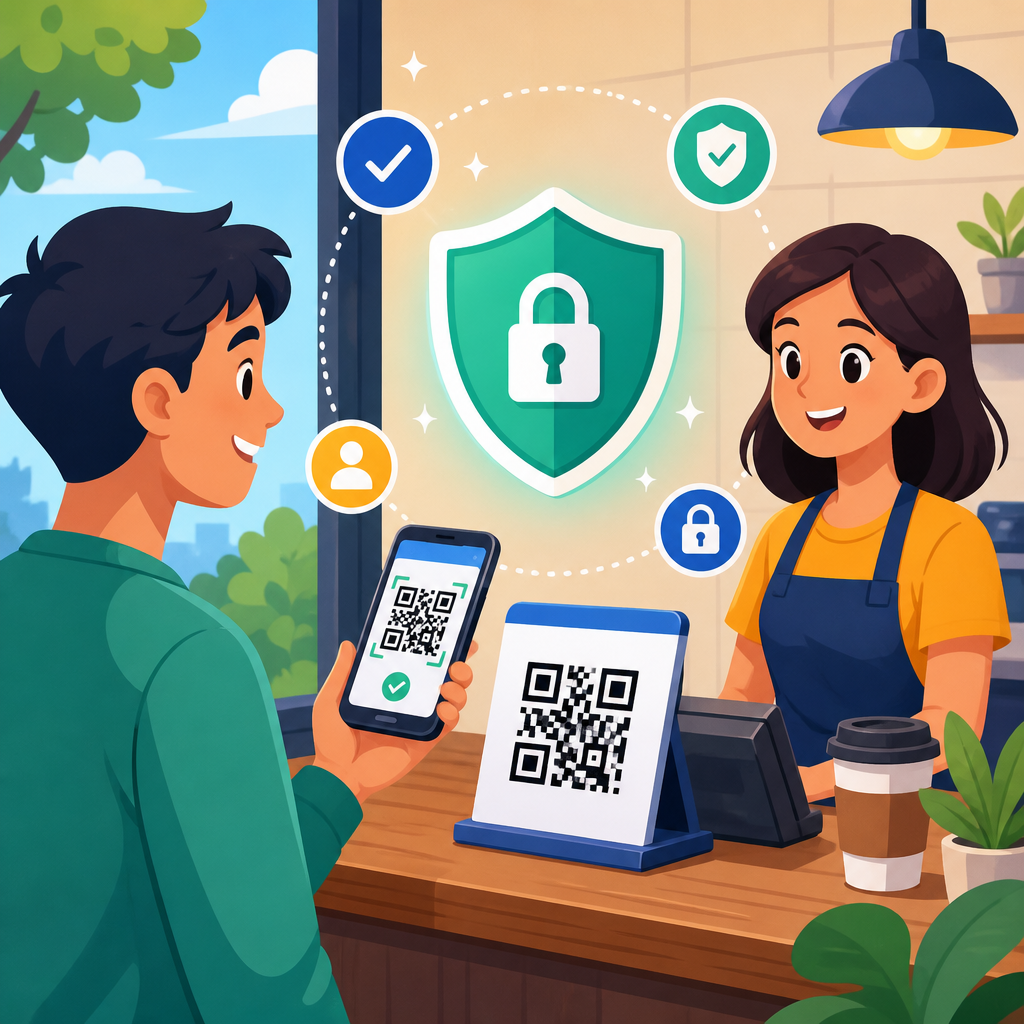
Most secure implementations also add customer authentication before funds move. That usually means device PIN, fingerprint, or face recognition. If the wallet uses tokenized credentials, the merchant never sees the underlying bank account or card number. When a QR code opens a secure payment app rather than a generic browser page, the user benefits from built-in certificate validation, fraud detection, and transaction confirmation screens. That distinction is important. A code linked to a regulated payment app is very different from a code that merely redirects to a website asking for credentials.
What makes QR code payments secure in practice
Several controls make QR code payments as secure as, and sometimes safer than, card-present transactions. First, encrypted communication protects data in transit between the app, gateway, processor, and issuing bank. Second, tokenization replaces sensitive account details with non-sensitive substitutes, limiting the value of intercepted data. Third, strong customer authentication, especially biometrics, reduces unauthorized use if a phone is lost. Fourth, transaction alerts let users detect fraud quickly. Fifth, dynamic codes prevent reuse and often expire within minutes, reducing opportunities for manipulation.
Payment networks and regulated wallets also apply machine-learning fraud models. These systems evaluate device fingerprint, geolocation consistency, behavioral history, merchant category, velocity, and anomaly signals before approving a transaction. A user who usually pays in one city but suddenly initiates multiple high-value QR transactions from another country may trigger stepped-up verification or a decline. Banks have used similar controls for years in mobile banking and e-commerce; QR payments benefit when they ride on those same rails rather than operating as a thin redirect layer.
Merchant controls matter just as much. A QR payment channel is secure when the merchant account is verified, settlement accounts are locked down, refund rights are role-based, and the POS generates auditable logs. Good implementations match payment confirmations to order IDs automatically instead of relying on staff to accept screenshots. In my experience, screenshot acceptance is one of the most avoidable failure points. A fake success screen can fool a busy cashier, while server-to-server confirmation from the acquirer cannot.
| Security factor | Why it matters | Stronger option | Higher-risk option |
|---|---|---|---|
| Code type | Determines reuse and tampering exposure | Dynamic QR per transaction | Static QR reused all day |
| User authentication | Prevents unauthorized payments | Biometric or app PIN confirmation | No app lock or weak device access |
| Payment destination | Controls where funds actually go | Verified merchant ID in wallet app | Browser page with manually entered details |
| Merchant confirmation | Reduces fake proof-of-payment fraud | Real-time server confirmation | Cashier checks customer screenshot |
| Operational governance | Limits internal errors and abuse | Restricted refunds and audit logs | Shared staff accounts and poor monitoring |
The biggest QR code payment risks consumers and merchants face
The most publicized risk is code replacement, sometimes called quishing when used for phishing. A fraudster places a sticker over a legitimate merchant QR code, redirecting victims to a fake payment page or to a different wallet destination. This attack works because people trust visible codes and often scan without checking the domain, merchant name, or app prompt. Restaurants, parking meters, charity posters, and public kiosks are frequent targets because they use unattended displays. The fix is straightforward but non-negotiable: inspect physical codes, prefer tamper-evident placement, and make the payment destination visible in the app.
Another common risk is fake payment confirmation. In markets where staff manually verify a customer’s phone screen, criminals can show edited images, delayed transfers, or lookalike app interfaces. This is not a flaw in QR technology; it is a process failure. Merchants should rely on POS-integrated payment status updates, printed confirmations, or merchant app notifications tied to the acquirer. If internet connectivity is unstable, staff need fallback rules, such as holding goods until the payment arrives in the merchant dashboard.
There are also privacy and account security concerns. A malicious QR code can open a page designed to harvest card credentials, online banking logins, or one-time passcodes. Some can trigger app downloads that install malware on unsecured Android devices. Meanwhile, legitimate providers still create risk if they collect more personal data than necessary or fail to store it properly. Businesses should evaluate providers against standards such as PCI DSS where card data is involved, plus local privacy laws and central bank guidance for account-to-account systems.
Static versus dynamic QR codes for payments
Dynamic QR codes are more secure for most commercial use cases because they reduce ambiguity and improve traceability. Each code can contain a unique transaction reference, exact amount, merchant terminal ID, and an expiration timer. That means if a code is captured in a photo, it may already be invalid by the time someone tries to reuse it. Dynamic codes also simplify refunds, charge investigations, and reconciliation because every payment maps cleanly to a specific basket or invoice.
Static QR codes still have a place, especially for micro-merchants, tips, donations, and low-complexity peer-to-business payments. They are inexpensive, easy to print, and compatible with basic account-to-account schemes. However, their simplicity creates tradeoffs. Customers may need to type the amount manually, which introduces error. The same code is exposed for long periods, making sticker replacement easier. And reconciliation can become messy if many customers pay similar amounts without separate invoice identifiers.
If a business wants both affordability and security, a practical compromise is to use static codes only where values are low and operational supervision is high, then move to dynamic codes for staffed retail, high-volume checkout, delivery orders, and invoice-based payments. That is how many merchants mature the channel: start simple, then upgrade once QR payment volume becomes material.
How banks, wallets, and merchants reduce fraud
The most effective fraud prevention approach is layered security. Banks and wallets start by onboarding users with identity checks, device registration, and app hardening. Many use certificate pinning, jailbreak or root detection, and risk-based authentication. Transaction engines then score each payment in real time. Some providers also support transaction signing, where the user approves exact details inside the app, making man-in-the-middle manipulation far harder.
Merchants add a second layer through integration quality and store operations. POS-linked dynamic QR generation prevents staff from entering wrong amounts. Merchant dashboards should separate approval, refund, and settlement roles. Physical signage should tell customers the exact merchant name they should see before authorizing payment. High-risk environments such as fuel pumps, parking locations, and public event spaces should be inspected for sticker overlays daily, the same way card skimmers are checked on terminals.
Network and scheme design matters too. National real-time payment systems in countries such as India, Brazil, and Singapore have accelerated QR payment adoption by combining interoperable standards with regulated participants. India’s UPI QR ecosystem, Brazil’s Pix, and Singapore’s SGQR show that security improves when users pay within trusted banking or wallet apps tied to strong account verification and instant confirmation. Fraud has not disappeared in these markets, but the primary attack vectors usually involve social engineering, mule accounts, or fake interfaces rather than the QR symbol itself.
Best practices for consumers and businesses using QR codes in payments
Consumers should treat payment QR codes the same way they treat links in email or text messages: useful, but worth verifying. Scan only codes from trusted merchants, check the merchant name shown in the app, review the amount before confirming, and avoid entering banking credentials into pages opened by an unknown code. Keep the phone operating system updated, install payment apps only from official app stores, and enable biometric login plus transaction notifications. If a payment seems wrong, contact the bank or wallet provider immediately and document the transaction time and merchant location.
Businesses should choose providers with strong integration, clear fraud workflows, and auditable settlement reporting. Use dynamic QR codes whenever possible. Do not accept screenshots as proof of payment. Train staff to verify real-time confirmation and to inspect printed codes for tampering. Lock down who can change settlement accounts, issue refunds, or print new static signs. For larger merchants, QR code payments should be included in the same risk register as card payments, e-commerce checkout, and account takeover prevention.
Are QR code payments secure? Yes, when they are implemented through trusted payment apps, protected by strong authentication, and supported by disciplined merchant operations. The code is only the doorway; the real security comes from the identity checks, encrypted rails, dynamic transaction data, and confirmation systems behind it. For consumers, the benefit is fast, contactless payment without exposing full card details. For businesses, the benefit is lower acceptance friction and broader digital payment reach, often at lower hardware cost. If you are building or evaluating a QR payment program, start with dynamic codes, app-based confirmation, and staff training, then expand from that secure foundation.
Frequently Asked Questions
Are QR code payments actually secure?
Yes, QR code payments can be very secure when they are supported by trusted payment apps, encrypted payment networks, and strong authentication controls. The QR code itself is usually just a way to pass payment information quickly, such as a merchant ID, invoice details, or payment link. The real security comes from what happens after the scan: whether the transaction is processed over secure payment rails, whether the app verifies the merchant, and whether the user must authenticate with a PIN, password, fingerprint, or face ID before sending money. In other words, the code is not the security layer by itself; it is simply the trigger for a payment workflow.
For businesses, secure QR payments depend on using reputable providers, generating codes dynamically when appropriate, monitoring transactions, and controlling how codes are displayed and managed. For consumers, safety improves when they scan only codes presented by legitimate merchants and review the payment details before authorizing the transaction. When those protections are in place, QR code payments can be just as secure as many other digital payment methods, and in some cases even safer than handing over a physical card that can be lost, copied, or skimmed.
What are the biggest security risks with QR code payments?
The most common risks do not come from the QR format itself but from fraud and poor operational controls around it. One major threat is QR code tampering, where a criminal places a fake code over a legitimate one so the payment is redirected to a different account. Another is phishing, sometimes called “quishing,” where a QR code leads the user to a fake payment page designed to capture login credentials or card details. Fraud can also happen if users scan codes from unverified emails, flyers, text messages, or websites that imitate real merchants.
There are also risks tied to weak app security, unsecured devices, and human error. If a customer’s phone is compromised, if a merchant account is poorly protected, or if transaction details are not reviewed before payment approval, the chance of misuse increases. Static QR codes may carry more operational risk than dynamic ones because they can be copied, replaced, or reused more easily if not carefully monitored. The good news is that these risks are manageable. Businesses can reduce exposure through tamper checks, secure placement, merchant verification, staff training, and transaction monitoring, while consumers can protect themselves by using official apps and confirming payment details before they authorize a transfer.
How can businesses make QR code payments more secure for customers?
Businesses can significantly improve QR payment security by focusing on the full payment environment, not just the code displayed at checkout. The first step is choosing a reputable payment provider that offers encrypted processing, tokenization where applicable, fraud detection tools, and strong merchant account protections. Businesses should also use dynamic QR codes whenever possible, especially for order-specific or amount-specific transactions. Dynamic codes are generally safer because they can contain limited-use transaction data and reduce the risk of code reuse or manual payment errors.
Operational controls matter just as much. Merchants should place QR codes where staff can monitor them, inspect them regularly for tampering, and replace damaged signage immediately. If printed codes are used, they should be produced and distributed under controlled conditions to prevent unauthorized substitutions. Businesses should also train employees to recognize suspicious activity and help customers verify that they are paying the correct merchant and amount. On the digital side, secure dashboards, multi-factor authentication for merchant accounts, audit logs, and transaction alerts add another layer of defense. When businesses treat QR code payments as part of a larger security system rather than a simple image on a counter, customer trust and payment safety both improve.
What should consumers do to stay safe when using QR code payments?
Consumers should start by scanning QR codes only from sources they trust, such as inside a legitimate store, on a verified invoice, or within a reputable merchant’s official app or website. Before completing a payment, they should always check the merchant name, payment amount, and destination details shown in the app. If anything looks unusual, including a misspelled business name, a strange URL, or a payment request that feels rushed, it is best to stop and confirm with the merchant directly. A quick review before tapping “pay” can prevent many of the most common QR-related scams.
It is also smart to use payment apps that require strong authentication, keep the phone’s operating system updated, and avoid scanning random codes posted in public places or shared through unsolicited messages. Consumers should be cautious if a QR code opens a browser page asking for excessive information, login credentials, or card details outside the expected payment flow. Turning on transaction notifications and reviewing account activity regularly can help catch unauthorized payments quickly. In short, safe QR payment behavior comes down to using trusted apps, verifying what is on screen, and treating unfamiliar codes with the same caution you would give to suspicious links or payment requests.
Are QR code payments safer than credit cards or contactless payments?
QR code payments are not automatically safer or less safe than credit cards or contactless payments; it depends on how each method is implemented. A well-designed QR payment flow that uses secure apps, encrypted networks, and biometric authentication can be highly secure. In some situations, it may reduce certain risks because the customer does not need to hand a card to someone else or insert it into unfamiliar hardware. That can limit exposure to card skimming, damaged terminals, or manual card handling. QR payments can also offer clear on-screen transaction details before approval, giving users a valuable chance to verify what they are paying.
That said, contactless card payments and mobile wallets also benefit from mature security technologies such as tokenization, EMV standards, and device-based authentication. QR payments introduce a different risk profile, particularly around fake codes, deceptive links, and code replacement in physical environments. The key takeaway is that no payment method is secure by default in every situation. Security depends on provider quality, merchant controls, user verification, and fraud prevention tools. When implemented correctly, QR code payments are absolutely capable of meeting modern security expectations and can be a reliable option for both businesses and consumers.