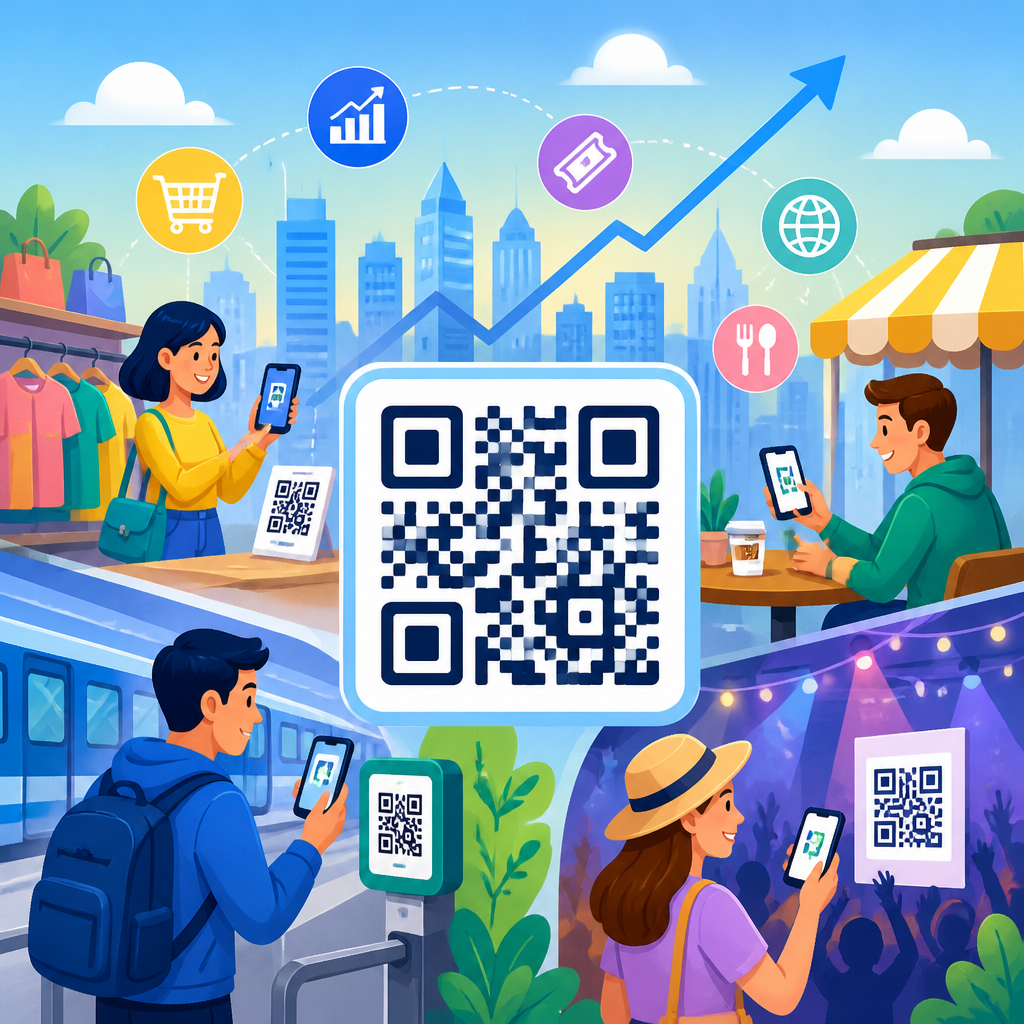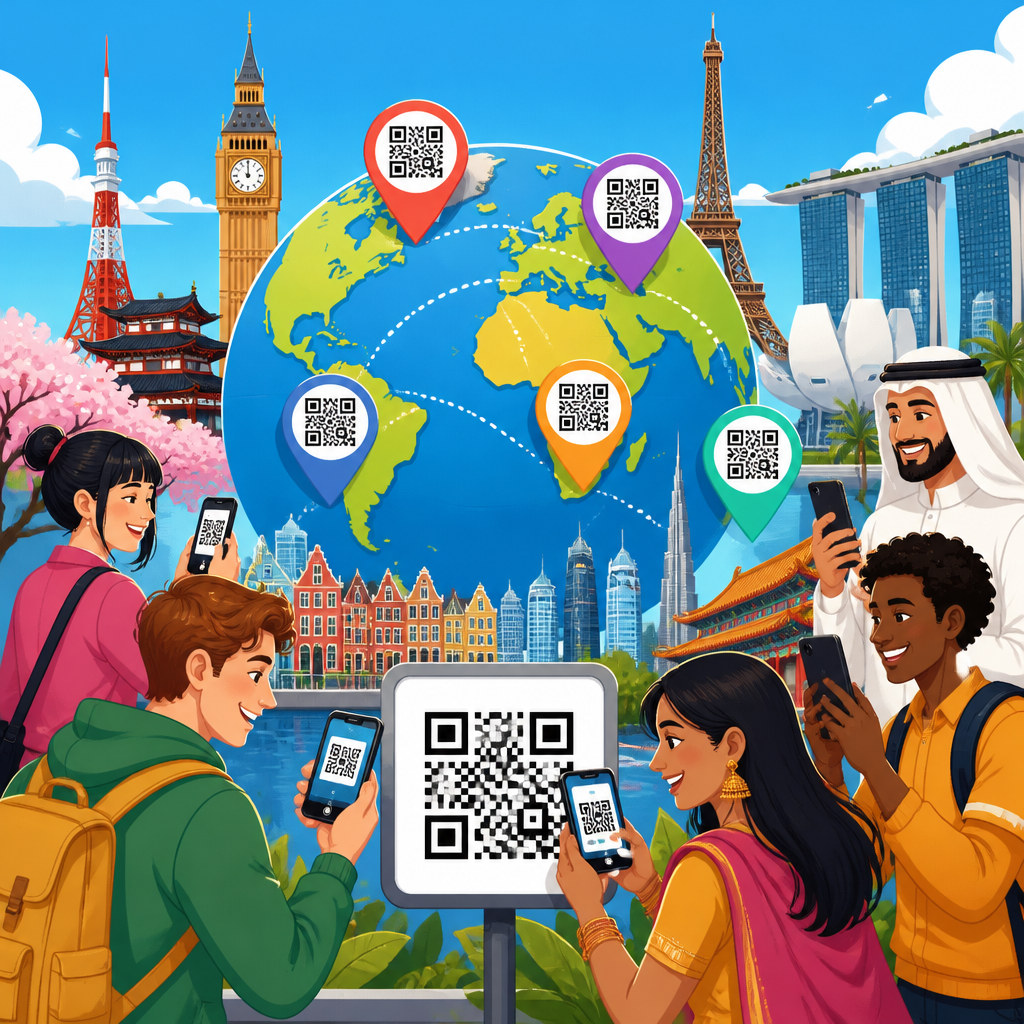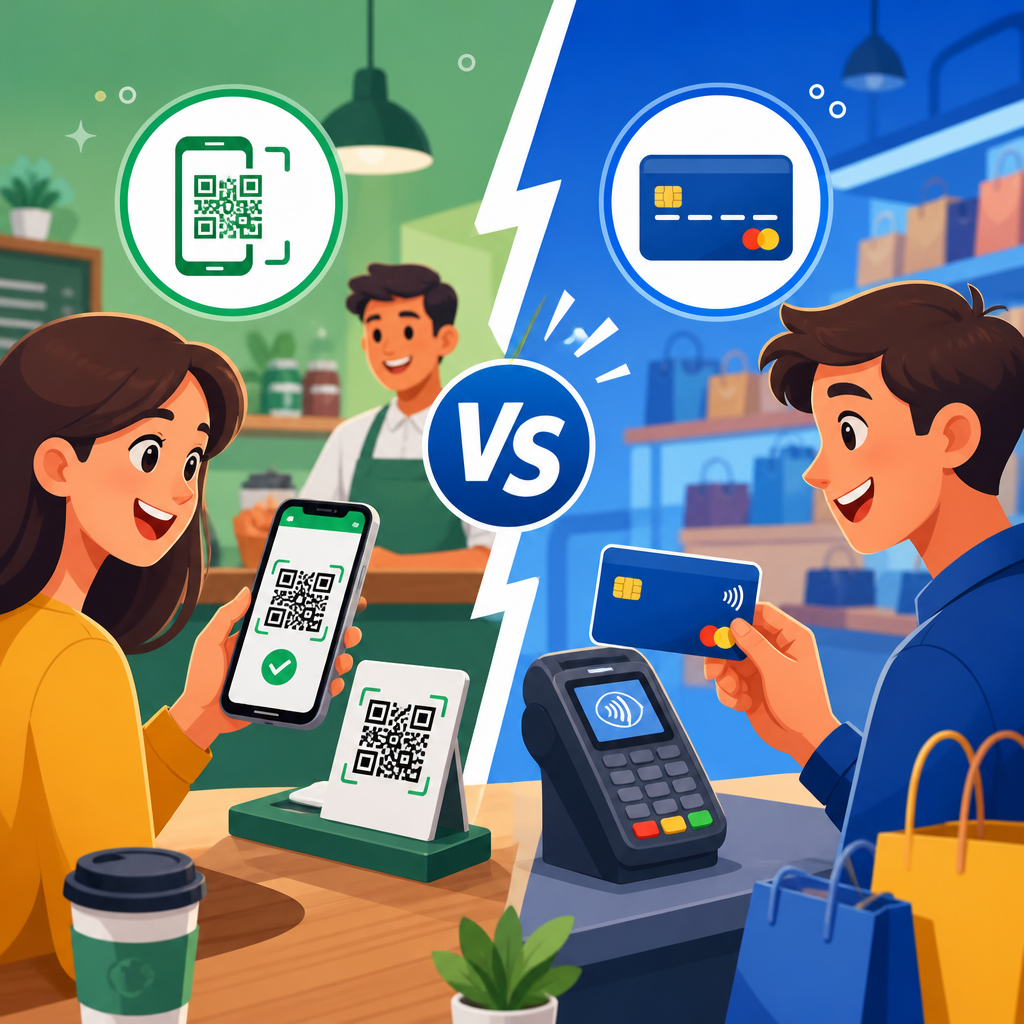
QR code payments and credit cards now compete at the checkout counter, in apps, at restaurant tables, and inside invoices, forcing businesses and consumers to decide which payment method delivers the best mix of convenience, cost control, security, and acceptance. A QR code payment is a transaction initiated by scanning a machine-readable code with a smartphone, usually through a banking app, digital wallet, or merchant payment app. A credit card payment relies on card network rails such as Visa, Mastercard, American Express, or Discover, whether the card is inserted, tapped, swiped, or stored on file. Both methods can complete a sale in seconds, yet they work very differently behind the scenes.
In payment operations, those differences matter. Over the last several years, I have helped merchants compare acceptance costs, reconcile settlement reports, and troubleshoot failed customer payments, and the same questions come up repeatedly: Are QR code payments cheaper than cards? Are they safer? Do customers trust them? Can they support refunds, subscriptions, and international buyers? The answers depend on use case. A street market vendor, a hospital billing team, and an online retailer face different economics and customer expectations, so there is no universal winner. There is, however, a clear framework for choosing wisely.
This hub article explains QR codes in payments comprehensively, because the topic spans far more than simply placing a printed square near a register. Payment QR codes can be static or dynamic, merchant-presented or customer-presented, interoperable across banks or tied to a single wallet, and processed in real time or through deferred settlement. Credit cards, meanwhile, bring decades of consumer protections, chargeback mechanisms, rewards ecosystems, and near-universal familiarity. Understanding these mechanics helps businesses reduce friction and helps buyers choose the tool that best fits the moment.
The reason this comparison matters now is simple: payment behavior is fragmenting. In markets such as India, Brazil, China, Singapore, and Indonesia, QR-based account-to-account payments have become mainstream. In the United States and much of Europe, cards still dominate, but QR payment use is growing in restaurants, parking, peer-to-peer transfers, event ticketing, self-checkout, and invoice collection. Merchants are under pressure to lower processing fees, while consumers want fast, contactless, low-effort checkout. Against that backdrop, comparing QR code payments vs credit cards is no longer theoretical. It is an operational decision that affects conversion rates, cash flow, fraud exposure, and customer satisfaction.
How QR code payments work and where they fit
A QR payment starts with encoded payment information. In a merchant-presented model, the seller displays a code at a counter, on a terminal screen, on packaging, or inside an invoice. The buyer opens a banking or wallet app, scans the code, confirms the amount, and authorizes the transfer with a PIN, biometric check, or device passcode. In a customer-presented model, the buyer shows a code generated by a wallet app, and the merchant scans it. That second model is common in some closed-loop systems, but the merchant-presented version is more widely discussed because it is simple to deploy and works in physical and remote settings.
There are two core QR formats in payments. A static QR code usually contains merchant account details or a payment alias. The customer often enters the amount manually, which makes static codes inexpensive and useful for microbusinesses, donations, table service, and printed bills. A dynamic QR code contains transaction-specific data, such as the exact amount, invoice number, merchant identifier, and expiration timestamp. Dynamic codes reduce data entry errors, improve reconciliation, and support stronger fraud controls because the code can be tied to a single authorized transaction.
Examples show why QR codes have spread so quickly. India’s Unified Payments Interface made interoperable QR payments routine for everyone from taxi drivers to chain stores. Brazil’s Pix uses instant bank transfers and QR codes for person-to-business and bill payments. Singapore’s SGQR consolidated multiple schemes into a single label at the point of sale. In each case, adoption accelerated because the payment experience was easy for buyers and relatively affordable for merchants, especially small businesses that did not want expensive card terminals or card-present processing fees.
How credit card payments work and why they remain dominant
Credit cards remain the benchmark because they combine convenience, consumer credit, broad merchant acceptance, and mature dispute processes. When a shopper taps a contactless card or a card stored in Apple Pay or Google Pay, the merchant sends an authorization request through a payment processor, acquiring bank, and card network to the issuing bank. The issuer approves or declines based on available credit, fraud rules, account status, and transaction details. Settlement follows later, usually in batches, with interchange, scheme fees, processor markups, and gateway fees deducted along the way.
The card ecosystem has become highly refined. EMV chips reduced counterfeit fraud in card-present environments. Network tokenization protects stored credentials and mobile wallet transactions. Strong Customer Authentication in Europe added extra controls for many online card payments. Chargebacks, while painful for merchants, offer a safety valve for consumers when goods do not arrive or card details are misused. Rewards also matter. Many consumers prefer cards because cashback, airline miles, purchase protection, and interest-free grace periods create value beyond the payment itself.
Cards also work exceptionally well across channels. A single credit card can support in-store purchases, subscriptions, hotel bookings, recurring software billing, cross-border ecommerce, and preauthorization holds for rentals or incidentals. That versatility explains why businesses rarely replace cards entirely, even when they promote QR payments. In practice, cards are often the default acceptance layer, while QR codes are added to serve cost-sensitive transactions, mobile-first customers, or local instant payment schemes.
Cost, speed, security, and user experience compared
The most practical way to compare QR code payments vs credit cards is across the operating factors merchants and consumers feel every day.
| Factor | QR Code Payments | Credit Cards |
|---|---|---|
| Merchant cost | Often lower when routed over account-to-account rails; may have flat or minimal fees in national instant payment systems | Usually higher due to interchange, assessment, processor, and gateway fees |
| Settlement speed | Can be real time or near real time, depending on scheme | Commonly one to three business days, though faster funding exists |
| Consumer protection | Varies by wallet, bank, and country; irreversible transfers can limit dispute rights | Generally strong dispute and chargeback rights |
| Acceptance | Excellent in some local markets, uneven globally | Broad domestic and international acceptance |
| Fraud profile | Less card theft risk, but vulnerable to spoofed or tampered codes and social engineering | Subject to card-not-present fraud, stolen credentials, and friendly fraud |
| User experience | Fast for mobile users; may require opening the correct app and internet access | Very fast for tap-to-pay; familiar for nearly all shoppers |
For merchants, cost is often the first deciding factor. In several instant payment systems, QR transactions can cost materially less than card acceptance because they bypass card interchange. A café processing thousands of low-ticket purchases may save meaningful margin with QR-led payments. Yet lower fees do not automatically equal better economics. If customers abandon checkout because they prefer cards, or if a business spends more time managing exceptions and refunds, the apparent savings can shrink quickly.
Security is more nuanced than simple claims of one method being safer. QR codes do not expose card numbers because there may be no card credential involved at all. That is a real advantage. But QR payments create different attack surfaces. Fraudsters can place stickers over legitimate merchant codes, redirecting funds to another account. Customers can be tricked into authorizing push payments that are difficult to reverse. Dynamic codes, signed payloads, trusted merchant apps, and visible payee verification reduce these risks significantly. Credit cards, by contrast, benefit from mature fraud monitoring systems, tokenization, and zero-liability policies, but they still suffer from stolen credentials and costly disputes.
Where QR payments outperform cards and where cards still win
QR payments are strongest when a buyer already uses a banking or wallet app, the merchant wants lower acceptance costs, and the transaction does not require revolving credit. They work especially well in face-to-face retail, utility payments, transit top-ups, food stalls, service invoices, event concessions, and table ordering. I have seen small merchants go live with QR acceptance in a single afternoon using printed displays and a settlement account, avoiding terminal rental entirely. For pop-up stores and seasonal vendors, that simplicity is a major operational advantage.
They also excel in remote but not fully ecommerce-like scenarios. A contractor can place a dynamic QR code on an invoice. A clinic can send a payment link with an embedded QR code for desktop users who want to complete the transfer on mobile. A restaurant can print a table-specific code that opens the menu, captures the order, and accepts payment without waiting for staff to bring a card machine. In each case, the QR code reduces friction by bridging physical and digital touchpoints.
Credit cards still win in several high-value scenarios. Travel bookings, car rentals, hotels, and subscription businesses depend on card rails because they need preauthorizations, delayed capture, recurring billing, and universal cross-border acceptance. Consumers making expensive purchases often prefer the chargeback rights and reward points attached to cards. Online stores selling internationally also lean heavily on cards because foreign buyers may not have access to the seller’s domestic QR scheme. If a business needs one payment method that works for the broadest audience with the fewest onboarding constraints, credit cards remain the safer baseline.
Implementation, compliance, and measurement for businesses
Choosing between QR code payments and credit cards should start with transaction mapping, not trend chasing. List your channels, average order value, refund rate, customer demographics, and geography. Then review technical requirements. Dynamic QR deployment usually needs a payment service provider, POS integration, order management mapping, and settlement reconciliation rules. Static QR deployment is easier, but internal controls become more important because staff must verify amounts and payment confirmations carefully. Businesses should document how they will handle partial refunds, duplicate scans, offline scenarios, and customer support when a bank app times out.
Compliance matters too. Card acceptance brings PCI DSS obligations, chargeback monitoring, and network rules. QR-based account payments can reduce card data exposure, but they still require secure API integration, device security, access controls, customer authentication, and privacy compliance for transaction records. If a QR program uses a wallet or local bank transfer scheme, merchants need to understand scheme operating rules, refund windows, and liability allocation. The safest deployments use dynamic codes, trusted deep links, clear merchant names, and visible confirmation screens that match the POS receipt.
Measurement should be equally rigorous. Track payment mix, authorization success, time to settlement, effective processing cost, average refund handling time, and customer adoption by channel. Compare conversion when QR is offered alongside cards rather than replacing them. Many merchants discover the best answer is not QR code payments versus credit cards, but QR code payments and credit cards together. Offer both, guide customers toward the lower-cost rail where it makes sense, and keep cards available for high-trust, high-flexibility use cases.
QR code payments are not a passing novelty, and credit cards are not becoming obsolete. They solve different payment problems with different strengths. QR codes shine when businesses want low-friction mobile payments, lower acceptance costs, and flexible deployment across counters, tables, invoices, posters, and packaging. Credit cards remain superior when customers want credit, rewards, strong dispute rights, and global acceptance. The better option depends on context: local retail and bill pay often favor QR, while travel, subscriptions, and international ecommerce still favor cards.
For businesses building a modern payment stack, the smartest strategy is usually layered acceptance. Start with the customer journey, add QR where it removes friction or lowers cost, and keep card acceptance where trust, reach, and payment flexibility matter most. For consumers, the practical rule is just as simple: use QR payments for fast, direct transactions you understand clearly, and use credit cards when you want protections, rewards, or broader usability. If you are planning your payment roadmap under the broader QR Code Trends & Innovations topic, audit your current checkout flows, measure the economics of each rail, and implement the mix that fits your customers best.
Frequently Asked Questions
1. What is the main difference between QR code payments and credit card payments?
The biggest difference is how the transaction starts and which payment rails usually sit behind it. A QR code payment begins when the customer scans a code with a smartphone using a banking app, digital wallet, or merchant payment app. The code may contain a payment link, merchant account details, invoice information, or a request for a specific amount. The customer then authorizes the payment on the phone, often with biometrics or a passcode. A credit card payment, by contrast, typically starts when a customer taps, inserts, swipes, or enters card details, and the payment is processed through card networks such as Visa, Mastercard, American Express, or Discover.
That difference affects the entire payment experience. QR code payments often feel especially convenient in restaurants, person-to-person transactions, e-commerce checkout flows, parking, ticketing, and invoice payments because they can remove the need for physical terminals or manual card entry. Credit cards remain highly familiar and standardized, which makes them easy to use in stores, online, in travel settings, and across international merchants. In simple terms, QR code payments are often app-driven and smartphone-centered, while credit cards are network-driven and card-centered, even when the card itself is stored digitally in a mobile wallet.
It is also important to understand that QR codes are not always a completely separate payment system. In some cases, scanning a QR code can still trigger a card-funded wallet transaction. In others, it may initiate an account-to-account bank transfer or wallet balance payment. That means the comparison is really about customer experience, cost structure, and infrastructure as much as it is about the visible payment method at checkout.
2. Are QR code payments safer than credit cards?
Both payment methods can be secure, but they manage risk differently. Credit cards benefit from decades of mature fraud controls, issuer monitoring, tokenization, EMV chip standards, chargeback rights, and broad consumer protection policies. If a credit card is compromised, cardholders often have strong dispute rights and limited liability, which is one reason consumers continue to trust cards for both online and in-person purchases. Merchants also benefit from a well-established ecosystem of fraud tools, though they may still absorb certain chargeback costs and compliance responsibilities.
QR code payments can also be very secure, especially when they route through trusted banking apps or reputable wallets with encryption, device authentication, and biometric approval. Because many QR transactions require the customer to log into a secure app and explicitly confirm the payment, they can reduce some risks associated with manual card entry or exposed card numbers. Dynamic QR codes, which are generated for a specific transaction, can be particularly useful because they may include exact payment amounts and order details, limiting human error and reducing certain tampering risks.
That said, QR code payments introduce their own threats. Criminals can replace legitimate codes with fraudulent ones, redirecting funds to the wrong account. Users may also be tricked into scanning malicious codes in phishing-style scams. Credit cards face more traditional risks like stolen card numbers, skimming, and card-not-present fraud. In practice, the safer option depends on execution. A trusted, well-designed QR system with dynamic codes, secure apps, and clear verification steps can be extremely safe. A properly managed credit card environment with EMV terminals, tokenized online payments, and strong fraud screening is also very safe. For consumers, credit cards often still offer stronger formal dispute protection. For businesses, security success depends more on implementation quality than on the payment label alone.
3. Which is better for businesses: QR code payments or credit cards?
For businesses, the better option depends on cost sensitivity, customer preferences, transaction environment, and operational goals. QR code payments can be attractive because they may lower hardware needs, simplify setup, and in some cases reduce processing costs, especially when transactions move through bank transfer rails or local real-time payment systems rather than traditional card networks. Small businesses, restaurants, market vendors, service professionals, and invoice-based businesses often like QR payments because they can accept money with minimal equipment and present payment options on tables, receipts, signs, websites, or digital invoices.
Credit cards, however, still offer major business advantages. They are widely accepted, familiar to nearly every customer, and highly effective at reducing checkout friction in both physical and online environments. Consumers are used to earning rewards, paying later, and relying on credit lines, which can increase purchase confidence and even average order value. Credit cards also integrate deeply with point-of-sale systems, recurring billing tools, e-commerce platforms, and subscription models. For many businesses, refusing or limiting card acceptance would mean turning away customers who expect to pay with a card.
From a cost perspective, QR payments may look appealing because some setups have lower merchant fees than credit card processing. But businesses should evaluate the full picture: settlement timing, reconciliation, refund handling, customer support burden, fraud exposure, accounting integration, staff training, and customer adoption rates. A cheaper payment type is not automatically better if it slows checkout or causes abandonment. In most cases, the best business decision is not choosing one over the other entirely. It is offering both, so customers can pay the way they prefer while the business balances convenience, acceptance, and cost control.
4. Which payment method is more convenient for consumers and everyday use?
Convenience depends heavily on context. Credit cards remain one of the most convenient payment tools for everyday spending because they are accepted almost everywhere, work online and offline, and do not require the consumer to open a separate banking app for each purchase. Whether the customer taps a physical card, uses a saved card online, or pays through a mobile wallet, the experience is usually fast and familiar. Cards are especially convenient for travel, hotel bookings, car rentals, subscriptions, and purchases where preauthorization or delayed settlement is common.
QR code payments can be even more convenient in the right scenarios. At a restaurant table, scanning a QR code to view the bill and pay without waiting for a server can feel faster than using a card terminal. For invoices, utility payments, donations, transit, event tickets, or social commerce, QR codes can eliminate typing errors and reduce steps. They are also useful when the merchant wants to accept payment without investing in traditional card terminals. In app-based and mobile-first environments, QR can feel frictionless, particularly in markets where consumers already use bank apps or super apps every day.
Still, convenience is shaped by habit and acceptance. If a consumer must unlock a phone, open the right app, scan the code, verify the amount, and confirm the payment, QR may feel slower than simply tapping a card. If phone battery life, internet access, or app compatibility becomes an issue, cards may be more reliable. On the other hand, if the merchant has no terminal available or the card machine is slow, QR may be much easier. For most consumers, credit cards win on universal convenience, while QR code payments excel in specific mobile-driven, self-service, and low-hardware situations.
5. Will QR code payments replace credit cards in the future?
QR code payments are growing quickly, but they are unlikely to fully replace credit cards in the near future. Instead, the more realistic outcome is coexistence. QR payments solve real problems: they can be inexpensive to deploy, flexible across channels, and highly effective in smartphone-first markets. They work well for peer-to-peer transfers, invoice collection, table-service restaurants, informal retail settings, and markets where account-to-account payments are strongly supported. As real-time payment systems expand and consumers become more comfortable authorizing payments in banking apps and wallets, QR adoption will continue to rise.
Credit cards, however, have durable strengths that are difficult to displace. They offer revolving credit, rewards programs, broad international acceptance, mature consumer protections, and seamless integration into countless commerce systems. Many consumers do not just use credit cards as a payment instrument; they use them as a short-term financing tool and a layer of purchase protection. That value proposition goes beyond checkout mechanics. Even if a QR code initiates the payment experience, the funding source behind it may still be a card.
For that reason, the future of payments is likely to be hybrid rather than winner-take-all. Businesses will increasingly present multiple options at checkout: tap-to-pay cards, saved cards in wallets, QR codes linked to bank transfers, buy now pay later services, and other digital methods. Consumers will choose based on speed, rewards, trust, and context. So the better question is not whether QR code payments will eliminate credit cards, but where each method fits best. In many industries, the strongest strategy will be to support both and let customer preference, economics, and use case determine the winning method in each transaction.