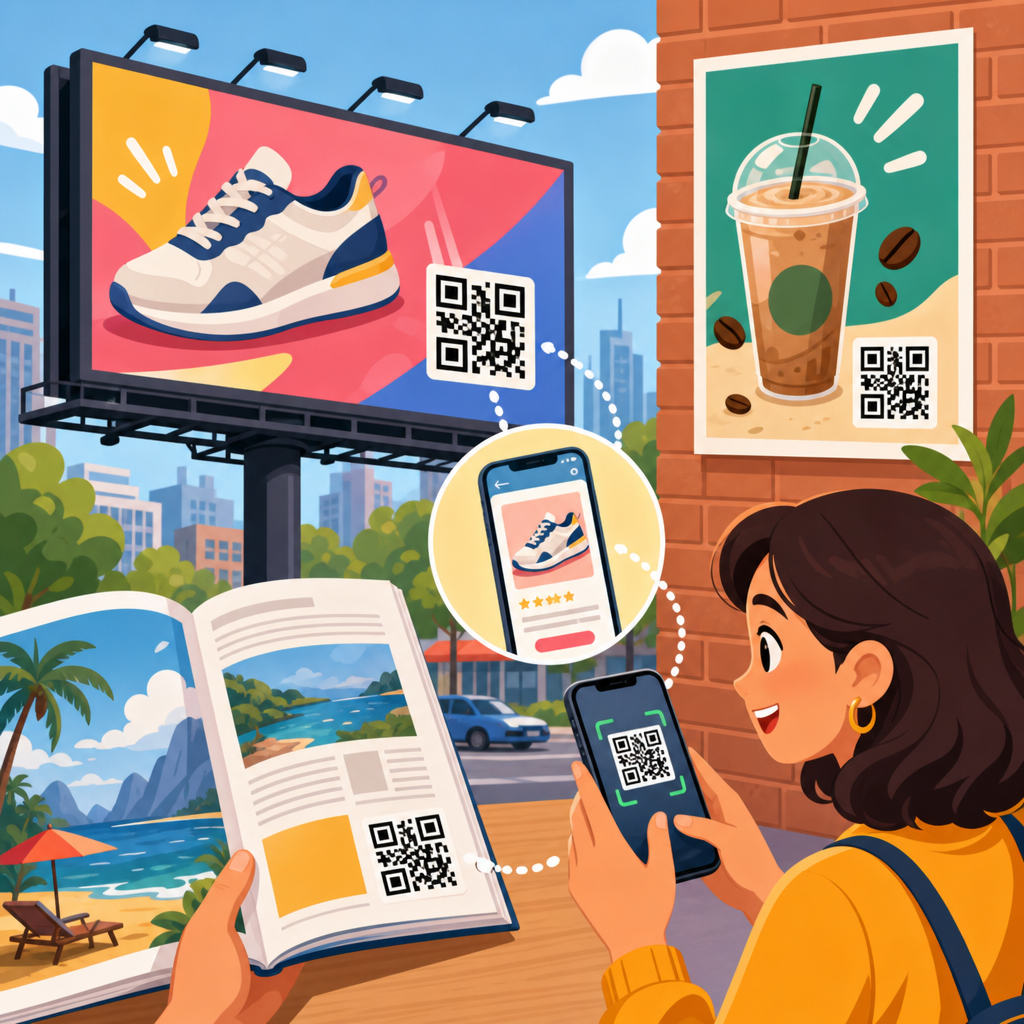
QR codes have become one of the most practical tools for connecting print, broadcast, and physical spaces with measurable digital experiences. In traditional advertising, a QR code is a scannable two-dimensional barcode that sends someone from an offline touchpoint such as a poster, brochure, mailer, package, billboard, shelf talker, magazine ad, or event sign to an online destination like a landing page, video, coupon, form, app store listing, or product catalog. When marketers talk about offline-to-online integration, they mean designing campaigns so that attention earned in the physical world continues in a digital environment where behavior can be tracked, nurtured, and converted.
I have used QR codes in direct mail, retail signage, trade show displays, transit ads, and restaurant table tents, and the pattern is consistent: results improve when the code is treated as part of the offer, not as a decorative afterthought. A code alone does not persuade anyone to scan. People scan when the benefit is obvious, immediate, and relevant to the moment. That is why integrating QR codes into traditional advertising matters. It reduces friction between interest and action, shortens the path to conversion, and gives offline media a clearer attribution model. It also lets brands personalize follow-up experiences, test creative by region or placement, and connect legacy channels to analytics platforms such as Google Analytics 4, Adobe Analytics, HubSpot, and Salesforce.
For a sub-pillar within QR code marketing strategy, this topic matters because it sits at the center of campaign planning. Print design, media buying, landing page optimization, mobile usability, tagging strategy, and compliance all intersect here. A strong hub page should answer the practical questions marketers ask before launch: where should the code appear, what should it link to, how should it be tracked, how large should it be, what mistakes reduce scan rates, and how do you judge whether the campaign actually worked. The best answers are operational. They connect creative choices to scan behavior, scan behavior to on-site engagement, and engagement to business outcomes such as leads, redemptions, appointments, downloads, and sales.
Done well, QR codes make traditional advertising interactive without forcing consumers to type long URLs or search manually. Done poorly, they create dead ends, broken trust, and wasted media spend. The difference comes down to strategy, execution, and measurement.
Choose the Right Offline Placement and Campaign Goal
The first step in integrating QR codes into traditional advertising is matching the code to the medium, the audience context, and the action you want next. A billboard viewed from a moving car is not the same as a postcard held in the hand. A product package scanned at home supports more detailed content than a subway poster scanned during a commute. In practice, each placement must answer one question: what can this person realistically do at the moment they see the ad?
For awareness media, QR codes work best when they continue interest rather than demanding a major commitment. A transit shelter ad for a fitness studio can send people to a class schedule, not a ten-field membership form. A magazine ad for a B2B software brand can offer a concise case study or benchmark report, then capture lead details on the next screen. A retail endcap can link to reviews, setup videos, or inventory by store. Direct mail often performs especially well because the recipient has time, proximity, and physical control of the piece; I have repeatedly seen postcards with a clear incentive outperform generic print ads because the scan happens in a calmer setting.
Goal clarity matters because it drives every downstream choice. If the campaign objective is coupon redemption, the destination should deliver the coupon instantly with a wallet-friendly or cashier-friendly format. If the goal is lead generation, the landing page should use progressive profiling, short forms, and CRM routing. If the goal is foot traffic, the page can prioritize maps, hours, and local inventory. If the goal is education, the best destination may be a comparison guide, product configurator, or FAQ built for mobile. The code is only the bridge; the destination must match user intent and campaign economics.
Placement also affects scanability. Indoor signage can use smaller codes because viewing distance is short and lighting is stable. Outdoor placements need larger print, high contrast, and more whitespace. On packaging, curvature and folds can impair scanners, especially near seams or glossy finishes. On TV or digital out-of-home, dwell time is critical; if a code appears for only two seconds, many viewers will miss it. In those cases, extending on-screen time, repeating the code, and adding a short vanity URL can improve accessibility.
Design QR Codes That People Will Actually Scan
Good QR code design balances brand presentation with technical reliability. Static codes store the destination directly and cannot be edited after printing. Dynamic codes redirect through a short URL, so the destination can be changed later and scan data can be captured by device, time, and location. For almost every paid traditional advertising campaign, dynamic codes are the safer choice because creative often ships before final landing pages are approved, and live optimization is usually necessary.
The technical basics are nonnegotiable. Use a dark code on a light background, maintain a quiet zone around the code, test print quality at actual size, and export in a format suitable for production, typically vector for print. Error correction can help if part of the code is obscured, but excessive logo overlays or stylized modules can reduce readability. I have seen brands force a code into low-contrast campaign colors and then wonder why scans lagged. A readable code beats a clever one every time.
Size depends on distance. A common print rule is that the scanning distance divided by ten approximates the minimum code size, though real-world testing matters more than formulas. A code on a flyer may work at under an inch square, while a store window or poster may need several inches. Material matters too. Matte finishes usually scan more reliably than reflective laminates under bright light. Curved bottles, textured cardboard, and perforated coupons deserve production proofs before the run is approved.
The call to action is just as important as the graphic. “Scan me” is weak because it describes the mechanism, not the reward. “Scan for today’s menu,” “Scan to compare plans,” “Scan for 15% off,” or “Scan to book your test drive” gives a concrete reason. Adding a line about what happens next reduces uncertainty and increases trust. Consumers are more likely to scan when they know they will reach a secure mobile page, a video demo, a local offer, or an exclusive download rather than an unknown destination.
Build Mobile Destinations That Complete the Offline-to-Online Journey
The landing experience determines whether the scan becomes a result. Every QR code campaign should assume the visitor is on a mobile device, may have limited time, and may be standing, walking, shopping, or multitasking. That means pages must load quickly, display the promised value immediately, and remove unnecessary steps. Core Web Vitals, responsive design, compressed images, and clear information hierarchy are not optional details; they directly affect conversion.
A high-performing mobile destination has one primary action. If the ad promised a coupon, show the coupon first. If it promised a product video, start with the video thumbnail and a short proof point. If it promised a local appointment, prefill location context and expose available times early. Every extra decision lowers completion rates. On campaigns I have managed, pages with a single focused action consistently outperformed pages that tried to serve as a general homepage substitute.
Message match is equally important. The headline, imagery, and offer on the landing page should mirror the traditional ad. If the poster says “See how the chair fits your space,” the page should open to a room-view visualizer or dimensions guide, not a category grid. This continuity reassures users that they arrived in the right place. It also helps analytics interpretation because bounce rates often signal a message mismatch rather than weak audience intent.
Offline-to-online integration also depends on what happens after the first click. A retailer can connect scans to store locator usage, cart adds, and loyalty enrollment. A healthcare clinic can route scans from a postcard into a location-specific appointment workflow. A manufacturer can use a QR code on a trade show banner to deliver a gated spec sheet, then trigger lead scoring in a marketing automation system. The destination should not just capture attention; it should enter the user into a defined journey with measurable next steps.
Track Attribution, Segmentation, and Performance Metrics
Measurement is where QR codes give traditional advertising a serious operational advantage. Every code should be linked to a campaign naming convention and tagged destination URL so scans can be analyzed by source, medium, placement, geography, product, and creative variant. UTM parameters remain the most common method for passing campaign data into analytics platforms. For more advanced setups, you can connect dynamic QR code platforms to customer data platforms, CRM records, call tracking systems, and point-of-sale reporting.
Meaningful metrics go beyond scan count. Scan rate relative to circulation or estimated impressions shows whether the placement and offer were compelling. Landing page engagement reveals whether the destination matched expectations. Conversion rate indicates whether the page and offer worked. Downstream metrics such as revenue per scan, qualified lead rate, cost per booked appointment, or coupon redemption rate show business value. A campaign with fewer scans but higher purchase intent may outperform one with broad curiosity and low conversion.
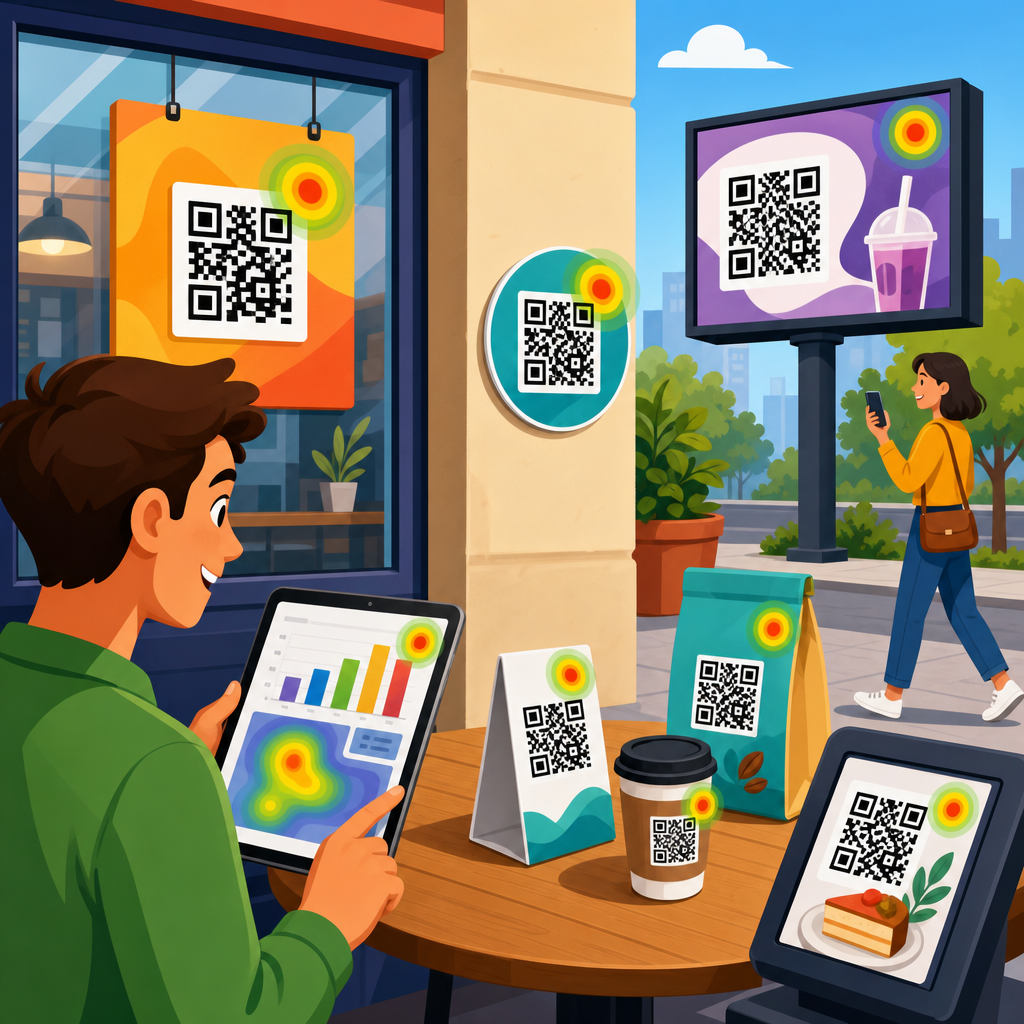
Segmentation improves decision making. Use unique QR codes for each ad size, audience segment, region, retailer, publication, or event asset. That lets you compare performance at the level where budget decisions are actually made. In direct mail, for example, separate codes by list segment and offer version. In retail, use one code for shelf signage and another for package inserts. In out-of-home, assign different codes to stations or neighborhoods. Granularity reveals where placement quality, audience fit, and local execution differ.
| Traditional ad channel | Best QR code destination | Primary KPI |
|---|---|---|
| Direct mail postcard | Personalized offer or appointment page | Conversion rate |
| Retail signage | Product reviews, specs, or local inventory | Assisted sales |
| Magazine ad | Guide, demo, or lead form | Qualified leads |
| Billboard or transit ad | Simple mobile landing page with locator or offer | Scans per impression |
| Trade show display | Spec sheet, meeting booking, or product video | Meetings booked |
Privacy and compliance should be built into tracking plans. If the destination collects personal data, the page must provide appropriate disclosures and consent mechanisms, especially in regulated categories. Avoid hidden redirects, insecure pages, or link shorteners that conceal the destination without context. Trust directly affects scan willingness.
Avoid Common Mistakes and Improve Results Over Time
Most QR code failures in traditional advertising come from avoidable execution errors. The most common is sending scans to a homepage. Homepages ask users to re-navigate and interpret too many choices. The second is weak connectivity between promise and destination. The third is poor physical design: tiny codes, bad contrast, cramped placement, or reflective materials. Another frequent issue is ignoring mobile page speed. If the page stalls on cellular data, the opportunity is gone.
Testing should happen before and after launch. Before launch, test with multiple phone models, camera apps, lighting conditions, and viewing angles. Confirm redirects, analytics tags, form behavior, and thank-you-page events. After launch, monitor by placement and time period, then optimize the underperforming variables. You may need a stronger call to action, a shorter form, a more immediate incentive, or a larger code. In one retail campaign I worked on, scans increased after we changed the line beneath the code from “Learn more” to “See compatibility and installation steps.” The audience wanted certainty, not general information.
Traditional advertising teams also need operational discipline. Designers, media buyers, web teams, analytics specialists, and sales stakeholders should agree on naming conventions, destination ownership, and reporting cadence before assets go to print. Dynamic codes help, but they do not solve governance problems by themselves. Someone still needs to validate redirects, retire expired offers, and maintain destination pages after launch.
As a hub topic within QR code marketing and strategy, offline-to-online integration is the practical bridge between creative intent and measurable performance. The strongest campaigns start with a clear user benefit, place the code where scanning is realistic, connect it to a fast mobile experience, and measure outcomes that matter to the business. If you want traditional advertising to produce traceable digital action, make QR codes part of the campaign architecture, not a late-stage add-on. Audit your current print and physical media, identify the moments where a scan would remove friction, and build one tightly aligned test campaign that you can measure end to end.
Frequently Asked Questions
1. How do QR codes improve traditional advertising campaigns?
QR codes make traditional advertising far more interactive, measurable, and action-oriented. Instead of asking someone to remember a website URL, search for a product later, or manually type in a promo code, a QR code gives them an immediate path from a physical ad to a digital experience. That simple scan can connect a poster, brochure, direct mail piece, product package, billboard, shelf display, or event sign to a landing page, video, coupon, appointment form, product catalog, or app download page in seconds.
One of the biggest advantages is convenience. Traditional advertising often creates awareness, but QR codes help close the gap between interest and action. If a customer sees your ad while commuting, shopping, or attending an event, they can respond in the moment rather than waiting until later, when intent may fade. That immediacy can increase engagement and improve conversion rates.
QR codes also introduce a level of tracking that many offline campaigns historically lacked. Marketers can monitor scans, landing page visits, time of engagement, device type, geographic trends, and downstream actions such as purchases or form submissions. This turns static placements into measurable performance channels. In practical terms, that means you can compare how a magazine ad performs against a mailer, test different calls to action, and make better budget decisions based on real user behavior rather than assumptions.
Just as importantly, QR codes help extend the life and usefulness of traditional media. A printed piece no longer has to carry every detail. Instead, it can focus on a strong headline, visual, and value proposition, while the QR code delivers richer digital content. That makes your offline advertising cleaner, more flexible, and better aligned with how modern audiences prefer to engage.
2. Where should you place QR codes in traditional advertising for the best results?
Placement matters just as much as the code itself. A QR code should appear where people can easily notice it, physically access it, and understand why they should scan it. In traditional advertising, that usually means placing the code near the core message, call to action, or offer rather than hiding it in a corner or surrounding it with clutter. If the viewer has to search for it or guess what happens next, scan rates usually drop.
Visibility and scanning distance are critical. A code on a brochure, countertop display, package insert, or direct mail piece can be smaller because people will likely scan it at close range. By contrast, a code on a billboard, transit ad, trade show banner, store window, or event sign needs to be larger and displayed in a location where users can safely and comfortably scan it. If someone has only a few seconds to view the ad, the code should not compete with too much text or appear in a location that is awkward to reach with a phone camera.
Context also influences performance. For example, a QR code on a product package may work best near usage instructions, promotional messaging, or loyalty program information. On a real estate sign, it should sit near the listing headline and drive to a mobile-friendly property page. On a restaurant flyer, it may perform best when paired with a menu preview, online ordering prompt, or limited-time discount. The most effective placements feel natural within the customer journey.
It is also smart to include a short supporting line of copy next to the code, such as “Scan to view the full catalog,” “Scan for a 15% coupon,” or “Scan to watch the demo.” That small instruction reduces uncertainty and increases motivation. In many campaigns, the combination of clear placement, a strong call to action, and a relevant destination has more impact than the visual design of the code itself.
3. What makes a QR code campaign successful in print, packaging, and other offline media?
A successful QR code campaign starts with a clear objective. Before generating a code, marketers should define what they want the audience to do: visit a landing page, claim an offer, watch a video, download an app, book an appointment, join a loyalty program, or learn more about a product. When the objective is specific, the destination, message, and call to action become easier to align. Without that clarity, QR codes often lead to generic pages that fail to convert.
The destination experience is just as important as the printed ad. If someone scans from a traditional ad, the landing page should load quickly, work perfectly on mobile devices, and match the promise made in the offline message. If the ad says “Scan for today’s coupon,” the user should not land on a homepage and be forced to hunt for the offer. Relevance and continuity are essential. The transition from physical media to digital content should feel seamless and intentional.
Design and usability also play major roles. The code needs enough contrast, sufficient quiet space around it, and an appropriate size for the viewing distance. It should not be distorted, stretched, or placed over a busy background that makes scanning difficult. Testing before launch is non-negotiable. Marketers should scan the code across different phones, screen settings, lighting conditions, print finishes, and real-world placement scenarios to make sure it works consistently.
Finally, high-performing campaigns usually offer a compelling reason to scan. Curiosity alone is rarely enough. A better incentive might be exclusive content, a discount, a product demonstration, a giveaway entry, a how-to guide, location-specific information, or faster access to something useful. When a QR code is paired with a strong value exchange and a frictionless mobile experience, it becomes much more than a technical feature—it becomes an effective response mechanism within traditional advertising.
4. How can marketers track and measure the performance of QR codes in traditional advertising?
QR code performance can be measured through a combination of scan analytics, web analytics, campaign tagging, and conversion tracking. At the most basic level, marketers can use dynamic QR codes that route through a trackable URL. This makes it possible to capture scan volume, time of day, approximate location, device type, and other engagement signals. Those insights help reveal how different offline placements are performing and where audience interest is strongest.
To go further, each advertising asset should have its own unique QR code or tracking parameter. For example, a retailer might assign separate codes to a window sign, an in-store shelf display, a direct mail postcard, and a magazine ad. Even if all of them lead to similar content, the unique tracking setup allows the marketer to compare results by channel, creative variation, geography, store location, or audience segment. That level of detail is what turns QR codes into a practical attribution tool for offline marketing.
Once users land on the destination, standard analytics tools can measure what happens next. You can track page views, bounce rate, time on site, form completions, purchases, coupon redemptions, video plays, and app installs. If you use UTM parameters or other campaign identifiers, the QR code scan can be connected to broader reporting dashboards. This gives teams a clearer picture of return on investment and helps answer key questions such as which ad drove the highest quality traffic and which offer generated the most conversions.
Measurement should also include qualitative evaluation. A code may receive many scans but produce poor results if the landing page is weak or the offer is not relevant. Conversely, a lower-volume placement may generate highly valuable leads. The best analysis looks at the full chain: exposure, scan rate, landing page engagement, and business outcome. When marketers review those metrics together, they can improve both the traditional ad and the digital experience behind it.
5. What are the most common mistakes to avoid when integrating QR codes into traditional advertising?
One of the most common mistakes is sending users to a generic homepage instead of a dedicated, mobile-optimized destination. A QR code creates immediate intent, and that intent should be met with a page that directly matches the advertisement. If someone scans a mailer about a specific service or a package promoting a limited-time offer, they expect to arrive at the exact information promised. Any mismatch creates friction and reduces the chance of conversion.
Another frequent issue is poor usability. Codes that are too small, low contrast, placed on reflective materials, wrapped around curved packaging, or printed in hard-to-reach locations can be difficult to scan. Marketers also sometimes place QR codes in environments where scanning is impractical, such as on fast-moving transit ads or billboards viewed from unsafe distances. The rule is simple: if the audience cannot comfortably scan it in the real world, the execution needs to be reconsidered.
A lack of instruction is another preventable problem. Many users still want a clear explanation of what they will get by scanning. A code with no context often feels ambiguous or untrustworthy. Adding a short call to action and a benefit statement significantly improves adoption. For example, “Scan to compare models,” “Scan for setup instructions,” or “Scan to claim your in-store discount” gives the audience both direction and motivation.
Finally, some brands fail to test, update, or maintain their QR code campaigns over time. Broken links, expired offers, slow pages, and outdated content can damage trust quickly. Dynamic QR codes are often the better choice because they allow you to update the destination without reprinting the ad. Even then, marketers should routinely verify that every code works, the destination remains relevant, and the analytics are properly configured. The most effective