Barcodes still run global commerce, but the question “Will QR codes replace barcodes completely?” has become far more urgent as packaging, payments, logistics, and customer engagement all shift toward data-rich labeling. A barcode is typically a one-dimensional symbol made of parallel lines that encodes a short numeric or alphanumeric identifier, while a QR code is a two-dimensional matrix that stores much more information and remains readable even when partially damaged. That basic difference explains why this debate matters. In my work with retailers, manufacturers, and product teams, I have seen companies treat barcodes as back-office infrastructure and QR codes as marketing tools, only to discover that the boundary is disappearing fast. Modern supply chains want faster scanning, better traceability, support for recalls, serialized inventory, authentication, and direct customer interaction from a single printed mark.
The future of QR code technology is not simply about one symbol winning and the other losing. It is about how identification standards evolve across checkout lanes, warehouse conveyors, industrial labels, pharmaceutical packaging, restaurant ordering, and omnichannel commerce. Consumers already use QR codes for menus, mobile payments, app downloads, product registration, and ticketing. Businesses use them for asset tracking, onboarding, maintenance records, and campaign attribution. Regulators and standards bodies are also pushing the market toward richer product data. GS1, the global standards organization behind the barcode system used in retail, has made clear through its Sunrise 2027 initiative that point-of-sale systems should be ready to scan two-dimensional codes that carry standard product identifiers plus extra attributes such as batch number or expiry date. That is a major signal, because standards adoption, not novelty, determines what scales globally.
For decision-makers, the practical issue is not whether QR codes are useful. They already are. The real issue is whether they can fully displace traditional barcodes across all environments. The honest answer is more nuanced than the headlines suggest. QR codes solve several limitations of linear barcodes, especially when more data, resilience, and smartphone readability are needed. Yet barcodes retain advantages in certain production, scanning-distance, and legacy-system contexts. Understanding where replacement is realistic, where coexistence is likely, and what technical and operational changes are required will help organizations invest correctly. This article serves as a hub on the future of QR code technology by covering standards, retail migration, logistics, consumer behavior, security, design constraints, and the long-term outlook.
Why QR codes are advancing faster than traditional barcodes
QR codes are advancing because they answer business problems that one-dimensional barcodes were never designed to solve. A standard UPC on a retail pack mainly identifies the product class. It tells the system what the item is, but not necessarily its unique history, expiration date, lot code, destination, or digital experience. A QR code can encode far more characters in a compact space and include error correction, which allows successful scans even when part of the symbol is scratched, curved, or printed on less-than-perfect packaging. In production environments, that extra resilience reduces misreads and rework. In consumer contexts, it turns the package into a digital touchpoint.
Smartphone compatibility is another decisive advantage. Almost every modern phone camera can scan a QR code natively, which means no specialized laser scanner is required for many uses. That simple fact changed adoption patterns after 2020. Restaurants switched to QR menus, transit systems expanded mobile ticketing, and brands started placing QR codes on shelves, ads, and packaging because customers could scan instantly without downloading a separate app. When a technology works with the hardware already in billions of pockets, adoption costs fall sharply. Traditional retail barcodes were never meant to be consumer-facing in the same interactive sense. They work well for checkout, but they do not inherently launch a tutorial, verify authenticity, or open a support page.
QR codes also support dynamic business models. A printed code can point to a managed URL that changes destination over time, enabling updated manuals, localized landing pages, warranty registration, or recall notices without changing the packaging. I have seen electronics brands use one code for setup videos, multilingual instructions, and replacement-part ordering, reducing printed inserts and support calls. None of that means the symbol itself is magical. It means the surrounding software stack, including redirect management, analytics, product information systems, and mobile web design, gives QR codes strategic value that standard barcodes usually lack.
Where traditional barcodes still hold strong advantages
Despite momentum behind QR adoption, linear barcodes are not obsolete. They remain deeply embedded in retail scanners, warehouse workflows, shipping labels, and enterprise software. Their biggest strength is installed infrastructure. Supermarkets, pharmacies, convenience stores, and distribution centers worldwide have scanners, scales, printer settings, quality controls, and staff habits built around UPC, EAN, and Code 128 formats. Replacing that ecosystem is not a matter of swapping graphics on packaging. It requires camera-based scanners, software updates, testing, retraining, supplier alignment, and compliance coordination across trading partners.
Barcodes can also be easier to scan in specific high-speed or long-range contexts. On a conveyor, a well-printed linear symbol can be captured rapidly when the system is tuned for that symbology and orientation. In some industrial applications, elongated barcodes fit narrow labels better than square matrix codes. Direct part marking on metal, tiny components, or cylindrical surfaces may favor one code type over another depending on the scanner, substrate, print resolution, and available quiet zone. The practical question is always environmental fit, not theoretical storage capacity.
Cost and simplicity matter too. If a business only needs a short product identifier and already has a stable process, a linear barcode remains efficient. More data is not always better when every extra field complicates governance. I have worked on packaging refreshes where teams wanted QR codes everywhere, but the underlying product data was inconsistent across markets, causing broken links and scan errors. In those cases, the older barcode kept operations running while the richer QR layer matured. That is why complete replacement has been slower than consumer enthusiasm suggests. Legacy systems are sticky because they work, scale, and are well understood.
How retail is moving toward two-dimensional product codes
Retail is the sector most likely to determine whether QR codes can replace barcodes at scale. The key driver is the shift from product identification alone to product identification plus attribute capture. A grocer may want to scan not only the item number but also weight, expiry date, lot number, or serialized details for recall management. A beauty retailer may want one symbol to support checkout, replenishment, anti-counterfeit verification, and post-purchase content. Two-dimensional codes can do that within established identification standards, which is why major retailers and brand owners are testing them now.
GS1 Digital Link is especially important in this transition. It allows a QR code or other two-dimensional carrier to contain a standards-based web structure that can resolve to different experiences for different users while still preserving structured product identifiers. In plain terms, the same code can serve a cashier, a warehouse system, and a shopper. At checkout, the scanner extracts the GTIN and any authorized attributes. On a phone, the same code can open ingredients, recycling instructions, or promotions. This multi-use capability is what makes QR codes more than a marketing add-on. It makes them candidates for primary product identification.
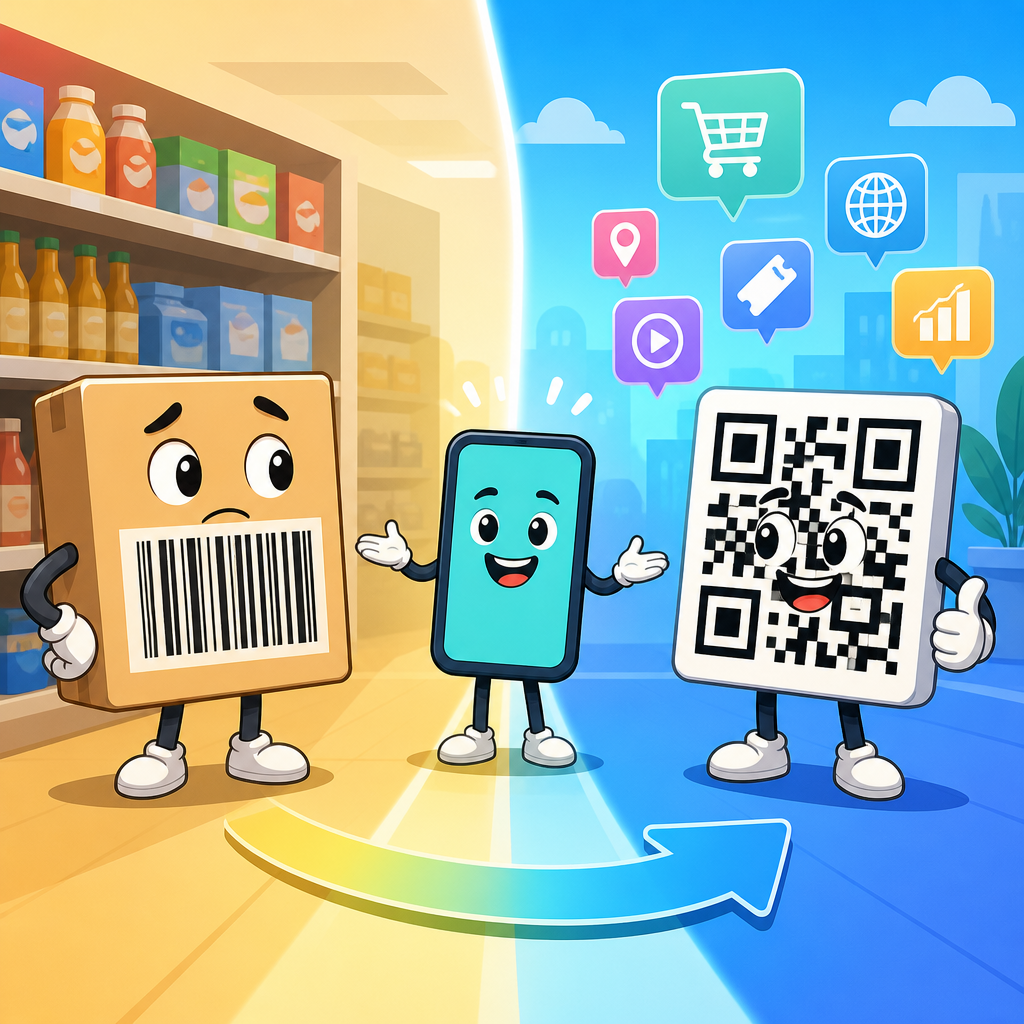
However, retail migration depends on scanner modernization. Laser scanners excel at reading one-dimensional barcodes but cannot read QR codes. Image-based scanners can handle both, but upgrading chains with thousands of lanes takes time and money. Suppliers also need print quality discipline. A tiny decorative QR code hidden in dark packaging may look modern and still fail on the shop floor. For that reason, many brands currently use both symbols side by side. In the near term, coexistence is the dominant model; in the longer term, two-dimensional codes are likely to become the primary retail standard where infrastructure supports them.
Comparing barcodes and QR codes across core use cases
The simplest way to evaluate replacement potential is to compare performance by use case rather than by hype. In warehouses, reliability, scan speed, and integration often matter more than consumer interactivity. In retail checkout, standards compliance and omnidirectional scanning are decisive. In marketing, smartphone accessibility and analytics dominate. In regulated industries such as healthcare, traceability, serialization, and data integrity can outweigh every other factor. When teams evaluate QR codes against barcodes in this context-specific way, decisions become clearer and less ideological.
| Use case | Barcode strength | QR code strength | Likely outcome |
|---|---|---|---|
| Retail checkout | Legacy compatibility, fast existing workflows | More data, one code for checkout and consumer content | Gradual migration to 2D as scanners upgrade |
| Warehouse logistics | Established labels and software support | Batch, serial, and status data in one symbol | Mixed use based on process design |
| Consumer packaging | Minimal identifier only | Phone scanning, dynamic destinations, analytics | QR dominant for engagement |
| Healthcare and pharma | Works for basic item coding | Serialization, expiry, traceability, authentication | 2D growth is strong and durable |
| Industrial parts | Fits long narrow labels in some settings | Error correction and dense encoding | Application-specific coexistence |
This comparison shows why absolute claims are usually wrong. QR codes are clearly better for data-rich and consumer-linked workflows, but linear barcodes remain effective when minimal identification and mature infrastructure are enough. The future of QR code technology is therefore additive at first and substitutive later, with timing shaped by hardware refresh cycles, standards adoption, and business incentives.
Security, trust, and the risks that shape adoption
One reason some organizations hesitate to rely too heavily on QR codes is security. A barcode that only points to an item number presents limited consumer risk. A QR code can launch a URL, and that creates phishing potential if bad actors place malicious stickers over legitimate codes or distribute fraudulent packaging. This risk is real, especially in payments, event ticketing, and public posters. The answer is not to avoid QR codes but to govern them properly. Brands should use verified domains, clear branding around the code, HTTPS, short redirect chains, and mobile landing pages that establish trust immediately. Staff should also be trained to inspect tampering in physical environments.
Authentication is another major frontier. Because QR codes can connect a unique serial number to a cloud record, they are increasingly used for anti-counterfeit programs in luxury goods, pharmaceuticals, and electronics. A customer scans the code, and the system verifies whether that serialized unit has been activated before, sold in the correct market, or linked to warranty registration. This can significantly improve product trust, but only if identity management, serialization rules, and backend controls are rigorous. A weak implementation creates false confidence rather than actual protection.
Privacy and analytics must also be handled carefully. Dynamic QR platforms can collect scan time, approximate location, device type, and campaign attribution. That data is valuable, but organizations need transparent privacy notices and jurisdiction-appropriate consent practices, especially where personal data may be inferred. The most successful deployments balance measurable engagement with respectful data governance. In my experience, QR programs gain executive support fastest when they solve a concrete operational problem first and treat analytics as an added benefit, not the sole purpose.
The long-term future: replacement, coexistence, and what businesses should do now
Will QR codes replace barcodes completely? Not completely, and not quickly. In mainstream retail and many regulated sectors, two-dimensional codes are on a clear path to becoming primary identifiers because they combine machine-readable product data with digital consumer access. That shift is being accelerated by standards initiatives, scanner upgrades, traceability demands, and pressure to connect physical products to online services. Yet complete elimination of linear barcodes across every environment is unlikely in the foreseeable future. Some industrial processes, low-cost applications, legacy systems, and narrow-label formats will continue to use traditional barcodes because they remain practical and economical.
The more accurate prediction is layered coexistence followed by selective replacement. Over the next several years, many products will carry both a linear barcode and a QR code. As imaging hardware becomes standard and software ecosystems mature, more organizations will consolidate around one two-dimensional code that serves operations and customer experience together. Businesses preparing for that future should audit current scanning infrastructure, map where richer data would create value, align packaging with GS1 standards, test print quality under real conditions, and build landing pages that answer customer questions directly. Teams should also define ownership across packaging, IT, ecommerce, compliance, and operations, because QR success fails when it is treated as a side project.
The main benefit of investing in QR code technology now is not trend-chasing. It is future-proofing product identification and making every label work harder. Companies that plan well can improve traceability, reduce friction, support recalls, unlock consumer education, and create measurable post-sale engagement from the same printed space. If you are deciding between barcodes and QR codes, do not ask which symbol is more modern. Ask which system best supports your data, your scanners, your customers, and your next five years of growth. Then start testing where replacement is realistic today.
Frequently Asked Questions
Will QR codes replace barcodes completely?
Probably not completely, at least not in the near term. Traditional one-dimensional barcodes still power a massive share of global retail, warehousing, manufacturing, and shipping because they are simple, inexpensive, fast to scan, and deeply embedded in existing systems. QR codes offer clear advantages, including much greater data capacity, error correction, and the ability to connect physical products directly to digital content, but replacing every barcode in every environment would require major infrastructure, software, printing, and workflow changes. In practice, the more likely outcome is coexistence: barcodes will remain important where a simple product identifier is enough, while QR codes will expand in areas that benefit from richer data, traceability, authentication, consumer engagement, and mobile scanning. So the real shift is less about total replacement and more about selective adoption based on business need.
What makes QR codes more advanced than traditional barcodes?
The biggest difference is the amount and type of data each format can hold. A standard barcode usually stores a short identifier, such as a product number, that must be looked up in a database to retrieve additional information. A QR code can hold much more data directly, including URLs, serial numbers, batch details, contact information, instructions, and other structured content. QR codes are also two-dimensional, which means they use both horizontal and vertical space to encode information, making them far more data-dense than linear barcodes. Another major advantage is resilience: QR codes include error correction, so they can often still be scanned even if part of the symbol is scratched, dirty, or obscured. On top of that, QR codes work especially well in smartphone-driven environments, allowing brands to connect packaging to websites, loyalty tools, product authentication, manuals, or payment systems without requiring specialized hardware in every use case.
Why do barcodes still dominate retail and logistics if QR codes can do more?
Because in many high-volume commercial settings, doing more is not always the top priority. Retail checkout lanes, warehouse conveyors, and shipping operations depend on speed, consistency, and low operational friction. Traditional barcodes are excellent at that job. They are easy to print, easy to place on labels and packaging, and supported by virtually every point-of-sale and inventory management system in the world. Staff are already trained to use them, scanners are optimized for them, and business databases are structured around the short identifier model they support. In other words, barcodes dominate not because they are technically superior in every way, but because they are efficient, standardized, and economically proven at scale. For many businesses, the existing barcode system already works extremely well, so the motivation to switch entirely to QR codes depends on whether the added functionality justifies the cost and complexity of transition.
In what industries or use cases are QR codes most likely to overtake barcodes?
QR codes are especially well positioned in environments where businesses need more than simple identification. Consumer packaged goods are a major example, since brands increasingly want packaging to deliver product details, promotions, sustainability data, ingredient transparency, recall information, and post-purchase engagement. Healthcare is another strong use case because QR codes can support serialization, traceability, patient safety information, and more robust record linking. Manufacturing and industrial operations may also adopt QR codes more widely when they need to track parts, maintenance history, lot data, or quality control details at a granular level. Payments are another area where QR codes already have substantial momentum, particularly in mobile-first markets. In short, QR codes are most likely to outpace barcodes where digital interaction, traceability, compliance, anti-counterfeiting, or dynamic data access create real operational or commercial value.
What would need to happen for QR codes to become the universal standard?
For QR codes to become truly universal, several things would need to happen at the same time. First, there would need to be broad standards alignment so that retailers, manufacturers, logistics providers, marketplaces, and software platforms all interpret and use QR-based data consistently. Second, scanning infrastructure would need to support QR codes seamlessly across checkout counters, warehouses, production lines, and mobile devices without slowing operations. Third, companies would need clear business incentives to justify the transition, such as better traceability, stronger consumer engagement, fewer labeling limitations, or compliance with new regulatory demands. Finally, the implementation would need to be practical at scale, including packaging redesign, printer compatibility, database integration, employee training, and testing across supply chains. That is why change is likely to be gradual rather than sudden. QR codes may become far more common, and in some sectors even dominant, but universal replacement depends as much on economics and interoperability as it does on technical capability.