QR code formats determine what kind of data a symbol can store, how efficiently it stores that data, and which scanners can read it reliably. In practical terms, when developers talk about numeric, alphanumeric, and binary QR code formats, they are usually referring to encoding modes defined in the ISO/IEC 18004 standard, the global specification that governs QR Code structure, character sets, error correction, masking, and decoding behavior. These modes matter because the same short message can require very different symbol sizes depending on how it is encoded. A string of digits can fit in a smaller code than the same content treated as raw bytes, which affects print size, scan speed, design flexibility, and production cost.
In real deployments, I have seen format choices cause both elegant solutions and avoidable failures. A warehouse team once encoded product IDs as byte data because their software defaulted to it; switching to numeric mode reduced module density enough to make labels readable on curved packaging. On another project, a marketing team used mixed punctuation that forced a less efficient mode, enlarging posters and limiting design options. Understanding QR code standards and formats is therefore not a niche technical exercise. It sits at the center of capacity planning, compatibility testing, and user experience. If you manage QR code technology and development, this hub article gives you the framework to evaluate encoding modes, data limits, scanner behavior, and implementation tradeoffs with confidence.
What QR code formats mean in the standard
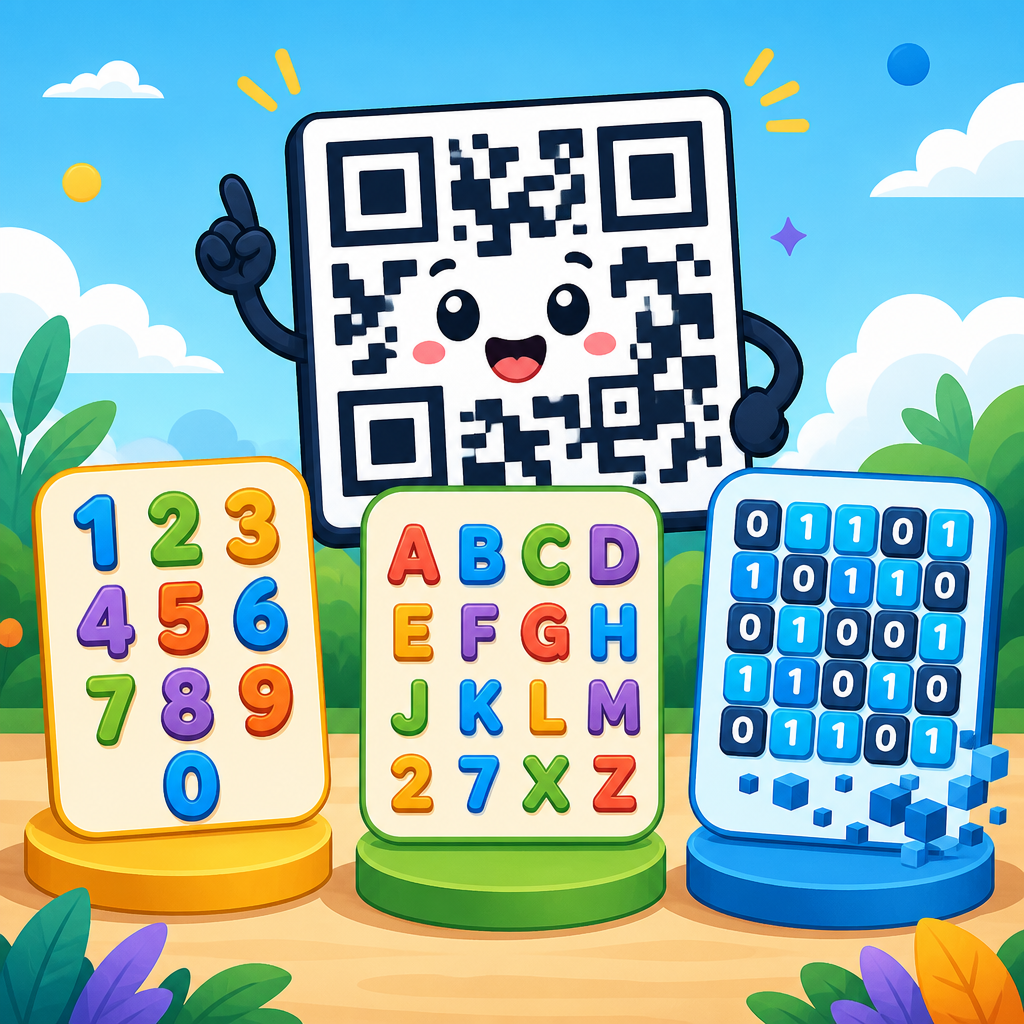
A QR Code is a two-dimensional matrix barcode made of dark and light modules arranged in a square grid. The standard defines several data encoding modes, including numeric, alphanumeric, byte, Kanji, and specialized extensions such as ECI and FNC1 for structured use cases. The three formats most teams encounter first are numeric, alphanumeric, and binary, with binary commonly used as shorthand for byte mode. Each mode uses a different bit-packing method. That difference is the reason capacity changes even when the visible text appears similar.
Numeric mode is the most efficient for strings containing only digits 0 through 9. It compresses three digits into 10 bits, two digits into 7 bits, and one digit into 4 bits. Alphanumeric mode supports digits, uppercase letters A through Z, space, and nine symbols: dollar sign, percent sign, asterisk, plus, hyphen, period, slash, and colon. It typically encodes pairs of characters into 11 bits, with a single leftover character using 6 bits. Byte mode stores data in 8-bit units and is the default for arbitrary text, URLs, UTF-8 strings, and application data, though actual behavior depends on the encoder and character set handling.
These modes are not cosmetic labels. They directly affect symbol version, from Version 1 at 21 by 21 modules through Version 40 at 177 by 177 modules, and they interact with Reed-Solomon error correction levels L, M, Q, and H. Higher error correction improves damage tolerance but lowers usable capacity. The result is a three-way balancing act between data type, symbol size, and resilience. Any serious guide to QR Code standards and formats has to treat these variables together, because production decisions are rarely made in isolation.
Numeric mode: the smallest symbols for digits-only data
Numeric mode is the best choice when the payload contains only decimal digits. Common examples include invoice numbers, one-time passwords, serial numbers, utility account identifiers, mobile payment references, and tracking IDs that intentionally exclude letters. Because it is the densest broadly used mode, numeric mode often produces the smallest possible symbol for a given message length. Smaller symbols scan faster at the same print quality and are easier to place on small labels, tickets, medicine packs, and industrial parts.
I regularly recommend numeric mode for controlled internal systems where the payload is generated by software and the allowed character set can be enforced. For example, a 30-digit shipment ID encoded in numeric mode may fit within a lower version than the same data forced into byte mode. That gives the printer more module size per symbol, which improves readability on thermal transfer labels. Numeric mode also reduces the chance of human formatting errors because there is no ambiguity about lowercase, punctuation, or whitespace.
The limitation is obvious but important: the moment a payload includes letters, separators, or symbols outside digits, numeric mode no longer applies unless the data is transformed first. Teams sometimes solve this by using a numeric token that maps to richer data in a backend database. That approach can be efficient, but it introduces dependence on network lookups and database integrity. If offline resolution matters, encoding only digits may be too restrictive despite the capacity gains.
Alphanumeric mode: a middle ground for common business data
Alphanumeric mode is often the most overlooked option in QR code implementation. It supports a restricted but useful set of characters: 0 to 9, A to Z, space, and selected punctuation. That makes it ideal for many business strings, including uppercase SKU codes, lot identifiers, reservation codes, coupon IDs, and short URLs written in uppercase where possible. Compared with byte mode, alphanumeric mode usually saves space, especially when the content naturally fits the allowed set.
A practical example is a boarding reference like AB12C34D or a warehouse location code such as A3-14-27. If the application can standardize on uppercase and approved separators, alphanumeric mode reduces module count without sacrificing readability. I have used this approach in asset tracking projects where label real estate was limited and scanner distance mattered. Reworking the identifier format to remain inside alphanumeric constraints was easier and cheaper than changing label stock or buying higher resolution printers.
The tradeoff is that alphanumeric mode is strict. Lowercase letters are not supported. Many everyday URL strings contain lowercase text, query parameters, underscores, or nonapproved punctuation, which pushes the encoder into byte mode. Some teams try to force uppercase URLs, but that is safe only where the server and path handling are confirmed case-insensitive. In web contexts, case sensitivity can exist in the path segment, so blindly changing case can break links. Alphanumeric mode is powerful, but only when the source data is genuinely compatible.
Binary or byte mode: flexibility for text, files, and real-world payloads
Binary, usually implemented as byte mode, is the workhorse of modern QR code usage because it handles arbitrary byte sequences. This includes standard URLs, vCard contact data, Wi-Fi configuration strings, calendar events, application payloads, and multilingual text when paired with the correct character encoding. If a QR code generator accepts ordinary text and creates a symbol without asking many questions, it is usually choosing byte mode behind the scenes.
Byte mode wins on flexibility, not density. A mixed-case URL with punctuation, for instance https://example.com/Promo?id=42, naturally belongs in byte mode. So does UTF-8 text containing accented characters, emoji, or non-Latin scripts, though support for complex characters depends on both encoder settings and decoder capability. In software development, byte mode is also important when embedding serialized data, cryptographic tokens, signed payloads, or custom application messages that do not map cleanly to simpler character sets.
The main drawback is capacity efficiency. Storing every character as bytes generally requires more space than numeric or alphanumeric packing. That increase can raise the QR version, making the symbol denser and harder to scan at small sizes or under poor printing conditions. In one retail deployment I reviewed, a long parameterized URL generated a visually busy code that failed on low-end Android scanners at arm’s length. Replacing the destination with a shorter redirect URL solved the problem without changing error correction or print process. Byte mode is often necessary, but payload discipline still matters.
Capacity, error correction, and version selection
When people ask how much data a QR code can store, the accurate answer is it depends on encoding mode, error correction level, and symbol version. Numeric mode has the highest maximum character capacity, followed by alphanumeric, then byte. Error correction level L offers the most room for data and the least redundancy, while H offers the strongest recovery from damage and the least room for payload. No capacity number is meaningful without those conditions attached.
| Mode | Best for | Relative efficiency | Common limitation |
|---|---|---|---|
| Numeric | Digits-only IDs, payment references, serial numbers | Highest | Cannot store letters or punctuation |
| Alphanumeric | Uppercase codes, structured business identifiers | Medium-high | No lowercase; limited symbol set |
| Byte | URLs, UTF-8 text, app data, mixed content | Lowest of the three | Larger symbols for the same visible content |
The standard also defines mode indicators, character count indicators, terminators, pad bits, and codewords that consume part of the symbol. That means usable capacity is never just the headline maximum. Real payload planning should include overhead from formatting and any application-level wrappers. If you add digital signatures, prefixes, delimiters, or schema markers, the symbol can grow faster than expected.
For implementation, I advise choosing the smallest version that preserves dependable scanning at the intended print size and distance. A compact QR code is not automatically the best QR code. If labels may be scratched, folded, or printed on textured surfaces, a slightly larger symbol with stronger error correction often outperforms a tiny dense one in the field. Standards give you limits; testing tells you what survives production.
Compatibility, standards, and scanner behavior
ISO/IEC 18004 defines how compliant QR Codes are structured, but scanner behavior still varies across devices and software libraries. Most current smartphone cameras and commercial imagers decode numeric, alphanumeric, and byte mode reliably when the symbol is well printed and the payload is conventional. Problems usually appear at the edges: unusual character encodings, poorly formed ECI usage, oversized payloads, low contrast printing, reflective substrates, or branded designs that intrude on finder and timing patterns.
Widely used libraries such as ZXing, ZBar, libqrencode, and commercial SDKs from vendors like DENSO WAVE partners, Scanbot, and Dynamsoft generally handle mainstream formats well. However, not every generator exposes the same controls. Some silently choose byte mode even when numeric or alphanumeric would be smaller. Others optimize segments automatically, mixing modes inside one symbol for better efficiency. That mixed-mode capability is part of the standard and can be extremely useful, but it complicates debugging if teams do not know what the encoder is doing.
Compliance also matters for special use cases. GS1 QR Codes, for example, use application identifiers and often rely on FNC1 conventions. Payment ecosystems may impose their own data templates and validation rules. Healthcare and manufacturing programs frequently define minimum module size, quiet zone, and verification grades using ISO/IEC 15415 for print quality assessment. In other words, QR Code standards and formats are not only about character sets. They connect to a larger compliance stack that governs whether a code works in the intended business process.
How to choose the right QR code format
The right format starts with the payload, but final decisions should also consider scanner environment, print method, lifecycle, and whether the code must work offline. Use numeric mode when the content is guaranteed to remain digits only and compactness is a priority. Use alphanumeric mode when identifiers can be constrained to uppercase and approved symbols. Use byte mode when content includes lowercase text, arbitrary punctuation, non-Latin characters, or application data. If your encoder supports segmented optimization, allow it, but verify the output with the scanners your audience actually uses.
Keep payloads short. Prefer redirects over long URLs. Avoid unnecessary tracking parameters inside the symbol when they can be handled server-side. Match error correction to the environment: M is a practical default for many campaigns, while Q or H may be justified for packaging, signage, and labels exposed to wear. Test on low-end and high-end devices, under dim and bright lighting, and at realistic distances. Verification is not optional if the code supports operations, payments, or regulated workflows.
This hub page should give you a stable mental model for QR Code standards and formats: modes control efficiency, standards define the rules, and deployment conditions decide what is truly usable. If you are building within QR Code Technology and Development, use this article as your starting point, then audit every payload against encoding mode, capacity, error correction, and scanner compatibility before you publish or print a single code.
Frequently Asked Questions
What do numeric, alphanumeric, and binary mean in QR code formats?
In QR codes, numeric, alphanumeric, and binary usually refer to encoding modes defined by the ISO/IEC 18004 standard. These modes tell the QR generator how to convert your data into the bit patterns stored inside the symbol. Numeric mode is the most specialized and efficient of the three, because it is limited to digits 0 through 9. Alphanumeric mode supports a broader but still restricted character set, including digits, uppercase letters A through Z, and a small set of symbols such as space, dollar sign, percent, asterisk, plus, hyphen, period, slash, and colon. Binary mode, often called byte mode in QR documentation, is the most flexible because it can store general byte-based data, including lowercase letters, punctuation, accented text, UTF-8 content when supported by the encoder, and even non-text payloads.
The important point is that these are not different kinds of QR codes visually. They are different ways of encoding data inside the same QR Code structure. A scanner generally does not care whether the symbol was encoded in numeric, alphanumeric, or binary mode in the same way a user might think of different file types. Instead, the scanner decodes according to the QR specification and reconstructs the original content. What changes is storage efficiency. If your content fits numeric mode, the QR code can usually store more characters in the same version and error correction level than if you encode the same content in binary mode. That efficiency can translate into a less dense symbol, better readability in smaller print sizes, and more room for error correction or additional data.
Why does the encoding mode matter for QR code size and scanning reliability?
Encoding mode matters because QR code capacity is not measured simply by character count. It depends on how efficiently each character can be represented in bits. Numeric mode is extremely compact because it packs digits very efficiently. Alphanumeric mode is slightly less efficient, but still optimized for a common set of business-friendly characters. Binary mode is more general, which makes it the least compact for plain numbers or uppercase identifier strings. As a result, the exact same human-readable message can produce noticeably different QR code densities depending on the mode used.
That density affects real-world performance. A denser QR code means more modules packed into the same physical space. If the printed code is small, placed on curved packaging, viewed through glare, or scanned by lower-quality cameras, very dense symbols can be harder to read consistently. This is one reason developers and marketers care about encoding modes even though end users usually never see them. By using the most efficient mode that fits the data, you can often reduce symbol complexity and improve scan reliability across a wider range of devices and conditions.
Mode selection also interacts with error correction. QR codes include Reed-Solomon error correction, allowing damaged or partially obscured symbols to remain readable. But higher error correction consumes capacity. If your payload is encoded inefficiently, you may be forced into a larger QR version or a lower error correction level than you would otherwise need. In short, choosing the right encoding mode can help you keep the code smaller, clearer, and more resilient without changing the underlying message.
When should I use numeric mode instead of alphanumeric or binary?
Use numeric mode when your content contains only digits and you want maximum efficiency. This is ideal for data such as reference numbers, invoice IDs, tracking numbers, one-time codes, serials composed entirely of numbers, and certain payment or ticketing payloads that are strictly numeric. Because numeric mode compresses digits better than the other standard modes, it gives you the highest character capacity and typically the least dense QR code for that data.
Numeric mode is especially valuable in constrained use cases. For example, if you need to print a very small QR code on a label, wristband, receipt, or industrial component, every bit of efficiency helps. The same is true if you need to combine a long numeric string with a high level of error correction for harsh environments. In these cases, numeric mode can be the difference between a compact, reliable symbol and one that becomes too dense for practical scanning.
However, numeric mode is not appropriate if your content includes letters, spaces, punctuation beyond digits, or encoded binary payloads. If even one unsupported character appears, the encoder must switch to a different mode or use mixed-mode segmentation. Developers should also avoid forcing numeric mode when the application may later introduce alphabetic prefixes or formatting characters, because that can break assumptions in the generation pipeline. Numeric mode is best when the data format is stable, strictly digit-only, and optimized for compactness.
What characters are supported in alphanumeric mode, and what are its limitations?
Alphanumeric mode supports a specific, standardized character set: digits 0 through 9, uppercase letters A through Z, space, and a limited symbol set that includes dollar sign, percent, asterisk, plus, hyphen, period, slash, and colon. This makes it useful for many common business strings such as product codes, order IDs, short URLs written in uppercase-friendly form, inventory labels, and tracking formats that combine numbers and capital letters. Compared with binary mode, alphanumeric often stores these values more efficiently, which can produce a smaller or less dense QR code.
Its biggest limitation is that it is not a general text mode. Lowercase letters are not part of the alphanumeric character set. Neither are most punctuation marks, accented characters, emojis, or arbitrary symbols. That means a string like Order-abc-123 cannot be fully represented in alphanumeric mode as written because of the lowercase letters. Likewise, many modern URLs, email addresses, and multilingual strings require binary mode or a combination of modes, depending on the encoder’s capabilities.
Another practical limitation is that developers sometimes assume “alphanumeric” means any letter-and-number combination. In QR terminology, it means a very particular set of uppercase-oriented characters defined by the standard. If your software silently uppercases input to force alphanumeric mode, it can change the meaning of case-sensitive data such as URLs, coupon tokens, API parameters, login credentials, or application identifiers. So while alphanumeric mode is efficient and useful, it should be chosen based on the actual allowed character set of the payload, not just on the fact that the content appears to be “text.”
What is binary mode in a QR code, and is it the same as byte mode?
Yes, in most practical discussions of QR code formats, binary mode and byte mode refer to the same concept: storing data as a sequence of bytes rather than using the specialized numeric or alphanumeric encodings. This is the most flexible standard mode for general-purpose content. It can represent lowercase and uppercase text, punctuation, structured data, encoded files, application payloads, and multilingual text when the generator and decoder agree on the character encoding. For modern software, this is often the default mode because it handles the widest range of real-world inputs without requiring the payload to fit a narrow character set.
The tradeoff is efficiency. Binary mode uses more space than numeric or alphanumeric mode for data those specialized modes can handle. For example, a long string of digits encoded in binary mode will typically require more bits than the same string encoded in numeric mode. That increased bit usage can push the QR code into a larger version or create a denser matrix at the same version, which may affect small-format printing and scanning consistency. So binary mode is powerful, but not always the most compact option.
It is also important to understand that binary mode does not automatically guarantee universal interpretation of every text payload. Raw bytes still need a character encoding convention if the data represents text. In many implementations, UTF-8 is common, but compatibility depends on the generator, scanner, and receiving application. For purely machine-read payloads, this is usually manageable because the software on both ends is designed together. For public-facing QR codes intended to open text, URLs, contact data, or multilingual content across many devices, testing matters. The format may be standards-based, but the user experience still depends on how faithfully different apps decode and interpret the bytes.