QR code standards define how two-dimensional barcodes are structured, encoded, printed, and decoded so that a symbol created in one system can be scanned reliably by another. In practical terms, standards answer the questions developers, manufacturers, marketers, and operations teams ask every day: how much data can a QR code hold, which character sets are supported, what error correction level should be used, how large must the quiet zone be, and which symbol type fits a specific use case. I have worked on QR code deployments for packaging, event access, industrial traceability, and mobile payments, and the same lesson always holds: performance depends less on visual style than on compliance with established rules. When teams skip standards, scan rates drop, interoperability breaks, and support costs rise quickly.
The term QR code standards usually refers first to the ISO specifications that govern QR Code and Micro QR Code symbols, especially ISO/IEC 18004, the foundational document that defines symbol versions, finder patterns, alignment patterns, masking, data modes, and Reed-Solomon error correction. Closely related standards shape how QR codes are captured and graded in the real world. ISO/IEC 15415 covers print quality measurement for two-dimensional symbols, while ISO/IEC 15416 and ISO/IEC 29158 influence broader barcode verification and direct part marking workflows. Industry programs add another layer. GS1 Digital Link defines how structured web identifiers can be encoded in QR symbols for retail and supply chain use, and payment ecosystems in countries such as Japan, India, and Singapore publish their own interoperability rules for merchant-presented codes.
This matters because QR codes now sit at the intersection of physical products, software systems, and customer experience. A code on medicine packaging may support anti-counterfeiting and regulated traceability. A code on a restaurant table may drive ordering and payment. A code printed on aircraft components may need to survive abrasion, heat, and low-contrast marking. In each case, the symbol itself is only one part of the system; standards make that system dependable. This guide explains the main QR code standards and formats, how they differ, where they are used, and what implementation choices improve compatibility.
Core QR Code Standards and What They Define
The core technical standard for QR codes is ISO/IEC 18004. If you need the short answer to what a QR code standard is, this is it: a formal specification describing symbol structure and data encoding rules so any compliant scanner can read any compliant code. The standard defines Model 2 QR Code, the version used almost everywhere today, along with Micro QR Code for constrained marking areas. It specifies symbol versions from 1 to 40, where each step increases the matrix dimensions and data capacity. Version 1 is 21 by 21 modules, and each higher version adds four modules per side. Those dimensions are not design suggestions; they are fixed requirements that decoder algorithms expect.
ISO/IEC 18004 also defines functional patterns. Finder patterns appear in three corners of standard QR codes and allow scanners to detect orientation. Alignment patterns improve geometric correction, especially on larger versions. Timing patterns help determine the module grid. A format information area stores error correction level and mask pattern, while version information appears on larger symbols. Data itself is encoded using supported modes, including numeric, alphanumeric, byte, kanji, and in newer interpretations Extended Channel Interpretation for alternate character sets. Error correction uses Reed-Solomon coding at four levels: L, M, Q, and H, roughly restoring 7, 15, 25, and 30 percent of damaged codewords under ideal conditions.
One point many teams miss is that standards govern more than binary data layout. They indirectly shape production decisions such as minimum print size, contrast ratio, and quiet zone width. A valid QR symbol should include a clear margin around the code, typically four modules wide, so scanners can separate the symbol from nearby graphics. Remove or crowd that margin and even a perfectly encoded symbol becomes difficult to detect. In projects I have audited, quiet zone violations are one of the most common causes of field failures, especially on labels where brand teams try to reclaim space.
QR Code Formats: Standard, Micro, rMQR, and Industry Variants
When people search for QR code formats, they often mean symbol families rather than file formats. The standard square QR Code is the dominant format because it balances capacity, robustness, and universal support across smartphones and handheld scanners. Micro QR Code is a smaller format intended for limited marking space. It uses fewer finder patterns and supports less data, but it can be ideal for electronics, laboratory assets, and compact components where a full symbol will not fit. The tradeoff is scanner support. Most modern industrial imagers can read Micro QR, but smartphone support is less consistent than for standard QR.
Another important format is rectangular Micro QR, commonly called rMQR. This variant was developed to support narrow, elongated spaces where square symbols are inefficient. Think syringes, test tubes, slim packaging, and small mechanical parts. rMQR can deliver practical capacity in footprints that standard QR and Data Matrix may not match as well. However, deployment requires checking scanner firmware, software libraries, and mobile applications carefully, because support is still uneven compared with conventional QR codes.
Industry variants add application rules on top of the underlying symbol. A payment QR code may still be an ordinary QR symbol according to ISO/IEC 18004, but the data payload follows a payment specification such as EMVCo merchant-presented QR or a national profile like UPI in India. A retail code carrying product identity may follow GS1 syntax rules so trading partners, apps, and checkout systems can interpret application identifiers consistently. In other words, the same black-and-white grid can represent different ecosystems, and compatibility depends on both symbol compliance and payload format compliance.
| Format | Best use case | Main advantage | Main limitation |
|---|---|---|---|
| Standard QR Code | Consumer scanning, packaging, marketing, payments | Broadest device support | Needs more area than compact variants |
| Micro QR Code | Small labels, electronics, asset tags | Fits tighter spaces | Lower capacity and mixed phone support |
| rMQR | Narrow components, medical tubes, slim packaging | Works in rectangular print areas | Limited ecosystem support |
| GS1 QR payload | Retail, supply chain, regulated products | Structured product data | Requires application-level integration |
| Payment QR payload | Merchant checkout and peer payments | Interoperable transaction data | Must meet scheme-specific rules |
Data Encoding, Capacity, and Error Correction in Practice
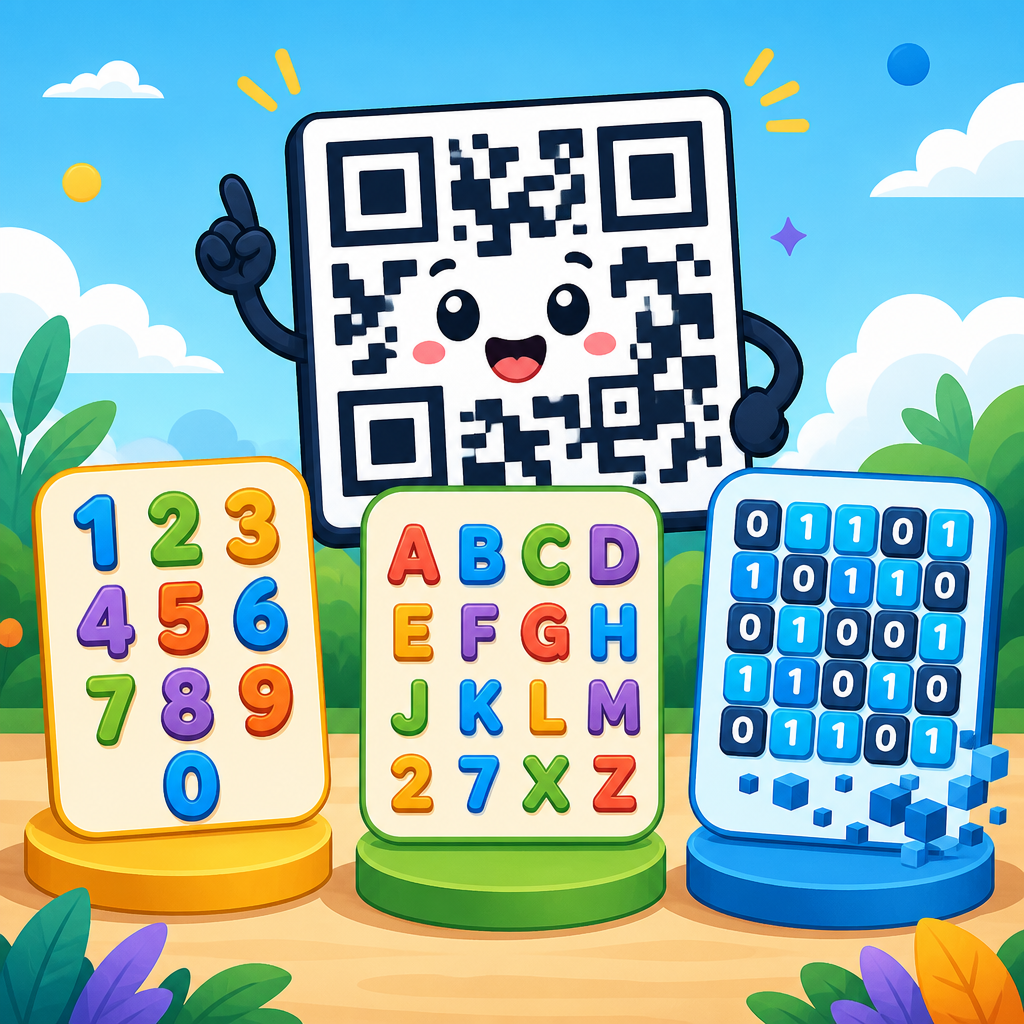
A QR code standard is only useful if you understand how encoding choices affect scan performance. Capacity depends on version, encoding mode, and error correction level. Numeric mode is most efficient because it compresses digits densely. Alphanumeric mode supports a limited character set efficiently. Byte mode is more flexible and typically used for URLs, UTF-8 text, and serialized identifiers, but it consumes more space. Kanji mode optimizes certain double-byte character representations. The practical rule is simple: choose the most efficient mode that preserves the exact data you need, because smaller symbols scan faster and print more reliably.
Error correction is often misunderstood. Higher error correction does not automatically make a poor design safe. It adds redundancy, which helps if parts of the code are obscured, worn, or stylized, but it also increases symbol density for the same payload. On a tiny label, moving from level M to level H can force a larger version or smaller modules, either of which may hurt readability. For packaging with potential scuffs or curved surfaces, level Q or H may be justified. For high-quality print on flat labels scanned at short range, level M is often the best balance. I usually recommend testing level M and Q first unless branding elements cover the symbol.
Masking is another standards-driven feature with real consequences. QR encoders apply one of several mask patterns to prevent problematic visual structures such as large runs of identical modules or patterns that resemble finder elements. A compliant encoder evaluates penalty scores and selects the best mask. Good libraries such as ZXing, Zint, and commercial SDKs handle this automatically, but custom generators sometimes get it wrong. If your team is building QR creation into an app or firmware, use a proven encoder rather than implementing the full logic from scratch unless you also plan to build a conformance test suite.
Print Quality, Verification, and Real-World Scannability
Generating a valid payload is not enough. A QR code that is technically correct can still fail in stores, factories, and public spaces if print quality is poor. That is why verification standards matter. ISO/IEC 15415 provides a methodology for grading printed two-dimensional symbols using parameters such as symbol contrast, modulation, fixed pattern damage, axial non-uniformity, grid non-uniformity, and unused error correction. These grades help quality teams move from subjective judgments like “it looks sharp” to objective acceptance criteria tied to scanner performance.
In production, verification should be separated from simple scanning. A scanner only answers whether one device could read one sample under one set of conditions. A verifier measures whether the printed symbol meets consistent quality thresholds. On pharmaceutical cartons, food labels, and electronics packaging, that distinction is critical. I have seen batches pass line-side spot checks with a phone camera and still fail downstream because thermal transfer ribbon wear reduced contrast or because quiet zones were invaded by dieline creep. Verification catches trends before they become expensive recalls or rework.
Environmental factors also affect scannability. Curved bottles introduce distortion. Gloss lamination creates glare. Low-energy plastics can cause ink spread issues. Direct part marking on metal can reduce contrast and require specialized illumination. Best practice is to test symbols in the exact substrate, print method, and scanning environment they will face. For example, inkjet on corrugated board behaves very differently from laser marking on anodized aluminum. The standard tells you what a valid symbol is; only validation testing tells you whether your full process is robust.
Application Standards: Retail, Payments, Healthcare, and Manufacturing
Many organizations do not fail because they chose the wrong symbol; they fail because they ignored the application standard layered above it. In retail, the most important shift is toward QR codes carrying GS1 identifiers and web-resolvable links. GS1 Digital Link allows brands to encode identifiers such as GTIN, batch or lot, serial number, and expiration date into a web URI that both scanners and consumer apps can use. This supports traceability, recalls, product pages, and circular economy initiatives without printing multiple codes. As retailers prepare for next-generation point-of-sale scanning, structured QR payloads are becoming more important than generic URLs.
In payments, interoperability depends on scheme rules, field definitions, and security controls. EMVCo QR specifications define merchant-presented and consumer-presented formats used by many banks and wallets. National systems then build profiles on top of those specifications. A merchant QR that works in one country may not work in another if the payload tags, routing identifiers, or required merchant metadata differ. For payment acceptance, always follow the acquiring bank or scheme documentation rather than relying on a general-purpose QR generator.
Healthcare and manufacturing add their own constraints. Medical device labels may need Unique Device Identification data in standardized formats. Pharmaceutical traceability programs often require serialized identifiers that integrate with enterprise systems and regulatory repositories. Manufacturing environments may favor Data Matrix for very small direct part marks, but QR remains common for documentation links, service records, operator instructions, and larger component labeling. Choosing between QR and another 2D symbology should be based on reading distance, available marking area, data syntax, scanner ecosystem, and regulatory expectations, not preference alone.
Implementation Best Practices for Developers and Content Teams
If you are building a standards-compliant QR program, start with the use case, then work backward to the symbol. Define the payload clearly: plain URL, dynamic redirect URL, serialized ID, GS1 syntax, payment request, Wi-Fi credentials, or vCard. Then choose the smallest symbol version that accommodates the data with sensible error correction. Preserve a four-module quiet zone, maintain strong foreground-background contrast, avoid reversing colors unless you have tested specific scanner support, and do not place logos over the code without measuring the impact. Vector output such as SVG is preferable for print, while PNG is acceptable for digital use if rendered at sufficient resolution.
Library choice matters. Open source tools such as ZXing, Nayuki QR Code generator, and Zint are dependable when configured correctly. Commercial SDKs can add better decoding performance, camera controls, and verification tooling for enterprise apps. Whatever you use, create a test matrix that includes older phones, low-end Android devices, dedicated handheld imagers, and real lighting conditions. Teams often validate only on flagship iPhones, then wonder why field adoption stalls among users with midrange hardware or scratched scanner windows.
Finally, treat this topic as a content hub inside a broader QR code technology and development strategy. Supporting articles should drill into QR code error correction, Micro QR versus standard QR, GS1 Digital Link implementation, print verification, payment QR specifications, and QR code security. Internal links between those topics help readers move from overview to execution, and they reflect how the discipline actually works: symbol standards, payload standards, print standards, and application standards are connected. A QR code is never just a graphic. It is a standards-based data carrier, and when every layer is implemented correctly, it becomes one of the most reliable bridges between physical objects and digital systems.
QR code standards are the foundation that makes widespread scanning possible across phones, industrial imagers, point-of-sale systems, and regulated workflows. The central standard, ISO/IEC 18004, defines the symbol itself: versions, finder patterns, encoding modes, masking, and Reed-Solomon error correction. Surrounding standards and industry rules determine whether that symbol performs well in practice. Print quality guidance from ISO/IEC 15415, structured payload frameworks such as GS1 Digital Link, and payment specifications from established schemes all shape whether a code is truly interoperable. The key lesson is straightforward: a code can look correct and still fail if the data format, print process, or scanning environment does not align with the relevant rules.
For teams evaluating QR Code Standards & Formats, the best approach is to match the standard to the job. Use standard QR codes for broad consumer compatibility, Micro QR or rMQR when space is constrained and device support has been verified, and application-specific payload standards whenever identifiers or transactions must work across organizations. Keep symbols small only when necessary, protect quiet zones, choose error correction based on real damage risk, and verify print quality with objective tools instead of informal camera checks. Those practices reduce scan failures, improve interoperability, and lower operational friction.
If you are building under the broader QR Code Technology & Development topic, use this guide as your starting point, then map your next steps to implementation details such as encoding, verification, and industry payload rules. Audit your current QR codes, confirm which standards apply, and test them in real conditions before scaling. Standards are what turn a simple square into dependable infrastructure.
Frequently Asked Questions
What are QR code standards, and why do they matter?
QR code standards are the technical rules that define how a QR code is designed, encoded, printed, and read. They cover the symbol’s structure, data encoding methods, sizing rules, error correction, masking, positioning patterns, and the minimum print requirements needed for reliable scanning. In short, standards make sure that a QR code generated by one device, software platform, or manufacturer can still be decoded by another scanner, smartphone, or industrial reading system without guesswork.
These standards matter because interoperability is the entire point of a machine-readable symbol. Without shared specifications, one system might create a code another system cannot interpret accurately. For businesses, that creates real operational problems: failed scans at checkout, poor response rates in marketing campaigns, inventory errors in warehouses, and inconsistent behavior across devices. Standards reduce those risks by establishing predictable rules for symbol quality and data handling.
They also help teams make better implementation decisions. Developers use standards to understand supported data modes and capacity limits. Manufacturers rely on them for print quality, module sizing, and contrast. Marketing teams benefit because standards improve scan success in real-world environments. Operations teams depend on them to ensure labels survive damage, distortion, or low-light scanning conditions. In other words, QR code standards are not just theoretical documentation; they are the foundation for dependable performance across industries and use cases.
How much data can a QR code hold, and what affects its capacity?
The amount of data a QR code can store depends on several factors, including the QR version, the encoding mode, and the error correction level selected. Standard QR codes are available in multiple versions, each with a different matrix size. As the version increases, the symbol contains more modules, which allows it to hold more data. However, more capacity also means a denser symbol, which may require a larger print size to remain easily scannable.
Capacity is heavily influenced by the type of data being encoded. Numeric data is the most efficient, followed by alphanumeric data, while byte mode and other character sets typically consume more space. This means a short numeric string can fit into a smaller code than a web address, and a multilingual text string may require even more space depending on the encoding used. If the content includes special characters, binary content, or non-Latin scripts, the available capacity can decrease further because the data becomes less compression-efficient within the symbol structure.
Error correction also plays a major role. Higher error correction levels allow the QR code to remain readable even if part of it is damaged, obscured, or poorly printed, but that resilience comes at the cost of usable data capacity. Choosing the right balance is important. For example, a warehouse label exposed to abrasion may justify a higher error correction setting, while a clean digital display may not need as much redundancy. In practice, the best approach is to keep content as short as possible, use the most efficient encoding mode available, and test the final symbol at its intended display or print size.
What character sets and encoding modes do QR code standards support?
QR code standards support several encoding modes so different kinds of data can be represented efficiently. The most common modes include numeric, alphanumeric, byte, and kanji. Numeric mode is optimized for digits only and offers the highest efficiency for numbers. Alphanumeric mode supports a defined set of uppercase letters, numbers, and a limited group of symbols. Byte mode is more flexible and is commonly used for general text, URLs, and data that must be represented as raw bytes. Kanji mode is designed to efficiently encode certain double-byte character sets used in Japanese text.
In real-world implementations, byte mode is often the most familiar because it can store standard text strings and web links with broad compatibility. However, the exact character set support depends on how the content is encoded before being placed in the QR code. If the application must support international characters, accents, or non-Latin languages, developers need to be careful about character encoding choices and scanner compatibility. Some systems may expect UTF-8 or another defined encoding convention, and mismatches can lead to unreadable or incorrectly displayed content even if the symbol itself scans successfully.
This is why standards are so important: they define the available data modes and the rules for how content is packaged, but successful implementation still depends on choosing the right mode for the actual use case. For simple identifiers, numeric or alphanumeric modes can reduce symbol size. For URLs, contact data, app deep links, or multilingual content, byte mode is often more practical. The key is not just whether the data fits, but whether it can be decoded accurately and interpreted correctly by the receiving software or device.
What error correction level should you use in a QR code?
QR codes use built-in error correction so they can still be read even if part of the symbol is dirty, scratched, faded, or partially blocked. The standard defines four main error correction levels: low, medium, quartile, and high. As you move upward, the symbol becomes more tolerant of damage because it contains more redundant recovery data. That added resilience is valuable in many environments, but it also reduces the amount of space available for the actual payload or forces the symbol to become denser.
The right error correction level depends on where and how the QR code will be used. For clean, controlled environments such as on-screen display, email graphics, or high-resolution packaging, a lower or medium level is often sufficient. For labels used in logistics, manufacturing, outdoor signage, or products that may be handled frequently, a higher level can be a smarter choice because it improves the chance of successful scans after wear and tear. Branded QR codes that place a logo in the center or intentionally modify the artwork also commonly require higher error correction to compensate for the altered symbol area.
That said, higher is not automatically better. Increasing error correction can make a QR code more complex and physically denser, which may hurt scan performance if the print area is too small or the camera quality is limited. The best practice is to choose the lowest error correction level that still provides reliable performance in the intended environment. Test the code at the final production size, on the actual material, under real lighting conditions, and with the devices your audience or staff will use. Standards provide the framework, but practical testing is what turns a technically valid QR code into a reliably scannable one.
How large should a QR code be, and what is the quiet zone requirement?
QR code size is determined by a combination of the symbol version, the number of modules in the matrix, the physical module size in print or on screen, and the surrounding clear space known as the quiet zone. The quiet zone is a blank margin around the QR code that allows scanners to distinguish the symbol from nearby text, graphics, borders, or background patterns. Without adequate quiet space, even a perfectly encoded QR code can fail because the scanner cannot correctly locate the symbol boundaries.
As a general rule, the quiet zone should be at least four modules wide on all sides of the QR code. A module is the smallest square in the symbol grid, so the required blank space scales with the code itself. This requirement is fundamental to reliable scanning and should not be treated as optional design padding. Crowding the QR code with decorative elements, placing it too close to edges, or printing it over busy backgrounds are common reasons otherwise valid symbols perform poorly in the field.
The overall printed size should be large enough that each module can be reproduced clearly and captured accurately by the scanning device. There is no single perfect size for every situation because viewing distance, print quality, material, lighting, and camera capability all matter. A code meant for close-range smartphone scanning on packaging can be much smaller than one intended for posters, equipment labels, or warehouse signage. The most reliable approach is to calculate the size based on content density and intended scan distance, preserve the full quiet zone, maintain strong contrast between foreground and background, and test the final output in realistic conditions. Standards define the structural rules, but successful sizing always comes down to matching the symbol design to the scanning environment.