QR code data capacity is the practical limit on how much information a QR symbol can store while remaining readable, and understanding that limit is essential for anyone building reliable labels, packaging, tickets, menus, payment flows, or industrial tracking systems. In QR code standards and formats, data capacity does not mean a single fixed number. It depends on the symbol version, error correction level, encoding mode, and the physical conditions under which the code is printed or displayed. I have seen teams assume a code can hold “about 3 kilobytes” and then discover that their real payload, after formatting choices and redundancy, no longer fits on a small label or scans poorly on older phones.
A QR code, formally defined in ISO/IEC 18004, is a two dimensional matrix barcode made of dark and light modules arranged in a square grid. Capacity is the amount of source data converted into codewords inside that grid. Standards and formats matter because they govern how data is encoded, how reserved function patterns reduce usable space, and how scanners reconstruct damaged symbols. For a sub pillar topic like QR Code Standards and Formats, capacity is the connecting concept: it ties together version sizes, character modes, error correction, model variants, structured append, Micro QR, rMQR, and practical implementation rules.
This topic matters because every capacity decision creates tradeoffs in size, resilience, cost, and user experience. A compact payload can scan instantly from a curved bottle. An overloaded payload may require a larger symbol, more white space, better contrast, and a higher camera resolution. In real deployments, the best result is rarely the maximum possible payload. The best result is the smallest symbol that reliably stores exactly what the workflow needs. That is why this hub article explains not only the numeric limits, but also how the standards shape those limits and how to choose the right format for production use.
What determines QR code data capacity
Four variables determine QR code data capacity. First is version, which defines the matrix size. Standard QR Code versions run from Version 1 at 21 by 21 modules to Version 40 at 177 by 177 modules, adding four modules per side each step. More modules mean more codewords and higher capacity. Second is error correction level. QR codes use Reed Solomon error correction with levels L, M, Q, and H, roughly allowing recovery of about 7 percent, 15 percent, 25 percent, and 30 percent damage respectively. Higher protection consumes more codewords, so usable data capacity drops.
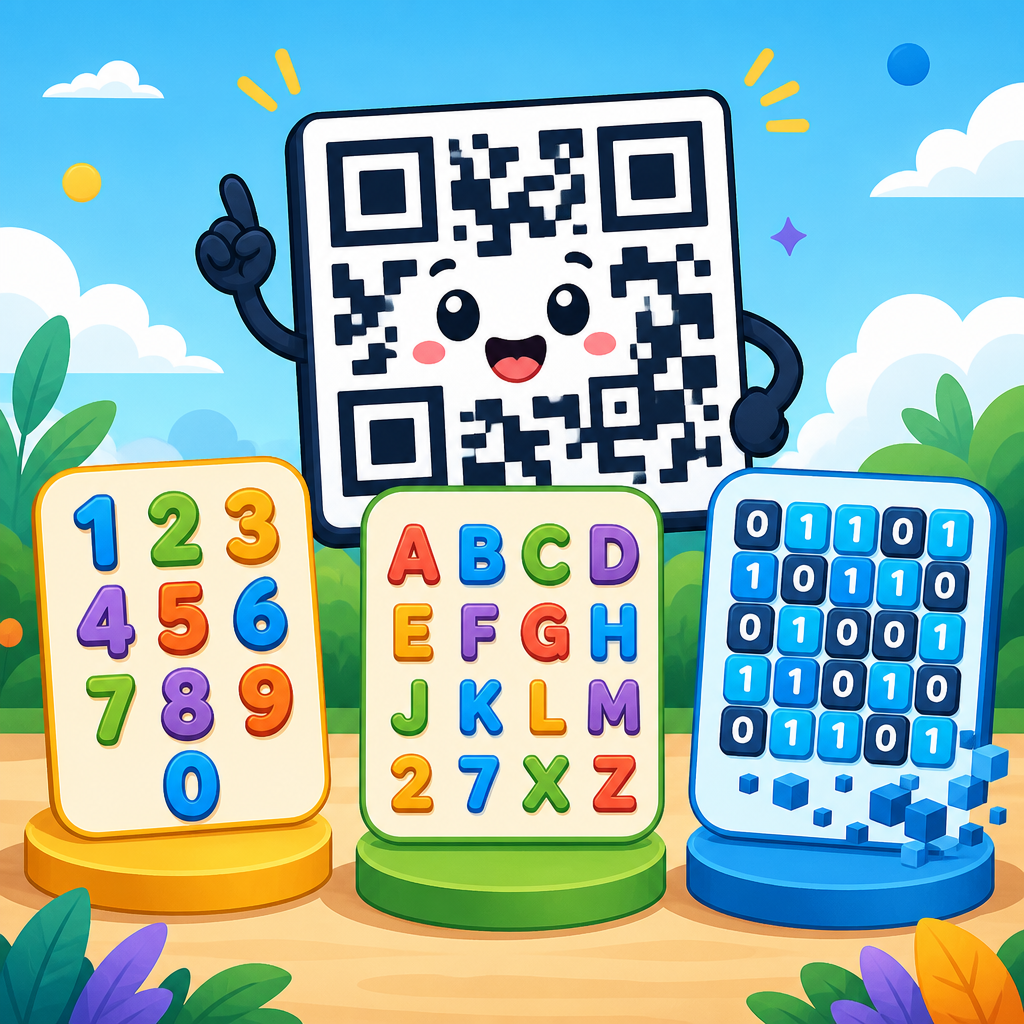
Third is encoding mode. Numeric mode is most efficient because digits compress densely. Alphanumeric mode supports a limited character set including digits, uppercase letters, and selected symbols. Byte mode stores general binary data and is commonly used for UTF-8 text, URLs, and application payloads, but it is less space efficient than numeric and alphanumeric for simple character sets. Kanji mode is optimized for double byte Shift JIS characters and can store certain Japanese text more efficiently than byte mode. Fourth is overhead. Mode indicators, character count indicators, terminators, padding bits, and error correction codewords all take space.
A practical example makes this clear. If you encode a short uppercase tracking ID in alphanumeric mode, it may fit into a much smaller version than the same content encoded as lowercase UTF-8 byte data. I have reduced required symbol size in packaging projects simply by normalizing payloads to uppercase and removing unnecessary query parameters from URLs. Capacity is never just about the amount of human readable text. It is about how that text is represented in the standardized bitstream.
Capacity by version, format, and error correction
The most important standard fact is that capacity rises with version and falls with stronger error correction. Version 1 QR Code has only 26 total codewords, while Version 40 has 3706. Those totals include both data and error correction, so the actual payload is lower. At the largest standard size, maximum capacities often cited are 7,089 numeric characters, 4,296 alphanumeric characters, 2,953 bytes in byte mode, or 1,817 Kanji characters, all at the lowest error correction level. Those are theoretical maxima under ideal formatting assumptions. Real payloads are usually smaller because applications add prefixes, separators, encoding metadata, or binary structure.
Capacity should also be evaluated against physical format. A larger version increases density when printed at the same size, shrinking each module. Once modules get too small for the printer, substrate, lighting, or scanner optics, read performance drops sharply. That is why standards and formats cannot be separated from production constraints. On a warehouse label printed by thermal transfer, Version 10 with medium redundancy may outperform Version 6 with high density because the module size remains above the scanner’s minimum requirement. On a smartphone screen, refresh artifacts, glare, and low brightness can create similar limits.
| Factor | Effect on capacity | Practical implication |
|---|---|---|
| Higher version | Increases available codewords | Lets you store more data, but usually requires a larger symbol or smaller modules |
| Higher error correction | Reduces net payload | Improves damage tolerance for labels, outdoor use, and logos |
| Numeric or alphanumeric mode | Uses bits more efficiently | Often fits the same message into a lower version |
| Byte mode with UTF-8 data | Consumes capacity faster | Common for URLs, multilingual text, and app payloads |
| Longer URLs and tracking parameters | Adds raw payload length | Frequently pushes a code into the next version unexpectedly |
When comparing formats, remember that “maximum capacity” is not a design target. It is a laboratory boundary. Production targets should include quiet zone, contrast ratio, expected scan distance, surface curvature, and the age of the scanning devices in the field.
Encoding modes and why character choice changes the result
Encoding mode is where many QR implementations quietly lose efficiency. Numeric mode packs three digits into 10 bits, making it the densest option for pure numbers. Alphanumeric mode packs two characters into 11 bits from a 45 character set. Byte mode generally uses 8 bits per byte, but the real size depends on the chosen character encoding and any application level structure. Kanji mode uses 13 bits for characters in the supported Shift JIS ranges. These differences are substantial. A payment reference made of digits only can fit comfortably into a low version, while the same reference embedded in a full URL with lowercase text, slashes, and parameters may require a much larger symbol.
Standards compliance matters here because scanners interpret the bitstream according to mode indicators and count indicators. If a generator encodes everything in byte mode for convenience, it may produce a valid code, but not an efficient one. I have audited marketing campaigns where a URL shortener was used to reduce length, yet the code remained larger than necessary because the generator forced byte mode and preserved mixed case campaign tags. A cleaner approach was to normalize the path, remove duplicate parameters, and test whether alphanumeric friendly content could be used without breaking analytics.
ECI, or Extended Channel Interpretation, can further affect capacity. ECI allows a QR code to signal a character set other than the default interpretation, which is useful for multilingual content and specialized data exchange, but it introduces additional overhead. FNC1, used in GS1 applications for structured business data, also consumes space while enabling scanner interoperability. In regulated or supply chain contexts, those overhead bits are worthwhile because they preserve parsing accuracy across systems.
How standards and formats fit together across the QR family
The QR ecosystem includes more than one symbol type. Standard Model 2 QR Code is the format most people mean by “QR code” and the one defined for widespread general use. Micro QR Code is a smaller variant designed for space constrained applications, such as tiny components or electronics labels, but it supports less data and fewer error correction options. Rectangular Micro QR, often written as rMQR, extends the family for narrow spaces where a square symbol is inefficient. There is also SQRC, a secure variant with restricted reading features used in specialized workflows.
These formats matter because capacity is not only about raw volume but about shape and deployment fit. On a medicine blister pack, a square symbol may waste space or force modules too small for the print process. A rectangular format can preserve scan reliability while matching package geometry. On a PCB label, Micro QR may be the only practical choice, but then the payload must be tightly designed, often pointing to a database key rather than embedding descriptive text. In other words, format selection is a capacity strategy, not merely a visual preference.
As the hub for QR Code Standards and Formats, this page connects naturally to deeper topics such as QR code versions, error correction levels, Micro QR versus standard QR, GS1 QR implementations, and QR code character encoding. Those subtopics all stem from the same principle: capacity is governed by standard rules, and every rule has operational consequences in printing, scanning, data modeling, and long term maintenance.
Real world design rules for reliable capacity planning
The most reliable way to plan QR code capacity is to start with the use case, not the maximum data table. Ask what the scanner must recover at the point of use, how much damage or distortion the symbol will face, and whether the payload should be direct data or a lookup key. In most commercial systems, a short identifier linked to a backend record is better than embedding full descriptive content. It reduces symbol size, protects flexibility, and allows updates without reprinting physical assets.
For consumer campaigns, short dynamic URLs are usually the best capacity choice. A dynamic URL keeps the QR symbol stable while letting the destination change for localization, A/B testing, analytics, or campaign expiry. For industrial traceability, structured identifiers under GS1 or internal serialization standards often outperform free form text because scanners and downstream systems can parse them consistently. For offline use, such as Wi-Fi onboarding, vCard contact exchange, or signed credentials, embedded data may be necessary, but every field should justify its space. I routinely strip optional fields first because they often add bytes without improving task completion.
Testing is nonnegotiable. Generate candidate symbols across multiple versions and error correction levels, then print or display them at the final size on the final material. Test with at least one flagship smartphone, one midrange Android device, and any dedicated scanner used in operations. Measure first scan success, scan time, and performance under glare, tilt, and partial obstruction. If a design only works in office lighting on a new phone, it is not production ready. Capacity planning is successful only when the selected format performs in the actual environment.
Common mistakes, limits, and the best way to choose
The most common mistake is trying to store too much direct information. Long URLs with UTM parameters, verbose JSON payloads, Base64 blobs, and multilingual text can all push a code into a higher version where modules become too dense. Another mistake is adding a logo without compensating with larger size or stronger error correction. Although many branded QR codes scan well, the visual modification consumes useful area and should be validated carefully. A third mistake is assuming every scanner handles every feature equally. Older devices may struggle with low contrast displays, tiny modules, unconventional colors, or advanced formats.
There are also hard limits to what standards can solve. Error correction repairs damage, but it does not compensate for poor contrast, inadequate quiet zone, or severe perspective distortion. Byte mode supports arbitrary data, but storing compressed binary directly in a QR code can make debugging and interoperability harder than using a short resolver URL. The best choice is usually the simplest compliant format that satisfies the workflow. Use the lowest version that scans reliably, the lowest error correction that matches the risk environment, and the most efficient encoding mode the content allows.
QR code data capacity works because the standard turns a square grid into a carefully structured balance of payload, redundancy, and readability. If you understand version, mode, error correction, and format variants, you can predict that balance instead of guessing. The main benefit is practical: smaller, cleaner, more reliable symbols that scan quickly and fit the realities of packaging, screens, and industrial operations. As you build out your QR Code Technology and Development knowledge, use this hub as the starting point for every standards and formats decision, then test your chosen configuration in the real world before deployment.
Frequently Asked Questions
What does QR code data capacity actually mean?
QR code data capacity is the amount of information a QR symbol can hold while still being scanned reliably in real-world conditions. That sounds simple, but it is not a single universal number. Capacity changes based on the QR code version, the error correction level, the type of characters being stored, and how the code is printed or displayed. In practice, data capacity is less about the absolute maximum allowed by the standard and more about the useful amount of data you can encode without making the symbol too dense to read consistently.
A QR code stores data in tiny modules, the square dots that form the symbol. As more data is added, the pattern becomes denser and usually requires either a larger symbol size or a higher version, which means more modules across and down. If the code becomes too compact for the intended print size, scanning performance drops. That is why capacity should always be thought of as practical capacity, not just theoretical capacity.
For example, a short numeric identifier can fit very efficiently and leave plenty of room for robust error correction. A long mixed-character string, by contrast, consumes much more space. The same QR code that easily stores a compact tracking number may struggle if you try to embed a long URL with parameters, product metadata, and internal routing information all at once. Understanding data capacity means understanding this tradeoff between information density and scan reliability.
What factors determine how much data a QR code can store?
The main factors are version, error correction level, encoding mode, and physical output conditions. The version controls the grid size of the symbol. Standard QR codes range from small versions with fewer modules to larger versions with many more modules, and larger versions can store more data. However, larger capacity also creates more visual complexity, which can reduce readability if the code is printed too small or shown on a poor-quality display.
Error correction level has a major impact because part of the symbol is reserved for recovery data. Higher error correction makes the QR code more resilient to scratches, smudges, distortion, and partial damage, but it reduces the amount of room available for the actual payload. Lower error correction increases available capacity, but the code becomes less tolerant of real-world wear and scanning problems. This is why packaging, industrial labels, and outdoor use cases often choose more conservative settings even when that means storing less data.
Encoding mode also matters. Numeric mode is the most efficient for digits only. Alphanumeric mode is efficient for a limited set of letters, numbers, and symbols. Byte mode is more flexible and commonly used for URLs and general text, but it uses capacity less efficiently than purely numeric data. Kanji mode is optimized for specific character sets. Two pieces of text with the same visible length can consume very different amounts of QR code space depending on which mode is used.
Finally, physical conditions often decide the practical limit more than the specification does. A high-density code on glossy packaging, curved bottles, small tickets, low-contrast labels, or dim phone screens may technically fit the data but scan poorly. In the field, capacity is always tied to module size, contrast, quiet zone, print quality, and the type of scanner being used. The best QR code is not the one that stores the most data; it is the one that stores enough data and still works quickly and consistently.
How does error correction affect QR code capacity and readability?
Error correction is one of the most important design choices in a QR code because it directly affects both durability and data capacity. QR codes use Reed-Solomon error correction, which allows scanners to reconstruct data even if part of the symbol is damaged or obscured. The standard levels are commonly referred to as L, M, Q, and H, with each higher level providing more recovery capability but consuming more of the symbol’s available space.
When you increase error correction, you reduce the amount of room left for the payload. That means a URL, serial number, or text block that fits comfortably at one level may require a larger version at a higher level. In other words, stronger protection usually means a bigger or denser code for the same content. This is the core tradeoff: resilience versus capacity.
From a readability standpoint, higher error correction is often worth it in challenging environments. A code on warehouse packaging may get scuffed. A restaurant menu may be exposed to spills. A payment code on a screen may suffer from glare or brightness issues. In these situations, allocating more space to error correction helps preserve scan performance. On the other hand, in controlled environments such as clean, high-resolution digital displays, lower levels may be perfectly adequate and allow a smaller symbol.
The key is to match the correction level to the use case rather than choosing the highest or lowest setting by default. If a QR code will be printed small, viewed at awkward angles, or exposed to damage, higher correction often improves reliability. If the environment is stable and you need to preserve space, moderate correction may be more practical. Capacity should never be evaluated separately from the conditions in which the code must actually be scanned.
Why is it often better to store a short URL or ID instead of a lot of text directly in the QR code?
In most real applications, storing a short URL, token, or identifier is a better strategy than packing a QR code with large amounts of direct text. The reason is simple: smaller payloads produce cleaner, less dense symbols that are easier to scan. A compact code can be printed smaller, read faster, and remain reliable across more surfaces, devices, and lighting conditions.
Using a short URL or ID also improves flexibility. If the destination content changes, you can update the linked resource in your system without changing the printed QR code itself, assuming you are using a managed redirect or database-backed identifier. That is extremely useful for packaging, menus, event tickets, service manuals, and industrial labels, where reprinting materials can be expensive or operationally disruptive.
Another advantage is analytics and control. A short URL or lookup key can route different users to different content, support localization, track scan events, enforce access rules, or connect to live inventory and transaction systems. None of that requires loading the QR symbol with all possible information. Instead, the code acts as a compact bridge to a dynamic backend.
There are exceptions. Offline environments, compliance requirements, air-gapped systems, or certain manufacturing workflows may require embedding data directly in the symbol so it remains usable without network access. In those cases, maximizing efficiency becomes more important, and careful attention must be paid to encoding mode, version, error correction, and print quality. But for many consumer and business use cases, less is more. A lean payload usually leads to a stronger and more dependable QR implementation.
How can I choose the right QR code size and data load for reliable scanning?
The best approach is to start with the minimum data necessary and then design around the scanning environment. First, reduce the payload wherever possible. Remove unnecessary parameters, shorten URLs, use compact identifiers, and avoid embedding verbose text unless there is a clear reason to do so. Keeping the data lean gives you more room to use a suitable error correction level and maintain healthy module size.
Next, consider where and how the code will be scanned. A code printed on a small product label, flexible packaging, metal plate, shipping carton, kiosk screen, or mobile app interface will each have different constraints. Distance, viewing angle, lighting, surface reflectivity, motion, and scanner quality all affect readability. A dense code that performs well in a controlled office test may fail on a factory line or in a retail aisle.
Module size is critical. Even if the total QR symbol seems physically large enough, the individual modules can become too small when too much data is packed in. Once those modules are hard to distinguish because of print spread, low screen resolution, glare, or camera limitations, scan performance drops quickly. Maintaining a clear quiet zone around the symbol and strong contrast between dark and light areas is equally important.
Finally, test under real operating conditions. Scan the code with multiple devices, at expected distances, under bright and dim light, on the actual materials and surfaces you plan to use. Try damaged samples if wear is realistic. Reliable QR systems are built through validation, not assumptions. The right capacity is not the maximum you can encode in theory. It is the amount of data your chosen symbol can carry while remaining fast, repeatable, and dependable in the real world.