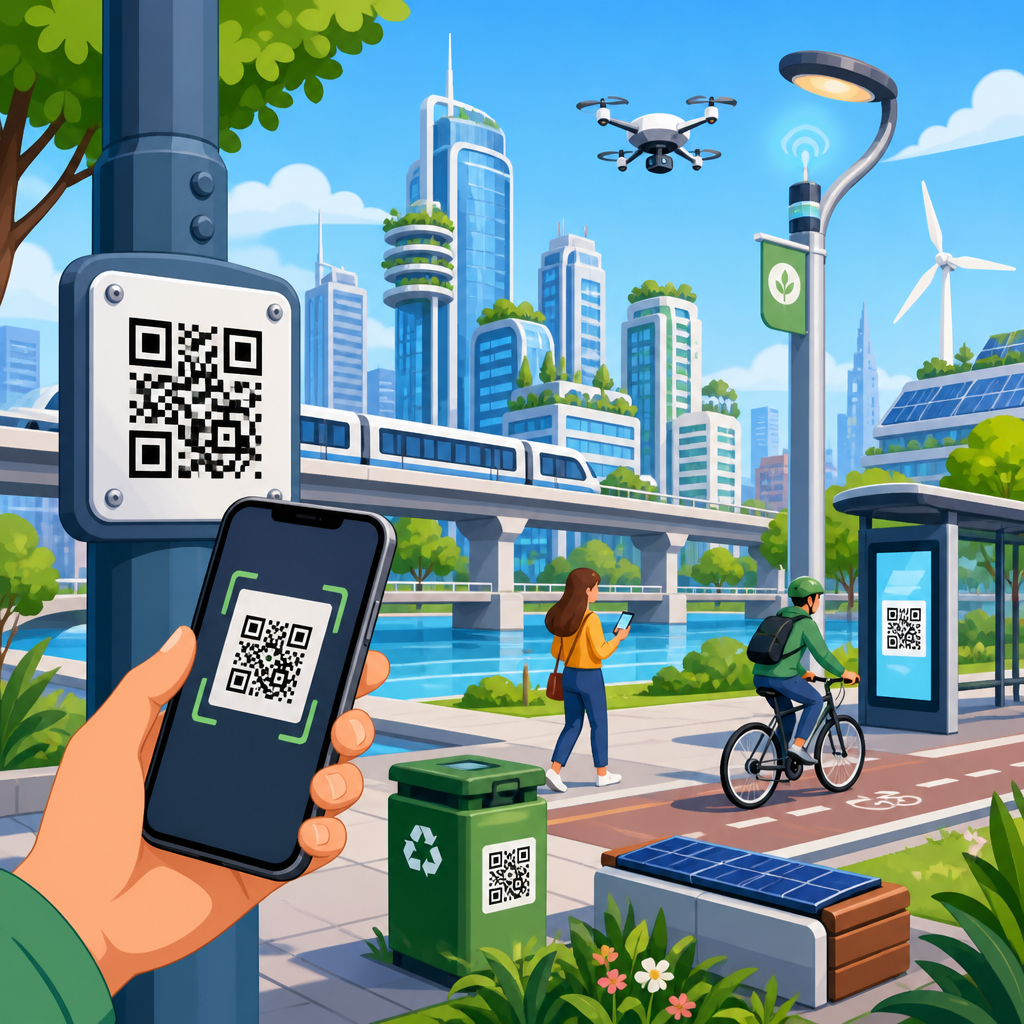
QR codes are becoming a practical interface layer for smart cities, linking streets, transit systems, utilities, public buildings, and maintenance workflows to live digital information with a simple camera scan. In the context of urban infrastructure, a QR code is not just a black-and-white square on a sign; it is a low-cost access point that connects people, assets, and services across physical and digital systems. Smart cities use connected sensors, data platforms, automation, and responsive public services to improve mobility, safety, sustainability, and operational efficiency. When I have worked on infrastructure digitization projects, QR codes consistently stood out because they solved an overlooked problem: giving residents, contractors, inspectors, and field crews an immediate, device-agnostic way to reach the right information at the exact location where they need it.
This matters because cities manage thousands of assets with different lifecycles, owners, and service standards. A bus shelter may need timetables, accessibility guidance, ad inventory records, and repair logs. A water valve may need GIS coordinates, inspection history, lockout procedures, and emergency contacts. A heritage building may need visitor interpretation, multilingual content, and conservation documentation. QR codes create a visible entry point into those systems without requiring expensive dedicated hardware at every touchpoint. They can support resident services, wayfinding, digital twins, asset management, payments, ticketing, civic engagement, and emergency response. As cities modernize, the future of QR code technology will be defined less by the code image itself and more by the data architecture, governance, security, and user experience attached to each scan.
For a sub-pillar topic under QR code technology and development, smart cities are a useful hub because they bring together nearly every major evolution in the field. Static versus dynamic code strategy, analytics, tamper resistance, accessibility, edge deployment, open standards, privacy controls, and cross-platform interoperability all become concrete when deployed in roads, transit, utilities, and public spaces. The central question is no longer whether cities can use QR codes; many already do. The more important question is how cities can deploy them at scale in ways that remain secure, inclusive, maintainable, and genuinely useful over ten or fifteen years. That long-term perspective is where the future of QR code technology becomes infrastructure strategy, not just marketing convenience.
How QR Codes Fit into Smart City Architecture
In mature smart city programs, QR codes sit at the interaction layer between physical assets and digital systems. They do not replace sensors, enterprise asset management platforms, geographic information systems, citizen service portals, or mobile apps. Instead, they bridge them. A scan can resolve to a dynamic URL, a secure API endpoint, a digital form, a maintenance record, a BIM object, a transit alert, or a contextual knowledge base article. This flexibility is why QR codes keep appearing across transportation, utilities, public health, tourism, and facilities management.
A practical example is street asset tagging. A municipality may assign every light pole, bench, cabinet, hydrant, and sign a unique identifier tied to its GIS record. By placing a durable, tamper-evident QR label on each asset, technicians can scan to view maintenance history, submit condition updates, attach photos, and confirm work completion in the field. Residents can scan a different public-facing code on the same asset class to report outages or damage. That separation of workflows is important. In well-designed systems, one visible marker can route users to role-based interfaces while preserving data quality and security.
The future direction is deeper integration with digital twins. A digital twin is a continuously updated virtual representation of a physical asset or environment. In a transit station, a QR code on an escalator could connect maintenance crews to the twin’s service records, sensor anomalies, parts inventory, and manufacturer documentation. In a flood-prone district, a code on monitoring infrastructure could open hydrology dashboards and emergency plans for authorized teams. The QR code becomes the simplest possible launcher into a much richer data environment.
Public Services, Mobility, and Citizen Experience
Residents encounter QR codes most often through public-facing services, and this is where adoption succeeds or fails. If scanning a code saves time, clarifies a process, or removes friction, people use it. If it leads to a broken link, a confusing landing page, or a forced app download, trust drops quickly. In transit, successful implementations include real-time arrival boards at bus stops, multilingual route maps, fare payment links, disruption notices, and accessibility guidance for elevators or step-free paths. During service interruptions, dynamic QR destinations let agencies update messaging instantly without replacing signage.
Tourism and placemaking are another strong use case. Cities can place QR codes on landmarks, murals, parks, and public art to deliver verified historical context, audio guides, archival images, and event schedules. Museums and cultural districts already use this model, but the broader smart city opportunity is interoperability. A visitor should be able to scan codes from different departments and receive a consistent mobile experience, not a patchwork of unrelated microsites. That requires design standards, content governance, and centralized analytics.
Accessibility must be part of the future of QR code technology, not an afterthought. A code alone is not accessible to everyone. Signage should include short fallback URLs, high-contrast design, tactile placement considerations, screen-reader compatible landing pages, and language options. In field testing, I have seen scan rates improve when agencies pair codes with a direct instruction such as “Scan for live arrivals and audio directions” instead of relying on the symbol alone. Clear labeling reduces hesitation and helps users understand immediate value.
Infrastructure Operations and Asset Lifecycle Management
The biggest long-term return often comes from back-end infrastructure operations. QR codes simplify how cities identify, inspect, repair, and audit distributed assets. Utilities, roads departments, airports, ports, campuses, and housing authorities all manage equipment spread over large geographies with varied contractors and service-level agreements. Traditional identification methods, such as faded serial stickers or handwritten logs, slow work and increase error rates. QR codes provide a standardized, scannable key that can connect the physical asset to a complete digital record.
For example, water utilities use coded asset tags on pumps, valves, meters, and treatment equipment. A field operator scanning a valve can verify location, operating status, inspection intervals, and isolation procedures before work begins. An electrical crew scanning a distribution cabinet can access one-line diagrams, lockout-tagout steps, and spare parts lists. Facilities teams use room-level QR codes for preventive maintenance rounds, cleaning verification, and contractor sign-off. In each case, the code reduces search time, improves record accuracy, and creates better audit trails.
The operational future lies in combining QR scans with condition monitoring and predictive maintenance. Sensors may detect vibration anomalies in a motor, but a technician still needs a frictionless way to reach the relevant record on site. By linking scan events with CMMS or EAM systems such as IBM Maximo, SAP EAM, Infor, or Cityworks, agencies can trace service history and dispatch more efficiently. QR codes also support temporary infrastructure. Construction barriers, portable generators, and event equipment can be tagged for inventory control and compliance tracking without expensive embedded electronics.
| Use Case | Primary User | What the QR Code Links To | Main Benefit |
|---|---|---|---|
| Bus stop signage | Resident or visitor | Real-time arrivals, route changes, fare tools | Faster access to live information |
| Streetlight pole | Maintenance crew | Asset ID, work orders, repair history | Quicker diagnostics and cleaner records |
| Water valve chamber | Utility operator | GIS map, inspection logs, safety procedures | Safer field operations |
| Public building entrance | Citizen | Hours, services, appointments, accessibility info | Improved service experience |
| Tourism landmark | Visitor | Historical content, audio guide, nearby attractions | Richer place-based engagement |
Security, Privacy, and Governance at City Scale
Security is the main reason some public agencies hesitate, and the concern is justified. QR codes can conceal malicious links, be replaced with fraudulent stickers, or route users to poorly governed third-party services. In a smart city setting, these risks are amplified because public trust is at stake and codes may remain in place for years. The future of QR code technology depends on treating deployment as part of cybersecurity and information governance, not as an isolated communications task.
Strong practice starts with dynamic QR management under a controlled domain. Cities should avoid sending users to random URL shorteners or vendor-owned destinations with unclear retention policies. Branded subdomains, HTTPS everywhere, certificate monitoring, and role-based publishing controls are baseline requirements. Tamper-evident labels, periodic inspections, and visual verification markers help reduce sticker swapping. For internal workflows, single sign-on, mobile device management, and least-privilege access prevent a simple scan from becoming an uncontrolled entry point into operational systems.
Privacy design matters just as much. A scan can generate location, time, device, and behavioral data. That information can improve services, but it should be collected minimally, retained deliberately, and governed transparently. Public notices should explain what data is recorded, why it is needed, and how long it is kept. In Europe, deployments must align with GDPR principles. In the United States, public sector rules vary by state and agency, but procurement teams increasingly require privacy impact assessments. Good governance also includes content ownership, archival policy, multilingual updates, and service-level commitments for broken links or outdated information.
What the Future of QR Code Technology Looks Like
Several developments will shape QR codes in cities over the next decade. First is deeper context awareness. A code scan will increasingly open experiences tailored by location, asset type, language preference, time of day, and user role. Second is broader use of secure dynamic resolution, allowing destinations to change as infrastructure status changes. Third is integration with computer vision, NFC, and sensor networks so a city can choose the right interface for the setting instead of forcing one technology everywhere.
Another important shift is standards-driven interoperability. QR deployments work best when identifiers connect cleanly to asset registries, GIS layers, BIM models, and service databases. Open data structures and API-first platforms will matter more than decorative code generation. The same asset tag may eventually support maintenance logs, carbon accounting, warranty records, and circular economy tracking at end of life. That is especially relevant as cities pursue resilience and sustainability targets under frameworks such as ISO 37120 for city services and quality of life indicators, as well as broader digital infrastructure standards.
There are limits. QR codes require line of sight, depend on user willingness to scan, and can fail in harsh environments if labels degrade. In some high-throughput situations, passive sensing or app-native experiences will be better. But that does not weaken the case for QR codes; it clarifies where they fit. They are most powerful when they provide low-cost, universal access at a physical point of need. Cities that plan for governance, maintenance, and interoperability will get far more value than those that treat codes as temporary signage.
QR codes in smart cities and infrastructure succeed because they turn physical assets into accessible digital touchpoints for residents, visitors, and field teams. They support transit information, civic services, tourism, inspections, maintenance, and emergency workflows while remaining inexpensive to deploy compared with many specialized interfaces. The real value comes from what sits behind the scan: accurate data, secure routing, accessible design, and integration with GIS, asset management, and service platforms.
The future of QR code technology will be shaped by dynamic content control, stronger security practices, digital twin integration, and standards-based interoperability across urban systems. Cities that approach QR codes strategically can improve service delivery, reduce maintenance friction, and create more transparent infrastructure experiences without adding unnecessary complexity. Cities that deploy them casually will struggle with broken links, inconsistent user journeys, and avoidable security risks.
For planners, technologists, and public agencies, the next step is straightforward: audit existing public touchpoints, identify high-value scan moments, and build a governance model before scaling deployment. Treat each QR code as part of critical digital infrastructure, and it can become one of the most practical tools in the smart city toolkit.
Frequently Asked Questions
How are QR codes used in smart cities and urban infrastructure?
QR codes serve as a simple but highly effective interface between physical infrastructure and digital city services. In a smart city environment, they can be placed on transit stops, streetlights, utility boxes, public buildings, parking meters, construction zones, waste containers, and wayfinding signs to give instant access to live information. A resident might scan a code at a bus stop to view real-time arrival data, service alerts, accessibility details, and route maps. A visitor could scan a code on a public building to access hours, digital directories, event schedules, or emergency guidance. Maintenance teams can use QR codes on assets such as pumps, panels, elevators, and lighting systems to open inspection histories, manuals, service tickets, and sensor-linked performance data.
What makes QR codes especially valuable in infrastructure is that they bridge existing physical assets with newer digital systems without requiring major hardware changes. Cities do not need to replace every object with a touchscreen or expensive smart display. Instead, a printed or engraved code can connect people to cloud-based platforms, asset management systems, GIS layers, digital twins, work order tools, and public information portals. This makes QR codes a low-cost, scalable access point for both citizen-facing services and operational workflows. In practical terms, they help cities make infrastructure easier to understand, easier to maintain, and more responsive to changing conditions.
Why are QR codes considered useful if smart cities already use sensors, apps, and connected platforms?
Sensors, automation platforms, and mobile applications are essential parts of smart city systems, but they do not always provide a direct and convenient access point at the exact place where information is needed. QR codes solve that problem by creating a location-specific link between a physical object and its relevant digital content. Instead of asking a resident to search through a city app, website, or menu system, a QR code can take them straight to the right page in seconds. That immediacy is important in public spaces, especially when people need fast answers about transit, parking, public safety, accessibility, or facility use.
QR codes are also useful because they lower barriers to participation. Most people already carry smartphones with cameras, so no special device is needed. In city operations, that same simplicity benefits field staff, contractors, and inspectors. A scan can instantly identify an asset, reduce manual data entry, and improve consistency in maintenance workflows. Compared with more complex interfaces, QR codes are inexpensive to deploy, easy to update through their linked digital destinations, and flexible enough to support everything from public engagement to back-end asset tracking. In other words, they do not replace smart city technology; they make it easier for people to access and use it in context.
What are the main benefits of QR codes for city residents, visitors, and municipal teams?
For residents and visitors, the biggest benefit is convenience. QR codes can turn ordinary public infrastructure into an on-demand information point. A single scan might provide transit schedules, multilingual instructions, digital maps, permit information, utility outage updates, local alerts, or accessibility support. This improves the public experience by reducing confusion and helping people interact with city services more independently. It also supports inclusion when codes are linked to translated content, audio guidance, simplified service explanations, or accessibility-friendly formats.
For municipal teams, the benefits are operational as well as strategic. QR codes can speed up inspections, support preventive maintenance, improve record accuracy, and reduce delays caused by disconnected systems. Workers scanning a code on an infrastructure asset can pull up serial numbers, repair logs, maintenance checklists, warranty information, parts data, and sensor readings without returning to an office or manually searching a database. This improves efficiency and can reduce downtime for critical public systems. Over time, cities also gain better data visibility because each scan can be tied to workflows, service requests, asset histories, or public engagement patterns. That combination of public usability and operational value is what makes QR codes so effective in smart infrastructure planning.
Are QR codes secure and reliable enough for public infrastructure use?
QR codes can be secure and reliable when they are deployed with proper governance, technical controls, and physical design standards. The code itself is simply a method of linking to information, so the real security depends on where that link goes and how the connected systems are managed. Cities can improve security by using trusted domains, encrypted connections, centrally managed link structures, and monitored landing pages. Dynamic QR code systems are often preferred because they allow administrators to update destinations without replacing the physical code, and they can also support analytics, access rules, and link validation.
Reliability depends on durable placement, good maintenance, and thoughtful user experience design. Codes used outdoors should be weather-resistant, placed at readable heights, and protected against fading, vandalism, or obstruction. It is also important that the linked pages load quickly, work well on mobile devices, and present current information. For critical public uses, cities should avoid dead links and outdated content by connecting QR codes to actively maintained content management or asset management systems. In high-trust environments, anti-tamper materials, branded labels, and public education can help users recognize official city codes. When treated as part of a managed infrastructure ecosystem rather than a one-off print element, QR codes can be both dependable and secure.
What should cities consider when implementing QR codes across infrastructure systems?
Cities should begin with clear use cases rather than deploying QR codes everywhere without a plan. The strongest implementations focus on moments where physical context matters, such as transportation, wayfinding, maintenance, reporting, public safety, utilities, and civic access. From there, city teams should define content standards, ownership responsibilities, update processes, and performance goals. A QR code on a transit shelter should not lead to stale PDF files or generic homepage content. It should deliver a focused, mobile-friendly experience that matches the user’s immediate need. The same principle applies to internal operations, where maintenance staff need fast access to accurate asset-level information rather than fragmented records.
Design and governance are just as important as technology. Cities should standardize code placement, signage language, branding, accessibility features, and multilingual support. They should also plan for lifecycle management, including inspection, replacement, analytics review, and content updates. Integration matters too. QR codes become far more powerful when linked with GIS, asset management databases, service request systems, digital twins, and live operational data. Finally, cities should measure results by tracking engagement, workflow improvements, response times, and service outcomes. A successful QR code strategy is not about placing more codes on infrastructure; it is about creating a reliable, scalable interface layer that helps people, systems, and city assets work together more intelligently.