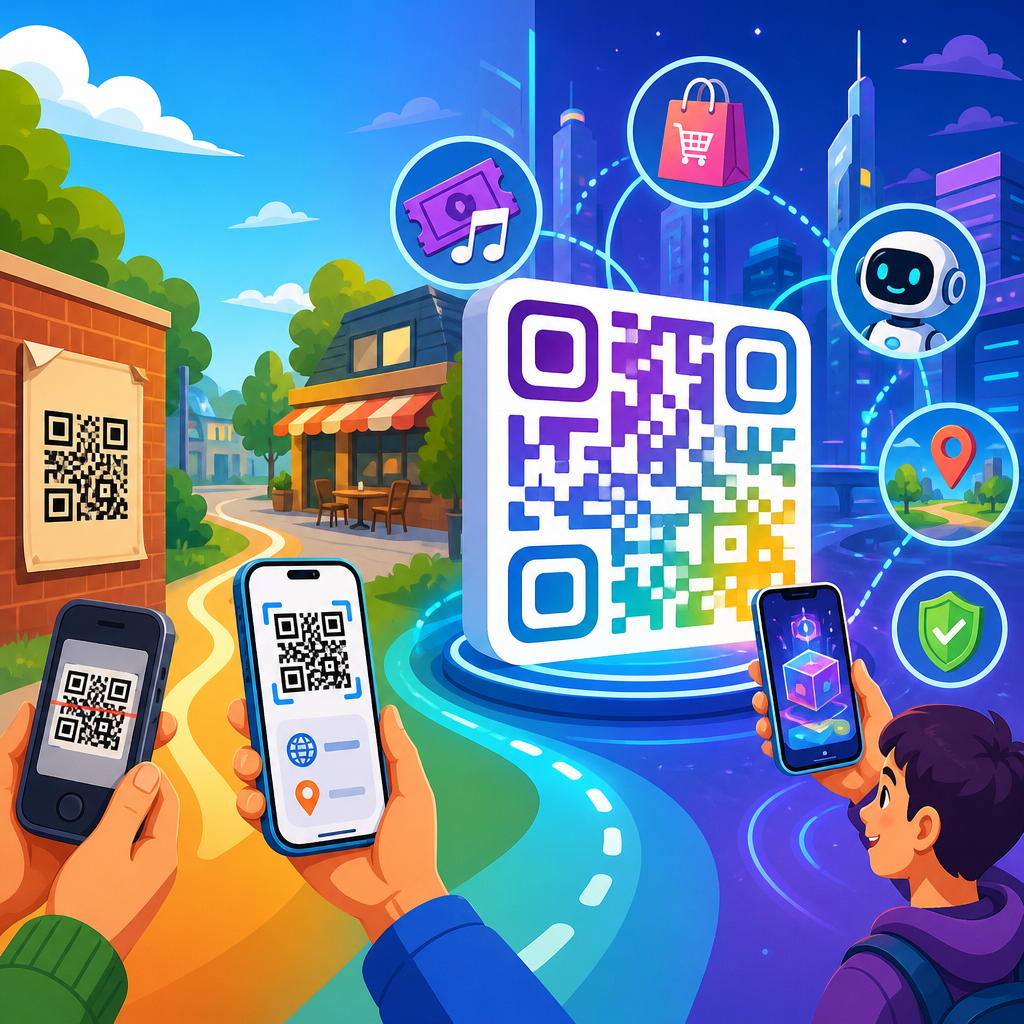
QR codes are no longer just black-and-white squares that open restaurant menus; in 2026 and beyond, they are becoming a flexible interface layer between physical spaces, connected products, identity systems, and real-time digital services. The future of QR code technology is being shaped by three forces at once: better smartphone cameras and operating systems, tighter security and compliance expectations, and a growing demand for low-cost links between offline experiences and cloud software. A QR code, or Quick Response code, is a two-dimensional matrix barcode that stores data in a machine-readable pattern. What matters today is not simply the symbol itself, but the full stack around it: dynamic redirection, analytics, authentication, design customization, API management, and interoperability across devices and platforms.
I have seen this shift firsthand in product launches, retail rollouts, and enterprise documentation projects. Five years ago, many teams treated QR codes as a campaign extra. Now they are often part of core customer journeys, from packaging traceability to mobile payment flows and field-service diagnostics. This change matters because QR codes solve a stubborn problem elegantly: they connect a physical object to a digital action without requiring special hardware, app installation, NFC alignment, or expensive infrastructure. For businesses, that means lower deployment cost and broader reach. For users, it means instant access. For developers, it means a standard visual trigger that can sit on paper, screens, labels, machines, storefronts, and wearable devices.
As this article hub explains, the future of QR code technology is not defined by one dramatic breakthrough. It is defined by steady evolution in usability, trust, intelligence, and context awareness. Static codes that point to a single URL still have a role, but most innovation is happening in dynamic QR systems that can be updated after printing, measured in real time, localized by region, and connected to customer data platforms or inventory systems. New use cases are also broadening adoption: circular economy tracking, digital product passports, secure check-in, omnichannel commerce, smart manufacturing, healthcare instructions, and AI-assisted support experiences. Understanding these shifts helps organizations build QR programs that age well instead of becoming fragmented collections of temporary links.
This hub article covers the major directions shaping QR codes in 2026 and beyond, with practical context for marketers, product managers, operations teams, and developers. It explains how dynamic infrastructure is replacing one-off code generation, why security standards are becoming nonnegotiable, how design and accessibility are improving scan rates, where regulation influences deployment, and which emerging use cases are likely to define the next phase of adoption. If you are planning a QR code strategy for packaging, retail, payments, support, events, logistics, or connected products, these are the developments that deserve your attention now.
Dynamic QR infrastructure is replacing one-off code generation
The most important shift in the future of QR code technology is the move from isolated images to managed infrastructure. In practical terms, organizations are replacing folders full of exported PNG files with platforms that issue dynamic QR codes tied to editable destinations, campaign rules, and analytics dashboards. A static QR code embeds its final data directly in the symbol, so changing the destination usually requires reprinting. A dynamic QR code typically encodes a short redirect URL or identifier managed by a service layer, allowing the destination, content, or workflow to change without changing the printed mark.
This matters because physical media lasts longer than many campaigns or systems. A product box may stay in warehouses, stores, and homes for eighteen months, while the linked content may need weekly updates. I have worked on packaging programs where a single dynamic code served setup videos, region-specific warranty pages, and safety notices in multiple languages based on scan context. The printed asset stayed constant, but the destination logic evolved. That approach reduced waste, preserved continuity, and allowed operations teams to respond quickly when product information changed.
Dynamic infrastructure also enables governance. Large organizations increasingly need permission controls, naming conventions, expiration rules, and API access so codes can be generated and managed at scale. Tools such as Bitly, QR Code Generator Pro, Scanova, Adobe Experience Manager integrations, and enterprise marketing platforms now support QR workflows that sit inside broader content operations. In mature deployments, each QR code becomes an addressable digital endpoint with metadata, ownership, performance history, and compliance review. That is a substantial step up from treating the code as a disposable graphic.
Security, trust, and authenticated experiences are becoming central
As QR usage rises, so does abuse. Phishing, sticker overlay attacks, malicious redirects, and counterfeit product labels have made security a first-order issue. The future of QR code technology therefore depends on trust signals and secure implementation patterns. The code itself is not inherently dangerous, but the destination can be. Best practice now includes branded domains, HTTPS everywhere, short redirect chains, mobile-safe landing pages, and active monitoring for hijacked links. In enterprise settings, teams are adding signed URLs, tokenized sessions, and device-aware validation to sensitive flows such as payments, account access, or service authentication.
Authentication is expanding beyond simple linking. Brands are embedding serialized identifiers into QR workflows to help verify products, prove provenance, or unlock post-purchase services. In luxury goods, cosmetics, and pharmaceuticals, a code may connect to a cloud record that confirms lot number, origin, and distribution status. In manufacturing, a serialized code on a component can link to maintenance history, operator instructions, and replacement part data. This does not eliminate fraud on its own, but it creates a verification layer that is far more useful than a generic landing page.
Consumers are also learning to judge QR safety more critically. Native camera apps in iOS and Android generally preview a URL before opening it, and that preview is becoming an important trust checkpoint. Clear domain naming, recognizable branding, and concise on-page explanations increase completion rates because users feel safer proceeding. Teams that ignore this behavior often see unnecessary abandonment. In 2026 and beyond, the QR experience that wins is not merely scanable; it is verifiable, legible, and intentionally designed to reduce doubt at every step.
Design, accessibility, and scan performance are improving together
Better design does not mean turning every QR code into abstract art. It means balancing aesthetics, error correction, print quality, contrast, quiet zones, and placement so codes remain reliably scanable in real-world conditions. The future of QR code technology includes more branded customization, but the best implementations respect technical limits. High error correction can support a center logo, yet overdesign still harms performance. Matte finishes usually scan better than reflective laminates. Curved packaging can distort modules. Low-light venues require larger codes and stronger contrast. These details decide whether a campaign works.
Accessibility is becoming part of that design conversation. A code without context excludes users who cannot scan easily or do not understand the expected action. Strong implementations pair the symbol with plain-language instructions, a fallback short URL, and enough nearby text to explain value before the scan. On medical instructions, transit signage, or government notices, that context is essential. I have seen scan rates rise simply because the call to action changed from “Scan me” to a specific promise such as “Scan for 60-second setup video” or “Scan to check refill eligibility.” Clarity outperforms cleverness.
Print and environmental testing are also getting more disciplined. Teams increasingly validate minimum size, viewing distance, substrate behavior, and camera performance across midrange devices, not just flagship phones. This is especially important in logistics, industrial settings, and outdoor installations where scratches, glare, dirt, or motion affect capture speed. Good QR programs now include test matrices before full rollout.
| Factor | What improves scan success | Common failure |
|---|---|---|
| Contrast | Dark code on light background | Low-contrast brand colors |
| Quiet zone | Clear margin around the symbol | Crowded edges or text overlap |
| Surface | Flat, matte, undistorted print area | Gloss, curves, folds, or creases |
| Size | Matched to viewing distance and lighting | Too small for quick camera lock |
| Labeling | Specific call to action and fallback URL | No explanation of outcome |
Payments, identity, and regulated workflows are expanding adoption
One reason QR codes have staying power is that they fit regulated, high-volume processes where simplicity matters. Payments are the clearest example. EMVCo-based QR payment frameworks, already influential in parts of Asia and Latin America, continue to normalize account-to-account and wallet-based transactions without specialized terminals. Merchants can deploy printed payment acceptance quickly, and consumers can authorize transactions using apps they already trust. Not every market will prefer QR over contactless tap, but QR remains highly attractive where cost sensitivity, interoperability, and merchant onboarding speed matter.
Identity and access workflows are also growing. Event credentials, visitor check-in, transit access, and appointment verification increasingly use time-bound QR tokens. In these cases, the code is less a hyperlink and more a compact carrier of session or authorization data. Airlines and rail operators have relied on barcode boarding passes for years; newer systems add fraud controls, revocation logic, and deeper integration with customer accounts. Healthcare providers use QR-linked intake forms and follow-up instructions because they reduce paperwork friction while preserving a direct handoff into secure portals.
Regulation will push further adoption in sectors where traceability and disclosure are mandatory. Digital product passport initiatives, extended producer responsibility schemes, food traceability requirements, and medical device documentation rules all favor inexpensive machine-readable links. A QR code can bridge a small physical label and a large body of digital information that would never fit on packaging. When implemented well, that bridge benefits both compliance teams and end users.
Connected products and lifecycle data will define the next wave
The most exciting long-term opportunity for the future of QR code technology is product lifecycle connectivity. A QR code can act as the persistent front door to a product record from manufacture through resale, service, recycling, and disposal. This is especially valuable as brands invest in circular economy models. A garment code might show material composition, care guidance, repair options, resale authentication, and end-of-life instructions. An appliance code might open installation help on day one, maintenance logs in year three, and parts recycling guidance at retirement.
These use cases become more powerful when QR systems connect to enterprise resource planning, customer relationship management, and product information management platforms. Instead of sending every scan to the same generic page, the experience can reflect SKU, batch, region, service history, or ownership status. In practice, this means a technician scanning a machine code can see serial-specific diagrams, while a customer scanning the same model on retail packaging sees buying guides and reviews. One symbol category supports multiple roles because the logic sits behind it.
AI will amplify this trend, not replace it. QR codes are ideal triggers for context-rich assistance because they anchor a digital session to a known object or location. Scan a boiler label, and an assistant can start with the exact model, error code family, and maintenance manual instead of asking broad diagnostic questions. Scan a museum placard, and the response can adapt to language preference, reading level, and available time. The code becomes the handshake that gives intelligent systems the situational context they need to be useful quickly.
What organizations should do now to prepare for 2026 and beyond
Teams planning a serious QR strategy should start with governance, not artwork. Choose whether each use case requires static or dynamic deployment, define ownership, standardize domain structure, and create testing rules for print, mobile rendering, and analytics. If the code may live longer than a campaign, dynamic management is usually the safer choice. Build naming conventions and documentation early, because unmanaged code libraries become impossible to audit once dozens of departments start generating their own versions.
Next, map the user journey behind every scan. The best QR code in the world cannot rescue a slow, irrelevant, or confusing landing experience. Pages must load fast, respect privacy requirements, and answer the exact question implied by the placement. A code on packaging should not dump users on a homepage. A code on industrial equipment should not require three clicks to reach safety guidance. Relevance is the difference between utility and friction.
Finally, measure outcomes beyond scan volume. Track completion rate, downstream actions, location context, device mix, and repeat engagement. In my experience, organizations often celebrate high scans even when the linked experience underperforms. A smaller number of successful scans that lead to registration, payment, repair completion, or support deflection is far more valuable. The future of QR code technology belongs to teams that treat codes as managed service entry points, not decorative shortcuts.
QR codes are evolving because they solve a real interface problem with exceptional efficiency: they connect physical moments to digital actions using infrastructure almost everyone already carries. In 2026 and beyond, the winning implementations will be dynamic rather than fixed, secure rather than generic, and context-aware rather than one-size-fits-all. Payments, product authentication, digital product passports, lifecycle service, and AI-guided support are not fringe experiments anymore. They are practical extensions of a mature technology that is finding new relevance as commerce, compliance, and connected products become more data driven.
The core lesson is straightforward. A QR code should no longer be planned as a graphic asset alone. It should be designed as part of a system that includes destination logic, trust safeguards, accessibility cues, analytics, and long-term content governance. Organizations that build that system now will be able to reuse it across packaging, retail, documentation, events, logistics, and post-purchase support without starting from scratch each time. Those that do not will keep reprinting codes, patching destinations, and missing valuable customer and operational data.
If you are building out a QR Code Technology & Development content plan, use this page as your hub and go deeper into the linked subtopics next: dynamic versus static QR architecture, QR code security best practices, QR design standards, analytics implementation, payments, digital product passports, and AI-powered scan experiences. The future of QR code technology is already arriving. The smartest move is to treat QR as durable infrastructure and start improving your deployment model now.
Frequently Asked Questions
1. How are QR codes changing in 2026 compared with how people used them a few years ago?
QR codes in 2026 are evolving from simple destination links into a much more capable interface layer between the physical world and digital systems. A few years ago, most people associated them with basic actions such as opening a menu, visiting a homepage, or downloading an app. Today, they are increasingly being used to trigger dynamic, context-aware experiences tied to products, places, identities, and cloud-based services. That means one QR code can now do far more than point to a static webpage. It can connect to live inventory data, launch a secure payment flow, verify a product’s authenticity, register a device, personalize customer support, or update information in real time without changing the printed code itself.
This shift is being enabled by several overlapping trends. Smartphone cameras and operating systems have become better at instantly recognizing codes in low light, at odd angles, or from greater distances, which reduces friction for everyday users. At the same time, businesses want cheaper and more flexible ways to connect offline touchpoints to digital workflows without deploying expensive hardware. A printed label, poster, package, badge, or display can now act like a lightweight smart interface. As a result, QR codes are becoming less of a one-time scan tool and more of a durable access point into ongoing digital interactions.
Another major change is that the QR code itself is no longer always the full story. Behind the visible code is often a managed software layer that controls routing, analytics, permissions, updates, and security policies. This is especially important in sectors such as retail, manufacturing, healthcare, logistics, events, and public services, where businesses need auditability and control. In practical terms, the QR code of 2026 is not just a printed square. It is increasingly part of a connected system designed to bridge physical objects and real-time software.
2. Why are QR codes becoming more important for connected products, smart packaging, and physical spaces?
QR codes are gaining importance because they solve a very practical problem: they provide a low-cost, widely accessible way to connect physical things to digital services. Unlike specialized hardware that requires batteries, sensors, or proprietary readers, a QR code can be printed almost anywhere and scanned with a device most people already carry. That makes it an efficient interface for connected products, packaging, displays, equipment, tickets, labels, and storefronts. In 2026 and beyond, this matters because more businesses want every physical asset to have a digital layer, but not every use case justifies the cost and complexity of embedded electronics.
In connected products, QR codes can support onboarding, warranty registration, setup instructions, software activation, maintenance logs, and customer support. A manufacturer can place a code on a device so that scanning it pulls up the exact model documentation, firmware notes, safety guidance, or replacement parts catalog. In smart packaging, brands can use dynamic QR codes to provide batch-level traceability, ingredient details, recycling instructions, promotions, authenticity checks, and region-specific compliance information. This is especially valuable when products move across markets, languages, and regulatory environments.
Physical spaces are also becoming more responsive through QR code interactions. In offices, hotels, transit environments, healthcare settings, museums, and retail stores, QR codes can act as entry points for navigation, reservations, wayfinding, feedback, check-in, identity verification, or service requests. Because the code can be tied to a location and updated through software, organizations can adapt the experience without replacing signage. A lobby code can reflect current visitor policies, a shelf label can surface live product data, and an event venue code can change based on schedule or crowd conditions.
The underlying reason this matters is that QR codes reduce the gap between offline moments and cloud software. They let businesses digitize interactions quickly, measure engagement, and update information centrally. For organizations looking to modernize physical operations without rebuilding infrastructure from scratch, that combination of simplicity, scale, and flexibility makes QR codes far more strategic than they once seemed.
3. What security improvements are shaping the future of QR code technology?
Security is one of the biggest forces redefining QR code use in 2026. As QR codes become more common in payments, identity systems, product verification, and regulated industries, organizations can no longer treat them as harmless shortcuts to generic web pages. The main concern is not the code pattern itself, but where it leads, what action it triggers, and whether the user can trust the interaction. Phishing, malicious redirects, fake labels, and tampered codes have pushed security higher on the priority list for both software platforms and end users.
In response, businesses are adopting stronger controls around QR code generation, management, and destination validation. Dynamic QR systems are increasingly paired with secure redirect layers that monitor links, enforce domain rules, and detect suspicious behavior. Some implementations use signed URLs, time-limited tokens, encrypted payloads, or authenticated workflows so a scan cannot be easily copied or abused. In environments where identity or payment is involved, the QR code may simply initiate a secure session rather than contain sensitive information directly.
Operating systems and mobile apps are also improving the user experience around trust signals. Modern smartphones are getting better at previewing destinations, flagging risky links, and handling QR-triggered actions in a more secure way. On the enterprise side, organizations are layering QR interactions into broader compliance and governance frameworks. That includes access controls for who can create or modify codes, audit logs for scan activity, lifecycle management for retiring old codes, and validation systems to confirm that a code placed on a product or in a facility is legitimate.
Security is also closely tied to physical integrity. Businesses are using tamper-evident labels, serialized codes, and product-level identity systems to reduce counterfeiting and unauthorized duplication. In some sectors, the future of QR codes is not just about making scanning easier. It is about making every scan more trustworthy, traceable, and policy-aware. That is essential if QR codes are going to function as a serious interface for commerce, credentials, healthcare, logistics, and connected services.
4. Will QR codes play a larger role in digital identity, payments, and secure access?
Yes, and that role is likely to expand significantly. QR codes are well suited to identity and access scenarios because they offer a simple handoff between a physical moment and a secure digital transaction. In payments, they already support everything from peer-to-peer transfers to merchant checkout flows. In the coming years, they are expected to become even more tightly integrated with banking apps, wallets, ticketing systems, and region-specific payment networks. Their advantage is that they can work across devices and environments without requiring expensive terminals or highly specialized hardware.
For digital identity, QR codes can serve as a bridge between credentials stored in secure apps and real-world verification points such as kiosks, reception desks, border checkpoints, clinics, workplaces, or event entrances. Instead of carrying paper documents or typing account details, a user may scan or present a QR code to initiate a permission-based exchange of verified information. Depending on the system design, that could include age verification, appointment confirmation, membership access, proof of purchase, employee authorization, or a digitally signed credential. In well-designed systems, the QR code does not expose unnecessary personal data. It simply starts a controlled process for validation.
Secure access is another area where QR codes fit naturally. Temporary building entry, visitor passes, hotel room workflows, equipment checkout, and gated digital content can all be managed through QR-enabled authentication. Organizations like this approach because it can be deployed quickly, updated centrally, and tied into existing identity providers and access policies. It also works well in hybrid environments where some people use mobile wallets, others use company apps, and still others need browser-based access.
That said, the future will depend on implementation quality. For QR codes to succeed in identity and payments, systems must prioritize anti-fraud protections, clear user consent, secure session handling, and interoperability across platforms. When those pieces are in place, QR codes become a very practical tool for secure, low-friction transactions that connect people, places, and trusted digital records.
5. What should businesses do now to prepare for the next generation of QR code use?
Businesses should start by thinking of QR codes as part of a broader digital infrastructure strategy rather than as isolated marketing assets. The most successful implementations in 2026 and beyond are tied to clear workflows, measurable outcomes, and backend systems that can actually respond to a scan in useful ways. That means the first step is identifying where a QR code can remove friction, improve traceability, enable self-service, or connect a physical touchpoint to live software. Common starting points include packaging, product support, check-in flows, signage, service requests, warranties, loyalty experiences, and authenticated information access.
Next, organizations should invest in managed and dynamic QR code systems instead of relying only on static codes that cannot be updated. A dynamic approach allows teams to change destinations, localize content, test experiences, retire broken links, and collect analytics without reprinting materials. Just as important, it creates a foundation for governance. Businesses need the ability to control who creates codes, where they redirect, how long they remain active, and what data is captured. This becomes especially important when QR codes touch regulated information, transactions, or identity-related processes.
Security and usability should be built in