QR codes remain remarkably readable even after scratches, smudges, folds, and partial obstruction because they are built with redundant data and mathematical error correction. That resilience is not accidental; it is a core design feature of the QR Code standard, formalized in ISO/IEC 18004 and proven daily on packaging, posters, invoices, menus, warehouse labels, and industrial parts. When people ask why QR codes still work when damaged, the short answer is this: the symbol stores data in a way that lets scanning software reconstruct missing pieces, as long as the damage stays within the correction capacity of the chosen level.
Understanding this topic starts with a few key terms. A QR code is a two-dimensional matrix barcode made of dark and light modules arranged in a square grid. Error correction is the process that allows a scanner to recover the intended data even when some modules cannot be read correctly. Error correction levels are predefined settings that determine how much damage or distortion the code can tolerate before scanning fails. In standard QR codes, those levels are L, M, Q, and H. They represent increasing resilience, but that extra durability comes with a tradeoff: the higher the correction level, the less room remains for actual payload data in a given symbol size.
This matters because QR codes are now expected to perform in messy real-world conditions rather than ideal laboratory prints. I have worked with QR implementations on retail cartons, laminated restaurant table tents, event badges, equipment tags, and direct mail pieces, and the same lesson appears every time: durability depends as much on smart error correction choices as on design. A code printed on a glossy bottle will face curved surfaces and reflections. A shipping label may be abraded in transit. A storefront window decal can fade from sun exposure. In each case, selecting the right error correction level can be the difference between a reliable scan and a dead end for the user.
For teams building a broader QR Code Technology & Development resource, error correction levels deserve hub status because they influence nearly every downstream decision. They affect symbol version, print size, quiet zone, logo placement, material choice, scanner performance, and user experience. They also shape practical policies such as whether marketing can safely place a logo in the center, whether operations can print on corrugated boxes, or whether product teams should use dynamic URLs instead of long static strings. Once you understand how error correction works, damaged QR codes stop looking mysterious. They become engineered systems with known limits, measurable tolerance, and predictable behavior.
How QR codes recover data after damage
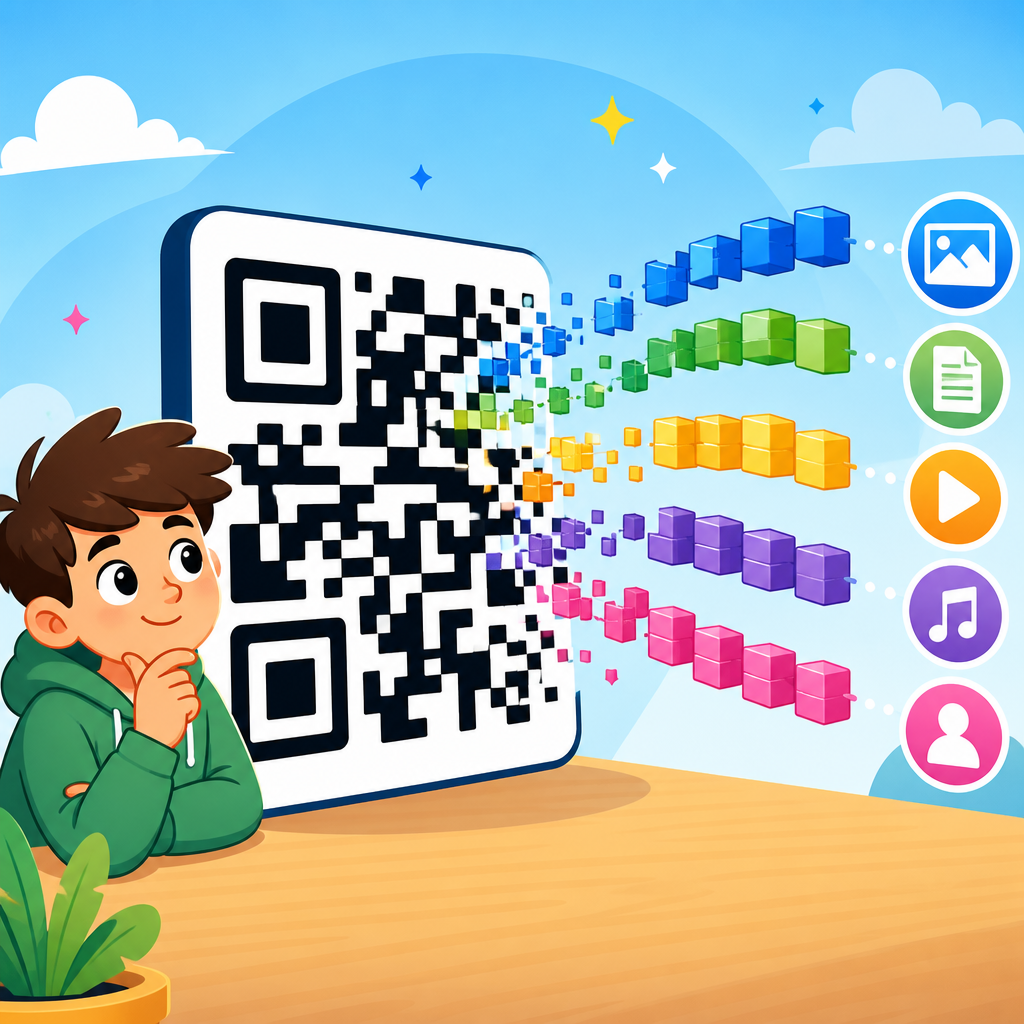
QR codes survive damage because they do not rely on every individual module being perfect. The symbol contains structural patterns and redundant codewords that help a scanner identify orientation, locate the grid, sample module positions, and repair a certain amount of corruption. Three visible features do important front-end work: the finder patterns in three corners, the timing patterns that help establish module spacing, and the alignment patterns used in larger versions to correct distortion. Once the scanner has mapped the symbol, it decodes the data and applies Reed-Solomon error correction to reconstruct missing or incorrect codewords.
Reed-Solomon is a block-based error correction method used in storage, telecommunications, and barcodes because it is effective against burst errors, where damage affects clusters rather than isolated points. That suits QR codes well. A coffee stain, torn edge, or logo overlay usually wipes out a region, not random single modules. During encoding, extra parity codewords are added to the data. During decoding, the scanner uses those parity relationships to detect and correct errors within the capacity of the chosen level. In plain terms, the code carries backup information about itself, so parts of it can be lost and still be rebuilt.
That is why a damaged QR code often scans when a one-dimensional barcode would fail. Traditional linear barcodes usually depend on a clean read across a horizontal band. If a scratch crosses the bars at the wrong point, the scanner may not have enough information. A QR code spreads information across two dimensions and includes stronger recovery mechanisms. I have seen warehouse labels with corners crushed by shrink wrap still open the correct tracking page because the finder patterns remained visible and the blocked codewords stayed within correction tolerance.
The phrase “up to 30 percent damage” is often repeated, but it needs context. Error correction levels do not mean any arbitrary 30 percent of the image can disappear. Damage location, print quality, contrast, quiet zone integrity, module size, curvature, and scanner quality all matter. Covering a finder pattern is far more harmful than scuffing a noncritical interior region. Low contrast on matte kraft paper can defeat a code long before theoretical correction limits are reached. The standard provides capacity, not a guarantee under all physical conditions.
What the four error correction levels mean
Standard QR codes offer four error correction levels, and each one reflects a different balance between capacity and resilience. Level L restores roughly 7 percent of codewords, M about 15 percent, Q about 25 percent, and H about 30 percent. These figures are practical approximations used across the industry and are sufficient for design planning. As the level rises, the symbol needs more parity codewords. If the data amount stays the same, the code may need a larger version, which means more modules per side.
| Error correction level | Approximate recovery capacity | Best use case | Main tradeoff |
|---|---|---|---|
| L | ~7% | Clean print environments, short-term indoor use | Lowest resilience |
| M | ~15% | General marketing, packaging, documents | Moderate symbol growth |
| Q | ~25% | Codes with moderate wear, some branding, mixed handling | Reduced payload capacity |
| H | ~30% | Harsh conditions, logo overlays, industrial labels | Largest symbol for the same data |
In practice, M is the default choice for many business applications because it offers useful protection without excessive symbol inflation. Q and H become valuable when the code will face abrasion, curved placement, or intentional obstruction such as a centered brand mark. Level L is still useful when print conditions are controlled and data density matters. For example, a manufacturing line printing tiny codes on electronics housings may need lower correction to fit a required payload into the available physical area.
Choosing the highest level is not automatically best. Higher correction can force a jump to a denser symbol version, and denser codes require larger print sizes to maintain module clarity. If you compress too much complexity into a small label, smartphone cameras may struggle, especially in low light. I often advise teams to shorten the encoded content first, usually by using a concise dynamic URL, then raise error correction if needed. That sequence preserves both resilience and scan speed.
Why damage location matters more than people expect
Not all damage is equal. The position of the missing or degraded area strongly influences whether the QR code remains scannable. Finder patterns, the three large corner squares, are essential for detection and orientation. If one is heavily obscured, many scanners will fail before error correction even begins. Timing patterns and format information are also critical because they tell the decoder how to interpret the matrix. Damage in these areas can be disproportionately destructive compared with similar damage in a central data region.
This is the main reason logo placement requires discipline. Designers often assume that if a code uses level H, they can place a large logo anywhere. That is unsafe. A center logo can work because central data loss is often recoverable, but only if the logo does not consume too much area, the quiet zone remains intact, contrast stays high, and the final symbol is tested across real devices. A logo drifting toward a finder pattern or alignment pattern can collapse scan reliability fast. I have seen beautifully branded codes fail on older Android devices because the logo was modest in size but slightly off-center.
Edge damage behaves differently from center damage. Torn corners may remove format or version information, while abrasion along one side can disrupt timing references. By contrast, a stain in the middle may be fully recoverable at Q or H. Curved surfaces introduce another type of localized error: module deformation. On a bottle or pipe, the code may not be physically missing, but the camera samples distorted modules. Error correction can save the read if distortion is moderate, yet excessive curvature demands a larger code, flatter placement, or a different label position.
Environmental conditions also create patterned damage. UV fading lowers contrast gradually; grease and condensation create glare hotspots; textured cardboard breaks clean module edges; thermal transfer ribbon issues can create streaks. These are not random failures. They produce repeatable scanning problems that good testing can reveal. The practical takeaway is simple: evaluate where damage is likely to occur and protect the most important symbol structures, not just the code in general.
How error correction affects size, capacity, and performance
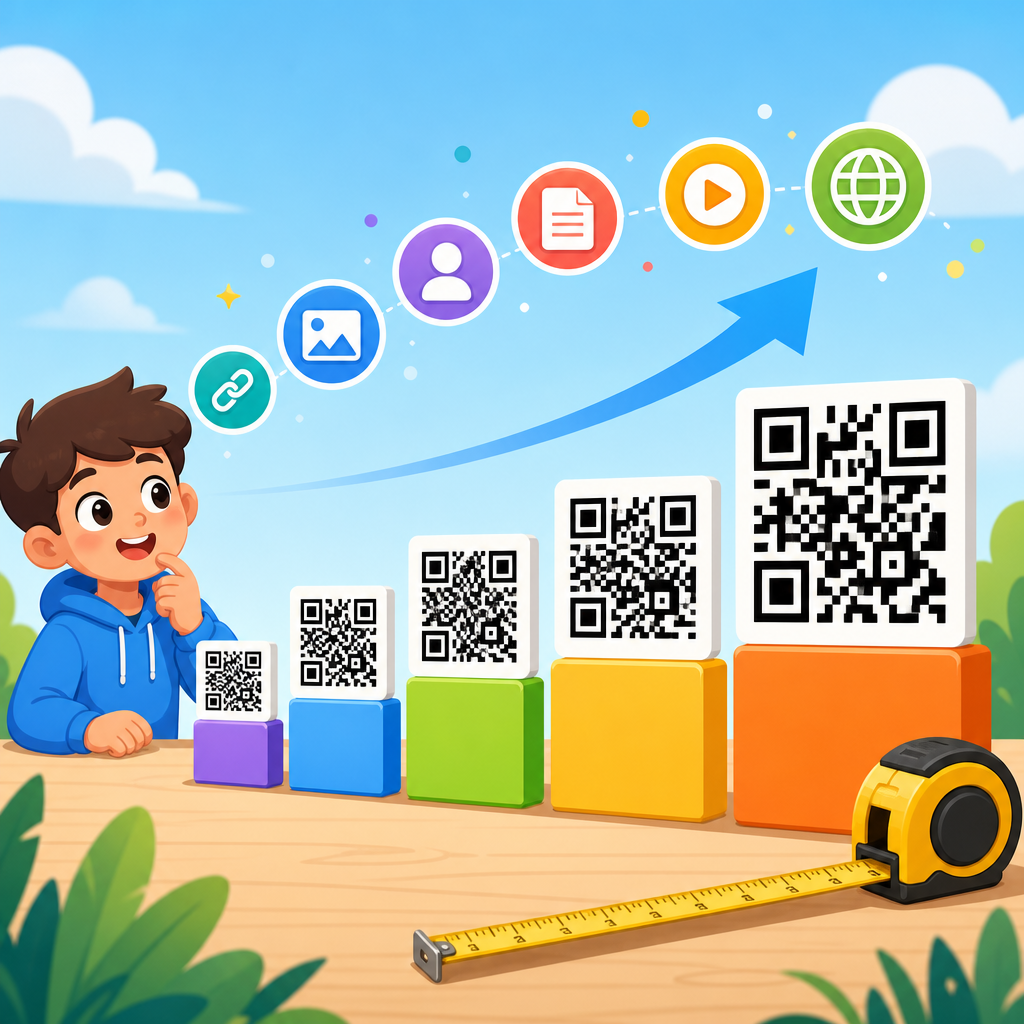
Error correction levels influence much more than durability. They directly affect how much data fits inside a QR code and how large the printed symbol must be for reliable scanning. QR versions range from Version 1 at 21 by 21 modules up to Version 40 at 177 by 177 modules. As you increase payload length or raise correction level, the encoder may move to a larger version. That increases module count, and if the physical print area stays the same, each module becomes smaller and harder to resolve.
This relationship explains a common failure pattern in marketing materials. A team encodes a long URL with UTM parameters, selects level H for safety, adds a logo, then reduces the code to fit a flyer corner. On screen it looks acceptable, but in print the modules become too fine, and scans drop sharply. The fix is usually straightforward: shorten the URL through a redirect, remove unnecessary parameters from the encoded string, increase print area, or lower correction one step after testing. Better data strategy often solves what looks like a scanning problem.
There is also a performance dimension on the scanner side. Modern phones are excellent at decoding, but denser symbols still demand better focus, steadier framing, and stronger lighting. In warehouse and industrial settings, dedicated imagers such as Zebra and Datalogic units can read dense codes at speed, yet even they benefit from sensible symbol sizing. A code that is technically valid but physically tiny creates operational friction. Staff pause longer, retry scans, and lose throughput. Error correction should improve resilience, not compensate for avoidable size mistakes.
The best implementation approach is to design around module size first. Define the minimum expected scanning distance and device quality, then choose a physical symbol size that gives each module enough area. After that, optimize data length and correction level together. This method is more reliable than picking a level in isolation because it treats the QR code as a complete scanning system rather than a graphic asset.
Best practices for choosing the right level
The right error correction level depends on environment, print process, encoded content, and design constraints. For indoor paper documents, business cards, invoices, and tabletop signage, M is usually the strongest default because it balances capacity and resilience well. For product packaging, direct mail, and posters that may be creased or scuffed, Q often provides useful extra tolerance. For industrial asset tags, outdoor labels, and branded codes with center overlays, H is frequently justified. L is appropriate for tightly controlled applications where every module counts and the symbol will stay clean.
Testing is not optional. I recommend printing sample codes at final size on the actual substrate, then checking them with multiple phones, both iOS and Android, under bright and dim lighting. Introduce realistic abuse: light scratching, fingerprints, slight crumpling, and angled scans. If the code includes a logo, test with lower-end cameras, not just flagship devices. If the code is destined for packaging, scan samples after transport simulation because abrasion and curvature reveal weaknesses quickly.
Use established tools to validate quality. Professional barcode verification systems from vendors such as Axicon, Cognex, and REA can measure print contrast, modulation, axial non-uniformity, and other factors that affect real scanning behavior. Although formal grading is more common with Data Matrix in regulated manufacturing, the same discipline improves QR deployments. For everyday teams using online generators, verify whether the platform exposes control over correction level, margin size, and output format. PNG is common, but SVG is usually better for print because it preserves edge sharpness at any size.
Finally, keep the surrounding design clean. Preserve the quiet zone, maintain strong dark-light contrast, avoid busy backgrounds, and never assume error correction can rescue poor artwork. Damage tolerance is powerful, but it works best as insurance on top of sound production choices, not as a substitute for them.
QR codes still work when damaged because their structure was engineered for loss, distortion, and imperfect handling. Finder patterns help scanners locate the symbol, redundant codewords preserve recoverability, and Reed-Solomon correction rebuilds missing information within known limits. The four error correction levels give teams a practical tuning system: L for maximum capacity, M for balanced everyday use, Q for rougher conditions, and H for the highest tolerance and careful logo use. Once you understand those levels, the reliability of damaged QR codes stops feeling like luck and starts looking like deliberate design.
The most important takeaway is that durability is always a tradeoff. More error correction improves resilience, but it also increases symbol complexity and can force larger print sizes. Damage location matters, not just damage percentage. Data length matters. Material, contrast, quiet zone, and scanner quality matter. The strongest QR implementations align all of those factors instead of focusing on a single setting. That is why two codes using the same correction level can perform very differently in the field.
If you are building or updating QR code systems, start by auditing current symbols for payload length, print size, and environment, then test M, Q, and H against real wear conditions. Use short dynamic URLs, protect critical patterns, and validate before launch. Done properly, error correction levels turn QR codes from fragile graphics into dependable tools that keep working when the physical world does its worst.
Frequently Asked Questions
Why can a QR code still scan even when part of it is scratched, dirty, or covered?
QR codes are designed to tolerate damage from the start. Unlike simpler barcodes that rely on a single line of data, a QR code stores information across a two-dimensional grid of black and white modules. More importantly, that data is encoded with built-in redundancy and error correction, so a scanner does not need every single square to be perfect in order to recover the original message. If a portion of the symbol is scratched, smudged, folded, or blocked by a label edge, the scanner can often reconstruct the missing information from the remaining readable areas.
This is not a lucky side effect. It is a formal part of the QR Code standard, defined in ISO/IEC 18004. The symbol includes structural patterns, such as finder patterns in the corners and alignment patterns in larger versions, which help the scanner identify orientation, scale, and distortion before decoding the payload. After that, mathematical error correction is applied to fill in gaps. In everyday use, this is why QR codes on shipping labels, food packaging, posters, menus, invoices, and machine parts can continue working even after rough handling. As long as the damage does not exceed the code’s recovery capacity or destroy critical structural areas, the code remains readable.
What kind of error correction do QR codes use, and how does it help recover missing data?
QR codes use Reed-Solomon error correction, a well-established mathematical method for detecting and correcting corrupted data. In simple terms, the code does not just store the message itself. It also stores extra recovery data that allows a scanner to rebuild parts of the message when some modules cannot be read correctly. That means a QR code can survive real-world problems such as scratches, print defects, wrinkles, glare, ink spread, or partial obstruction and still decode successfully.
The QR standard provides four error correction levels: L, M, Q, and H. These levels trade storage capacity for resilience. Level L offers the least redundancy and can recover a smaller amount of damage, while Level H offers the most redundancy and can tolerate substantially more data loss. That is why a code meant for harsh environments, such as industrial labeling or outdoor signage, may be generated with a higher error correction level than one used in cleaner, more controlled conditions. The key point is that the ability to scan a damaged QR code is based on deliberate engineering. Redundant coding gives the scanner room to work around missing or corrupted areas instead of failing the moment the symbol is imperfect.
How much damage can a QR code take before it stops working?
There is no single percentage that applies in every situation, because scan success depends on several factors at once: the error correction level used, where the damage occurs, the size of the printed code, contrast, lighting, camera quality, and how well the symbol was printed in the first place. In general, a QR code can tolerate a surprising amount of localized damage, especially when generated with higher error correction. However, “tolerate damage” does not mean “invincible.” If too much data is destroyed, or if critical reference patterns are damaged, the scanner may no longer be able to interpret the symbol.
Placement of the damage matters just as much as quantity. A small tear across a noncritical region may be recoverable, while a smaller obstruction over a finder pattern or severe warping across the whole symbol can cause failure. Smudging that lowers contrast across the entire code can also be more harmful than a single scratch in one area. In practice, QR codes often keep working through minor wear because scanners only need enough clean, decodable information to reconstruct the rest. That is why real-world testing is so important. If a code will be used on curved packaging, exposed to moisture, or handled repeatedly, it should be tested under those actual conditions rather than relying on theory alone.
Do all damaged QR codes work equally well, or do design and printing choices affect durability?
Design and production choices have a major effect on how well a QR code survives damage. Error correction level is one of the biggest factors, but not the only one. The printed size must be large enough for the intended scanning distance and device type. The contrast between dark modules and the light background must be strong. The quiet zone, which is the blank margin around the symbol, must remain clear so scanners can isolate the code from surrounding graphics. If any of these basics are compromised, the code becomes less forgiving, even if its built-in error correction is strong.
Material and printing method also matter. A QR code printed on glossy packaging may suffer glare, while one placed on a textured or flexible surface may distort or crack. Codes engraved on metal, printed on corrugated cardboard, or applied as stickers in industrial settings face different risks than codes on a flat paper flyer. Even aesthetic customization can reduce resilience if it removes too much contrast or interferes with important patterns. A well-made QR code combines proper encoding, appropriate error correction, high-quality printing, and realistic placement. When those elements are handled correctly, the symbol’s built-in recovery features perform far better in the face of wear and damage.
Why is QR code damage resistance so important in real-world applications?
Damage resistance is one of the main reasons QR codes have remained so effective across industries. In the real world, codes rarely stay pristine. Packages get scuffed in transit, menus are handled constantly, warehouse labels collect dust, posters fade outdoors, and invoices may be folded or marked up. A code that only worked under perfect conditions would not be practical at scale. QR codes succeed because they were designed for these messy environments, where partial damage is normal rather than exceptional.
This reliability has real business and operational value. It reduces failed scans, lowers friction for customers, improves tracking accuracy, and supports automation in logistics, manufacturing, retail, healthcare, and field service. It also makes QR codes more versatile than many people realize. They can be placed on products, equipment, documents, signs, and components with confidence that ordinary wear will not instantly make them useless. In short, QR codes still work when damaged because resilience is part of their architecture, not an afterthought. Their combination of structured layout, redundant encoding, and standardized error correction is exactly what allows them to perform so consistently in everyday conditions.