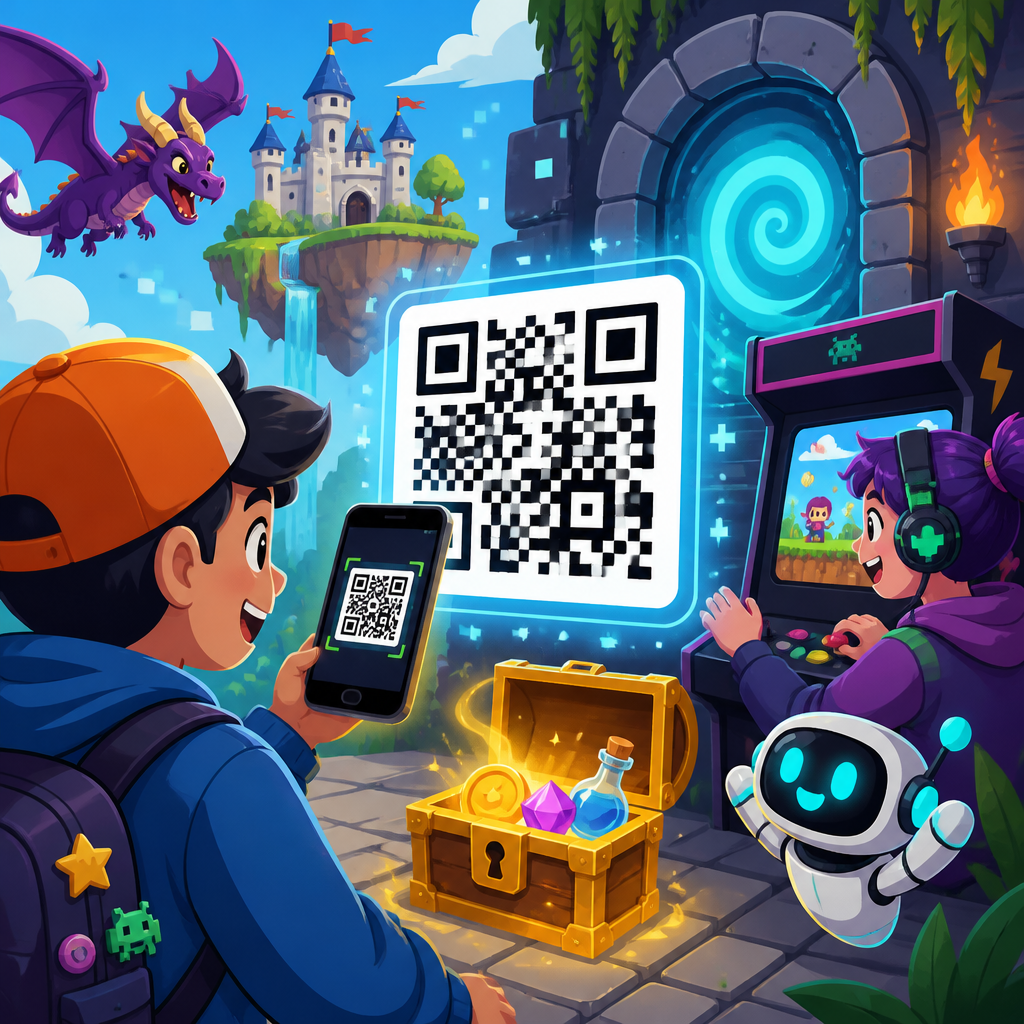
QR codes in gaming and interactive experiences have moved far beyond simple website links, becoming flexible tools for discovery, progression, rewards, community building, and measurable engagement across physical and digital play. In practice, a QR code is a two-dimensional matrix barcode that stores data such as a URL, unique identifier, deep link, coupon token, or game state reference. When scanned with a smartphone camera or dedicated device, it can trigger content instantly. That speed matters because modern players expect low-friction entry points, whether they are joining an alternate reality game, claiming an in-store cosmetic item, unlocking a live event quest, or jumping from packaging into a branded mini-game. I have worked on campaigns where a code printed on a poster outperformed paid social click-through rates simply because it met people in the moment of curiosity.
For gaming teams, the appeal is straightforward: QR codes bridge channels that used to be disconnected. A billboard can lead to a mobile mission. A trading card can verify ownership and unlock digital content. A convention badge can become both access control and a social matchmaking trigger. For players, the value is convenience, but only when the experience is designed well. Poorly implemented codes feel gimmicky. Strong implementations connect the scan to a clear outcome, such as a reward, a story beat, or a personalized game state. This article examines the emerging use cases shaping this space, the operational decisions behind successful deployments, and the standards teams should follow if they want QR-enabled experiences to feel seamless rather than bolted on.
Why QR codes fit modern game design
QR codes work in gaming because they solve three practical problems at once: discovery, authentication, and continuity. Discovery is the easiest to understand. A code on a stream overlay, event sign, cereal box, or toy package can move a player directly into a game page, app store listing, browser game, or account-linked reward flow without requiring manual search. Authentication is more nuanced. Dynamic QR codes can encode one-time tokens, session identifiers, or signed URLs that confirm a player was physically present at a venue or had access to a specific product. Continuity matters because game experiences increasingly span devices. A player might scan on mobile, authenticate through OAuth, and continue on console or PC with the reward attached to the correct account.
The rise of free-to-play ecosystems, live service content, and cross-platform accounts has expanded the number of moments where a scan creates value. Pokémon GO normalized location-based interaction at scale. Fortnite demonstrated how external media, events, and crossovers feed in-game activity. Board game publishers now use companion apps to update rules, deliver narrative content, and reduce printing constraints. Escape room operators use QR codes as adaptive clue systems. Museums, stadiums, and theme parks use them to layer game mechanics onto real spaces. The common thread is not the code itself. It is the ability to connect context in the physical world with responsive digital content in a measurable way.
Emerging use cases across gaming and interactive experiences
The most important emerging use cases fall into distinct categories, each with different design and measurement requirements. In collectible gaming, QR codes increasingly connect physical objects to digital inventories. Trading card game publishers can place serialized codes inside packs to unlock digital boosters, event tickets, or deck-building utilities. In retail activations, brands use shelf talkers and endcap displays to launch short-form games tied to product education or sweepstakes entry. In live events, organizers print QR codes on badges, signage, and stage screens to trigger scavenger hunts, polls, reward claims, or faction-based participation. In education and edutainment, children’s products use QR-linked mini-games to reinforce reading, science, or history lessons through interaction rather than passive viewing.
Another major use case is narrative expansion. Alternate reality games and transmedia campaigns thrive on QR codes because they turn ordinary objects into portals. A poster can reveal a character voicemail. A restaurant placemat can expose a hidden map. A comic book panel can unlock side missions or audio logs. Horror games have used codes in trailers and social media posts to hide cryptic clues, driving community speculation. Sports and esports organizations are also adopting scan mechanics for prediction games, loyalty points, seat upgrades, and sponsor activations. These experiences work best when scanning feels native to the environment. If a player must scan five times before understanding the payoff, the interaction breaks. If one scan unlocks a meaningful next step, adoption rises quickly.
| Use case | How the QR code is used | Primary player benefit | Key operational requirement |
|---|---|---|---|
| Live event quest | Codes placed around a venue unlock checkpoints | Exploration and rewards | Reliable mobile connectivity and anti-repeat logic |
| Physical-to-digital collectible | Code inside packaging links item to an account | Ownership verification and bonus content | Unique token generation and fraud controls |
| Retail mini-game | Shelf or packaging code opens a browser game | Instant engagement without app install | Fast landing page and analytics tagging |
| ARG storytelling | Code reveals clues, audio, or hidden pages | Deeper immersion and community solving | Content sequencing and moderation planning |
| Loyalty and fandom | Codes on merch or tickets award points | Recognition and repeat participation | Account linking and redemption limits |
Design principles that separate novelty from value
In every successful QR-enabled game flow I have helped review, four design principles were present. First, the player understood why scanning was worth doing before opening the camera. Signage that says “Scan to learn more” usually underperforms “Scan to claim tonight’s exclusive skin” or “Scan to start the arena quest.” The call to action must be concrete. Second, the reward matched the effort. A scan at home might justify a small cosmetic or a lore drop. A scan that requires standing in line at a convention or traveling across a venue should deliver something more substantial, such as progress in a larger challenge, a limited badge, or meaningful social status.
Third, the post-scan path must be frictionless. Browser-based experiences often convert better than forced app installs, especially for first-time users. When account linking is necessary, progressive profiling helps: let players sample content first, then authenticate to save rewards. Fourth, teams need a fallback for failure states. Venue Wi-Fi may degrade. Older camera apps may not interpret stylized codes. Accessibility needs vary. Good implementations provide a short vanity URL near the code, sufficient contrast, and instructions that do not assume technical confidence. Brand teams often want heavily customized code art, but scannability must win. Error correction levels, quiet zones, and print quality are not cosmetic details. They directly affect participation.
Technical architecture, security, and measurement
The technical side of QR codes in gaming is where many promising concepts fail. Static QR codes are fine for a permanent landing page, but dynamic QR codes are usually better for campaigns because they allow destination changes, campaign tagging, device routing, and scan analytics without reprinting. For high-value rewards, use one-time tokens stored server-side rather than exposing redeemable values directly in the code. Signed URLs, short expiration windows, and account-bound redemption rules reduce abuse. If the use case involves physical attendance verification, geofencing alone is not enough. Combine venue placement, event-specific tokens, time windows, and rate limits to make spoofing harder.
Measurement should be planned before launch. At minimum, track scans, unique users, landing page load time, authenticated conversions, reward claims, retention after the scan, and downstream revenue or participation. UTM parameters remain useful for channel analysis, but gaming teams also need event-level telemetry in systems such as Google Analytics 4, Mixpanel, Amplitude, Firebase, or first-party data warehouses. A scan is not the success metric. The useful metric is what happened because of the scan. Did players complete the quest, share the experience, return next week, or make a purchase? Privacy and compliance also matter. If the experience targets children, regional rules on consent and data handling become especially important. Security, analytics, and legal review should be part of the initial brief, not late-stage cleanup.
Examples by format: mobile, console, tabletop, venues, and education
Mobile games are the natural home for QR interactions because the camera is built in and the operating system can hand off directly to web content or the app itself. A common pattern is the event poster or stream overlay that links to a timed reward page with deep linking into the installed game. Console ecosystems use QR codes differently. Because entering long URLs with a controller is painful, many publishers place QR codes on login screens, companion app prompts, and age-gated flows to shift input to the phone. Nintendo has long understood the value of physical-digital interplay, and newer campaigns across the industry use scan mechanics for account linking, second-screen features, and promotional drops.
Tabletop and venue-based experiences are where QR codes feel most transformative. Modern board games use them for branching narration, soundtracks, tutorial videos, and scenario updates that would be impossible to include in a static box. Escape rooms use QR checkpoints to personalize hints or log team progress. Museums and science centers use scanned interactions to turn exhibits into missions, often awarding digital badges for completion. In classrooms and libraries, educators use QR scavenger hunts to turn reading comprehension or historical exploration into game loops. These use cases are effective because they make environments responsive. The physical object or place becomes interactive without expensive hardware, and the operator gains data on what players actually explored, skipped, or repeated.
Building a scalable hub strategy for emerging use cases
As a sub-pillar within QR code trends and innovations, this topic works best when treated as a hub that connects specific implementation guides rather than a single broad essay. Teams researching QR codes in gaming usually have one of several intents: they want examples for branded activations, technical guidance for reward security, ideas for education or museum programming, methods for linking physical collectibles to digital assets, or metrics for proving campaign value. A strong content hub should therefore branch into focused pages on event gamification, tabletop companion design, packaging scans, loyalty programs, alternate reality games, and anti-fraud architecture. Internal linking between those topics helps both users and search systems understand the relationship between practical use cases and broader innovation trends.
From an operational standpoint, the smartest brands start with one repeatable framework instead of many custom one-off experiences. Define the scan destination pattern, deep linking logic, token rules, analytics schema, accessibility checklist, and reward taxonomy once, then adapt it for each campaign. This reduces launch risk and shortens creative approval cycles. It also makes results comparable across activations. If a retailer, game publisher, or venue operator wants to expand quickly, standardization is what turns QR codes from a novelty into an interaction layer. The opportunity is real because the hardware barrier is gone, smartphone camera behavior is now familiar, and audiences understand what scanning does. The question is no longer whether people will scan. It is whether the experience behind the code deserves their attention.
QR codes in gaming and interactive experiences are valuable because they connect physical context, digital content, and measurable player behavior with very little friction. They can power scavenger hunts, collectible unlocks, retail games, museum missions, event rewards, and story-driven puzzles, but success depends on disciplined design rather than surface-level novelty. The best implementations make the value of the scan obvious, match the reward to the effort, support multiple devices, protect against abuse, and measure outcomes beyond raw scan counts. They also respect accessibility, privacy, and the realities of crowded venues, imperfect connectivity, and mixed user confidence.
For teams building under the broader banner of QR code trends and innovations, this emerging use case category deserves a central place because it touches entertainment, commerce, education, and fandom at once. The practical lesson is simple: treat the QR code as an entry point, not the experience itself. Build the surrounding journey with the same care you would give any game loop. If you are planning your next activation, start with one high-intent use case, instrument it thoroughly, and expand from there into a connected hub of interactive experiences.
Frequently Asked Questions
How are QR codes used in gaming and interactive experiences today?
QR codes are now used as flexible interaction points that connect physical and digital gameplay in ways that feel fast, seamless, and trackable. In modern gaming, a QR code can do much more than open a website. It can launch a game through a deep link, unlock a limited-time challenge, connect a player to a specific in-game event, assign a unique reward, redeem a coupon, restore a saved state, or bring a player directly into a multiplayer lobby or community channel. Because a QR code can store a URL, identifier, token, or other structured data, it becomes a lightweight bridge between discovery and action.
In practice, developers and experience designers use QR codes across many formats. In mobile games, they may appear in promotional materials, retail packaging, event booths, or social campaigns to drive instant installs or reward claims. In console and PC ecosystems, QR codes are often used to help players transition from a main screen to account setup, companion apps, downloadable content, or second-screen experiences without typing long links. In live events, escape rooms, scavenger hunts, museums, and location-based games, QR codes can trigger story beats, clues, checkpoints, or character interactions in real time.
They are especially valuable because they reduce friction. Instead of asking users to search manually, remember a code, or navigate multiple menus, a single scan can move them directly into the next meaningful step. That speed matters in interactive design. When the action feels immediate, players are more likely to stay engaged, complete the task, and continue progressing. For studios and brands, QR codes also add measurable engagement because each scan can be associated with a campaign, placement, device type, region, or player journey stage.
Why do QR codes work so well for player engagement and progression?
QR codes work well in gaming because they support one of the most important principles in interactive design: reducing the gap between curiosity and participation. If a player sees a hidden symbol in a trailer, on a poster, inside a livestream overlay, or within a physical game space, scanning it feels immediate and rewarding. That small action can trigger a meaningful response right away, such as a secret mission, a lore reveal, bonus currency, an access code, or an invitation into a community event. The interaction is simple, but the outcome can be layered and memorable.
They also fit naturally into progression systems. A QR code can represent a checkpoint in an alternate reality game, a collectible in a real-world quest, a chapter unlock in a story-driven campaign, or a branching path in an interactive brand experience. Because each code can be unique, developers can tailor progression based on where the player found it, when they scanned it, or which account is tied to the scan. That makes QR codes useful for personalized advancement, time-gated content, region-specific activations, and cross-channel campaigns that merge retail, events, streaming, and gameplay.
Another major advantage is that QR codes can make discovery feel intentional. Hidden or strategically placed codes can encourage exploration, social sharing, and collaboration. Players may compare findings, trade clues, or coordinate scans as part of a larger challenge. In that sense, the QR code is not just a utility tool. It becomes part of the game loop itself. When used thoughtfully, it adds momentum to progression, reinforces the narrative or reward structure, and creates measurable touchpoints that developers can analyze and improve over time.
What types of rewards or interactive content can QR codes unlock in games?
QR codes can unlock a wide range of rewards and interactive experiences, from simple incentives to sophisticated, personalized content flows. On the reward side, common uses include bonus currency, cosmetic items, character skins, exclusive levels, battle pass boosts, trial access, event tickets, limited-edition collectibles, discount codes, and loyalty perks. A scan can also grant entry into sweepstakes, reward a player for attending a physical event, or confirm participation in a promotional campaign tied to merchandise, streaming, or retail purchases.
Beyond rewards, QR codes are highly effective for triggering interactive content. A scan might open a hidden cutscene, reveal game lore, start an audio clue, launch an augmented reality overlay, connect a player to a puzzle sequence, or unlock a community challenge with shared progress. In educational or experiential games, QR codes can initiate object recognition tasks, guided walkthroughs, mini-games, or branching story moments based on the player’s location or stage in the experience. In multiplayer contexts, they can simplify team joining, spectator interactions, tournament sign-ins, or friend invitations.
What makes this particularly powerful is the ability to control context. A static reward code is useful, but a dynamic or unique QR code is far more versatile. It can identify the campaign source, validate a one-time redemption, attach the interaction to a player account, or adapt the destination based on timing and device. That flexibility lets designers create content that feels exclusive and responsive rather than generic. The result is an experience where the scan is not just a doorway to content, but part of a smart system for reward delivery, engagement tracking, and player retention.
Are QR codes useful for community building and live events in gaming?
Yes, QR codes are extremely effective for community building because they make it easy to move players from passive awareness into active participation. At live gaming events, conventions, esports tournaments, pop-up activations, and launch parties, QR codes can instantly connect attendees to Discord servers, event schedules, livestreams, giveaways, feedback forms, digital collectibles, and post-event content. Instead of relying on verbal instructions or printed URLs, organizers can create a smooth entry point that works in seconds and scales across large audiences.
They are also useful for encouraging social interaction around a shared experience. A QR code on signage, merch, stage screens, booth displays, or badges can unlock scavenger hunt tasks, team challenges, fan polls, or collaborative milestones. These interactions help transform an audience into a participating community. In fan-driven environments, that matters because players are more likely to stay engaged when they feel connected to others, recognized for their activity, and included in a larger narrative or event structure.
From an operational perspective, QR codes also bring measurable value to community campaigns. Organizers can track which placements generated the most scans, which rewards drove the highest conversions, and which event moments led to stronger participation. That data can inform future activations, improve event layout, and help teams understand how digital engagement ties back to physical attendance. When paired with thoughtful design, QR codes support community growth not just by making access easier, but by creating structured, interactive pathways for players to join, contribute, and return.
What should developers and marketers consider when implementing QR codes in gaming experiences?
Successful QR code implementation depends on usability, technical reliability, security, and design intent. First, the scan experience must be fast and intuitive. Codes should be placed where players can realistically scan them, with enough size, contrast, and lighting to work across different devices and conditions. If a code appears in a trailer, on a moving screen, or in a crowded venue, designers need to account for scan distance, dwell time, and visual clarity. A great concept can fail quickly if the code is hard to capture or leads to a slow, confusing landing experience.
Second, the destination matters just as much as the code itself. Players should arrive at content that feels relevant, optimized for mobile, and aligned with the promise of the scan. If the code advertises a reward, the path to redemption should be simple. If it launches an experience, account authentication and onboarding should be lightweight. Deep links, app fallback behavior, one-time token validation, and cross-platform compatibility all need to be planned carefully. The goal is to preserve momentum, because any friction after the scan reduces the impact of the interaction.
Security and trust are equally important. Since players are being asked to scan and act, brands and studios should use recognizable domains, secure destinations, and clear messaging about what the scan does. For reward systems, teams should consider abuse prevention, code expiration, redemption limits, and account binding. Finally, measurement should be built in from the start. Tracking scan volume, conversion paths, reward claims, repeat interactions, and campaign-level performance helps teams understand what is actually driving engagement. When implemented thoughtfully, QR codes become more than a shortcut. They become a reliable part of the product, marketing, and community ecosystem.