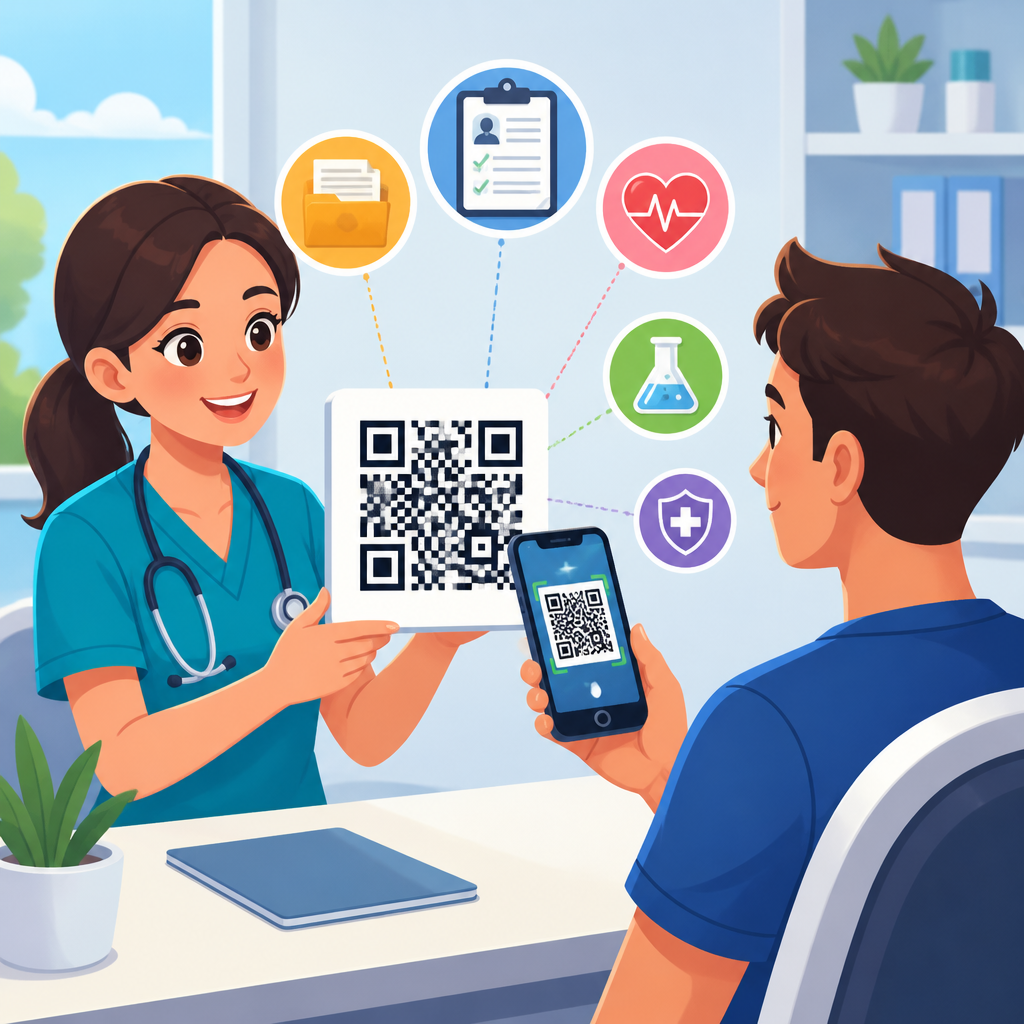
QR codes for patient information and records are becoming a practical healthcare tool because they connect physical care settings with digital data quickly, accurately, and at low cost. In hospitals, clinics, pharmacies, ambulances, and long-term care facilities, staff need immediate access to the right record, the right instruction, and the right patient identity. A QR code can bridge that gap by linking a wristband, discharge packet, medication label, specimen container, appointment card, bedside poster, or emergency document to secure information systems. In healthcare, that simple square pattern is not just a convenience feature. Used correctly, it improves patient safety, reduces administrative friction, supports documentation workflows, and helps patients participate more actively in their own care.
A QR code, or Quick Response code, is a two-dimensional barcode that stores more information than a traditional linear barcode and can be scanned by smartphones, tablets, handheld scanners, and many clinical devices. In a healthcare context, the code may contain a patient identifier, a tokenized link to an electronic health record portal, medication instructions, consent forms, lab status updates, vaccination records, or emergency data. The important distinction is that responsible healthcare deployments rarely place full medical records directly inside the code. In my work with operational QR implementations, the safer and more scalable approach is to encode a secure URL, a unique encounter ID, or a time-limited token that points to data controlled by the provider’s existing systems.
This matters because healthcare workflows are fragmented. A patient may move from primary care to imaging, then to inpatient treatment, rehabilitation, pharmacy pickup, and home monitoring. At each handoff, errors can occur: wrong-patient events, duplicate data entry, delayed discharge education, missing consent documentation, unread medication instructions, and inaccessible after-visit summaries. QR codes do not solve every interoperability problem, but they are effective at the edge of care, where a person, paper document, medicine package, or physical location needs a fast digital connection. As a healthcare sub-pillar topic, QR codes support patient records, identification, medication management, appointment coordination, bedside education, telehealth enrollment, public health campaigns, and emergency access. Understanding these use cases helps healthcare organizations choose deployments that are clinically useful, compliant, and realistic to maintain.
How QR codes support patient identification and record access
The most immediate healthcare use case is patient identification linked to records. A QR code printed on a wristband, chart label, specimen label, or appointment sheet can connect staff to the correct patient context in the electronic health record. This is especially valuable at registration desks, emergency departments, infusion centers, outpatient surgery suites, and labs, where patients move quickly and staff perform repeated verification steps. In practice, the code should not expose diagnoses, medications, or insurance details when scanned by a general camera app. Instead, it should resolve to a secure workflow inside the provider’s identity and access management system, where role-based permissions control what a registrar, nurse, physician, lab technician, or transporter can see.
Health systems commonly pair QR codes with established patient safety protocols such as two-identifier verification and barcode medication administration. The Joint Commission emphasizes accurate patient identification as a core safety goal, and barcode-assisted workflows support that standard by reducing wrong-patient and wrong-specimen errors. QR codes can extend those workflows beyond medication rounds. For example, a phlebotomist can scan a bedside code to confirm the patient and print specimen labels tied to the right encounter. A radiology technologist can scan a referral sheet to launch the scheduled imaging order without retyping accession details. A home health nurse can scan a discharge handoff packet to retrieve the most current care plan, rather than relying on a stale printout that may have changed after discharge.
For patient-facing record access, QR codes are also effective on after-visit summaries, billing statements, vaccine cards, and discharge folders. Patients often lose portal instructions or struggle with long URLs and passwords. A code that opens the portal login page, a record download page, or a specific educational packet removes a basic access barrier. In ambulatory care, I have seen clinics raise portal adoption simply by adding scannable codes to check-out paperwork and exam room signage. The code works best when it points to a mobile-optimized experience with plain-language labels, multilingual options, and support for caregivers acting under proxy permissions.
Core healthcare use cases across the patient journey
QR codes for patient information and records are most valuable when mapped to specific stages of care. Before the visit, they can simplify preregistration, digital forms, insurance card upload, symptom questionnaires, and wayfinding. During the visit, they support check-in, patient identification, specimen collection, medication verification, consent capture, bedside education, and clinician documentation shortcuts. After the visit, they extend access to discharge instructions, prescription counseling, follow-up scheduling, rehabilitation programs, telehealth links, and patient portals. The technology is simple, but the operational impact is broad because nearly every step in healthcare involves matching a person or document with the correct data.
Hospitals often use QR codes on bedside materials to reduce repetitive questions and improve patient understanding. A code on a room whiteboard or admission folder can open care team introductions, unit policies, meal ordering instructions, fall prevention guidance, and discharge planning checklists. In maternity care, hospitals can link a mother’s packet to lactation resources, newborn screening information, postpartum warning signs, and follow-up scheduling. In oncology, infusion centers can place codes on visit summaries that connect patients to adverse effect guidance, medication calendars, and direct lines for urgent symptom reporting. In rehabilitation and orthopedics, a code can open exercise libraries with videos tailored to the patient’s procedure, making instructions easier to follow at home.
Public health and community health programs benefit as well. Vaccination campaigns have used QR codes on posters, flyers, and packaging to provide immunization facts, consent information, digital records, and appointment booking. During infectious disease response, codes can direct people to testing eligibility tools, isolation instructions, or local reporting forms. Pharmacies use them for medication education, refill enrollment, and adverse event reporting. Dental clinics can attach codes to treatment plans and post-procedure instructions. Behavioral health providers can place codes on intake materials that route patients to crisis contacts, teletherapy portals, and secure questionnaires between visits. The same pattern applies repeatedly: a scan removes friction at the moment information is needed most.
Implementation models, security controls, and compliance requirements
Healthcare organizations should treat QR projects as clinical workflow and information governance initiatives, not just marketing deployments. The first design decision is what the code contains. Static codes may be acceptable for general education materials, location pages, or campaign landing pages. For patient-specific access, dynamic codes are usually preferable because they can redirect, expire, log scans, and be deactivated if a document is lost. The recommended pattern is a minimal payload: a random token, unique record locator, or signed URL that maps to protected data server-side. This reduces risk if someone photographs or forwards the code.
Security and privacy controls need to align with HIPAA in the United States and similar privacy laws elsewhere. Protected health information should not be embedded in plaintext. Authentication should be proportionate to sensitivity: educational handouts may open directly, while lab results, medication lists, and visit notes should require patient portal login, multifactor authentication where appropriate, or a verified session. Access logs, session timeouts, encryption in transit, and device management matter. If staff scan codes on shared devices, mobile device management policies should govern app permissions, local storage, screenshots, and remote wipe capability. For printed materials, organizations need revocation procedures when a packet is misprinted, handed to the wrong person, or taken home by someone else.
Integration is where many healthcare QR initiatives succeed or fail. The code should connect cleanly with the EHR, patient portal, customer relationship management platform, document management system, and scheduling tools already in place. Major environments may include Epic, Oracle Health, athenahealth, MEDITECH, Cerner legacy workflows, Microsoft Entra ID for access control, and mobile front ends built on SMART on FHIR principles. FHIR APIs can make QR-triggered record retrieval more standardized, but implementation still depends on local permissions, consent policy, and data mapping. Governance should involve compliance, security, clinical operations, patient access, and health information management from the start.
| Healthcare QR use case | What the code should contain | Main benefit | Key risk to manage |
|---|---|---|---|
| Patient wristband identification | Unique patient or encounter token | Faster, safer verification at point of care | Unauthorized scanning if token links too broadly |
| Discharge instructions | Secure link to mobile education packet | Better patient understanding after discharge | Broken links or outdated content |
| Medication packaging or leaflets | Drug education URL and refill tools | Improved adherence and counseling access | Patients landing on nonlocalized information |
| Lab specimen workflow | Order-linked accession identifier | Lower labeling and matching errors | Workflow failure if printers or scanners are inconsistent |
| Emergency medical profile card | Time-limited secure emergency summary link | Rapid access to allergies and conditions | Balancing urgent access with privacy controls |
Best practices for design, governance, and patient adoption
Successful healthcare QR codes are designed for reliability, not novelty. Print quality matters because wristbands wrinkle, labels smear, and discharge packets get folded into bags. Choose sufficient contrast, quiet zones, and error correction levels for the expected environment. Test on older smartphones, clinical scanners, tablets in rugged cases, and low-bandwidth guest networks. A code in a glossy brochure may scan well in a conference room and fail under fluorescent lighting at a nursing station. Physical placement matters too. On a medication label, the code should not cover dose text. On a bedside poster, it should sit at a height a patient in bed can reach with a phone camera.
Content governance is equally important. Every destination behind a code needs an owner, review schedule, plain-language standards, accessibility checks, and multilingual support when populations require it. In healthcare, stale information is not a minor editorial problem; it can become a patient safety issue. If a code opens outdated bowel prep instructions, old insulin dosing guidance, or a retired phone number for urgent symptoms, the result can be missed procedures or preventable harm. I recommend inventorying every QR deployment in a central registry with location, purpose, owner, target audience, linked system, expiry policy, and analytics source. That registry makes audits, updates, and incident response much easier.
Patient adoption improves when organizations explain the benefit in one sentence at the point of use. “Scan to view your discharge plan,” “Scan for your lab instructions in Spanish,” or “Scan to refill this prescription” performs better than generic labels. Provide a fallback path for people without smartphones, limited data plans, visual impairment, or low digital confidence. That may include printed summaries, short URLs, staff assistance, interpreter support, or kiosk access. Healthcare equity matters here. A QR strategy should not assume every patient is comfortable with mobile tools. It should expand access, not replace essential offline options.
Measuring results and building a healthcare content hub
Healthcare leaders should evaluate QR codes using operational, clinical, and patient experience metrics. Useful measures include portal activation rates, form completion before arrival, registration time, specimen relabel events, wrong-document incidents, discharge instruction views, medication refill conversions, no-show reduction, and call center volume after visits. Scan rate alone is not enough. A code may be scanned frequently because users are confused, while a lower-scan workflow may still produce strong outcomes if it shortens check-in or improves adherence. Segment results by department, language, age group, and device type to see where friction remains.
As a hub topic within healthcare QR code use cases, this page should connect to deeper articles on patient wristbands, emergency medical IDs, medication packaging, vaccine records, hospital wayfinding, consent forms, telehealth onboarding, lab specimen tracking, and discharge education. That structure helps readers move from strategy to implementation and helps healthcare organizations compare use cases by risk, effort, and value. It also reflects how teams actually buy and deploy this technology: not as one giant transformation, but as a set of focused workflows that can be piloted, measured, and expanded.
The central lesson is simple. QR codes for patient information and records work best when they solve a specific care problem, protect privacy by design, and connect seamlessly with existing clinical systems. They are inexpensive to print, familiar to most patients, and versatile across healthcare settings, but the real value comes from disciplined implementation. Start with one high-friction workflow, define the data path, secure the experience, test with real patients and staff, and measure outcomes. Then extend the model across the healthcare journey. Done well, QR codes make information easier to reach, records easier to trust, and care easier to navigate. If you are building a healthcare QR strategy, begin with the patient handoff points where one scan can prevent one error or answer one urgent question.
Frequently Asked Questions
How are QR codes used for patient information and records in healthcare settings?
QR codes are used in healthcare to create a fast, reliable connection between a physical item and the correct digital information. In practice, that means a QR code can be placed on a patient wristband, discharge paperwork, medication label, specimen container, appointment card, bedside sign, ambulance form, or long-term care record so staff can scan and immediately open the relevant details. Depending on how the system is designed, the code may point to an electronic health record entry, medication instructions, allergy alerts, care plans, lab orders, consent forms, appointment check-in pages, or patient education materials.
This is especially valuable in environments where speed and accuracy matter. In hospitals and clinics, a quick scan can help confirm patient identity before treatment, connect staff to the latest chart information, and reduce the need to manually search databases or re-enter data. In pharmacies, QR codes can link prescriptions to dosage instructions and verification workflows. In ambulances and emergency response situations, they can provide rapid access to critical information such as diagnoses, current medications, emergency contacts, or advance directives. In long-term care facilities, they can support continuity of care by helping rotating staff access the right resident record and care instructions without delay.
The real advantage is that QR codes are inexpensive to produce, easy to scan with standard mobile devices or barcode scanners, and simple to integrate into existing workflows. Rather than replacing core record systems, they usually act as an access layer that makes those systems easier to reach at the point of care. When implemented well, they help reduce friction, improve coordination, and support safer, more informed decisions.
What are the main benefits of using QR codes for patient records and care workflows?
The biggest benefits are speed, accuracy, convenience, and cost-effectiveness. Healthcare professionals often work in busy, high-pressure settings where even small delays can affect patient experience and safety. A QR code allows staff to retrieve the exact information they need with a quick scan instead of relying on handwritten notes, verbal handoffs, or time-consuming manual searches. That can improve efficiency during admissions, medication administration, specimen collection, discharge planning, and follow-up care.
Accuracy is another major advantage. Because the QR code links directly to a specific patient record, form, or instruction set, it can reduce the risk of selecting the wrong file or entering incorrect details by hand. This is particularly important for patient identification, medication verification, and lab workflows where mix-ups can have serious consequences. A well-designed QR-based process also helps standardize steps across departments, which can improve consistency and reduce avoidable errors.
There are practical benefits for patients as well. QR codes on discharge packets, prescription materials, or appointment cards can make it easier for patients to access aftercare instructions, telehealth links, billing portals, maps, educational content, or refill requests from their own phones. This can support better understanding, stronger engagement, and smoother transitions between care settings. From an operational standpoint, QR codes are also appealing because they are affordable to create, easy to print on existing materials, and compatible with many digital systems. For organizations trying to modernize workflows without a major hardware investment, that makes them a very accessible solution.
Are QR codes for patient information secure and compliant with healthcare privacy requirements?
They can be secure and compliant, but that depends entirely on how they are implemented. A QR code by itself is simply a machine-readable way to store or reference information. The security question is not really about the code format alone; it is about what the code contains, where it leads, and what protections are in place around access. If a QR code contains sensitive patient data directly in the image without encryption or access controls, it can create unnecessary privacy risk. In contrast, if the code points to a secure system that requires authentication, logs access, and limits what each user can view, it can fit well within a compliant healthcare workflow.
Best practice is usually to avoid placing protected health information in plain text inside the QR code whenever possible. Instead, many healthcare organizations use QR codes as secure references or tokens that connect authorized staff to the appropriate record inside a protected platform. Additional safeguards may include user login requirements, role-based permissions, encrypted connections, device management policies, session timeouts, and audit trails that show who accessed what information and when. These controls are important for meeting privacy and security expectations under healthcare regulations and internal governance standards.
Organizations should also think carefully about physical exposure. A wristband, medication label, or printed discharge sheet may be seen by patients, family members, transport personnel, or visitors. That means the design should minimize accidental disclosure while still supporting efficient care. Security reviews, vendor assessments, staff training, and clear policies all play a role. In short, QR codes can absolutely be part of a secure patient information strategy, but they should be deployed as part of a broader privacy-first system rather than treated as a standalone shortcut.
What information can a patient-related QR code link to without overwhelming staff or patients?
A patient-related QR code can link to a wide range of useful information, but the key is relevance and context. For clinicians, the code may lead to identity verification details, medication administration records, allergy lists, care plans, current orders, lab status, imaging requests, discharge summaries, or emergency notes. For laboratory and pharmacy use, it might connect to specimen tracking data, chain-of-custody steps, prescription instructions, dosage checks, or verification screens. For nonclinical workflows, it can support appointment confirmations, registration forms, insurance updates, transport coordination, and patient education libraries.
For patients and caregivers, the most effective uses tend to be focused and easy to understand. A QR code on discharge paperwork could open personalized aftercare instructions, symptom monitoring guidance, follow-up scheduling, wound care videos, medication reminders, or contact information for the care team. A code on an appointment card could provide directions, digital check-in, telehealth access, fasting instructions, or preparation steps for a procedure. In long-term care and home health scenarios, a code may help caregivers access daily routines, mobility guidance, dietary restrictions, or escalation instructions if a patient’s condition changes.
The goal is not to put everything behind one code, but to connect each code with the information needed for that moment of care. Good design matters here. If a scan opens a cluttered page or a confusing portal, users may stop relying on it. The best QR code experiences are targeted, role-appropriate, mobile-friendly, and updated in real time. That helps staff move faster and helps patients get answers without frustration.
What should healthcare organizations consider before implementing QR codes for patient records?
Before implementing QR codes, healthcare organizations should start with workflow design rather than technology alone. The most important question is where a scan would genuinely save time, reduce errors, or improve patient experience. High-value use cases often include patient identification, medication administration, specimen labeling, discharge communication, emergency record access, and appointment management. Once the use cases are clear, the organization can determine what each code should do, which systems it needs to connect with, and who should be allowed to access the linked information.
Integration is a major consideration. QR codes are most effective when they work smoothly with electronic health records, pharmacy systems, lab platforms, patient portals, and mobile devices already used by staff. Organizations should also evaluate device availability, internet connectivity, scanner compatibility, print quality, and backup procedures in case a code is damaged or a system is temporarily unavailable. A QR-based process should never create a single point of failure in patient care.
Security, privacy, and governance should be built in from the start. That includes deciding whether the code stores data or only points to it, setting access controls, maintaining audit logs, and defining retention and update policies. Staff training is equally important. Even a strong technical setup can fail if employees do not understand when to scan, what to verify, or how to handle exceptions. Finally, organizations should measure results after rollout. Tracking scan rates, error reduction, staff adoption, turnaround times, and patient engagement can show whether the system is delivering real value. When planning is thoughtful and implementation is disciplined, QR codes can become a practical, scalable tool for safer and more efficient patient information management.