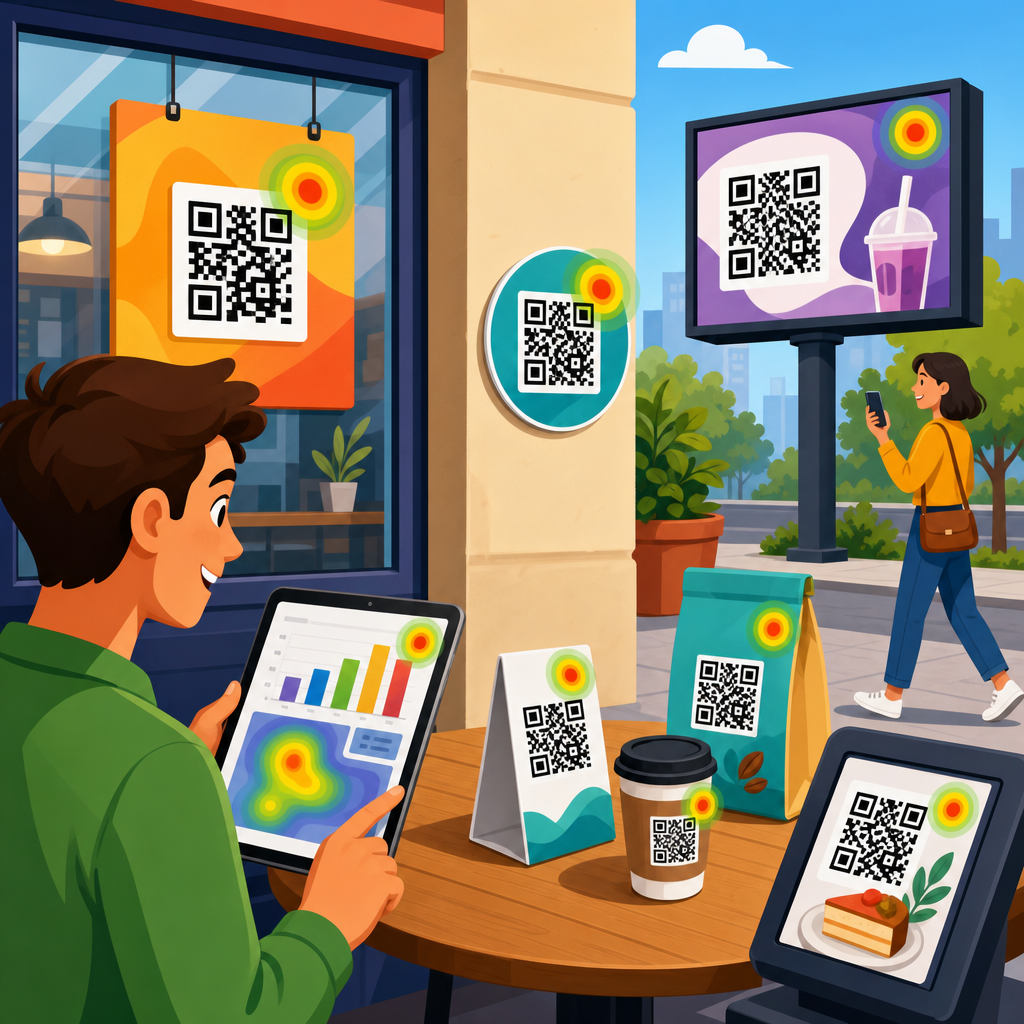
Measuring QR code campaign performance means connecting every scan to a business outcome, then using that data to improve future marketing decisions. In practice, that requires more than counting scans. A useful measurement framework tracks where the code appeared, who scanned it, what happened after the scan, and whether the campaign produced leads, sales, downloads, appointments, or some other defined result. As companies use QR codes across packaging, direct mail, retail displays, events, menus, product manuals, and out-of-home ads, performance measurement has become the difference between a novelty tactic and a dependable acquisition channel.
A QR code campaign is any marketing or operational initiative that asks a person to scan a code and complete an action. Tracking and analytics refer to the systems that capture scan events, session behavior, conversion actions, attribution data, and revenue. The central metrics usually include total scans, unique scans, scan rate, landing page visits, bounce rate, conversion rate, cost per acquisition, and return on ad spend. For more mature programs, I also track assisted conversions, repeat scans, location variance, device splits, and time-to-conversion because those metrics reveal how audience intent changes by context.
This matters because QR codes sit at the intersection of offline exposure and digital behavior. A billboard, package insert, shelf talker, conference badge, or restaurant tabletop may generate engagement that standard digital attribution misses unless the tracking architecture is set up correctly. Teams often launch codes with attractive creative but weak measurement, then conclude the format underperformed when the real problem was missing UTM parameters, broken redirects, inconsistent naming conventions, or no event mapping in analytics. When measurement is handled properly, QR codes become highly diagnosable. You can compare versions, isolate placements, calculate conversion efficiency, and decide whether the code belongs on print, signage, packaging, or post-purchase materials.
For a sub-pillar page focused on tracking and analytics, the goal is to build a complete measurement model. That model starts with campaign objectives, continues through tagging and platform setup, and ends with reporting that stakeholders can actually act on. Every scan should answer a practical question: how many people engaged, from where, on what device, and what value did they create?
Start with campaign objectives and a measurement plan
The first step in measuring QR code campaign performance is defining success before the code is generated. If the objective is vague, the reporting will be vague. I have seen teams judge the same campaign as both successful and disappointing because marketing cared about scan volume while sales cared about qualified pipeline. A stronger approach is to assign one primary outcome and a short list of secondary indicators. For example, a trade show QR code may target demo requests as the primary conversion, with brochure downloads and booth revisit traffic as secondary signals. A product packaging QR code may prioritize product registration, with video views and support article visits as secondary signals.
Your measurement plan should document the audience, placement, offer, destination URL, tracking parameters, conversion events, reporting cadence, and owner for each campaign. It should also specify what counts as a unique scan, how long attribution windows remain open, and whether conversions will be credited by first touch, last touch, or a blended model. This prevents the common reporting problem where platform totals conflict because one dashboard counts scans and another counts sessions. A scan is not always a visit, and a visit is not always a conversion. Treat those as separate events in the measurement chain.
In practical terms, define benchmarks at launch. If a direct mail campaign sends 25,000 pieces, estimate an expected scan rate range based on list quality, incentive strength, and design prominence. If a retail endcap drives a coupon page, estimate redemption rate and average order value. Benchmarks do not need to be perfect; they simply create a standard against which performance can be interpreted. Without them, teams overreact to raw totals that look high or low without context.
Build the right tracking architecture before launch
Reliable QR code analytics begin with the URL structure behind the code. Dynamic QR codes are generally better for marketing measurement than static codes because the destination can be updated without reprinting the code, and scan data is usually captured at the redirect layer. I recommend dynamic codes for almost every campaign that needs optimization, A/B testing, or long-term maintenance. Static codes still have a place for permanent destinations, but they are less flexible when a landing page changes, a product is discontinued, or a campaign needs improved attribution.
At minimum, use UTM parameters consistently. Source should identify the distribution environment, medium should describe the channel type, and campaign should map to the broader initiative. Content can distinguish creative variants, placements, or audience segments. For example, a code on in-store signage might use source=retailstore, medium=qr, campaign=summersale, and content=endcap-a. A code in a catalog could use source=catalog, medium=qr, campaign=holidaygiftguide, and content=page12. These details are what make placement-level reporting possible in Google Analytics 4, Adobe Analytics, or other measurement platforms.
You also need event tracking on the destination. Scans alone rarely justify investment. Configure events for page_view, form_start, form_submit, click_to_call, add_to_cart, purchase, video_progress, file_download, and any lead qualification steps relevant to the campaign. In GA4, mark the highest-value actions as key events so reports reflect business impact rather than traffic volume alone. If the landing page contains a form managed by HubSpot, Marketo, Pardot, or another automation system, connect campaign metadata so submissions retain their originating QR code source.
Redirect testing matters more than many teams expect. Before launch, test every code across iOS and Android camera apps, multiple browsers, slow connections, and password-protected environments if applicable. Confirm that the redirect resolves quickly, preserves parameters, and does not break in-app browsers. I have audited campaigns where 15 percent of traffic lost attribution because a redirect chain stripped UTMs between the QR platform and the final landing page. Those errors make later analysis noisy and often impossible to repair.
Track the metrics that actually explain performance
Strong QR code reporting balances top-of-funnel engagement with bottom-of-funnel outcomes. The core metrics each answer a different question. Total scans show overall interaction volume. Unique scans estimate how many individuals engaged, though exact uniqueness depends on the vendor’s methodology. Scan rate compares scans to estimated impressions or distributed units, which helps evaluate creative visibility and offer relevance. Landing page sessions reveal how many scans became measurable visits. Conversion rate shows whether the destination experience matched user intent. Revenue per scan and cost per acquisition determine whether the campaign created economic value.
Secondary metrics often explain why a campaign succeeded or failed. Time of day can reveal whether commuter, in-store, or event traffic behaves differently. Device type affects page speed and form completion. Geographic data helps when the same code appears across multiple venues or store clusters. New versus returning users can indicate whether the code is driving discovery or repeat engagement. Assisted conversions matter when the QR code introduces the customer but the purchase occurs later through paid search, email, or direct visit. In those cases, a last-click model understates QR contribution.
| Metric | What it measures | Why it matters |
|---|---|---|
| Total scans | All recorded scan events | Shows overall engagement volume |
| Unique scans | Estimated distinct scanners | Reduces inflation from repeat scans |
| Scan rate | Scans relative to impressions or units distributed | Evaluates placement and creative effectiveness |
| Session rate | Visits generated from scans | Identifies redirect or browser drop-off |
| Conversion rate | Conversions divided by sessions | Measures landing page effectiveness |
| Revenue per scan | Revenue attributed to each scan | Connects engagement to financial impact |
| CPA | Campaign cost divided by conversions | Supports budget decisions |
One caution: vendor dashboards can overstate certainty. Some platforms infer location from IP address and uniqueness from device behavior, both of which have limitations. Use vendor scan data as directional and validate it against web analytics and CRM outcomes. When the numbers differ, investigate definitions before drawing conclusions. In most cases, the discrepancy is methodological, not fraudulent.
Use attribution, segmentation, and testing to find what drives results
Once data collection is stable, the next job is interpretation. Attribution answers which touchpoints deserve credit. For QR code campaigns, I usually review both session-level and user-level reporting. Session-level analysis shows what happened immediately after the scan. User-level analysis shows whether that scan influenced a later purchase. This is especially important for higher-consideration products such as B2B software, healthcare services, home improvement, education, or financial products, where a user may scan from a brochure, research later on desktop, and convert days afterward.
Segmentation reveals where performance differs. Break reports by placement, audience, store, event, creative version, and destination experience. A code on product packaging often behaves differently from the same offer on window signage because the scanner is at a different stage of intent. At events, attendees scanning from booth graphics may convert at a lower rate than those scanning from a one-to-one salesperson follow-up card. In retail, endcap signage might generate many scans but fewer purchases than shelf-level comparison cards that answer a specific product question. Segmenting by context turns broad results into useful insight.
Testing should be built into the campaign, not added after weak results. A/B test calls to action, incentive strength, code size, surrounding copy, color contrast, and landing page design. Even small wording changes can shift scan behavior. “Scan to learn more” usually underperforms more specific prompts such as “Scan for installation steps,” “Scan for 10% off today,” or “Scan to compare models.” On the destination page, test shorter forms, mobile wallet coupons, autofill, and social proof. If a campaign has enough volume, test separate pages by audience segment rather than forcing one page to serve all scanners.
Some of the best-performing QR programs I have managed shared one trait: they answered the immediate question created by the physical context. On packaging, users wanted setup help or authenticity verification. On direct mail, they wanted an offer with minimal friction. At a trade show, they wanted slides, scheduling, or a product walkthrough. Measurement works best when the code, destination, and conversion event align with that moment of intent.
Report results clearly and turn analytics into action
A QR code performance report should help stakeholders decide what to scale, change, or stop. Start with an executive summary that states the objective, campaign period, placements, spend, scans, conversions, revenue, and the plain-language conclusion. Then include deeper breakdowns for marketing, sales, and operations teams. A retail stakeholder may care most about store-level variance and coupon redemption. A lifecycle marketer may care about email capture and downstream repeat purchase. A field team may need proof that one event format outperformed another.
Dashboards should combine three data layers: scan platform data, web analytics data, and business outcome data from the CRM, ecommerce platform, or point-of-sale system. Looker Studio, Tableau, Power BI, and native GA4 explorations can all work if the taxonomy is clean. The critical point is consistency. If campaign names differ across the QR generator, analytics tool, and CRM, reporting turns into manual reconciliation. Establish naming rules once and enforce them. That discipline is what makes this page a hub topic within QR code marketing strategy: tracking quality determines whether every downstream tactic can be evaluated reliably.
Finally, use findings to improve the next campaign. If scans are strong but conversions are weak, fix the landing page, offer, or form friction. If impressions are high but scans are low, improve visibility, placement, or call to action. If certain locations outperform others, reallocate budget. If repeat scans are common, consider whether the code is serving support needs rather than acquisition and measure it accordingly. Good analytics does not just prove value; it compounds value by making each next QR code campaign smarter.
Measuring QR code campaign performance is ultimately about creating a complete line of sight from physical touchpoint to business result. The strongest programs define objectives early, use dynamic codes and consistent UTM tagging, instrument meaningful events, and validate scan data against analytics and CRM outcomes. They also look beyond raw scan counts to understand session quality, conversion efficiency, assisted revenue, and variation by placement or audience. That is how a simple square code becomes a measurable marketing asset instead of an untracked bridge between offline and online activity.
For teams building a broader QR code marketing strategy, tracking and analytics should function as the operating system for every campaign. Without disciplined measurement, you cannot compare packaging against print, events against retail, or one offer against another. With disciplined measurement, you can identify winning contexts, reduce friction, improve attribution, and justify investment with confidence. Review your current QR code setup, document your taxonomy, audit your redirects, and make sure every future scan has a clear path to a measurable outcome.
Frequently Asked Questions
What metrics matter most when measuring QR code campaign performance?
The most important metrics are the ones that connect scans to a meaningful business result. Scan volume is a useful starting point because it shows whether people noticed and interacted with the QR code, but on its own it does not tell you whether the campaign worked. A strong measurement framework usually includes total scans, unique scans, scan location, device type, time of scan, landing page visits, engagement after the scan, and the final conversion action. That conversion might be a form submission, purchase, app download, appointment booking, coupon redemption, or another goal tied directly to the campaign.
It is also helpful to separate early-stage metrics from outcome metrics. Early-stage indicators include impressions of the printed placement, scan rate, and click-through behavior after the code is scanned. Outcome metrics include leads generated, revenue influenced, cost per acquisition, and return on investment. If a QR code on product packaging gets many scans but very few completed actions, that may point to a weak landing page, an unclear offer, or a mismatch between audience intent and the destination content. In contrast, a campaign with fewer scans but a high conversion rate may actually be more successful because it produces better-quality traffic.
For the clearest view of performance, every QR code campaign should be tied to a defined objective before launch. Once the objective is set, you can identify the primary KPI and supporting metrics around it. For example, if the goal is lead generation, then qualified leads and form completion rate matter more than raw scan count. If the goal is in-store redemption, then redemptions by location and time period become more important. The best metrics are not the ones that are easiest to collect; they are the ones that explain whether the campaign created measurable business value.
How can businesses track what happens after someone scans a QR code?
Tracking post-scan behavior starts with sending users to a destination that can be measured properly. In most cases, that means a landing page with analytics installed, campaign parameters added to the URL, and clear conversion events configured. UTM parameters are commonly used to identify the traffic source, campaign name, placement, or audience segment. This allows businesses to distinguish scans coming from packaging, direct mail, retail displays, trade show signage, menus, or other channels. Without those tags, QR code traffic may be harder to separate from other visits in analytics reports.
Beyond the initial page visit, businesses should configure specific events that reflect meaningful engagement. These can include button clicks, video plays, document downloads, add-to-cart actions, account registrations, appointment requests, or completed checkouts. In a CRM or marketing automation platform, those actions can then be linked to lead records, customer journeys, and eventual revenue. This is where QR code measurement becomes far more valuable than simply reporting how many scans occurred. It shows not only who arrived, but what they did next and whether they moved closer to becoming a customer.
For stronger attribution, many organizations create unique QR codes for each placement, audience, or creative variation rather than reusing a single code everywhere. That makes it possible to compare performance across channels and identify which physical touchpoints are driving the best results. If offline conversion is important, businesses can also connect scans to coupon codes, point-of-sale systems, call tracking, or booking systems. The goal is to create a complete path from scan to outcome so that decisions about budget, creative, and placement are based on evidence rather than assumptions.
Why is counting scans alone not enough to evaluate a QR code campaign?
Counting scans only tells you that someone used their phone to open the QR code destination. It does not reveal whether the traffic was relevant, whether the experience met user expectations, or whether the campaign generated any real return. A high number of scans can look impressive in a report, but if those visitors leave immediately or fail to complete the desired action, the campaign may not be effective. In the same way, a lower scan count can still represent strong performance if the visitors are highly qualified and convert at a high rate.
Scan totals also lack context. They do not explain where the code performed best, which creative version attracted the strongest response, what time of day generated more engagement, or whether one placement produced better downstream results than another. They cannot show whether a QR code on a store display drove purchases while the same code on direct mail drove form fills. They also do not account for repeat scans, accidental scans, or users who experienced friction after landing on the page. A campaign should be evaluated based on quality and outcomes, not just activity.
That is why a better approach is to treat scan count as one metric inside a larger performance model. Businesses should look at scan-to-visit quality, landing page engagement, conversion rate, completion rate by source, and revenue or lead value associated with each code. When those measures are combined, they reveal whether the campaign is attracting the right audience and turning interest into action. This broader view helps marketers optimize future campaigns with confidence, instead of making decisions based on a number that may be easy to report but difficult to interpret.
How do you attribute QR code performance across different placements and channels?
Accurate attribution begins by assigning a distinct QR code or destination URL structure to each placement. If a brand is using QR codes on packaging, shelf displays, event booths, postcards, menus, and outdoor signage, each one should be identifiable in analytics. The simplest method is to use unique URLs with campaign parameters that specify the source, medium, campaign, and content variation. That way, when traffic appears in your analytics platform, you can compare how each offline placement contributed to visits, leads, sales, or other defined conversions.
This placement-level tracking becomes even more useful when combined with location data, time stamps, and conversion behavior. For example, a retailer may discover that QR codes in window displays drive more scans on weekends, while packaging codes generate more repeat visits after purchase. An event marketer may find that booth signage produces many scans, but session handouts produce higher-quality leads. These insights are only possible when the campaign is structured to preserve the identity of each scan source throughout the customer journey.
Attribution can also be improved by integrating QR code data with CRM, ecommerce, and point-of-sale systems. If a person scans a code, fills out a form, and later makes a purchase, those touchpoints should ideally be connected. While not every business can achieve perfect multi-touch attribution, even simple source-based tracking can provide a much clearer picture than a generic scan total. The key is consistency: naming conventions, standardized campaign parameters, and defined reporting rules make it much easier to understand which channels and placements are actually influencing business outcomes.
What are the best ways to improve QR code campaign performance over time?
The best way to improve performance is to treat every QR code campaign as a testable system rather than a one-time execution. Start by reviewing the full journey: where the code appears, how visible it is, what message surrounds it, where it sends users, and what action you expect them to take. If scan rates are low, the issue may be placement, size, contrast, call-to-action wording, or audience fit. If scans are healthy but conversions are weak, the problem may lie in the landing page experience, load speed, form friction, weak incentives, or unclear next steps.
Ongoing optimization usually involves A/B testing and segmented analysis. Businesses can test different calls to action such as “Scan to Save,” “Scan to Book,” or “Scan to Learn More” to see which phrasing produces stronger response. They can compare codes placed at checkout versus store entrance, on the front of packaging versus the inside insert, or on direct mail envelopes versus the letter itself. They can also evaluate landing page versions, form lengths, offers, and mobile page layouts. Because QR code interactions often happen in fast, real-world environments, even small design and messaging changes can significantly affect results.
Performance also improves when data is reviewed regularly and tied back to business goals. Look for patterns in conversion rate by placement, device type, geography, campaign date, and audience segment. Identify which codes generate not just traffic, but valuable actions. Then use those findings to shift budget, refine creative, and prioritize the placements that produce the strongest return. The most effective QR code programs are built on continuous learning: measure the right outcomes, compare performance at a detailed level, and use each campaign to make the next one more efficient and more profitable.