QR codes have evolved from simple square barcodes into adaptive digital gateways, and artificial intelligence is accelerating that change faster than most businesses expected. A QR code, or Quick Response code, is a two-dimensional matrix barcode that stores data such as URLs, payment credentials, product identifiers, authentication tokens, or app actions. Artificial intelligence, in this context, refers to machine learning, computer vision, natural language processing, and predictive systems that can generate, optimize, secure, personalize, and analyze QR code interactions. When people ask about the future of QR code technology, they are really asking how these once-static symbols are becoming smarter, more dynamic, and more useful across marketing, payments, logistics, healthcare, retail, and industrial operations.
I have worked with QR deployments in campaigns, packaging systems, and mobile product flows, and the shift is clear: the code itself matters less than the intelligence wrapped around it. Early QR programs were often treated as print add-ons. A brand placed a code on a poster, linked to a homepage, and hoped for scans. Today, AI helps determine the best destination, predicts scan likelihood by location, adjusts content based on device and intent, flags fraudulent redirects, and improves readability under difficult real-world conditions. That changes both technical implementation and business value. A QR code is no longer just a bridge between offline and online; it is becoming a context-aware interface layer.
This matters because QR adoption is now mainstream. Consumers scan restaurant menus, event tickets, payment prompts, loyalty cards, medicine packaging, transit passes, and product labels without needing explanation. Global payment networks, smartphone camera apps, and operating systems have normalized the behavior. As usage expands, expectations rise. People want fast loads, relevant destinations, secure interactions, and frictionless authentication. Businesses want measurable outcomes, lower support costs, and stronger conversion rates. AI addresses these expectations by making QR systems more resilient, responsive, and data-driven. For any company planning the future of QR code technology, the core question is no longer whether to use QR codes, but how intelligently to design the ecosystem around them.
From Static Symbols to Intelligent Interaction Layers
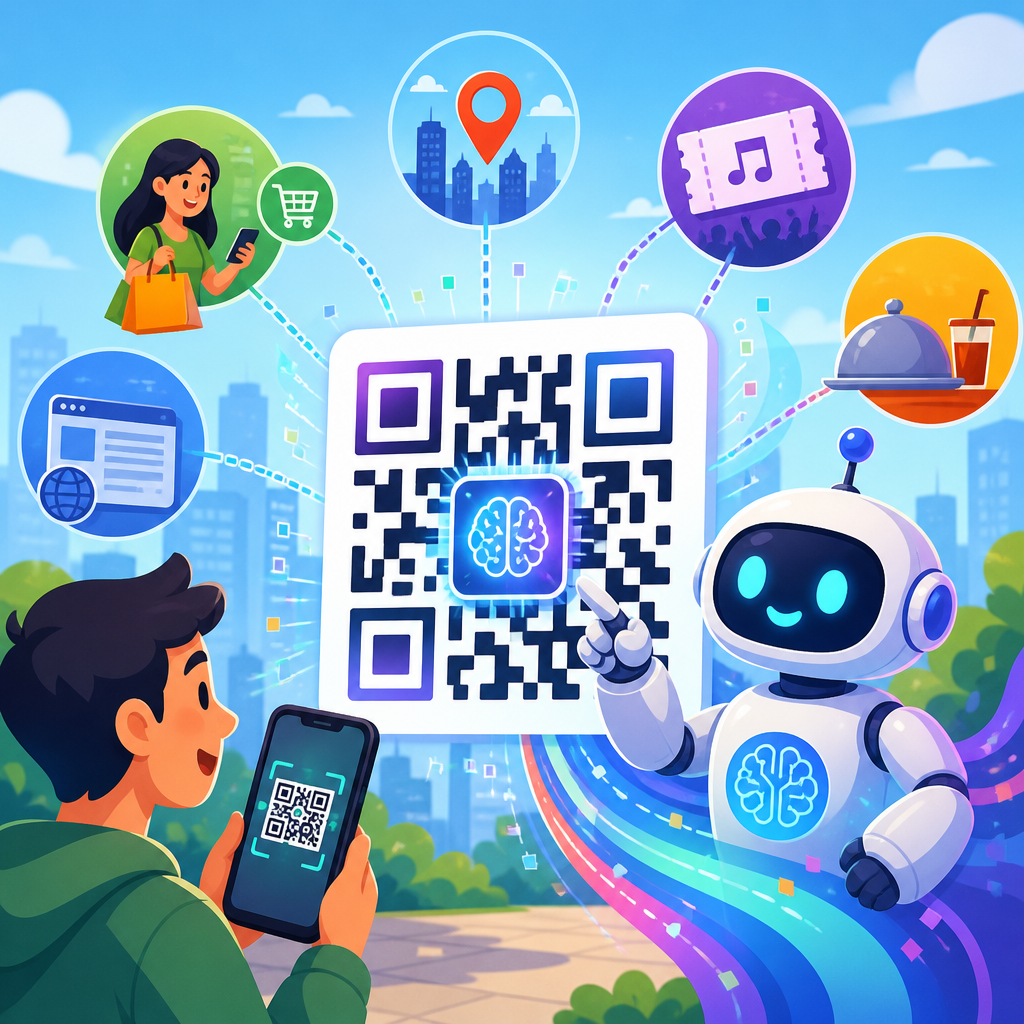
The biggest change AI brings to QR code technology is the move from static encoding to dynamic orchestration. A static QR code contains fixed information that cannot be changed after printing. A dynamic QR code points to a managed short URL or resolver, allowing the destination and experience to change without replacing the physical code. AI makes that dynamic layer far more powerful. Instead of sending every scanner to the same page, machine learning models can route users based on device type, time of day, geography, historical engagement patterns, inventory availability, language preference, or campaign cohort. In practice, that means one printed code on packaging can lead first-time users to educational content, returning users to replenishment offers, and support-seeking users to troubleshooting resources.
This routing intelligence is especially valuable in omnichannel environments. Retailers can connect shelf displays, direct mail, packaging, and in-store signage to a single QR management platform, then let AI optimize destinations according to measured outcomes such as click-through, add-to-cart rate, or store visit uplift. In one packaging workflow I helped evaluate, scan behavior varied sharply by region. AI-based segmentation identified that customers in urban stores scanned for reviews and comparisons, while suburban customers scanned more often for coupons and reorder options. A single code design stayed in market, but the post-scan experience changed by intent cluster, improving conversion without increasing print complexity.
Computer vision also improves the code itself. Traditional QR generation focuses on error correction level, module size, contrast, and quiet zone compliance under ISO/IEC 18004 principles. AI-enhanced design tools test how stylistic changes affect scan reliability across camera models, lighting conditions, and viewing angles. That matters because brands increasingly want customized codes with embedded logos, color treatments, and creative shapes. AI can predict whether a branded code remains machine-readable before a campaign goes live, reducing the common failure mode of visually attractive but weak-performing assets.
AI-Driven Design, Testing, and Performance Optimization
Modern QR programs succeed or fail on small implementation details, and AI is becoming the fastest way to improve them systematically. In the past, teams relied on manual best practices: use dark modules on a light background, keep sufficient contrast, avoid over-stylization, and place codes where phone cameras can frame them easily. Those rules still apply, but AI testing introduces scale and precision. Models can simulate real scan environments across glare, motion blur, print distortion, low battery camera performance, cracked screens, and low-bandwidth conditions. This produces better pre-launch recommendations than a simple visual review.
For marketers, AI optimization increasingly includes placement and creative decisions. Heatmap tools and visual attention models estimate whether a user is likely to notice a QR code on a package, poster, kiosk, or billboard. If the code competes with dense text or sits near a fold, the system can recommend size changes or repositioning. This is especially important in out-of-home advertising, where scan windows may last only seconds. A commuter passing a transit ad needs a code large enough to capture quickly and a landing page fast enough to load before attention disappears. AI supports both sides: visibility prediction before placement and destination optimization after the scan.
The technical gains are practical, not abstract. Better scan reliability reduces abandonment. Better page routing increases conversion. Better testing shortens deployment cycles. Teams using platforms such as QR TIGER, Bitly, Scanova, Adobe analytics stacks, or custom mobile measurement setups increasingly combine scan data with AI models to answer operational questions: Which package version produces more repeat scans? Which CTA wording drives activation? Which store environment lowers scan completion? Because AI can process many variables at once, it reveals relationships a spreadsheet review often misses.
| AI application | How it changes QR technology | Real-world example |
|---|---|---|
| Computer vision testing | Predicts readability across lighting, angles, and devices | A beverage brand validates a stylized can code before national printing |
| Dynamic destination routing | Personalizes landing pages by context and behavior | A retailer sends new scanners to product education and repeat scanners to offers |
| Anomaly detection | Flags suspicious redirects and scan spikes | A payment provider detects a tampered sticker placed over a merchant code |
| Predictive analytics | Forecasts scan volume and campaign outcomes | An event organizer adjusts staffing based on expected mobile ticket scans |
Security, Trust, and Fraud Detection in the Next Generation of QR Codes
As QR code use grows, so does abuse. Criminals replace legitimate payment codes with fake ones, redirect users to phishing pages, or distribute malicious login prompts through printed stickers. AI is becoming central to QR security because it can detect patterns humans miss in real time. A secure QR ecosystem now includes domain reputation checks, redirect analysis, certificate validation, behavioral anomaly detection, and device fingerprinting. If a code suddenly begins sending users to a newly registered domain, from an unusual geography, with an unusual failure rate, an AI model can quarantine that destination or trigger review before large-scale harm occurs.
Financial services offer the clearest example. QR payments used in systems such as UPI, Alipay, and merchant-presented wallet flows depend on trust at the moment of scan. AI helps verify whether the payee profile matches historical norms, whether transaction timing is suspicious, and whether the user interface should display an additional warning. In physical environments, computer vision can compare expected printed layouts with camera-captured merchant displays to detect tampering. That is far more scalable than relying only on manual merchant audits.
Authentication is another area where the future of QR code technology is tightly linked to AI. Brands use serialized QR codes on medicine boxes, electronics, luxury goods, and industrial parts to confirm authenticity and trace provenance. AI can evaluate scan frequency, route consistency, and supply-chain anomalies to identify gray market diversion or counterfeit replication. A single scan may not prove fraud, but a cluster of scans from impossible locations, or scans occurring before a product officially ships, can reveal a problem quickly. This strengthens product integrity while giving customers direct confidence signals.
Personalization, Conversational Experiences, and Smarter Customer Journeys
One reason AI is changing QR code technology so profoundly is that the scan no longer ends at a webpage. It often begins a conversation. After a user scans, AI systems can infer likely intent and present the most useful next step: product comparison, warranty registration, setup guidance, refill reminders, language localization, chatbot assistance, or support escalation. This is especially effective on packaging and post-purchase materials, where customer needs change over time. The same code on a device box can serve onboarding on day one, troubleshooting on day thirty, and accessory recommendations after several months.
Natural language systems make these flows much more usable. Instead of navigating a support tree, a customer can scan a QR code on an appliance and ask, in plain language, why the machine is beeping or how to descale it. The AI assistant can identify the product model from the encoded identifier and return accurate, model-specific instructions. In healthcare, a patient can scan a code on discharge paperwork and receive reminders tailored to medication schedule, preferred language, and accessibility needs. In restaurants, dynamic codes can adapt menus based on dietary preferences, item availability, and prior ordering history.
The business impact is significant. Personalized QR journeys increase relevance, and relevance improves response rates. Support teams benefit because basic questions are resolved faster. Customers benefit because they are not forced into generic microsites. The key implementation principle is consent and transparency. Personalization should be based on clearly governed data, not hidden surveillance. The strongest programs state what is collected, why it is used, and how users can opt out. Trust is not a soft issue here; it directly affects scan willingness and repeat engagement.
Industry Use Cases Shaping the Future of QR Code Technology
Retail will remain a major driver of QR innovation, but it will not be the only one. In manufacturing and logistics, AI-enhanced QR systems support asset tracking, maintenance history, operator guidance, and exception handling. A technician can scan a machine label and receive not only manuals, but also AI-prioritized maintenance steps based on fault history and sensor data. In warehouses, QR-linked workflows can improve picking accuracy and training by connecting workers to visual instructions in the right language at the right station.
Healthcare is another high-impact sector. Hospitals already use barcodes and QR labels for patient identification, specimen tracking, and medication administration support. AI adds predictive value by identifying workflow bottlenecks, flagging unusual scan gaps, and helping validate chain-of-custody records. Pharmaceutical companies use QR serialization to support traceability requirements and patient education, while AI analyzes scan trends to spot regional supply issues or possible diversion. Because errors in healthcare carry high stakes, reliability and governance standards matter more than novelty.
Smart packaging, circular economy programs, and connected products are also pushing the future of QR code technology forward. Digital Product Passport initiatives in Europe, sustainability reporting, and right-to-repair expectations all favor packaging that can connect consumers to material sourcing, recycling instructions, compliance data, and service documentation. AI helps summarize complex information into the specific answer a person needs at the moment of scan. That keeps labels clean while making data deeper. Over time, the winning QR experiences will be those that reduce friction, not those that merely add content.
What Businesses Should Do Now
Companies planning for AI and QR codes should start with infrastructure, not surface design. Use dynamic codes by default, establish a governed redirect layer, and connect scan analytics to your broader measurement stack. Test every code across devices, distances, lighting conditions, and network speeds. Protect destinations with domain controls, certificate monitoring, and anomaly detection. Map the top user intents for each scan location, then build post-scan journeys that answer those intents directly. If a package code is mostly scanned for ingredients, do not send people first to a campaign splash page.
The next step is operational discipline. Assign ownership across marketing, product, security, and analytics teams. Define naming conventions, version control, expiration policies, and incident response procedures. Measure not just scans, but successful task completion: purchases, registrations, payment completions, support deflection, or authentication confirmations. Where AI is introduced, evaluate outputs regularly for bias, false positives, and privacy compliance. Standards from GS1, ISO guidance, mobile accessibility rules, and payment network requirements should shape implementation choices. The future of QR code technology belongs to organizations that treat the code as a managed digital product, not a printable graphic.
AI is changing QR code technology by making codes more adaptive, secure, measurable, and useful in real contexts. The most important shift is conceptual: value no longer sits only in the symbol, but in the intelligent system behind it. Dynamic routing, computer vision testing, fraud detection, conversational support, and predictive analytics turn QR codes into responsive service points across the customer lifecycle. That applies to retail shelves, factory floors, pharmacy boxes, event gates, restaurant tables, and connected devices alike.
For businesses building a long-term QR strategy, the lesson is simple. Start with reliability, layer in intelligence, and design every scan to solve a real user need quickly. AI can improve scan rates and conversions, but its larger benefit is relevance: the right action, answer, or safeguard delivered at the exact moment someone points a camera. As QR adoption continues to spread, that relevance will separate useful implementations from forgettable ones. Review your current QR estate, identify where static experiences are limiting results, and begin upgrading the system around the code.
Frequently Asked Questions
How is AI changing the way QR codes work?
AI is transforming QR codes from static links into intelligent, adaptive digital tools. Traditionally, a QR code simply stored fixed information such as a website URL, payment address, product ID, or login token. With AI involved, the experience around that code becomes far more dynamic. Machine learning systems can analyze when, where, and how a code is scanned, then help determine what content should be shown, which audience segment is engaging, and what outcome is most likely to convert. That means the same QR code can support smarter routing, personalized landing pages, better campaign tracking, and more efficient user journeys.
Computer vision is also improving how QR codes are recognized in less-than-ideal environments. AI can help scanners interpret damaged, partially obscured, low-contrast, or oddly angled codes more effectively than older rule-based systems. Natural language processing adds another layer by making the destination behind the code more interactive, such as sending users into AI chat experiences, multilingual support flows, or conversational product guidance. In practical terms, AI is not replacing QR code technology itself; it is expanding what happens before, during, and after the scan, making QR codes more responsive, measurable, and useful for businesses and consumers alike.
Can AI make QR codes more secure?
Yes, AI can significantly improve QR code security, especially as QR codes become more common in payments, authentication, ticketing, and product verification. One of the biggest risks with QR codes is that users cannot always see where a code leads before scanning it. Attackers can exploit this by placing malicious QR stickers over legitimate ones or directing users to phishing pages. AI helps address this by detecting suspicious scan destinations, unusual redirect patterns, domain spoofing, or behavior that does not match known safe activity. These systems can flag threats in real time and help prevent users from landing on harmful pages.
AI is also valuable in fraud detection and authentication workflows. For example, businesses can combine QR codes with machine learning models that evaluate device signals, location patterns, scan frequency, and transaction behavior to identify anomalies. If a QR-based login attempt appears abnormal, the system can trigger extra verification steps. In supply chains and anti-counterfeiting efforts, AI can compare expected product movement and packaging data against scan activity to detect counterfeit goods or unauthorized distribution. While no technology is perfectly secure on its own, AI adds an important layer of intelligence that helps organizations monitor risk, respond faster, and protect users more effectively.
What role does AI play in QR code marketing and customer engagement?
AI plays a major role in turning QR codes into performance-driven marketing assets instead of simple access points. When a customer scans a QR code on packaging, in-store signage, direct mail, or an event display, AI-powered systems can analyze the context of that interaction and tailor the next step accordingly. A user in one region might see localized content, while a repeat customer could be sent to a loyalty offer and a first-time visitor could receive educational information. This level of personalization helps brands increase relevance, improve conversion rates, and create a smoother customer experience.
Beyond personalization, AI improves measurement and optimization. Marketers can use predictive analytics to understand which QR placements generate the most engagement, what time of day scans are most likely to convert, and which customer journeys produce the best outcomes. AI can also support A/B testing of landing pages, recommend content adjustments, and identify drop-off points after the scan. In customer engagement, QR codes can now act as entry points to AI chatbots, product recommendation engines, customer support assistants, or interactive experiences powered by natural language processing. As a result, QR codes become part of a smarter omnichannel strategy rather than a disconnected offline-to-online shortcut.
How does AI improve QR code scanning and usability?
AI improves QR code usability by making scanning faster, more accurate, and more reliable across a wider range of real-world conditions. Standard QR scanning can struggle when a code is blurry, poorly lit, printed on reflective material, partially damaged, or viewed from an angle. AI-enhanced computer vision models are better at identifying patterns and reconstructing readable data even when the image quality is imperfect. This is especially useful in retail, logistics, manufacturing, transportation, and field operations where conditions are not always controlled and scanning speed matters.
AI also enhances the overall user experience around the scan itself. Smart scanning applications can recognize the type of QR interaction taking place and prepare the appropriate action, whether that is opening a payment flow, verifying a ticket, launching an app function, or retrieving product information. In accessibility use cases, AI can support voice assistance, translation, and contextual guidance after the code is scanned. For businesses, improved scan reliability means fewer failed interactions and less friction in customer journeys. For users, it means QR codes feel more dependable and intuitive, which increases trust and encourages continued use.
What industries are benefiting the most from AI-powered QR code technology?
Several industries are seeing major gains from combining AI with QR code systems. Retail and e-commerce are among the biggest beneficiaries because AI-powered QR codes can support personalized promotions, product authentication, smart packaging, inventory visibility, and post-purchase engagement. In payments and fintech, AI helps strengthen fraud detection, streamline checkout flows, and improve identity verification tied to QR-based transactions. Healthcare is another important area, where QR codes can connect patients to records, instructions, appointment workflows, and medication details, while AI helps organize data, flag irregularities, and support more accurate routing of information.
Manufacturing, logistics, and supply chain operations also benefit because QR codes are widely used for tracking assets, verifying products, and monitoring movement across facilities and markets. AI adds predictive insights by detecting anomalies, improving demand forecasting, and identifying inefficiencies in scan-based workflows. In travel, hospitality, and events, AI-enhanced QR codes can simplify ticketing, access control, guest services, and personalized experiences. Education, real estate, and consumer packaged goods are also adopting these systems to make offline materials interactive and measurable. The broad appeal comes from the fact that QR codes are simple for users, low-cost to deploy, and highly adaptable, while AI gives organizations the intelligence needed to make each interaction more valuable.