QR code conversion optimization is the discipline of increasing the percentage of scans that turn into meaningful business outcomes, such as purchases, sign-ups, bookings, downloads, or qualified leads. In practical terms, it sits at the intersection of mobile user experience, campaign analytics, offer design, and channel strategy. A QR code itself does not convert anyone; it simply bridges an offline or physical moment to a digital destination. The conversion happens because the landing page loads fast, the message matches what the user expected, the incentive is relevant, and the path to action is frictionless. After working on QR-driven campaigns for retail, events, packaging, direct mail, and out-of-home media, I have seen the same pattern repeatedly: teams focus heavily on generating the code and too lightly on what happens after the scan.
That imbalance is expensive. A beautifully printed code on packaging or signage can produce impressive scan volume while still underperforming commercially if the post-scan experience is weak. Conversion optimization matters because QR marketing often captures high-intent moments. A shopper scanning on shelf is evaluating a product now. An attendee scanning at a trade show is engaging during a live conversation. A diner scanning a table tent is deciding in real time. These moments are short, context-rich, and easy to lose. Improving conversion rates means extracting more revenue and insight from existing media spend, packaging inventory, foot traffic, and audience attention.
Key terms help clarify the work. A scan rate measures how often people scan relative to impressions or exposure. A conversion rate measures how often scanners complete the desired action. A landing page is the destination users see after scanning, though in advanced campaigns the destination may be app content, a wallet pass, a form, a video, or a messaging flow. Dynamic QR codes are editable destinations that support redirection and tracking, while static codes point to a fixed URL. Attribution is the process of connecting scans and subsequent behavior to a source, campaign, placement, or audience segment. Optimization means systematically improving those variables through testing, measurement, and user-centered design.
This hub article covers the core practices that consistently improve QR code conversion performance. It explains how to align the scan context with the offer, how to design landing pages for mobile completion, how to choose measurable calls to action, how to instrument analytics correctly, and how to test placements, creative, and destinations. It also addresses frequent failure points, including slow pages, poor message match, privacy friction, weak incentives, and inaccessible code placement. If your broader goal within QR code marketing and strategy is not just to generate scans but to generate outcomes, these are the best practices that matter most.
Start with conversion intent, not the code
The first best practice is to define the primary conversion before creating the QR asset. Teams often begin with a request like “we need a QR code for the poster” or “put one on the package,” which frames the code as the deliverable. The better approach is to ask what business action the scan should produce. For a retailer, the goal may be add-to-cart or store locator usage. For a B2B event, it may be demo requests. For consumer packaged goods, it may be loyalty enrollment, recipe engagement, or first-party data capture. When the target action is clear, every later decision becomes easier: destination type, copy, incentive, analytics, and follow-up sequence.
Intent also determines the right level of friction. A high-commitment conversion, such as financing prequalification, can justify a longer flow if the user value is obvious. A low-consideration environment, such as transit advertising, demands a shorter path, often one tap beyond the scan. In campaigns I have audited, the biggest gains usually came not from changing the code itself but from reducing mismatches between context and ask. Asking for a six-field lead form from a street poster generally underperforms. Sending that same user to a short explainer, then offering a one-field callback request, usually performs better because it respects mobile attention and environmental constraints.
Match the scan context to the destination
Context determines what users are willing and able to do. Someone scanning from product packaging at home has more time than someone scanning a QR code on a subway platform. Someone scanning from a restaurant menu wants speed, not brand storytelling. Someone scanning at a conference booth may expect product specs, pricing, or a calendar link. High-converting campaigns map the physical setting, user motivation, connectivity conditions, and urgency level to the destination experience.
Message match is central here. If a sign says “Scan for 20% off today,” the landing page must immediately confirm the discount, explain eligibility, and present a direct redemption path. If a display says “Scan to see ingredients,” forcing users through a newsletter gate is a trust-breaking detour. Relevance increases conversion because it lowers cognitive load. The user should never need to wonder whether they landed in the right place. Headline continuity, visual continuity, and offer continuity all support this. Even simple details matter: if the QR appears on a black-and-gold luxury package, a generic white landing page with unrelated stock imagery can weaken perceived legitimacy and reduce completion.
Build for mobile speed and clarity
Most QR scans happen on smartphones, so mobile performance is not a secondary requirement. It is the core experience. Conversion drops when pages take too long to become interactive, shift visually during load, or bury the primary action beneath excessive copy. In field testing, I have repeatedly seen dramatic improvements from moving clients off heavy campaign microsites and onto lean, purpose-built landing pages. Compressing images, limiting third-party scripts, using responsive layouts, and simplifying forms are not technical niceties; they directly affect revenue.
Clear hierarchy matters as much as speed. The first screen should answer three questions immediately: what is this, why should I care, and what should I do next? A strong mobile page uses a concise headline, a short supporting line, one dominant call to action, and enough proof to reduce hesitation. Depending on the offer, proof might be star ratings, trust badges, ingredient details, event dates, inventory status, or a concise privacy note. Avoid multiple competing buttons above the fold. If the user scanned for a specific outcome, make that outcome the primary button and defer secondary navigation.
Use offers and calls to action that fit user motivation
Conversion optimization improves when the offer aligns with the reason the person scanned in the first place. Discounting is common, but it is not always the best incentive. On packaging, utility often beats coupons: setup instructions, authentication, refill ordering, warranty registration, or how-to content can convert strongly because they solve an immediate problem. In B2B environments, high-value assets such as implementation checklists, calculators, benchmark reports, or live consultations usually outperform generic “learn more” prompts. Strong calls to action are explicit and concrete. “Get your quote,” “See sizes in stock,” and “Book a 15-minute demo” outperform vague language because they reduce ambiguity.
Urgency can help, but it should be genuine. A limited-time event code, an in-store bonus available that day, or early-access enrollment can lift conversion. False scarcity erodes trust and suppresses repeat engagement. The best-performing QR offers I have seen are specific, immediately understandable, and easy to claim on mobile. If redemption requires a promo code, pre-apply it. If a form is necessary, ask only for the fields required to fulfill the offer. Every extra step should earn its place.
Measure the full funnel, not just scans
Many organizations report QR campaign performance using scans alone. That is incomplete and often misleading. A scan is a top-of-funnel interaction, not a business result. Proper measurement tracks the sequence from impression to scan to landing-page engagement to conversion and, where possible, downstream value such as revenue, repeat purchase, or sales qualification. Dynamic QR platforms, web analytics, UTM parameters, CRM integrations, and event tracking should work together so you can compare placements, creative variants, and audiences accurately.
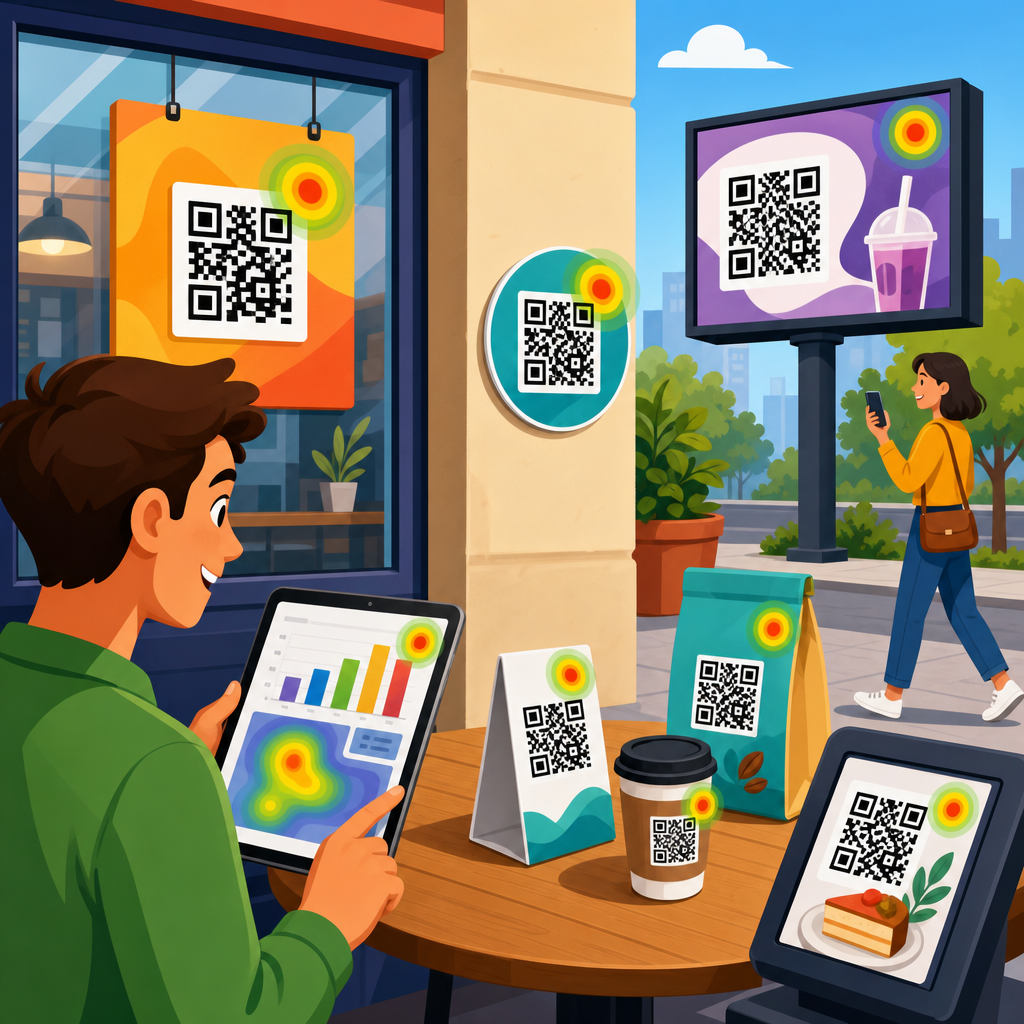
A practical framework is to separate metrics into exposure, engagement, and outcome. Exposure includes estimated impressions by placement. Engagement includes scans, unique visitors, bounce rate, scroll depth, and click-through to key steps. Outcome includes purchases, form completions, bookings, app installs, wallet saves, or attributed revenue. This structure prevents a common error: scaling a placement that produces many scans but weak conversion quality. In one retail campaign, shelf talkers generated fewer scans than end-cap signage, yet shelf talkers produced a much higher purchase rate because the scan happened closer to buying intent. Without full-funnel reporting, that insight would have been missed.
Test placements, creative, and destinations systematically
Optimization requires controlled testing, not guesswork. QR performance varies significantly by size, placement height, surrounding copy, incentive framing, destination type, and timing. A code on direct mail may convert best when paired with a personalized offer and short URL fallback. A code on product packaging may convert better on the side panel than the back because it is easier to notice while handling the item. A table tent in hospitality may perform better with “Scan to pay now” than with “Explore our digital experience” because clarity beats creativity in transactional moments.
The most useful tests isolate one variable at a time and run long enough to gather stable data. When budgets are limited, prioritize the variables closest to conversion impact: offer, landing-page layout, form length, and call-to-action copy. Then test physical execution such as code size, quiet zone, contrast, and placement angle. Real-world validation matters because environmental factors change behavior. Glare on glossy packaging, poor indoor connectivity, and crowded visual layouts can all suppress results in ways that mockups do not reveal.
| Optimization area | What to test | Why it affects conversion | Example |
|---|---|---|---|
| Offer | Discount vs utility benefit | Different motivations drive different audiences | “10% off” versus “Find your exact fit” |
| CTA copy | Specific action wording | Clarity lowers hesitation | “Book a demo” versus “Learn more” |
| Landing page | Short form vs long form | Reduced friction increases completion | 3 fields versus 7 fields |
| Placement | Eye-level vs lower position | Visibility changes scan likelihood | Shelf edge versus bottom panel |
| Design | High contrast vs branded styling | Scan reliability affects the whole funnel | Black on white versus low-contrast color mix |
Reduce friction after the scan
Every unnecessary action after the scan lowers conversion. Common friction points include app-download walls, cookie banners that cover the call to action, pop-ups triggered before users understand the offer, forced account creation, and forms that are difficult to complete on a phone. The best practice is to keep the path as direct as possible. If a purchase can happen as guest checkout, allow it. If location is needed, explain why before requesting permission. If age verification is required, use the lightest compliant method available.
Accessibility is part of friction reduction too. Buttons need sufficient size, contrast, and spacing. Text must be readable without zooming. The QR itself should be easy to scan, with an adequate quiet zone and reliable error correction, but the page also needs to support assistive technologies and varied user conditions. In multilingual markets, routing users by language preference can lift conversion materially. So can preserving continuity by pre-filling campaign-specific details, such as store location, SKU, event code, or referring source.
Build trust with transparency and proof
Trust is especially important in QR campaigns because the user often moves from a physical object into a digital experience with limited context. Suspicion rises quickly when the destination URL looks unfamiliar, when the page design does not match the brand, or when the first ask is personal information. Strong trust signals include branded domains, HTTPS, recognizable visual identity, clear value propositions, privacy explanations, return policies, verified reviews, and concise statements about how data will be used. For regulated categories such as healthcare, alcohol, and financial services, compliance language should be present without overwhelming the path to action.
Proof should match the decision being requested. For ecommerce, that may mean ratings, delivery timing, and payment options. For lead generation, it may mean client logos, implementation timelines, or sample outcomes. For product education, it may mean ingredient sourcing, certifications, or comparison details. Trust improves conversion not because it sounds reassuring, but because it reduces perceived risk at the exact moment the user decides whether to continue.
Use dynamic infrastructure and governance
High-performing QR programs are managed as systems, not one-off assets. Dynamic codes allow destination updates without reprinting, which is critical for seasonal offers, inventory changes, regional routing, and issue remediation. Governance matters just as much. Maintain naming conventions for campaigns, preserve a registry of live codes, document redirect logic, and monitor for broken destinations. Large organizations should define ownership across creative, analytics, web, legal, and operations so campaigns do not launch with missing tags or expired pages.
Use established tools where they fit the stack: analytics platforms such as Google Analytics 4 or Adobe Analytics, tag management through Google Tag Manager, CRM syncing with Salesforce or HubSpot, and experimentation platforms for landing-page testing. Standards-based implementation produces cleaner data and faster optimization cycles. The operational payoff is significant: when a campaign underperforms, you can identify whether the problem is low scan propensity, weak message match, high page abandonment, or poor offer economics, then fix the correct layer.
QR code conversion optimization works best when every element serves the same outcome: a clear user motivation, a relevant offer, a fast mobile destination, and measurable follow-through. The code is only the entry point. Real performance comes from matching the physical moment to the digital experience, reducing friction at each step, and tracking outcomes beyond simple scan counts. Organizations that treat QR as a strategic conversion channel consistently outperform those that treat it as a print add-on.
The key takeaways are straightforward. Define the conversion goal first. Align the landing experience with the scan context. Build for speed, clarity, and trust on mobile. Measure the full funnel so you can distinguish curiosity from commercial value. Test systematically across offer, creative, placement, and destination. Use dynamic infrastructure and campaign governance so improvements compound over time instead of resetting with each launch. These practices apply whether your QR code appears on packaging, direct mail, in-store signage, event materials, menus, or out-of-home advertising.
If you are building out a broader QR Code Marketing & Strategy program, use this page as the hub for your conversion work. Audit one live campaign, identify the biggest post-scan friction point, and fix that first. Then add stronger measurement and structured testing. Incremental gains in QR conversion rates quickly turn into meaningful revenue, better lead quality, and more efficient media performance.
Frequently Asked Questions
What does QR code conversion optimization actually mean?
QR code conversion optimization is the process of improving how often a QR code scan leads to a meaningful business result, such as a purchase, form submission, appointment booking, app download, email signup, or qualified lead. The important distinction is that the QR code itself is not the conversion event. It is the bridge between an offline touchpoint and a digital experience. The actual conversion depends on what happens after the scan: how relevant the offer is, how quickly the page loads, how clearly the next step is presented, and how easy it is for the user to complete that action on a mobile device.
In practice, this discipline combines several areas of marketing and user experience. It includes campaign strategy, mobile landing page design, analytics setup, message clarity, and audience intent. For example, a restaurant table tent, product package, event banner, and direct mail piece may all use QR codes, but each context creates different expectations. Someone scanning a code on packaging may want product details or a discount, while someone scanning at an event may expect registration, directions, or a downloadable resource. Optimization means aligning the destination with that real-world moment so the transition feels natural and useful rather than disruptive.
Strong QR code conversion optimization also requires measurement. Marketers need to know not just how many scans occurred, but how many people completed the desired action and where friction caused drop-off. That means tracking scan volume, click-through behavior, landing page engagement, form completion rates, revenue, and other downstream outcomes. When done well, QR code conversion optimization turns a simple scan mechanic into a measurable channel that supports broader business goals instead of functioning as a novelty or an untracked offline add-on.
What are the most important best practices for improving QR code conversion rates?
The most effective best practices start with relevance and clarity. A person should instantly understand why they should scan the code and what they will get in return. Vague prompts like “Scan me” usually underperform compared with specific calls to action such as “Scan to get 15% off,” “Scan to book your free consultation,” or “Scan to see today’s menu.” The message around the code matters just as much as the code itself because it sets expectations and motivates action. If the value proposition is weak or unclear, the scan rate and the conversion rate will both suffer.
The next major best practice is sending users to a mobile-first destination. Most QR code scans happen on smartphones, so the landing experience must load quickly, display properly on small screens, and make the next step obvious. Reduce unnecessary navigation, keep forms short, use large tap targets, and place the primary call to action high on the page. If users have to pinch and zoom, search for information, or fill out too many fields, conversions drop quickly. It is also smart to match the landing page headline and visuals to the context where the code appeared so users feel reassured that they landed in the right place.
Testing and analytics are equally critical. Use trackable URLs, campaign parameters, and event tracking to measure performance by location, placement, audience segment, creative version, and offer. Compare different calls to action, page layouts, incentives, and scan contexts to see what actually improves outcomes. Also pay attention to operational details like QR code size, contrast, placement height, lighting conditions, and surrounding design elements. A high-intent audience can still fail to convert if the code is hard to scan or the page is slow. The best-performing QR campaigns treat creative, technology, and user journey design as one connected system.
How do landing pages affect QR code conversion performance?
Landing pages are one of the biggest drivers of QR code conversion success because they determine whether initial interest becomes action. A scan reflects curiosity or intent, but the landing page must carry that momentum forward. If the page does not immediately confirm that the user is in the right place, explain the offer clearly, and make the next step easy, conversion rates will decline. This is especially true with QR traffic because users often come from fast, real-world moments where attention is limited. They may be standing in a store aisle, walking through an event, opening mail, or sitting at a table. The page has only a short window to prove relevance.
High-converting QR landing pages are typically simple, focused, and context-aware. They avoid generic homepages and instead present a dedicated destination tied to the specific campaign. That means using consistent messaging between the physical asset and the digital page, highlighting the main benefit immediately, and minimizing distractions. If the goal is booking, show the booking option right away. If the goal is lead generation, make the form straightforward and explain why submitting it is worthwhile. If the goal is a purchase, reduce friction with clear pricing, trust signals, and a streamlined checkout path. Every extra decision point introduces drop-off risk.
Technical performance also matters. Page speed, responsive design, secure connections, and reliable analytics implementation are foundational. Even a compelling offer can underperform if the page is slow or broken on common mobile devices. Beyond that, landing pages should be optimized for trust and reassurance. Include recognizable branding, concise copy, social proof when appropriate, and transparent information about what happens next. In many campaigns, improving the post-scan landing page produces a larger lift in conversions than changing the QR code design itself, because the page is where intent is either captured or lost.
How can businesses track and measure the success of QR code campaigns?
Measuring QR code success starts by defining the right outcome. Many teams stop at scan count, but scans alone do not reveal business impact. A campaign should be evaluated based on the conversion event that matters most, whether that is sales, registrations, downloads, form fills, phone calls, demo requests, or another revenue-linked action. Once that goal is clear, businesses can build a measurement framework that connects each QR code placement to post-scan behavior and final outcomes. This usually includes unique URLs or dynamic QR codes, campaign parameters, analytics events, and conversion tracking inside web analytics and CRM platforms.
A strong tracking setup makes it possible to answer practical performance questions. Which print piece generated the most qualified traffic? Which in-store location produced the highest conversion rate? Did one offer outperform another? Did users bounce because the page was slow, because the message was mismatched, or because the form was too long? Dynamic QR codes are especially useful because they allow destination updates and more granular reporting without needing to reprint the code. They can support campaign-level data collection across multiple channels, placements, geographies, and creative variants.
To get the full picture, businesses should look beyond top-line metrics and analyze the complete funnel. Useful metrics may include scan rate, landing page engagement, bounce rate, click-through rate, completion rate, average order value, cost per acquisition, and lead quality. Offline context should also be considered. For example, the same code may perform differently depending on foot traffic, audience intent, time of day, packaging design, or signage placement. The most mature QR code programs combine digital analytics with campaign context and business outcomes, allowing teams to optimize based on what drives actual conversion value rather than what merely generates scans.
What common mistakes reduce QR code conversions, and how can they be avoided?
One of the most common mistakes is assuming that adding a QR code automatically creates engagement. In reality, users need a clear reason to scan. Codes placed without a compelling offer, benefit, or instruction often fail because they do not answer the basic question, “Why should I do this now?” Another frequent problem is directing scans to a generic homepage or a poorly matched destination. When users scan from a specific physical context and land on a broad website with no clear next step, they often abandon the session quickly. The fix is to create campaign-specific landing pages that continue the exact message and intent introduced at the scan point.
Technical and design errors also hurt performance. Codes that are too small, printed with poor contrast, placed in awkward positions, or surrounded by clutter can be hard to scan. Likewise, pages that load slowly, display poorly on mobile, or require excessive typing create unnecessary friction. Long forms are a particularly common conversion killer in QR campaigns because mobile users are often on the go. Avoid these issues by testing the code across devices before launch, following QR design best practices for readability, and simplifying the mobile journey as much as possible. The smoother the experience, the better the conversion odds.
Another major mistake is failing to track results in a structured way. Without attribution and conversion measurement, teams cannot tell whether poor performance comes from the code placement, the creative, the offer, the landing page, or the audience fit. Businesses should also avoid running one-size-fits-all campaigns across very different environments. A QR code on product packaging should not necessarily use the same destination and messaging as a code on a trade show booth or a printed flyer. The best way to avoid these mistakes is to treat QR as a strategic conversion channel: define the goal, align the user journey, test every step, and optimize based on real data rather than assumptions.