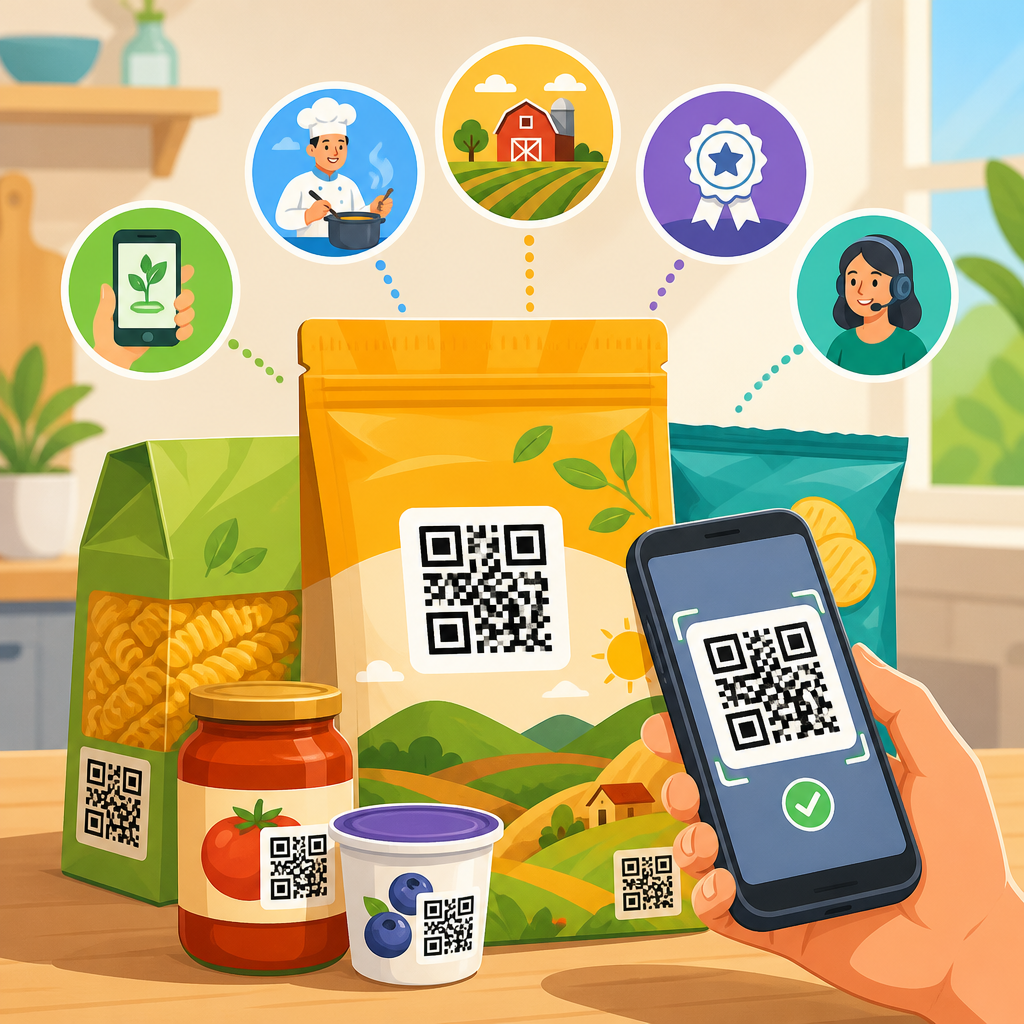
QR codes for food packaging have moved from novelty to practical infrastructure, giving brands a low-cost way to connect a physical pack with digital information, compliance records, and post-purchase engagement. In food and beverage operations, smart packaging usually means adding scannable, sensor-enabled, or connected features to a package so it can communicate useful data beyond what fits on a label. A QR code is the most widely adopted starting point because it works with ordinary smartphone cameras, requires no special hardware for the shopper, and can support everything from ingredient transparency to recall response. I have implemented QR code programs for packaged foods, restaurant takeout, and private-label products, and the pattern is consistent: when the code solves a real customer question, scan rates rise and support costs fall. This matters because food companies face growing pressure from consumers, retailers, and regulators to provide clearer origin data, allergen details, sustainability claims, and usage guidance. Static labels are constrained by space and print cycles, while digital destinations can be updated quickly, localized by market, and expanded as requirements change. For a smart packaging strategy, QR codes act as the bridge between compliance, operations, marketing, and customer experience, which is why they now sit at the center of many food packaging roadmaps.
At a technical level, a QR code on food packaging can be static or dynamic. A static code contains fixed information and cannot be changed after printing, making it suitable for simple URLs or permanent product identifiers. A dynamic code routes through a management platform, which allows the destination, tracking parameters, language rules, and campaign logic to be edited without reprinting the pack. That flexibility is especially valuable in food packaging, where a single SKU may have regional formulas, retailer-specific promotions, or evolving regulatory disclosures. Smart packaging also intersects with broader systems such as GS1 Digital Link, lot-level traceability databases, enterprise resource planning software, and customer relationship platforms. The business value comes from using one code to serve multiple functions at once: educate buyers, authenticate products, support recalls, encourage repeat purchase, and generate first-party scan data. As brands rethink packaging in response to transparency demands and tighter margins, QR codes are no longer an add-on graphic. They are a scalable digital layer that turns food packaging into an interactive, measurable channel.
Core use cases for QR codes on food packaging
The most effective use cases start with information customers actively want at the moment they handle the product. In grocery, that often means ingredient sourcing, allergen clarification, preparation guidance, and freshness context. A pasta sauce jar can link to region-specific nutrition panels, recipe variations, and wine pairing ideas. A protein bar can direct athletes to amino acid profiles, third-party testing summaries, and subscription reorders. For infant food and medical nutrition, the code can surface precise mixing instructions, storage conditions, and contraindication notes that would be unreadable in full on a small label. When the content answers a practical question in under two taps, the packaging becomes more useful, not just more promotional.
Traceability is another primary use case. Food recalls are expensive because they require rapid identification of affected lots, clean communication, and retailer coordination. A QR code tied to batch and production data can help brands isolate impacted units faster and direct customers to live recall instructions. The code itself does not replace formal recall channels, but it adds a responsive consumer-facing layer that printed labels cannot provide. In produce and premium packaged foods, brands also use QR codes to show farm origin, harvest date, processing facility, and transport milestones. This is common in coffee, seafood, olive oil, and chocolate, where provenance influences trust and price perception. Counterfeit-sensitive categories, including high-value honey and specialty supplements sold as foods in some markets, benefit from serialization and authentication checks attached to the scan journey.
Engagement and retention use cases are equally important. After launch, packaging often becomes the cheapest recurring touchpoint a brand owns. A cereal box can invite a family to loyalty rewards, educational games, or seasonal promotions. A frozen meal can link to microwave timing by wattage, reducing complaints about uneven heating. A spice brand can use the code to send buyers to video recipes and pantry pairing suggestions, increasing repeat purchase by demonstrating versatility. Restaurants and ghost kitchens now print QR codes on takeaway labels that connect to reheating instructions, allergen disclosures, and feedback forms. In each case, the packaging does more than identify the product; it supports the product experience after purchase, where satisfaction and repurchase decisions are made.
Benefits for brands, retailers, and consumers
For brands, the clearest benefit is flexibility. Printed packaging is expensive to revise, especially across multiple markets and pack sizes. Digital destinations let teams update compliant information, promotional assets, and educational content without scrapping inventory. That reduces artwork pressure and shortens the time needed to respond to changes in formulas, claims substantiation, or market conditions. Dynamic codes also create measurable interactions. Scan analytics can reveal which products generate curiosity, which stores drive engagement, what time people scan, and which content keeps them on page. When combined with consented first-party data collection, packaging becomes a source of customer insight rather than a one-way communication surface.
Retailers benefit when QR codes reduce friction at the shelf and after purchase. Shoppers who can quickly access dietary suitability details are less likely to abandon a product because the front label is unclear. Clear prep guidance lowers return and complaint rates in deli, meal kit, and frozen categories. For omnichannel grocery, QR-enabled packaging can align in-store products with richer digital product pages, creating consistency between shelf, app, and ecommerce listing. This is especially useful in private label, where retailers control both packaging and the digital ecosystem and can standardize information architecture across categories.
Consumers gain transparency and utility. They can verify ingredients, understand sourcing claims, learn proper storage, and find recipe support instantly. That is particularly valuable for people managing allergies, religious dietary rules, diabetes, or pediatric feeding concerns. Accessibility also improves when QR destinations support large text, screen readers, multiple languages, and video. A printed label can only do so much on a small pouch or bottle, but a mobile landing page can present information in formats suited to different users. The result is a better-informed purchase and a lower chance of misuse or disappointment.
| Use case | What the QR code links to | Primary benefit |
|---|---|---|
| Traceability | Lot data, origin, recall notices | Faster issue response and stronger trust |
| Preparation support | Cooking times, storage, video tutorials | Fewer complaints and better product results |
| Ingredient transparency | Allergen details, sourcing, certifications | Higher confidence at purchase |
| Loyalty and reorders | Offers, subscriptions, rewards enrollment | More repeat purchases |
| Sustainability education | Recycling rules, material guidance, impact data | Clearer disposal behavior and brand credibility |
Smart packaging applications across food categories
Different categories require different smart packaging designs. Fresh produce often uses pack-level or case-level QR codes to communicate farm origin, certifications, and handling information. Growers selling berries, avocados, or leafy greens can connect scans to harvest windows, region maps, and food safety protocols. In meat and seafood, where cold chain integrity and sourcing claims are highly scrutinized, QR pages often include catch method, processing location, and safe cooking temperatures. I have seen seafood brands improve retailer confidence simply by making vessel, species, and certification data easier to retrieve through a code rather than a customer service request.
Packaged grocery has broader creative room. Beverage labels can link to cocktail recipes, caffeine explanations, or recycling instructions for mixed materials. Dairy products can use QR codes for storage advice, recipe inspiration, and verification of animal welfare claims. Snack brands often use the code to explain flavor ingredients, support sweepstakes, or collect reviews. In premium categories such as single-origin coffee, tea, olive oil, and craft chocolate, provenance storytelling can justify higher price points when it is backed by named farms, lot details, roast dates, or tasting notes rather than vague brand language.
Prepared foods and meal kits benefit most from operational content. Consumers regularly need help with heating instructions, substitutions, serving ideas, and shelf-life questions. A code on a ready meal can detect device language and send the shopper to precise oven, air fryer, or microwave directions. Meal kits can use one printed code across weekly menus while dynamically routing customers to the correct recipe card and nutrition page. This reduces insert printing and gives brands a path to correct errors immediately. For foodservice packaging, especially delivery, QR codes can carry allergen disclosures, reorder prompts, and customer support options without cluttering the label.
Implementation best practices that improve scan performance
Placement, design, and content quality determine whether a QR code is scanned or ignored. On food packaging, the code should appear where hands and eyes naturally pause: near preparation instructions, nutrition information, or a clear benefit statement. A code buried in a seam, crimp, reflective curve, or transparent area will underperform even if the campaign idea is strong. Size matters too. For most consumer packs, keeping the code at least 0.8 by 0.8 inches is a practical minimum, with more space needed for longer encoded strings or difficult print conditions. High contrast, quiet zones, and print testing across substrates are non-negotiable.
The call to action is equally important. “Scan for recipes,” “Scan for allergen details,” or “Scan to trace this batch” outperforms a bare code because it gives the shopper a reason. Generic prompts such as “Learn more” are weaker than specific value propositions tied to a real need. Landing pages should open fast, match the packaging claim, and answer the promised question immediately above the fold. If the code requests email signup before delivering basic product information, abandonment will spike. In my experience, packaging scans succeed when utility comes first and data capture comes later, if at all.
Governance is the last major implementation requirement. Food companies should assign ownership across regulatory, quality, packaging, and digital teams before rolling out QR-enabled smart packaging at scale. Version control, archived content, approval workflows, and lot-data integrations matter because inaccurate information can create legal and safety risk. Platforms from packaging management vendors, QR campaign tools, and enterprise content systems can all work, but they need documented rules for redirects, expiration, localization, and analytics access. A QR code is easy to print; running it responsibly across thousands of packages is the harder discipline.
Compliance, standards, and limitations to understand
QR codes can strengthen compliance, but they do not remove the need for mandatory on-pack information. Core labeling requirements, allergen declarations, net quantity statements, date coding, and jurisdiction-specific disclosures still need to follow applicable rules from authorities such as the FDA, USDA, EFSA, and national food agencies. Digital content can supplement printed labels, provide deeper explanation, and support multilingual access, but companies should verify which claims and disclosures must remain directly visible on pack. This is especially important for alcohol, infant nutrition, supplements classified differently by market, and products sold across borders.
Standards are evolving in a useful direction. GS1 Digital Link allows brands to use web-enabled identifiers that connect products to structured data and different digital endpoints, supporting retail scanning and consumer engagement through a more unified architecture. For companies thinking long term, that matters because it reduces fragmentation between supply chain identification and marketing URLs. At the same time, not every market or retailer supports the same workflows yet, so implementation often requires a phased approach that preserves compatibility with existing barcodes and point-of-sale systems.
There are also practical limitations. Not every consumer wants to scan, mobile connectivity varies in stores, and some audiences still prefer printed essentials. QR destinations must be privacy-conscious, secure, and maintained over the full life of the package, including long shelf-life items. Broken links, expired promotions, or pages that fail accessibility checks damage trust quickly. Smart packaging works best when it extends a strong label and strong product experience, not when it tries to compensate for weak fundamentals.
The future of QR-enabled food packaging
The next phase of QR codes for food packaging is less about novelty and more about integration. Brands are connecting package scans to traceability clouds, customer data platforms, loyalty systems, and recycling databases so one code can support the entire product lifecycle. Artificial intelligence will make these experiences more adaptive, translating product information, summarizing nutrition attributes, and answering ingredient questions in real time. Packaging lines are also getting better at batch-level serialization, which opens the door to more precise recall handling, anti-diversion controls, and freshness communication.
Sustainability will be a major driver. As extended producer responsibility rules expand and consumers demand clearer disposal guidance, QR codes can deliver location-aware recycling instructions and explain material choices in plain language. Circular packaging pilots already use codes to support return, refill, and deposit workflows. For food brands, this is a practical way to connect sustainability messaging with action instead of broad claims. The same code that tells a shopper how to sort the pack can also capture feedback, measure engagement, and direct them to a refill reorder option.
For companies building a smart packaging hub, the strategic lesson is simple: start with the customer question, connect the code to reliable data, and design the scan experience as part of the product, not as an afterthought. QR codes for food packaging deliver the most value when they make food safer to use, easier to understand, and more convenient to buy again. They give brands a scalable path to transparency, traceability, and measurable engagement without changing shopper behavior dramatically, because the smartphone is already in the customer’s hand. If you are shaping a packaging roadmap under the broader QR code trends and innovations category, this is the smart packaging foundation to build now: map your highest-value use cases, test on a small product set, and expand only after the content, governance, and analytics are ready.
Frequently Asked Questions
What are QR codes on food packaging used for?
QR codes on food packaging are used to extend the package far beyond the limited space of a printed label. At the most basic level, they can direct shoppers to product details such as ingredients, nutrition facts, allergen information, preparation instructions, storage guidance, and sourcing claims. For food and beverage brands, that makes the package more useful at the point of purchase and after the product is brought home. Instead of trying to fit every detail onto a small container, companies can connect consumers to a mobile-friendly digital page that is easier to update and easier to read.
They are also widely used for traceability and transparency. A scan can link to batch-specific information, origin data, certifications, sustainability details, or recall-related notices. In some operations, the QR code acts as a bridge between the consumer-facing package and internal supply chain systems, helping brands support food safety documentation and compliance communication without redesigning packaging every time details change.
Beyond information sharing, QR codes are a practical tool for marketing and retention. Brands use them to deliver recipes, serving ideas, loyalty rewards, product registration, feedback forms, subscription offers, and social media experiences. This makes the packaging interactive instead of static. In short, QR codes on food packaging serve multiple roles at once: they improve access to information, support compliance and traceability efforts, and create post-purchase engagement opportunities at a very low implementation cost.
How do QR codes improve transparency and traceability in the food industry?
QR codes improve transparency and traceability by giving each package a direct digital connection to information that matters to retailers, regulators, and consumers. In food systems, traceability often involves tracking where ingredients came from, how products moved through processing and distribution, and which batch or lot a package belongs to. A QR code can connect that physical item to a digital record, allowing brands to present useful details in a simple scan instead of forcing consumers to search manually or rely only on abbreviated label text.
For transparency, this can include farm or region of origin, production dates, certifications, animal welfare claims, sustainability practices, and testing or quality assurance details. For traceability, it may connect to lot-level records, manufacturing data, expiration information, or recall instructions. If a company uses dynamic QR codes, the destination can be updated in real time, which is especially valuable when product guidance changes, a recall needs to be communicated quickly, or regional compliance information differs across markets.
From an operational standpoint, QR codes do not replace a full traceability system on their own, but they make that system more visible and actionable. They help translate internal data into something consumers and channel partners can actually use. That visibility builds trust. When shoppers can quickly verify where a product came from and access clear supporting information, transparency becomes a practical customer experience rather than just a brand claim.
What are the main benefits of using QR codes instead of adding more information directly to the label?
The biggest benefit is flexibility. Printed packaging is expensive to revise, limited in space, and difficult to customize for every market, language, or product variation. A QR code allows a brand to keep the physical package clean and compliant while linking to a digital destination that can hold far more content. That content might include expanded nutrition details, ingredient explanations, FAQs, certifications, recipes, videos, recycling instructions, or customer support resources. Instead of overcrowding the label, the brand can organize information in a much more user-friendly format.
Another major advantage is updateability. Once packaging is printed, static label text cannot be changed without new inventory and reprinting costs. With a dynamic QR code, brands can update the linked content without replacing the package itself. That is particularly useful for seasonal campaigns, evolving regulations, corrected product details, temporary promotions, and changing sustainability disclosures. It also helps reduce waste associated with outdated printed materials.
There is also a strong engagement benefit. Traditional labels communicate one-way information, while QR codes support a two-way relationship. A shopper can scan to learn more, leave feedback, join a loyalty program, or discover related products. That turns packaging into a measurable digital touchpoint. Brands can see scan behavior, test different landing pages, and improve communication over time. In many cases, QR codes offer a better balance of compliance, usability, and marketing value than trying to fit everything onto the label itself.
Are QR codes on food packaging useful for compliance and food safety communication?
Yes, QR codes can be very useful for compliance and food safety communication, especially when brands need to provide more information than a physical label can reasonably contain. Food packaging often has to balance mandatory disclosures, branding, multilingual requirements, and design constraints. A QR code gives companies a way to supplement the on-pack information with detailed digital content such as allergen explanations, ingredient sourcing, regulatory statements, handling instructions, storage conditions, and documentation related to certifications or testing.
They are particularly valuable when information changes over time or varies by region. A dynamic QR code can direct users to the most current guidance without requiring immediate package redesigns. In the event of a recall, quality advisory, or formulation update, a QR code can become an efficient communication channel for publishing lot-specific instructions, safety notices, and next steps for consumers. This can improve response speed and reduce confusion compared with relying only on static packaging or broad public notices.
That said, QR codes should generally be viewed as a complement to required labeling, not a substitute for legally mandated on-pack information unless a specific market explicitly allows it. The best use case is to enhance accessibility, depth, and timeliness. When implemented correctly, QR codes support stronger food safety communication by making critical information easier to access, easier to update, and easier to connect to specific products or production batches.
What should brands consider before adding QR codes to food packaging?
Brands should start with purpose. A QR code should not be added just because it is trendy; it should solve a real communication, compliance, traceability, or engagement need. Before deployment, companies should define what the code will do for the consumer and for the business. Will it provide sourcing transparency, connect to recipes, support loyalty, deliver lot-specific product data, or simplify customer service? A clear use case helps shape the landing page, data structure, packaging design, and measurement strategy.
Usability is another important factor. The code must be easy to find, easy to scan, and linked to a mobile-optimized experience that loads quickly. If a consumer scans and lands on a cluttered page, a generic homepage, or a broken link, the value is lost immediately. The destination should be relevant to the exact product and written in clear language. Brands should also think about multilingual support, accessibility, privacy disclosures, and whether the content needs to vary by market, batch, or campaign.
Operationally, companies should decide whether they need static or dynamic QR codes, how the linked content will be maintained, and who owns the process internally. If the QR code is tied to traceability or compliance information, it should connect reliably to accurate backend data. If it is used for marketing, analytics and testing should be in place to evaluate scan rates and engagement quality. Finally, packaging teams should consider print quality, placement, material finish, and scanning performance under real-world retail conditions. A successful QR program depends not just on generating the code, but on building a dependable experience around it.