QR code data storage seems simple on the surface, but it raises important questions about privacy, persistence, and control that many organizations overlook until a campaign, login flow, or payment rollout is already live. A QR code is a two-dimensional matrix barcode that stores data in a grid of black and white modules, while data privacy concerns refer to the risks that personal, behavioral, or confidential information can be exposed, collected, linked, or retained without proper safeguards. In practice, the central issue is not only how much data a QR code can hold, but what kind of data should be stored directly, what should be referenced indirectly, and who can observe the scan event. I have worked on QR implementations for retail packaging, secure visitor check-in, and healthcare intake forms, and the same pattern appears every time: teams focus first on scan reliability and only later realize the code may reveal customer identifiers, campaign attribution data, location context, or device metadata. That matters because QR codes are now used for payments, ticketing, authentication, document sharing, product verification, and omnichannel marketing at global scale. According to ISO/IEC 18004, QR codes support structured encoding, error correction, and multiple character modes, making them highly versatile, but versatility expands the attack surface. A printed code can be photographed, forwarded, archived, scraped, or replaced, and each of those actions changes the privacy posture of the system behind it. Understanding QR code data storage therefore requires looking beyond capacity charts and into system design, because the real privacy risk usually sits at the intersection of encoded content, scan handling, analytics collection, and backend retention.
What a QR code actually stores and what it does not
A QR code stores symbols that represent data characters according to a standard encoding scheme; it does not inherently store permissions, consent records, or security policies. The code may contain plain text, a URL, a phone number, contact fields in vCard format, Wi-Fi credentials, payment payloads, geolocation coordinates, or application-specific tokens. Static QR codes embed the final data directly, which means anything encoded can be read by any scanner that understands the format. Dynamic QR codes usually encode a short redirect URL or lookup key that points to server-side content, allowing updates after printing. From a privacy standpoint, that distinction is decisive. If a medical appointment code includes the patient name, clinic location, and appointment ID in plaintext, anyone with camera access can decode it instantly. If the same printed symbol contains only a random opaque token resolved server-side over TLS, the printed artifact discloses far less. Capacity is often misunderstood as permission to embed more. A Version 40 QR code at low error correction can hold thousands of numeric characters, but storing more data directly often makes the code denser, harder to scan, and much riskier if copied. In every production deployment I have audited, the safest default has been data minimization: encode the least sensitive payload possible and shift protected details to controlled infrastructure.
Where data privacy concerns arise in the QR lifecycle
Privacy risk begins before the first scan and continues long after the campaign ends. During creation, teams may import spreadsheet rows containing names, loyalty numbers, invoice references, or email addresses into a bulk generator. If that generator is a third-party cloud tool, the upload itself is a disclosure event. During distribution, printed labels, posters, badges, menus, and invoices can be viewed by unintended parties, copied at distance, or preserved in photographs. During scanning, the user’s camera app, browser, and landing page may expose IP address, timestamp, user agent, approximate location, referrer context, and device identifiers to the destination service. After resolution, backend logs, CRM enrichment, ad pixels, and analytics dashboards can combine the scan event with purchase history or account records. The table below shows how common design choices change privacy exposure.
| Design choice | What is stored in the code | Privacy impact | Safer approach |
|---|---|---|---|
| Static profile code | Name, phone, email in vCard | Anyone can extract personal data from a photo | Use a short URL to a protected contact page |
| Event ticket code | Order ID and attendee name | Enables identity leakage and resale fraud | Store a random token validated server-side |
| Marketing poster code | Tracked redirect URL with campaign parameters | Scan analytics may capture location and device data | Limit retention and disclose analytics collection |
| Wi-Fi access code | SSID and password | Password can be shared beyond intended users | Use segmented guest networks and rotate credentials |
These concerns are not theoretical. Restaurants have used QR menus with third-party analytics scripts that silently profile visitors. Residential buildings have issued guest passes with embedded unit numbers and resident names. Employers have printed onboarding codes that linked to forms prefilled with personally identifiable information. In each case, the QR code was merely the visible trigger; the deeper privacy issue was excessive data exposure across the full lifecycle.
Static versus dynamic QR codes and the privacy tradeoff
Static and dynamic QR codes solve different problems, and the privacy tradeoff is not as simple as dynamic equals safe. A static code has no dependency on a redirect service, so it can be durable, offline-friendly, and resistant to provider shutdown. However, static content is fixed forever. If sensitive information is encoded directly, you cannot revoke or rotate it once printed at scale. A dynamic QR code usually contains a compact URL managed by a service that can change the destination, enforce access controls, and record scan events. That flexibility supports privacy by allowing token rotation, expiration, and content removal. It also creates a new concentration of risk because the redirect platform becomes a data processor with access to event logs. I generally recommend dynamic codes for business systems that need governance, but only when the operator controls logging, regional data storage, retention periods, and link-level permissions. For example, a university can issue a dynamic QR code for a student service portal that expires after semester end and rejects repeated scans from unknown contexts. That is better than printing a static code containing student identifiers. But if the university relies on a consumer-grade QR platform that stores scan histories indefinitely and shares aggregate analytics across accounts, the privacy advantage erodes quickly. The correct decision depends on threat model, regulatory obligations, and the ability to manage the redirect layer as carefully as any other application component.
Personal data, metadata, and why scan analytics matter
When organizations discuss QR code privacy, they often focus on the visible payload and ignore metadata. That is a mistake. Even if a code contains only a generic URL, the resulting web request can generate a detailed event record. Web servers routinely log IP address, timestamp, request path, user agent, and status code. Analytics tools may add browser fingerprinting signals, ad campaign IDs, language settings, session cookies, and conversion events. In retail and out-of-home advertising, scan time and approximate location can reveal commuting patterns, store visits, or attendance at sensitive venues. In healthcare and employee settings, a single scan can suggest treatment type, department affiliation, or shift status even when no direct identifier appears in the QR code. Privacy engineering therefore must address both payload data and contextual metadata. A practical pattern is to classify data into three layers: direct identifiers such as name or email, persistent pseudonymous identifiers such as customer ID or device token, and contextual signals such as location or time. Each layer needs separate controls. Direct identifiers should rarely be embedded in the code. Persistent identifiers should be random, scoped, and revocable. Contextual signals should be collected only when necessary, documented in privacy notices, and retained for the shortest useful period. This is especially important for organizations subject to GDPR, CCPA, HIPAA-adjacent expectations, or sector-specific procurement rules, where a scan event can become regulated personal data once linked to an identifiable person.
Best practices for privacy-first QR code architecture
The most effective way to reduce risk is to treat QR codes as pointers, not containers. Encode a short-lived opaque token, resolve it over HTTPS, and keep sensitive content behind authenticated or time-bound endpoints. Use signed tokens when offline validation is necessary, but avoid packing readable personal fields unless there is no workable alternative. Apply least privilege to generator tools, store source data in controlled systems rather than in vendor dashboards, and disable public code indexes where possible. If analytics are needed, separate operational metrics from marketing enrichment so scan counts do not automatically merge with profile data. Configure retention schedules explicitly; many teams discover too late that default logs persist for a year or more. Add abuse controls such as destination allowlists, domain monitoring, and tamper-evident print design for codes placed in public spaces. In payment or authentication use cases, align implementation with established specifications such as EMVCo merchant-presented QR standards or FIDO-based login flows rather than inventing custom payloads. For internal governance, require a privacy review before bulk printing and maintain an inventory of active dynamic links, owners, expiration dates, and linked data classes. I have seen this simple inventory prevent major issues, including forgotten codes on warehouse labels that still resolved to live admin pages months later. Privacy-first architecture is not about making QR codes complicated; it is about ensuring each code exposes only what must be exposed, for only as long as necessary, under controls the organization can actually enforce.
Common mistakes, real incidents, and how to evaluate vendors
The most common mistake is embedding sensitive data because it feels convenient in the moment. Teams put customer emails into discount codes, employee IDs into attendance posters, and medical record references into appointment slips because scanning works immediately. Convenience disappears when codes are shared on social platforms, harvested from discarded packaging, or indexed in screenshots. Another frequent error is trusting free QR generators without reviewing where uploaded data goes, how redirects are logged, or whether the provider reserves the right to analyze traffic. Vendor evaluation should cover data residency, subprocessors, encryption in transit and at rest, administrative audit logs, SSO support, deletion workflows, and incident response commitments. Ask whether redirect logs can be disabled or anonymized, whether expired links are actually purged, and whether access to dashboards can be scoped by role. Real incidents illustrate the stakes. Attackers have replaced parking meter QR stickers with fraudulent payment links, turning a usability feature into a credential and card theft channel. Marketing teams have left dynamic codes active after promotions ended, allowing old links to route users into unrelated campaigns with different tracking terms. Schools have printed student QR badges that exposed identity details when photos circulated online. These are not edge cases; they are predictable outcomes of weak governance. A careful vendor review, paired with internal design standards, is the difference between a QR program that scales safely and one that becomes a recurring privacy exception.
QR code data storage should be understood as a system design question, not a printing question. The symbol itself can hold text, identifiers, credentials, or URLs, but privacy outcomes depend on whether that data is direct or indirect, static or revocable, minimally necessary or overly revealing. The safest pattern is consistent across industries: store as little as possible in the code, move sensitive information to secured backend services, and control the scan event with clear retention, access, and disclosure policies. Dynamic QR codes often improve privacy because they support rotation and expiration, but they also introduce a logging layer that must be governed carefully. Static QR codes can be appropriate for non-sensitive information, yet they are unforgiving when mistakes are printed at scale. Metadata matters as much as payload, because timestamps, IP addresses, and location context can become personal data once linked. For teams building under the broader QR Code Security & Privacy umbrella, this hub should guide every related decision: payload design, vendor selection, analytics setup, user consent, and lifecycle management. If you are auditing an existing deployment, start with a simple inventory of what each code stores, what each scan records, and how long each linked record persists. That review will reveal most privacy gaps quickly and give you a practical roadmap for safer QR code use.
Frequently Asked Questions
How is data actually stored in a QR code?
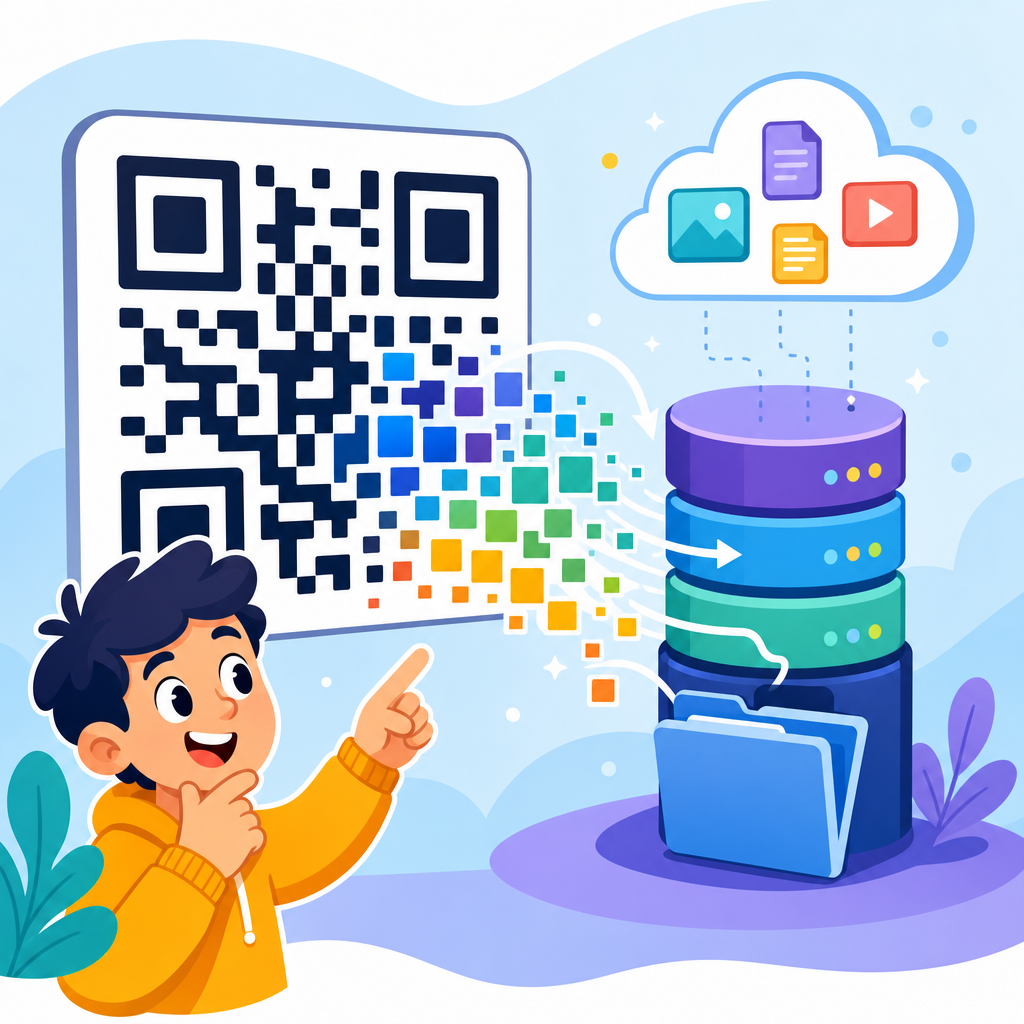
A QR code stores information directly inside its pattern of black and white squares, called modules. Those modules are arranged in a two-dimensional grid, and the specific placement of dark and light cells encodes binary data that a scanner can interpret. Depending on how the code is generated, that data may be plain text, a website URL, contact details, Wi-Fi credentials, payment instructions, or other structured information. QR codes also include built-in formatting information, alignment patterns, and error correction data, which help scanners read the code accurately even if part of it is smudged, damaged, or partially obscured.
It is important to understand that a QR code does not “connect” to a database by default. In a static QR code, the information is embedded permanently in the symbol itself. If the code contains a URL, the QR image stores that URL text, not necessarily the content of the destination website. In a dynamic QR implementation, the code often stores a short redirect link rather than the final destination. That makes the campaign more flexible because the destination can be updated later, but it also means the system behind the redirect may collect scan data, timestamps, device information, or location indicators. From a storage perspective, then, the QR image may be simple, but the surrounding infrastructure can be much more complex than many organizations initially assume.
How much information can a QR code hold?
The storage capacity of a QR code depends on several factors, including the QR version, the type of data being encoded, and the level of error correction selected. In general, QR codes can store numeric data, alphanumeric characters, binary data, and certain character sets used for international text. Smaller codes hold relatively little information, while larger versions can hold much more. In practical use, however, the theoretical maximum is less important than the scanning experience. As more data is packed into the symbol, the pattern becomes denser, which can make it harder to scan quickly, especially on low-quality prints, small labels, curved packaging, or dim mobile screens.
For most business applications, it is better to store only what is necessary. If the goal is to direct someone to a webpage, embedding a short URL is usually more reliable than trying to store long strings of data directly. If the use case involves sensitive workflows, such as login, identity verification, or payments, minimizing the amount of exposed information is even more important. The more data encoded directly in the symbol, the more likely it is that someone can inspect, copy, reuse, or share it outside the intended context. Capacity is not just a technical limit; it is also a privacy and operational design decision.
Are QR codes secure for storing sensitive information?
QR codes are useful, but they should not be treated as inherently secure containers for sensitive information. A QR code is easy to scan with almost any smartphone, and the information inside it can often be extracted by anyone who has access to the image. If confidential details, personal data, authentication tokens, or internal system references are embedded directly in the code without protection, that information may be copied, forwarded, photographed, or indexed in ways the issuer did not intend. In other words, the code itself is a transport mechanism, not a security boundary.
That does not mean QR codes are unsafe in every scenario. It means security has to come from the overall system design. A safer approach is to keep the QR code content minimal and use it to reference a secure backend process rather than expose the sensitive data itself. Organizations often pair QR experiences with expiring tokens, signed URLs, server-side validation, authentication checks, and encrypted transport over HTTPS. For payment, access control, and login flows, time limits, one-time-use rules, and replay protection are especially important. If a process depends on a QR code, the right question is not “Is the code secure?” but “What happens if this code is copied, seen by the wrong person, or scanned outside the intended moment?”
What are the main privacy risks associated with QR code use?
The most common privacy risks come from what happens before, during, and after a scan. Before a scan, the code may already expose embedded information if it contains personal identifiers, account references, or other readable data. During a scan, the linked system may collect device details, referral information, approximate location, campaign parameters, timestamps, and behavioral signals without the user fully realizing it. After a scan, organizations may retain those logs, combine them with CRM records, profile user behavior across channels, or share the data with analytics and advertising platforms. That creates privacy concerns even when the QR image itself appears harmless.
Another major risk is loss of control over context. A QR code can be copied from a poster, packaging, email, badge, or receipt and scanned by anyone, anywhere, at any time, unless technical restrictions are built into the system. That matters in healthcare, events, workforce systems, retail, and financial services, where a code may act as an entry point into a broader workflow. If organizations do not clearly define what data is collected, how long it is stored, who can access it, and whether it is linked to identifiable users, they can create compliance and trust issues very quickly. Clear notice, data minimization, retention limits, vendor oversight, and purpose limitation are all essential when QR codes become part of a user journey.
How can organizations use QR codes while protecting privacy and maintaining control?
The strongest approach is to treat QR code deployment as both a technical and governance decision. Start by deciding what absolutely needs to be encoded and what should remain on secure servers. In most cases, the QR code should contain the minimum information required to initiate an action, not the full payload of sensitive data. Dynamic routing can be helpful because it allows destination changes, analytics controls, and lifecycle management, but it should be implemented carefully with access controls, encryption in transit, token expiration, and monitoring. If third-party QR platforms are involved, their logging practices, retention policies, and data processing terms should be reviewed just as closely as any other software vendor.
Operational discipline matters just as much. Organizations should document the purpose of each QR code campaign or workflow, define ownership, set expiration or rotation policies where appropriate, and test what happens if the code is screenshotted, copied, or scanned repeatedly. User-facing transparency is also important: people should understand where the code leads, what data may be collected, and whether their interaction is tied to an identity or account. For high-stakes use cases such as payments, authentication, regulated communications, or physical access, add layered safeguards rather than relying on the code alone. When QR code programs are designed with privacy, retention, and misuse scenarios in mind from the beginning, they become far easier to manage safely at scale.