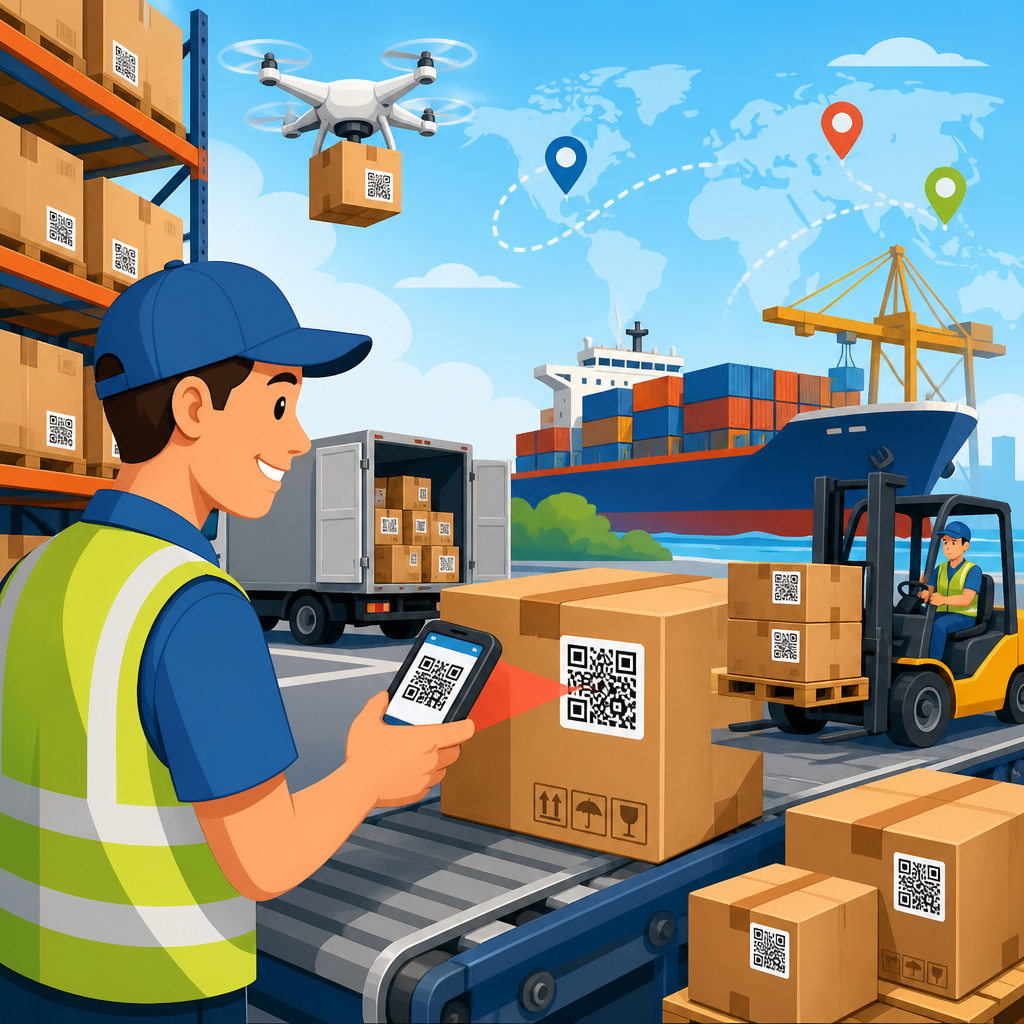
QR codes in logistics have moved from a niche labeling tool to a core part of how manufacturers, warehouses, carriers, and distributors track goods, reduce errors, and connect physical operations with digital systems. A QR code is a two-dimensional barcode that stores more data than a traditional linear barcode and can be scanned by industrial readers, handheld terminals, or smartphones. In manufacturing and logistics, that matters because every shipment, pallet, carton, return, and production component carries information that teams need instantly: item identity, batch number, destination, handling instructions, work order, or proof of delivery. When I have implemented labeling workflows in warehouse and factory environments, the practical value was never the code image alone. The value came from tying that code to a warehouse management system, manufacturing execution system, transportation management system, or enterprise resource planning platform so operators could scan once and trigger a reliable transaction.
This topic matters because logistics performance is measured in execution details. A mislabeled pallet can miss a truck. A missing batch record can delay a recall. A manual receiving process can add minutes to every inbound shipment and create avoidable inventory discrepancies. QR codes help solve those problems by making data capture faster, more accurate, and more flexible than paper-based methods. They also support traceability requirements across manufacturing and distribution, especially in sectors such as automotive, food, pharmaceuticals, electronics, and industrial equipment. Unlike one-dimensional barcodes, QR codes can encode URLs, serial numbers, lot data, and structured text in a compact space, and they often remain scannable even when partially damaged because of built-in error correction. For companies building a modern manufacturing and logistics operation, QR codes are no longer optional infrastructure. They are a practical bridge between shop floor activity, warehouse movement, transportation visibility, and customer service outcomes.
How QR codes work in manufacturing and logistics operations
In logistics, a QR code usually acts as a machine-readable key that points to a record in a business system. That record may contain stock keeping unit data, serial numbers, lot genealogy, supplier information, packing configuration, shipment status, or customer instructions. In a factory, the same code may identify a raw material bin, a work-in-progress assembly, a machine asset, a quality checkpoint, or a finished unit waiting for packaging. The scan event matters as much as the code. When an operator scans at receiving, the system can create an inbound transaction and update available stock. When a picker scans during order fulfillment, the system can validate that the right item and quantity have been selected. When a driver scans at delivery, the system can timestamp proof of handoff and attach images or signatures.
Compared with traditional barcodes such as Code 128 or UPC, QR codes provide two major advantages. First, they can store more information in less space, which is useful on small labels, parts, and cartons. Second, they can support dynamic digital workflows by linking directly to cloud records, manuals, routing instructions, or customer portals. In practice, most mature operations still use both barcode types. I have seen warehouses keep GS1-128 labels for carrier and pallet standards while adding QR codes for richer internal data and mobile workflows. That hybrid approach works well because it aligns with existing scanning hardware and compliance requirements while expanding what each scan can do.
Core use cases across the supply chain
The most common use case is inventory identification and movement tracking. QR codes on bins, shelves, pallets, and cartons allow teams to record every movement with a scan, reducing manual key entry and improving inventory accuracy. During receiving, staff scan supplier labels to confirm purchase orders, lot numbers, and quantities. During put-away, they scan the storage location and item label to create a verified location assignment. During cycle counts, teams use mobile devices to reconcile system stock against physical stock quickly. In my experience, these simple workflows produce immediate gains because they eliminate transcription mistakes and make exception handling visible sooner.
A second major use case is end-to-end traceability. Manufacturers use QR codes to track components from inbound receipt through production, packaging, shipment, and after-sales support. If a quality issue emerges, teams can isolate the affected lot or serial range instead of broadening the recall unnecessarily. Food and beverage companies use this for ingredient tracking and expiration control. Automotive and electronics manufacturers use it for serialized assembly and warranty management. The business benefit is not abstract. Faster traceability reduces regulatory risk, lowers recall cost, and protects customer trust.
A third use case is shipment execution and last-mile delivery. Carriers and in-house fleets place QR codes on shipping labels, manifests, and delivery documents so drivers and dock teams can verify handoffs, loading sequence, and destination. QR-enabled proof of delivery is especially useful when paired with mobile apps that capture geolocation, timestamps, photos, and recipient confirmation. Reverse logistics is another strong fit. Return merchandise authorizations can be encoded in a QR label so receiving teams know exactly what the customer sent back, why it was returned, and which disposition workflow applies.
Where QR codes add the most value in manufacturing
Manufacturing environments benefit when QR codes are tied to process control rather than treated as passive labels. Raw material tracking is a strong example. Each container or reel can carry a code with supplier lot, receipt date, inspection status, and storage conditions. Operators scan before consumption, and the system verifies that the correct material is being issued to the right order. This supports first-expired, first-out rotation where needed and creates a material genealogy record automatically. In regulated sectors, that record can be essential during audits or investigations.
Work-in-progress control is another high-value area. Assemblies moving between stations can be scanned to pull up standard work instructions, torque specifications, bill of materials revisions, or in-process quality checks. If a station requires a prior operation to be completed first, the system can block progression until the scan history confirms compliance. I have seen this reduce rework because operators no longer rely on outdated printed instructions or memory. Maintenance teams also benefit. Machine QR labels can link technicians to service logs, spare parts lists, lockout procedures, and digital checklists, cutting time spent searching for documentation.
Finished goods packaging and outbound staging complete the manufacturing picture. A QR code can connect each finished unit to its serial history, test results, packaging line, and shipment assignment. That creates a reliable chain from production record to customer order. For manufacturers serving distributors and direct customers simultaneously, this visibility is valuable because service teams can answer status, warranty, and replacement questions quickly.
Operational benefits: speed, accuracy, and visibility
The clearest benefit of QR codes in logistics is data capture accuracy. Manual entry introduces common errors such as transposed digits, missed lot numbers, and incorrect locations. Scanning reduces those errors dramatically because the identifier is captured exactly as encoded. Accuracy matters not only for inventory integrity but also for labor efficiency. Every receiving discrepancy, pick correction, or shipment investigation consumes time that operations teams rarely have. When scan compliance rises, exception volume falls.
Speed is the second major benefit. A worker can scan a pallet, location, and task prompt in seconds. Across thousands of warehouse transactions per day, those seconds become meaningful labor savings. Faster scans also support higher throughput during peak periods. In e-commerce fulfillment, for example, QR-coded tote and carton workflows help teams sustain rapid pick-pack-ship cycles without sacrificing control. In manufacturing, scan-driven confirmations allow supervisors to see bottlenecks as they happen instead of discovering them from end-of-shift paperwork.
Visibility is the third benefit and often the most strategic. QR scans generate event data that feeds dashboards, audit trails, and customer updates. Managers can see where a pallet was last handled, which production batch went into which shipment, or whether a return has reached inspection. That visibility supports better forecasting, faster customer communication, and more disciplined root-cause analysis. When companies say they want a digital thread across operations, QR codes are frequently one of the simplest and least disruptive ways to build it.
Implementation models, standards, and system integration
Successful deployment depends less on the label artwork than on process design and system integration. The first decision is data architecture: should the QR code contain all relevant data directly, or should it contain a unique identifier that points to a master record? In most enterprise settings, the second model is better because it keeps labels compact and lets teams update associated data without relabeling inventory. The next decision is standards. Many organizations align with GS1 identification structures because they support interoperability across suppliers, manufacturers, and logistics providers. Depending on the use case, companies may also use internal serial schemas, shipment IDs, or license plate numbers managed by the WMS or ERP.
Hardware and software fit are equally important. Warehouses often use rugged mobile computers from Zebra or Honeywell, fixed mount scanners at conveyor points, and thermal printers from Zebra, SATO, or TSC. The software layer may include SAP Extended Warehouse Management, Oracle WMS, Manhattan Associates, Blue Yonder, NetSuite, or a manufacturing execution platform. QR codes should be integrated into those existing transaction flows, not added as a side process. If scanning requires duplicate work, adoption will suffer. Label durability must also match the environment. Frozen storage, chemical exposure, abrasion, and outdoor handling all affect symbol readability, so print method, substrate, and placement should be tested before rollout.
| Use case | Primary data in QR code | Connected system | Main operational benefit |
|---|---|---|---|
| Inbound receiving | PO reference, supplier lot, SKU | ERP or WMS | Faster receipt verification and fewer discrepancies |
| Production tracking | Work order, serial, process step | MES | Real-time genealogy and process compliance |
| Warehouse picking | Item ID, location, task ID | WMS | Higher pick accuracy and labor efficiency |
| Shipping and delivery | Shipment ID, route, customer order | TMS or mobile delivery app | Better proof of delivery and shipment visibility |
| Returns processing | RMA number, reason code, item ID | Returns platform or ERP | Quicker triage and disposition decisions |
Challenges, limitations, and best practices
QR codes are highly useful, but they are not a cure-all. Dirty labels, poor contrast, damaged packaging, weak mobile connectivity, and inconsistent operator training can all undermine results. Dense codes can become harder to scan if they are printed too small or placed on curved surfaces. Some high-speed conveyor environments still favor other machine vision approaches depending on angle and read distance. Security is another consideration. If a QR code links to a web resource, access controls and domain management matter; otherwise, teams can create unnecessary risk or confusion.
The best implementations start with one clearly defined workflow, such as receiving, pallet movement, or serialized production tracking. Measure baseline error rates, transaction time, and exception volume before rollout, then compare after deployment. Establish label standards, quiet zones, print verification, and reprint controls. Train users on the reason behind each scan, not just the button sequence. In every rollout I have supported, the sites with the strongest scan discipline were the ones where supervisors could explain exactly how each scan prevented a shipment error or protected traceability. Finally, design for scale. A hub strategy works well: standardize naming, IDs, and integration patterns so future projects such as supplier labels, field service support, and customer self-service can build on the same foundation.
QR codes in logistics deliver measurable benefits because they improve how physical goods are identified, tracked, and verified at every handoff. For manufacturing teams, they strengthen material control, work-in-progress traceability, maintenance access, and finished goods genealogy. For warehouse and transportation teams, they streamline receiving, put-away, picking, shipping, proof of delivery, and returns. The strongest results come when QR codes are integrated with core systems, aligned to standards, and supported by disciplined label design and training.
As a hub for manufacturing and logistics use cases, this topic points to a simple conclusion: QR codes work best when they are treated as part of operational architecture, not as a standalone label project. They reduce manual errors, increase speed, and create the event data needed for visibility and continuous improvement. If you are evaluating where to begin, map one high-friction workflow, define the scan event that should trigger the transaction, and pilot it with the right hardware and system integration. That is the fastest path to turning QR codes into a durable advantage across manufacturing and logistics operations.
Frequently Asked Questions
What are QR codes used for in logistics?
QR codes are used across the logistics workflow to identify, track, verify, and update the status of goods as they move through manufacturing, storage, transportation, delivery, and returns. In practical terms, a single QR code can be placed on a pallet, carton, product label, shipping document, or return authorization and linked to a digital record in a warehouse management system, transportation management system, enterprise resource planning platform, or customer-facing portal. When scanned, the code can instantly surface shipment details, batch or lot numbers, serial numbers, destination data, handling instructions, proof-of-delivery information, and inventory status.
They are especially valuable at operational handoff points where errors are most likely to occur. For example, QR codes can be scanned during receiving to confirm inbound shipments against purchase orders, during putaway to direct items to the correct storage location, during picking and packing to verify order accuracy, and during outbound staging to ensure the correct load is assigned to the right carrier. They are also widely used in reverse logistics for returns processing, repair workflows, and warranty verification. Because QR codes can store more data than traditional one-dimensional barcodes and can still be read even when partially damaged, they support more flexible and information-rich tracking in real-world logistics environments.
How do QR codes improve tracking and visibility in the supply chain?
QR codes improve supply chain visibility by creating a fast and reliable link between a physical item and its digital record. Every time a QR code is scanned, the system can capture who scanned it, when it was scanned, where it was scanned, and what process step occurred at that moment. That simple action creates a traceable event history, which is critical for companies trying to monitor inventory movement, shipment progress, production status, and chain-of-custody records. Instead of relying on manual data entry or paper-based updates, teams get near real-time information that is easier to trust and easier to act on.
This level of visibility has direct operational value. Warehouse teams can quickly identify whether inventory has been received, picked, packed, staged, or loaded. Transportation teams can verify transfer points and delivery events. Manufacturers can trace materials and finished goods by production batch or serial number. Distributors can reduce uncertainty around location, quantity, and status across multiple facilities. When delays, shortages, misroutes, or quality issues occur, QR-based tracking makes root-cause analysis much faster because each scan creates a clear timeline. For organizations focused on service levels, compliance, and inventory accuracy, that visibility is one of the biggest reasons QR codes have become so important in modern logistics.
What are the main benefits of using QR codes instead of traditional barcodes in logistics operations?
The biggest advantage of QR codes is data capacity. A traditional linear barcode typically holds a limited identifier that must be looked up in a database, while a QR code can store substantially more information directly within the symbol. That may include shipment IDs, product references, lot numbers, serial numbers, expiration dates, supplier codes, routing details, or URLs that connect users to live records and documents. This gives logistics teams more flexibility in how they label and manage goods, especially when multiple data points need to travel with the item.
QR codes also offer practical scanning benefits. They can be read from different angles, work well in compact label sizes, and often remain scannable even if part of the code is damaged or obscured. That matters in warehouses, production environments, and transportation settings where labels may be exposed to abrasion, moisture, handling damage, or imperfect placement. In addition, QR codes are highly compatible with a broad range of devices, from industrial scanners and mobile computers to smartphones, making them easier to deploy across different users and facilities.
From a business perspective, QR codes help reduce manual errors, improve process speed, support better traceability, and simplify connections between physical workflows and digital systems. They can lower training friction because scanning is intuitive, and they can support both internal users and external partners. While traditional barcodes still have a place in many operations, QR codes are often the better choice when companies need richer data, more resilient scanning, and more versatile use cases throughout the logistics chain.
How can warehouses and manufacturers implement QR codes effectively?
Effective implementation starts with a clear use case, not just the label itself. Companies should first identify where QR codes will create measurable value, such as receiving accuracy, inventory movement tracking, work-in-process visibility, outbound verification, asset tracking, or returns handling. From there, they need to define exactly what each code represents, what data it should contain, and which systems will receive scan events. In many cases, the best approach is to use the QR code as a key that connects to records in warehouse, manufacturing, or shipping systems rather than trying to embed every possible data element directly in the code.
Label design and placement are also critical. The code must be sized correctly for the scanning distance and device type, printed with adequate contrast, and positioned where operators can scan it without slowing down the workflow. In industrial environments, material selection matters as well. Labels may need to withstand heat, cold, chemicals, moisture, abrasion, or outdoor exposure depending on the application. Standardized formatting is equally important, especially when multiple suppliers, plants, carriers, or distribution centers are involved. Consistent data structures reduce confusion and improve interoperability.
Finally, successful implementation depends on integration, training, and governance. Scan data should feed directly into operational systems so teams can act on it immediately. Employees should understand not only how to scan the code, but why each scan matters at a given process step. Companies should also establish procedures for exception handling, label reprinting, damaged-code management, and audit controls. A strong QR deployment is not just about printing smarter labels; it is about building a repeatable process that improves visibility, accountability, and decision-making across logistics operations.
Are QR codes useful for returns, compliance, and customer communication in logistics?
Yes, and this is one of the most valuable aspects of QR codes in modern logistics. In returns management, QR codes can streamline the entire reverse logistics process by connecting returned items to order records, return merchandise authorizations, inspection instructions, and refund workflows. Instead of relying on handwritten notes or manually matched paperwork, warehouse and service teams can scan the code and immediately see what the item is, why it was returned, where it came from, and what should happen next. That reduces delays, lowers handling errors, and improves the customer experience.
For compliance and traceability, QR codes are equally powerful. They can support product authentication, batch tracking, recall management, and documentation access for regulated industries such as food, pharmaceuticals, automotive, and electronics. If a company needs to isolate affected inventory, prove chain of custody, or demonstrate adherence to handling and shipping procedures, QR-based scan records create a much more reliable audit trail than manual logs alone. This can be especially important when dealing with safety standards, customer requirements, or cross-border shipping documentation.
QR codes also improve communication beyond the four walls of the warehouse. A code on a package or pallet can link carriers, distributors, field teams, or end customers to live delivery status, setup instructions, service documentation, or return portals. That creates a bridge between internal logistics systems and external stakeholders without requiring complex manual coordination. In other words, QR codes are not just tracking tools; they are communication tools that make logistics operations more transparent, responsive, and connected.