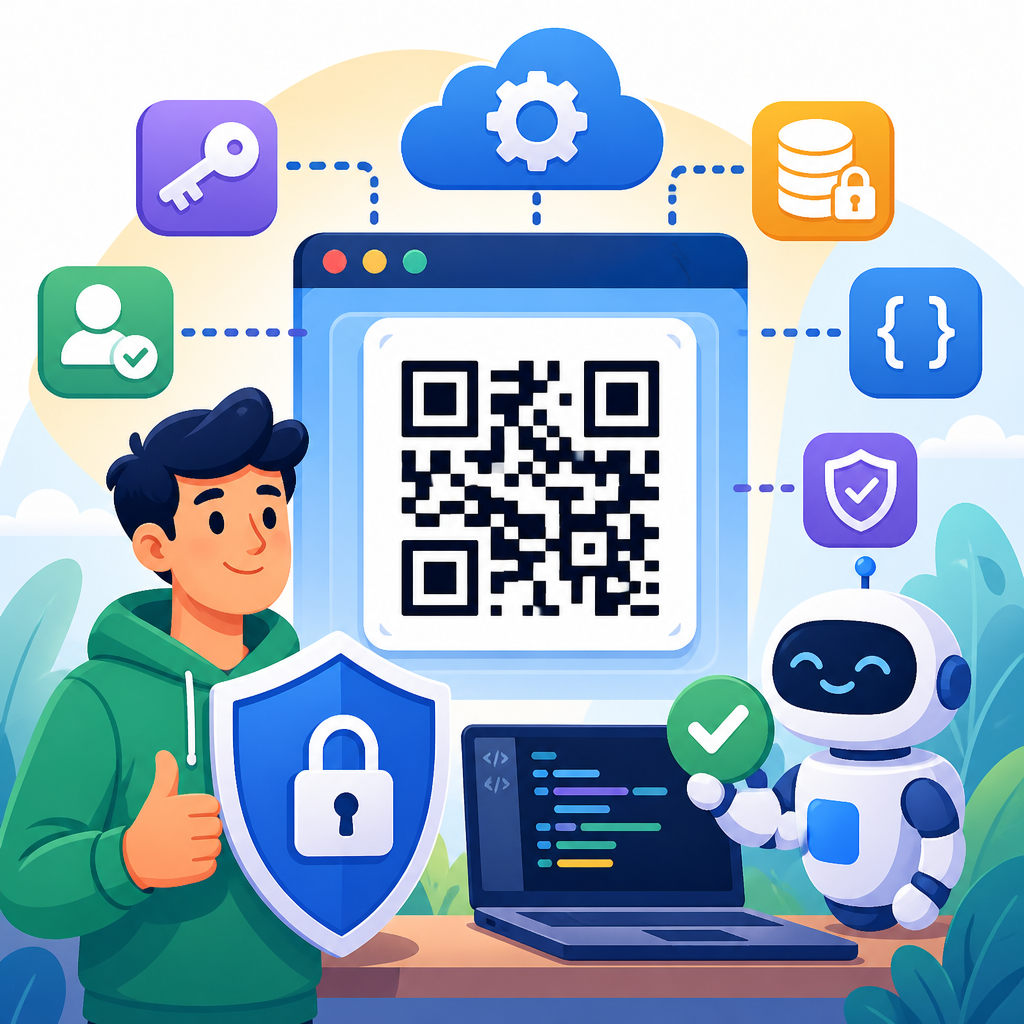
QR code API integrations power everything from dynamic menu links and mobile payments to warehouse labeling and event check-ins, but they also expand an application’s attack surface in ways many teams underestimate. A QR code API is any web service that generates, customizes, tracks, decodes, or validates QR codes through programmatic requests, while an SDK is the language-specific toolkit that wraps those calls for developers using JavaScript, Python, Swift, Kotlin, or server frameworks. Securing these integrations matters because QR workflows often touch customer data, payment sessions, device cameras, analytics events, and third-party redirect destinations. In projects I have worked on, the risk was rarely the QR image itself; the real problems came from weak authentication, over-permissive webhooks, unsigned redirects, leaked API keys, and poor validation of encoded content. This hub article explains how to secure QR code APIs and SDKs across the full lifecycle: vendor selection, authentication, transport security, input validation, storage, monitoring, incident response, and governance. It also serves as the central guide for teams building a broader QR code technology stack, because secure integrations depend on architecture decisions made long before the first code is generated. If you want reliable QR code automation without exposing users, systems, or campaigns to preventable abuse, security must be designed in from the start.
Understand the QR Code API Threat Model
The first step in securing QR code API integrations is to define what can go wrong. Most teams focus on whether the QR code scans correctly, but attackers focus on the systems behind the code. A QR platform may generate static codes, issue dynamic short URLs, collect scan analytics, accept logo uploads, store campaign metadata, and send event callbacks. Each function introduces a different threat. Static QR codes can embed malicious or malformed payloads if user input is not validated. Dynamic QR codes can be hijacked if redirect rules are weak. Analytics dashboards can leak location, timestamp, and device data if access control is poor. Webhooks can be forged to poison reporting or trigger workflows. SDKs can expose secrets in mobile apps if credentials are hardcoded.
In practice, the most common attacks are credential theft, unauthorized code generation, redirect abuse, and data exfiltration. For example, a retailer might use a QR code API to create in-store product links. If an attacker obtains the API token, they can generate fraudulent codes that point to phishing pages styled like the retailer’s domain. A logistics team may decode inbound QR labels through an API; if the decoding endpoint accepts oversized files or malformed images without limits, it can become a denial-of-service vector. A venue using webhooks for scan events might trust any incoming POST request and allow false attendance records. Security starts with mapping these assets, trust boundaries, and abuse cases before you write integration code.
Choose Vendors and SDKs with Security Controls Built In
Your security posture depends heavily on the API provider and SDK you adopt. A strong QR code API vendor should support TLS 1.2 or higher, scoped API keys or OAuth 2.0, webhook signing, audit logs, rate limiting, role-based access control, and data retention settings. If the provider offers dynamic QR redirection, it should also support domain allowlists, HTTPS-only destinations, and change history for link edits. For SDKs, review release cadence, dependency health, package signing, and whether the library exposes low-level controls for timeout handling, certificate validation, and retries. Public GitHub activity, software bill of materials support, and clearly documented vulnerability disclosure processes are positive indicators.
I recommend treating QR code APIs like payment or identity vendors during assessment. Ask where data is stored, how secrets are rotated, whether scan analytics include IP addresses, and whether customer content is used for model training or product analytics. Look for compliance alignment relevant to your environment, such as SOC 2, ISO 27001, GDPR support, or HIPAA readiness where healthcare workflows are involved. On mobile, verify that the SDK does not require embedding master credentials in the app bundle. On the server, prefer service-to-service authentication and short-lived tokens. If a vendor cannot explain how they secure redirects, webhooks, and administrative access, that is a material risk, not a documentation gap.
Protect Authentication, Authorization, and Secret Management
Most QR code API breaches begin with poor credential handling. The baseline rule is simple: never place privileged API secrets in front-end JavaScript, mobile binaries, public repositories, or client-side QR generation widgets. Use a backend service to broker requests whenever the API allows resource creation, editing, analytics access, or deletion. Issue separate credentials for development, staging, and production. Scope them by environment, application, and function. A service that only generates codes should not have permission to delete campaigns or export scan reports. If the provider supports OAuth 2.0 client credentials, use that instead of long-lived static tokens. If only API keys are available, rotate them on a defined schedule and immediately after personnel or system changes.
Store secrets in a managed vault such as AWS Secrets Manager, Azure Key Vault, or HashiCorp Vault, and inject them at runtime rather than baking them into container images. Enforce least privilege in your own admin console as well. Marketing teams may need to create branded landing pages, while engineers manage API settings and finance reviews payment-linked campaigns. These roles should not share accounts. Enable multi-factor authentication for the QR platform dashboard and centralize sign-on through SAML or OIDC if supported. Every integration should have traceable ownership. When I audit implementations, orphaned keys with no owner are one of the fastest indicators that rotation, monitoring, and revocation will fail during an incident.
Secure Data in Transit, at Rest, and in Redirect Flows
Transport security is non-negotiable. All QR code API requests, webhook deliveries, and redirect destinations should use HTTPS with modern cipher suites and valid certificate chains. Mobile apps should consider certificate pinning for highly sensitive use cases such as ticketing or healthcare forms, though pinning adds operational overhead during certificate changes. At rest, encrypt campaign metadata, destination URLs when they contain sensitive query parameters, and any user identifiers linked to scan events. If you cache generated QR payloads or analytics responses, apply the same storage protections you would to other customer data.
Redirect security deserves special attention because dynamic QR codes often resolve through an intermediate short link controlled by the provider. Restrict destination domains with allowlists. Strip unnecessary query parameters to avoid leaking session tokens or personal data. Never encode raw authentication tokens, password reset links, or direct object references into QR codes intended for public circulation. For signed actions, use short-lived, single-purpose URLs generated server-side. A practical example is event check-in: instead of embedding attendee email and order ID in the code, embed a random token that maps to a server record and expires after validation. This preserves usability without disclosing meaningful data if the code is photographed or reused.
Validate Inputs, Sanitize Outputs, and Defend the Decode Path
QR code APIs typically accept text, URLs, images, logos, colors, and files. Every field needs validation. Limit payload length, enforce character sets where appropriate, and canonicalize URLs before storage or encoding. Reject dangerous schemes such as javascript:, data:, or file: in any field that may become a redirect or rendered link. If the platform supports Wi-Fi, vCard, SMS, or payment payload types, validate each schema separately rather than treating all content as generic text. This prevents malformed data from creating insecure behavior in scanning apps or downstream systems.
The decode path is equally important. If your application uploads user-provided images to decode QR content, scan files for malware, enforce file type and size limits, and isolate image processing in a sandboxed environment. Libraries such as ZXing and ZBar are widely used, but they still sit inside a broader pipeline that can be abused through oversized images, parser edge cases, or repeated decode attempts. Do not trust decoded content simply because it came from a machine-readable symbol. Pass it through the same validation and business-rule checks applied to manual input. In one warehouse deployment, we blocked inventory corruption by requiring decoded product identifiers to match existing SKU formats and known facility codes before the scanning event updated stock.
Harden Webhooks, Rate Limits, and Operational Controls
Many QR code platforms send webhooks for scan events, campaign updates, billing notices, or failed deliveries. These callbacks must be authenticated. The preferred approach is an HMAC signature computed over the raw request body with a shared secret, plus a timestamp header and replay window. Verify the signature before parsing JSON. Reject old timestamps and store event IDs to prevent replay. IP allowlisting can help, but it is not sufficient on its own because cloud source ranges change and addresses can be spoofed upstream of weak controls.
Operational limits prevent small issues from becoming outages or abuse. Set per-key and per-IP rate limits on your broker service. Cap QR generation bursts, file upload sizes, and decode attempts. Time out slow upstream requests and use idempotency keys for creation endpoints so retries do not generate duplicate assets. Monitor error rates, signature verification failures, and sudden spikes in redirects to new domains. The table below highlights practical controls teams should implement early.
| Integration area | Primary risk | Recommended control |
|---|---|---|
| API authentication | Leaked long-lived secrets | Scoped keys or OAuth 2.0, vault storage, scheduled rotation |
| Dynamic redirects | Phishing or open redirect abuse | HTTPS-only destinations, domain allowlists, change approval |
| Webhook processing | Forged scan events | HMAC signature verification, timestamp checks, replay protection |
| Decode endpoints | Malicious files or resource exhaustion | File scanning, size limits, sandboxed image processing |
| Analytics exports | Exposure of location or device data | Role-based access, minimization, retention policies |
Manage Privacy, Logging, and Compliance Requirements
Scan analytics can become a privacy issue quickly. A QR code campaign may collect timestamp, approximate location, device type, language, referrer, and conversion activity. If you combine that with account IDs, loyalty numbers, or health information, your QR integration moves into regulated territory. Minimize what you collect. If you only need total scans by region, do not retain full IP addresses or granular GPS-like data. Define retention periods for event logs, exported reports, and image uploads. Make sure deletion requests can be honored across the QR provider and your internal systems.
Logging should support investigations without exposing secrets or personal data. Mask API keys, authorization headers, signed URLs, and customer identifiers in application logs. Separate security logs from marketing analytics dashboards so operational staff can investigate incidents without broad access to sensitive campaign data. Align the integration with your broader compliance controls, including data processing agreements, cross-border transfer reviews, and records of processing where required. For payment-related use cases, remember that a QR code initiating a payment flow may still fall under the security expectations of the payment ecosystem even if the code itself does not store card data.
Build an Incident Response and Secure Development Process
No QR code API integration stays secure through setup alone. You need ongoing review. Start with threat modeling during design, then add code review checks for redirect logic, secret handling, and webhook verification. Use dependency scanning for SDKs and image-processing libraries. In CI/CD, run static analysis and secret scanning to catch exposed tokens before deployment. In staging, test expired signatures, malformed QR payloads, oversized image uploads, and unauthorized role access. These are routine scenarios, not edge cases.
Incident response should be documented before launch. Define how to revoke API keys, disable compromised campaigns, freeze redirect edits, and notify stakeholders if fraudulent QR codes are distributed. Keep an inventory of every application, environment, and physical asset that uses a given QR provider. This matters when a vendor outage or key leak affects thousands of printed labels, posters, or tickets already in circulation. Maintain fallback plans, such as alternate landing pages or app-based lookup paths, so business operations can continue while damaged codes are remediated. Teams that rehearse these steps recover much faster and make better decisions under pressure.
Securing QR code API integrations requires more than protecting a barcode image; it requires protecting the services, workflows, and data connected to every scan. The essentials are clear: choose vendors with strong controls, keep secrets out of client apps, enforce least privilege, secure redirects, validate all inputs, authenticate webhooks, limit abuse, minimize data collection, and prepare for incidents before they happen. When these practices are built into your QR Code APIs and SDKs program, you get safer automation, more reliable analytics, and fewer surprises in production. Use this hub as the foundation for deeper implementation guides across your QR code development stack, and review your current integration against each control area today.
Frequently Asked Questions
1. What are the biggest security risks in QR code API integrations?
The biggest risks usually come from treating QR code workflows as simple image generation rather than as full data-processing pipelines. A QR code API may generate, decode, validate, redirect, or track content, which means it often handles URLs, identifiers, session references, payment instructions, user metadata, and analytics events. If that data is not tightly controlled, attackers can exploit the integration through malicious redirects, parameter tampering, injection attacks, insecure object references, credential theft, or abuse of dynamic QR codes that resolve to altered destinations. In practical terms, a vulnerable implementation can let an attacker swap a legitimate link for a phishing page, embed harmful payloads into decoders, scrape sensitive tracking information, or abuse open API endpoints for fraud and denial-of-service activity.
Another major issue is trust in downstream content. A QR code itself is only a carrier; the true risk lies in the destination and in the backend systems that create or interpret the code. Teams sometimes allow user-supplied URLs, text, or metadata to flow directly into QR generation endpoints without normalization, validation, or policy checks. That creates opportunities for cross-site scripting in admin dashboards, server-side request forgery in validation tools, and poisoned analytics if scan events are not authenticated. Security problems also appear when SDK defaults are accepted without review, such as weak certificate validation, excessive logging, permissive CORS settings, or storing API keys in mobile apps where they can be extracted. The safest mindset is to view every QR payload, scan event, and API response as untrusted until verified.
2. How should developers authenticate and authorize access to a QR code API?
Strong authentication and authorization should start with the assumption that QR code endpoints can be abused at scale if exposed too broadly. At a minimum, use modern API authentication methods such as short-lived OAuth 2.0 access tokens, signed service-to-service credentials, or tightly scoped API keys stored only in secure backend environments. Avoid embedding privileged secrets in client-side JavaScript, mobile binaries, kiosk apps, or browser-accessible code whenever possible. If a mobile or frontend experience must interact with the service, route sensitive operations through your own backend so you can enforce policy, rate limits, payload inspection, and audit logging before requests ever reach the QR platform.
Authorization matters just as much as authentication. Separate permissions by function so a system that only needs to generate QR codes cannot also delete records, export scan analytics, or change redirect targets. Use role-based or attribute-based access controls for internal users and machine identities, and assign the least privilege necessary for each workload. In multi-tenant environments, make sure every request is scoped to the correct account, project, environment, or customer, and verify ownership server-side rather than trusting identifiers supplied by the client. Rotating secrets regularly, enforcing mutual TLS for high-trust integrations, and monitoring for unusual token usage patterns add another layer of protection. Good API security is not just about proving identity; it is about proving the caller should be allowed to perform that exact action on that exact resource.
3. What data validation and input handling practices help secure QR code API workflows?
Data validation is one of the most effective ways to reduce risk because QR code systems frequently process external input in both directions. On the generation side, developers should strictly validate all payload fields before they are encoded into a QR code or passed to the API. That includes allowlisting accepted URL schemes, enforcing domain restrictions for redirect destinations, setting maximum lengths, rejecting malformed UTF-8 and control characters, and preventing dangerous content from being stored in metadata fields. If your application supports dynamic QR codes, validate every update to the destination with the same rigor as the original creation request. Never assume that because content will eventually become an image it is harmless; the underlying payload is still data that other systems will later parse, render, or execute logic against.
On the decoding and validation side, treat scanned data as hostile until proven safe. If your backend receives decoded strings, do not automatically fetch, render, or redirect based on that content. Normalize inputs first, inspect them against policy, and isolate any enrichment steps such as URL previews or remote lookups to controlled services with network restrictions. For web applications, escape decoded content before display to prevent script injection in dashboards or reports. For server-side processing, use parameterized queries, safe parsers, strict content-type handling, and schema validation for API responses. Logging also deserves care: sanitize or redact QR payloads before writing them to logs so that tokens, personal data, or payment information do not become exposed through monitoring systems. The goal is to ensure QR-related data is validated consistently at every boundary, not just at the first point of entry.
4. How can teams protect dynamic QR codes, redirects, and scan tracking from abuse?
Dynamic QR codes are especially valuable operationally because they let teams update destinations without reprinting physical assets, but that flexibility also introduces a high-value attack target. If an attacker can change a redirect target, they can silently turn trusted printed materials into phishing lures, malware distribution points, or fraudulent payment requests. To prevent this, protect redirect management interfaces with strong authentication, least-privilege access, approval workflows for sensitive changes, and immutable audit trails showing who changed what and when. Consider requiring step-up authentication or dual authorization for modifications to production QR destinations, especially in sectors like payments, healthcare, logistics, or event operations where a single change can affect many users quickly.
Scan tracking also needs security controls because analytics endpoints can leak sensitive business intelligence or be manipulated by bots. Require signed or authenticated update operations, validate the integrity of scan events where feasible, and use rate limiting, bot detection, anomaly monitoring, and geographic or behavioral analysis to spot abuse. If redirect services append user identifiers, campaign parameters, or session references, minimize that data and avoid exposing internal IDs unnecessarily. Protect the redirect infrastructure itself with HTTPS everywhere, HSTS, secure headers, and tight origin rules. It is also wise to monitor for destination drift, sudden spikes in redirect changes, unusual scan volume, or repeated failures from specific clients. Dynamic QR systems should be treated like miniature traffic-routing platforms: resilient, observable, and subject to the same change control standards as any other security-sensitive production service.
5. What are the best practices for securely deploying and maintaining QR code API integrations over time?
Long-term security depends on disciplined operational practices, not just a secure initial implementation. Start by placing the QR code API integration within a broader secure software development lifecycle. Perform threat modeling to identify how the service generates, stores, decodes, and routes QR payloads, then define controls for each stage. Keep SDKs, API client libraries, mobile dependencies, and server frameworks up to date so known vulnerabilities do not linger in production. Store secrets in a dedicated secret manager, enforce TLS for all communications, pin certificates where appropriate for mobile use cases, and separate development, staging, and production credentials. Infrastructure controls such as web application firewalls, API gateways, DDoS protections, and network segmentation can further reduce blast radius if an endpoint is targeted.
Maintenance also means visibility and preparedness. Log all sensitive administrative actions involving QR creation, updates, deletions, decoding requests, and redirect changes, then feed those logs into centralized monitoring with alerts for anomalies. Conduct periodic penetration testing and code review focused specifically on QR-related workflows, including payload handling, redirect logic, and analytics endpoints. Establish data retention limits for scan records and metadata so you do not keep more sensitive information than necessary. Finally, create an incident response plan that covers compromised API keys, malicious destination changes, poisoned QR batches, and suspicious scan behavior in the field. The most secure teams treat QR integrations as living systems that need continuous hardening, auditing, and governance as usage grows and threat patterns evolve.