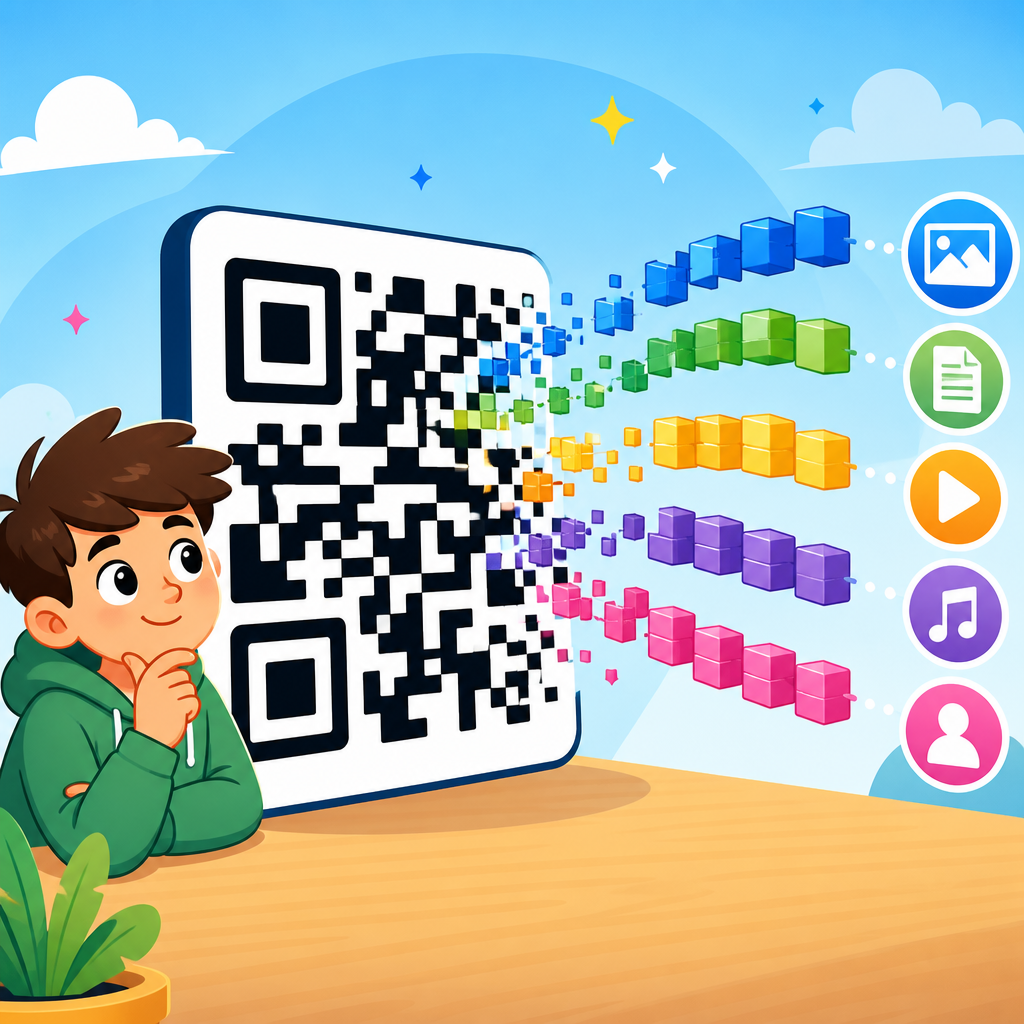
QR code size and data capacity are inseparable because every increase in the amount of information stored inside a symbol changes the number of modules that must be printed, the amount of error correction required, and the physical dimensions needed for reliable scanning. In QR code standards and formats, “size” has two meanings that are often confused: the symbol version, which defines the grid from 21×21 modules in Version 1 up to 177×177 modules in Version 40, and the printed size, which is the real-world measurement of that grid on paper, packaging, labels, signs, or screens. Data capacity refers to how many numeric, alphanumeric, byte, or kanji characters a symbol can hold after accounting for encoding mode, structural overhead, and error correction level. This relationship matters because a code that technically fits the data may still fail in practice if the modules are too small for a camera, too dense for a curved surface, or too damaged for the selected redundancy level.
In day-to-day implementation work, this is where many teams make preventable mistakes. Marketing wants to fit a long URL, product engineering wants a tiny label, compliance may require traceability data, and print production needs a quiet zone and contrast that survive the manufacturing process. The result is often a QR code that is valid according to the specification but unreliable in the field. Understanding how QR code size relates to data capacity is therefore not a design detail; it is the basis for choosing the right format, the right encoding strategy, and the right physical dimensions. As a hub for QR Code Standards & Formats, this article explains the core standards, how versions and error correction affect capacity, how printing and display conditions alter the required size, and when alternatives such as Micro QR, rMQR, Model 1, Model 2, or specialized industrial symbols make more sense than a standard square QR code.
QR code standards and formats: the foundation behind size and capacity
The dominant standard used today is the QR Code specification standardized through ISO/IEC 18004. Most real-world symbols are Model 2 QR codes, the familiar square matrix with finder patterns in three corners, alignment patterns that increase with larger versions, timing patterns, format information, and optional version information beginning at Version 7. Model 1 is the earlier form and is rarely used in modern deployments. Micro QR reduces the footprint for very small data payloads by using fewer finder structures and smaller matrices. More recently, rectangular Micro QR, commonly called rMQR, was designed for narrow spaces where a square code is inefficient, such as medical devices, electronics, and compact industrial labels.
These formats exist because size constraints vary by application. A warehouse carton can carry a large square symbol with generous quiet zones, while a syringe label or PCB component cannot. However, the standards do not override the physics of scanning. Every QR format balances available modules, error correction overhead, and orientation support. A larger matrix can hold more data, but it also demands either more physical space or smaller modules. Smaller modules reduce the margin for blur, glare, low contrast, ink spread, display pixelation, and camera motion. That is why standards selection is not simply a matter of “what fits”; it is a matter of what fits and still scans under expected conditions.
How versions, modules, and encoding modes determine theoretical capacity
A standard QR code version increases by four modules per side as the symbol grows. Version 1 is 21×21 modules, Version 2 is 25×25, and the progression continues until Version 40 at 177×177. Those modules are the true storage canvas. Not all modules are available for user data because finder, timing, alignment, format, and version patterns consume fixed areas, and Reed-Solomon error correction consumes codewords as redundancy. The remaining space becomes data codewords. Capacity therefore depends on three variables at minimum: version, error correction level, and encoding mode.
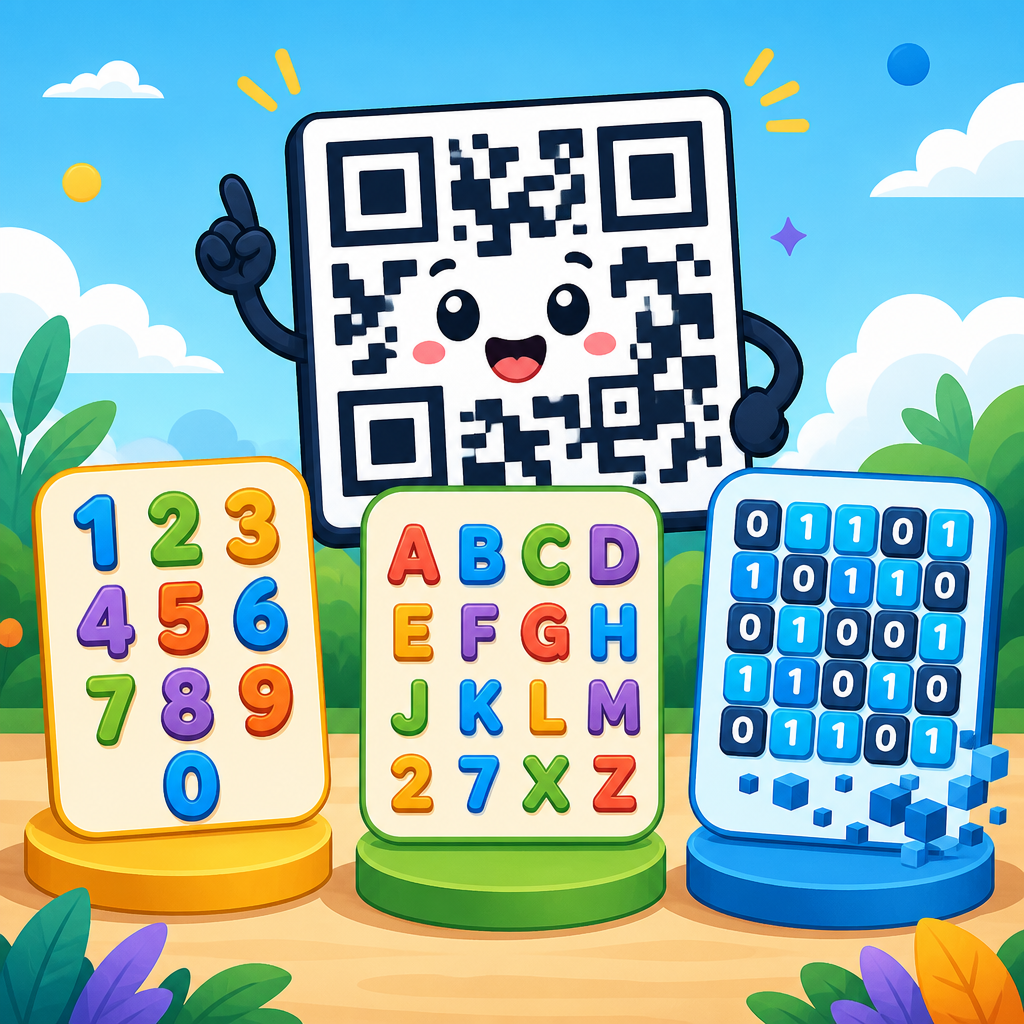
Encoding mode matters more than many teams expect. Numeric mode is the most efficient for digits. Alphanumeric mode supports a limited character set and is less efficient than numeric but more efficient than byte mode. Byte mode is the common choice for URLs, UTF-8 text, serialized IDs, and mixed content, but it uses more space. Kanji mode can be more efficient for Shift JIS encoded characters. A short numeric string may fit in a very small version, while the same information expressed as a verbose URL or as UTF-8 text may require a significantly larger one. In practice, I often reduce symbol size simply by shortening query parameters, using a redirect domain, or replacing descriptive text with a compact identifier resolved by a backend system.
Error correction level also changes capacity substantially. QR codes provide four standard levels: L, M, Q, and H. Higher levels reserve more codewords to recover from damage, contamination, or occlusion. The tradeoff is direct and unavoidable: more resilience means less room for data in the same version. This is why a code printed on a clean brochure can often use a lower level than a code etched on metal, wrapped around a bottle, or exposed to abrasion in logistics.
| Factor | Effect on Capacity | Effect on Required Physical Size |
|---|---|---|
| Higher version number | More modules and more total data codewords | Can stay same printed size only if modules become smaller |
| Higher error correction | Less room for user data | May require a larger version or larger print area |
| Numeric or alphanumeric encoding | More efficient than byte mode for eligible content | Often allows a smaller symbol for the same message |
| Long URLs or verbose text | Consumes data codewords quickly | Usually forces a denser or physically larger code |
| Structured or shortened data | Reduces payload length | Improves scan reliability at smaller sizes |
Why printed size is different from symbol size
A Version 10 QR code is not “big” or “small” until it is printed or displayed. Symbol size defines module count; printed size defines the dimensions of each module and the quiet zone around the code. Scanners read contrast transitions between modules, not abstract versions. If a code has too many modules packed into too small an area, the camera cannot resolve each square cleanly. This is why practical sizing guidance often starts with module size or X-dimension rather than just version number. In print, a common baseline for close-range consumer scanning is around 0.4 mm per module, though workable values vary by scanner quality, standoff distance, substrate, and process control.
The quiet zone is equally important. Standards require a clear margin around the symbol, typically four modules wide for standard QR codes. Teams frequently violate this by placing text, borders, icons, or background graphics too close to the matrix. The code may still scan on a flagship phone under studio conditions and then fail in a retail aisle. In production reviews, I treat quiet zone protection as part of total size because the scanner does. A 20 mm code with an inadequate quiet zone is effectively smaller and less reliable than a 20 mm code with proper margins.
Distance changes the equation further. A large-format poster scanned from several feet away needs larger modules than a business card scanned from arm’s length. A practical rule used in signage is to size the code based on expected scan distance, increasing module dimensions as the distance rises. The exact ratio depends on camera optics and environmental conditions, but the principle is consistent: more distance requires larger physical features. Dense symbols that perform well in hand-held packaging tests may perform poorly on window graphics or event banners if the user cannot get close enough for the camera to resolve the module pattern.
Error correction, damage tolerance, and real-world tradeoffs
Error correction is often described as a simple percentage, but field performance is more nuanced. Reed-Solomon coding can recover lost or corrupted codewords up to a limit, yet the location and pattern of damage matter. Smearing across timing patterns, finder interference from decorative branding, or glare over alignment regions can hurt scanability even when the nominal damage percentage appears acceptable. For that reason, choosing Level H “just to be safe” is not always the best answer. If Level H forces a jump to a larger version and the design then shrinks the printed area to fit a label, the resulting tiny modules can reduce scan reliability more than the extra redundancy helps.
The best approach is to match error correction to the environment. For indoor brochures, business cards, and email signatures displayed on high-resolution screens, Level M is often a balanced choice. For food packaging exposed to condensation, warehouse labels subject to scuffing, or outdoor assets where dirt and abrasion are likely, Level Q or H can be justified. Industrial direct part marking introduces additional constraints because dot peen, laser etch, and chemical etch processes alter edge quality and contrast. In those cases, test scans with representative readers matter more than assumptions based on a generic online generator.
Choosing the right QR format for the application
Standard Model 2 QR is the default for most websites, packaging, payments, and marketing materials because it has broad scanner support and flexible capacity. Micro QR is useful when payloads are very small, such as a compact serial number or abbreviated command string, and space is severely limited. It is not a drop-in replacement for consumer campaigns because scanner compatibility may be narrower depending on the device and software. rMQR solves a different problem: it allows more efficient use of narrow rectangular spaces without the waste of forcing a square symbol into a long thin label.
There are also adjacent standards that teams sometimes confuse with QR codes. Data Matrix, standardized separately under ISO/IEC 16022, is widely used in healthcare, electronics, aerospace, and manufacturing because it performs well at small sizes and is common in direct part marking. Aztec Code, covered in ISO/IEC 24778, is often used for transport tickets and boarding passes because it does not require a traditional quiet zone in the same way. Choosing among these is not brand preference; it is an engineering decision based on space, scanner ecosystem, error environment, and data structure. If the goal is a public-facing code scanned by smartphones, standard QR generally remains the safest choice. If the goal is marking tiny metal components, Data Matrix may outperform QR even when both are technically possible.
Capacity optimization techniques that reduce size without sacrificing function
The easiest way to reduce QR code size is to reduce payload length. For web use, that usually means replacing a long destination URL with a short redirect domain under your control. A URL containing campaign parameters, product names, and verbose path structures can easily add dozens of characters. A short domain plus a compact path often cuts the symbol version by several steps. Dynamic QR platforms such as Bitly, QR Code Generator, Scanova, and enterprise campaign tools apply this principle by storing destination logic on a server while the symbol carries only a short URL.
For operational systems, use identifiers rather than descriptive text. Instead of embedding a full maintenance note, embed an asset ID that resolves to current records in a CMMS or ERP system. Instead of storing a customer’s detailed profile in the code, store a token that retrieves authorized data after authentication. This approach not only reduces symbol size but also improves security, update flexibility, and analytics. Compression can help in specialized workflows, but broad consumer support depends on the scanning application understanding the encoding scheme, so plain compatibility usually beats clever compactness.
Mask pattern selection, contrast control, and print process validation also matter. The QR specification allows mask patterns that reduce problematic visual artifacts in the module arrangement. Most mature encoders choose these automatically, but poor implementations can generate patterns that are technically valid yet harder to scan under certain conditions. On press, monitor gain, edge definition, and substrate reflectance. On screens, ensure sufficient pixel density and avoid scaling that introduces anti-aliasing blur. Reliable QR deployment is not only about storing data; it is about preserving machine-readable geometry from generation to scan.
Testing standards compliance and scan performance before launch
A QR code should be validated in two ways: conformance to the symbol specification and performance in its actual use environment. Standards-based verification checks parameters such as modulation, symbol contrast, axial non-uniformity, grid non-uniformity, and fixed pattern damage using barcode verifiers aligned with ISO/IEC 15415 for two-dimensional symbols. That process is common in regulated and industrial settings because it catches defects that casual phone testing misses. A code that scans on one device in the office may still be marginal in production.
Field testing should mirror reality. Print the code at final size, on final materials, with final artwork, then test under expected lighting, angle, and distance using representative devices. Include older smartphones, lower-cost Android cameras, enterprise imagers, and any line-of-business scanner apps that customers or staff will actually use. Test after abrasion, moisture exposure, flexing, or thermal transfer printing if those conditions apply. This discipline is what separates a code that merely exists from one that performs reliably at scale.
When QR code size relates to data capacity, the key lesson is simple: capacity is never free. More data, more redundancy, and tighter spaces always force a tradeoff somewhere else. The best implementations start with the standard that suits the use case, choose the leanest encoding that preserves function, set an error correction level based on real risk, and then size the printed or displayed symbol so modules remain easy to resolve. That process consistently produces codes that scan faster, fail less often, and fit the product instead of fighting it.
As the hub for QR Code Standards & Formats, this page should guide every later decision about version selection, Micro QR, rMQR, Data Matrix comparisons, print specifications, and verification workflows. If you are building labels, packaging, tickets, industrial marks, or digital campaigns, review the payload first, then validate the format, then prototype at final size before deployment. Start with a shorter message and a larger module than you think you need, test in realistic conditions, and refine from measured results rather than guesswork.
Frequently Asked Questions
What does “QR code size” actually mean?
In discussions about QR codes, “size” can refer to two different things, and confusing them is one of the most common reasons people misjudge capacity and scan reliability. First, there is the symbol size, also called the version. A QR code version determines how many modules, or tiny square cells, the code contains. Version 1 uses a 21×21 module grid, and each higher version adds more modules until Version 40 reaches 177×177 modules. This version is directly tied to how much data the QR code can hold.
Second, there is the printed or displayed physical size, such as how large the code appears on a label, sign, package, screen, or poster. Physical size affects whether a scanner can clearly distinguish the modules at a given distance, angle, and lighting condition. A QR code can have a high-capacity symbol version but still fail to scan if it is printed too small for its module density. Likewise, a physically large QR code may still contain very little information if it uses a low version.
These two meanings of size are inseparable in practice. As data increases, the QR code typically moves to a higher version with a denser module grid. That denser grid usually needs to be printed larger to keep each individual module readable. So when people ask, “How big should my QR code be?” the correct answer depends on both how much data is encoded and how large the finished code must be for dependable scanning in the real world.
How does data capacity affect the version and dimensions of a QR code?
Data capacity has a direct effect on the QR code version because more information requires more modules to represent it. A simple URL might fit in a lower version, while a long URL with tracking parameters, contact details, Wi-Fi credentials, or a large block of text may require a higher version. As the version increases, the grid expands, giving the code more room to store data, formatting information, and error correction codewords.
Capacity is not determined only by the number of characters. It also depends on the type of data. Numeric data is more space-efficient than alphanumeric data, and both are more efficient than byte or binary data. This means two strings of similar length can require different QR code sizes depending on what characters they contain. For example, a short sequence of numbers may fit comfortably in a smaller version, while a similar-length string with lowercase letters, symbols, and special characters may push the code into a larger version.
Once the symbol version grows, the physical dimensions often need to grow as well. A 21×21 grid can remain scannable at a relatively modest print size because each module can still be large enough to distinguish. But a 97×97 or 177×177 grid packs many more modules into the same area, making each square much smaller if the print dimensions do not increase. That is why data capacity, module count, and physical size must be considered together rather than separately.
Does adding more error correction make a QR code larger?
Yes, higher error correction can make a QR code larger because it uses some of the available capacity for redundancy instead of user data. QR codes support several error correction levels, commonly referred to as L, M, Q, and H. Higher levels allow the code to remain readable even if part of it is smudged, scratched, obstructed, or poorly printed, but the tradeoff is reduced room for actual content. If your data no longer fits at a chosen error correction level, the generator must move to a higher version with more modules.
This relationship matters a great deal in practical applications. If you plan to place a logo in the center of the QR code, print the code on packaging that may crease, or display it in environments where dirt and wear are likely, stronger error correction is often a smart choice. However, that added resilience may force the symbol into a denser grid, which in turn can require a larger physical print size to preserve scanability.
In other words, error correction does not simply improve durability for free. It influences total capacity and therefore affects symbol size. The best approach is to match the error correction level to the actual use case. A clean digital display might work well with a moderate level, while industrial labeling or branded marketing materials may justify a higher level despite the increase in required QR code size.
Why can a QR code with a lot of data become harder to scan?
A data-heavy QR code becomes harder to scan because storing more information usually means using a higher version with a denser module pattern. As modules become smaller and more tightly packed, scanners have less margin for error. Camera focus, motion blur, glare, low contrast, print bleed, screen pixelation, and viewing distance all have a greater impact when the modules are tiny. What looks sharp on a designer’s monitor may become difficult for a smartphone camera to resolve in everyday conditions.
Physical reproduction adds another layer of risk. In print, ink spread or low-resolution output can blur the boundaries between adjacent modules. On screens, scaling artifacts or insufficient pixel density can distort the pattern. If the quiet zone around the QR code is too narrow, or if the code is placed over a busy background, scan performance drops even further. These issues become more pronounced as the module density rises.
That is why best practice is usually to keep the encoded data as short as possible. Instead of embedding a long block of text or an unwieldy URL, many publishers use a short URL or dynamic QR code that redirects to the final destination. This reduces the data load, allows for a lower symbol version, keeps module sizes larger, and improves the odds of fast, consistent scanning across different phones and environments.
What is the best way to choose the right QR code size for reliable scanning?
The most reliable way to choose QR code size is to start with the content, then work outward to version, error correction, and physical dimensions. First, minimize the amount of data you need to encode. Use short URLs where possible, avoid unnecessary parameters, and choose an efficient data format. Then select an error correction level based on the environment: modest for controlled, clean use cases, and higher for situations involving wear, branding overlays, or difficult scanning conditions.
Next, look at the resulting symbol version and consider the physical context in which the QR code will be used. A code on a business card, product label, restaurant table tent, shipping carton, or roadside sign will all have different scanning distances and viewing conditions. The more modules the symbol contains, the larger the final printed size should be so each module remains clearly defined. It is also essential to preserve a proper quiet zone around the code and maintain strong contrast between the dark modules and the light background.
Finally, test the QR code in realistic conditions before publishing or printing at scale. Scan it with multiple devices, under different lighting, and from the expected user distance. This is especially important for higher-version codes or designs with customized colors and logos. In practice, the “right size” is not just the smallest code that technically fits the data. It is the smallest code that still scans quickly, consistently, and effortlessly for real users.