QR codes stay readable even after scratches, smudges, poor printing, or partial obstruction because they are built with error correction, a mathematical recovery system that lets scanners reconstruct missing data. In QR code technology, error correction means adding redundant codewords to the original message so a decoder can identify damaged regions and recover the intended content without guessing. This capability is the reason a shipping label still scans after rain, a restaurant menu code works with a logo in the middle, and an industrial part marker survives abrasion on a factory floor. When developers discuss QR code error correction levels, they usually mean the four standardized settings defined in ISO/IEC 18004: L, M, Q, and H. Each level reserves a different share of symbol capacity for recovery data, trading raw storage space for resilience. The practical question is simple: how much damage should the code tolerate in its real environment?
I have had to answer that question for packaging teams, mobile app developers, and operations managers, and the wrong choice always shows up later as either scan failures or oversized symbols. A tiny coupon code printed cleanly on glossy paper may perform perfectly at level L or M. A payment code displayed on a cracked phone screen, or a branded QR code with a centered icon, usually needs Q or H. Understanding the mechanics behind those choices matters because error correction is not magic. It works within strict limits, it interacts with masking and version size, and it behaves differently when damage is spread across the symbol versus concentrated in one area. This article serves as a hub for the full topic of QR code error correction levels, explaining the core mathematics, the four levels, design tradeoffs, testing methods, and the implementation decisions that separate robust codes from fragile ones.
What error correction does inside a QR code
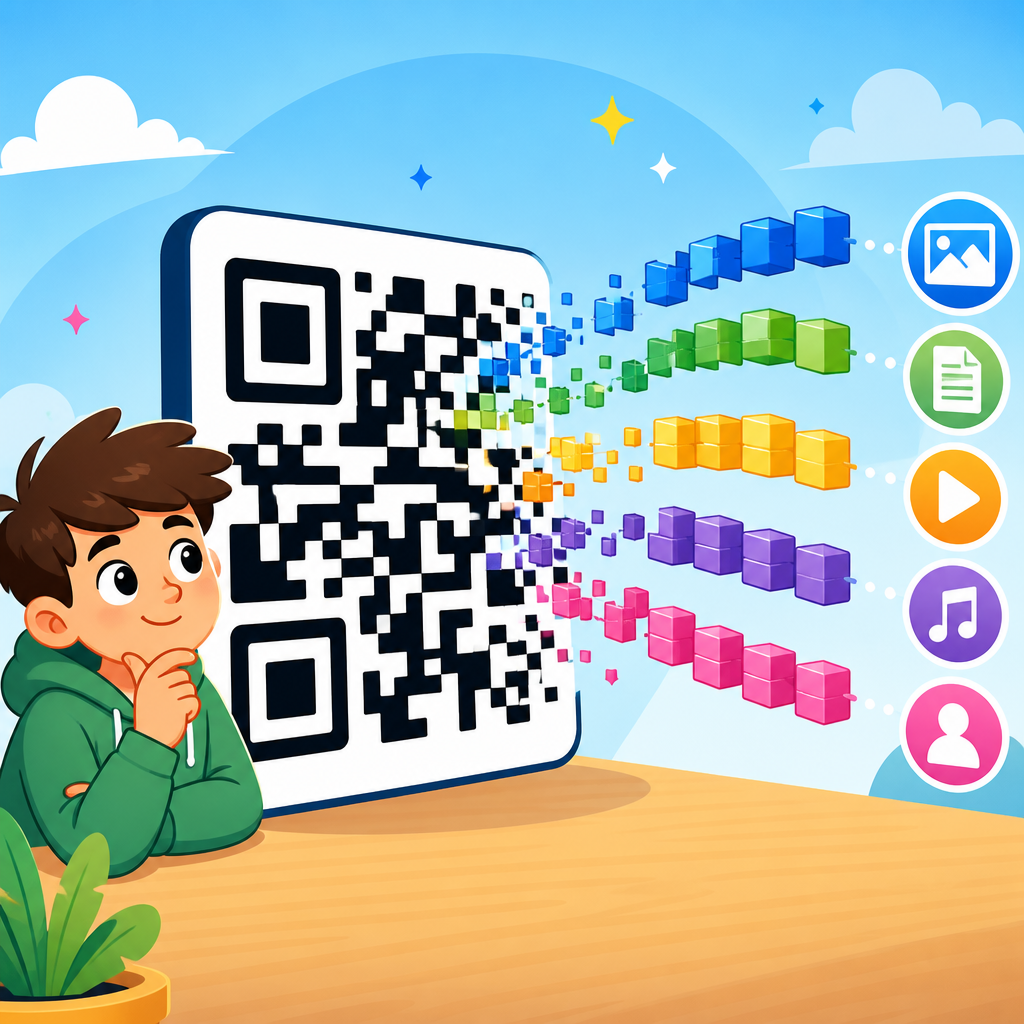
A QR code stores information as codewords, which are eight-bit values placed into the module grid according to a fixed layout. Some codewords carry user data, while others carry error correction data generated from that message. In standard QR codes, the recovery method is Reed-Solomon coding over the finite field GF(256). That matters because Reed-Solomon is designed to correct symbol errors and erasures at the codeword level, making it well suited to two-dimensional marks that may lose chunks of printed area. During decoding, the scanner reads the code, applies perspective and sampling corrections, separates data from function patterns, and then uses syndromes and error locator polynomials to identify codeword inconsistencies. If the number of damaged codewords is within the design limit, the decoder reconstructs the original message exactly.
People often describe QR error correction as allowing 7 percent, 15 percent, 25 percent, or 30 percent damage, but that shorthand needs context. Those percentages correspond to the approximate recovery capability associated with levels L, M, Q, and H, yet they are not a promise that any random 30 percent of a symbol can disappear and still scan. Recovery depends on how the damage is distributed, whether quiet zones remain intact, whether finder and timing patterns are still detectable, and how well the scanner captures contrast. If a coffee stain wipes out one corner, results differ from many tiny specks spread across the symbol. Error correction helps after the code is found and sampled correctly. It cannot compensate for a missing quiet zone, severe blur, or a code so small that the camera never resolves the modules cleanly.
The four QR code error correction levels
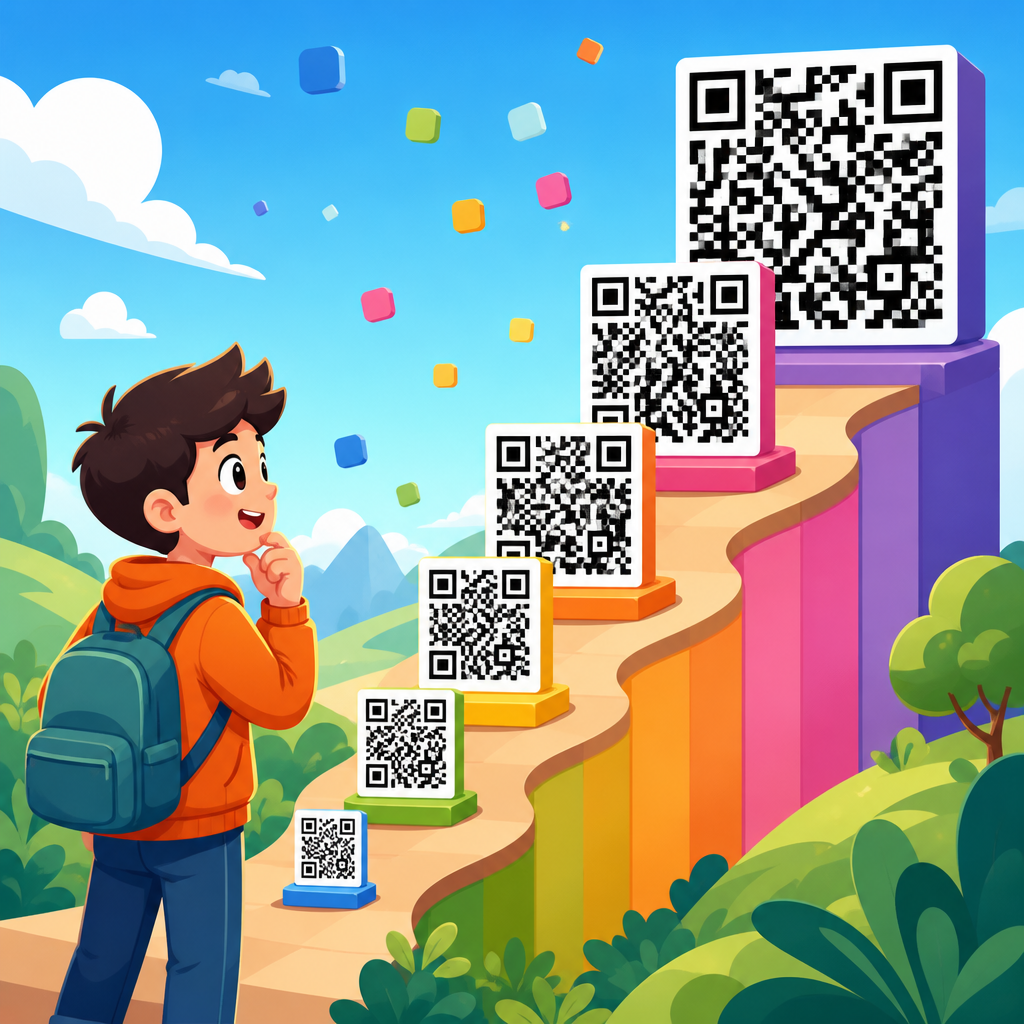
The standard defines four selectable levels. Level L offers the least redundancy and the highest data capacity. Level M is the common default because it balances size and durability for general consumer use. Level Q adds substantial redundancy and is often selected for packaging, outdoor posters, and moderate branding. Level H gives the strongest protection and is the preferred choice when logos cover central modules, when print quality may vary, or when codes face wear. The higher the level, the fewer data codewords remain for the same symbol version. That means a URL that fits comfortably in version 3 at level L may need version 4 or 5 at level H, increasing the printed area and changing scan behavior at distance.
| Level | Approximate recovery capacity | Best use cases | Main tradeoff |
|---|---|---|---|
| L | 7% | Clean digital displays, short-lived promotions, high-capacity payloads | Lowest tolerance for damage |
| M | 15% | General marketing, product labels, most smartphone scanning scenarios | Moderate capacity loss |
| Q | 25% | Branded codes, packaging, semi-harsh environments | Larger symbols or shorter payloads |
| H | 30% | Logo overlays, industrial use, damaged surfaces, long service life | Greatest capacity reduction |
In real projects, level selection should start with the medium and failure cost. If a scan failure means a user gives up on a campaign, M is usually acceptable if the print process is controlled. If a failed scan interrupts inventory movement, field service documentation, or mobile payment, moving to Q or H is usually justified. I have seen teams insist on compact symbols for aesthetic reasons, then spend more money on reprints and support when the codes underperform under fluorescent glare or curved bottle packaging. The better workflow is to choose the shortest possible payload, then assign the error correction level based on environment, then test printed samples with multiple devices. Error correction works best when it is part of an overall readability strategy, not a decorative afterthought.
How Reed-Solomon recovery actually repairs missing data
Reed-Solomon coding adds parity codewords computed from the original message polynomial. In plain terms, the encoder treats the QR payload as a structured sequence of values and generates extra values that let a decoder verify and rebuild the sequence later. QR codes also split data into blocks, and many versions use interleaving. Interleaving spreads adjacent codewords across different regions of the symbol, which is why localized damage does not always destroy one continuous stretch of data. A tear through the middle may affect pieces of several blocks instead of completely erasing one block. That design significantly improves recovery from smudges, scratches, and logos because the burden is distributed across the correction structure.
Decoders first compute syndromes from the received codewords. If all syndromes are zero, the message is presumed intact. If not, the decoder solves for an error locator polynomial, commonly using Berlekamp-Massey or Euclidean algorithms, then finds error positions and magnitudes with Chien search and Forney’s formula or equivalent methods. Most developers never need to implement those steps from scratch because libraries such as ZXing, ZBar, BoofCV, and OpenCV-based toolchains already handle them. However, understanding the process is useful when evaluating scan failures. If a code decodes inconsistently across devices, the issue is often not the mathematics but the image acquisition stage: poor focus, motion blur, overexposure, reflective laminate, or undersized modules feeding bad samples into an otherwise solid correction engine.
Capacity, version size, and why stronger correction makes bigger symbols
Every QR code version defines a fixed module matrix, from version 1 at 21 by 21 modules up to version 40 at 177 by 177. Within that fixed space, higher error correction consumes more codewords, leaving fewer available for actual content. That is why error correction levels directly affect capacity. Numeric mode is most efficient, alphanumeric less so, byte mode more costly, and Kanji mode optimized for specific characters. A long URL in byte mode with tracking parameters can force a surprisingly large symbol, especially at level Q or H. This is one reason many production teams shorten URLs or use redirects: reducing payload length gives more room for robust correction without increasing print size.
The design implication is straightforward. If the symbol cannot grow because packaging space is fixed, increasing the error correction level may require shortening the payload or changing the encoded data structure. Dynamic QR systems help because they encode a short redirect URL instead of a full destination with analytics parameters. In one retail packaging project, shortening a 120-character URL to a branded short link allowed the team to move from level M to level H while keeping the same visual footprint. Scan rates improved on corrugated cartons because the larger effective module size reduced printing noise and gave the decoder more reliable samples. Stronger correction alone did not solve the issue; stronger correction combined with a shorter payload and cleaner modules did.
When to use L, M, Q, or H in real-world deployments
Level L is appropriate when capacity matters more than durability and the code is presented under controlled conditions. Examples include on-screen login tokens, event check-ins inside an app, or temporary internal workflow labels printed by a calibrated office printer. Level M fits most everyday uses: brochures, restaurant menus, product inserts, and shelf talkers. It is often the safest default because many modern smartphone cameras and decoding libraries perform well with clean M-level symbols. Level Q is the practical choice when branding or moderate physical stress enters the picture. If a designer wants a small logo in the center, or if the code goes on a bottle, carton, or outdoor sign, Q provides useful headroom.
Level H should be chosen intentionally, not automatically. It is valuable for direct part marking references, healthcare workflows, warehouse labels, public transit stickers, and branded codes with substantial visual modification. Yet H can backfire if it forces the symbol to become too dense for the printing process. On a low-resolution thermal printer, a larger version with tiny modules may scan worse than a simpler M-level code with thicker, cleaner modules. That is why there is no universal best setting. The best error correction level is the one that survives the actual failure modes of the application while preserving adequate module size, contrast, and quiet zone. In practice, this decision belongs to testing, not assumption.
Branding, logos, and the limits of deliberate damage
Many marketers learn about QR code error correction because they want to place a logo in the center. That is a legitimate use case, but it often leads to overconfidence. A logo overlay removes modules in a concentrated area, and concentrated loss is harder than evenly distributed noise. The finder patterns, alignment patterns, timing patterns, and format information must remain untouched, and the quiet zone must stay clear. Even with level H, a large opaque logo can exceed recoverable limits once printing variation, glare, and camera angle are added. I usually recommend treating the published percentage as a ceiling, then staying comfortably below it. Rounded modules, gradients, and inverted colors further tighten the margin.
A safer branding workflow uses level Q or H, short payloads, high contrast, and logo sizes validated with print tests rather than mockups alone. Tools such as ZXing generators, Segno, qrcodegen, and commercial platforms can output branded symbols, but they do not know your substrate, laminate, viewing distance, or phone mix. A code that scans on a flagship phone in office light may fail on a midrange Android device under store lighting. The most reliable branded QR codes preserve standard structure, use dark-on-light contrast, maintain a four-module quiet zone, and avoid decorative edits near function patterns. Error correction provides room for tasteful customization, not permission to treat the symbol as freeform artwork.
Testing and troubleshooting QR code error correction
Effective testing combines laboratory checks with field conditions. Start by validating the symbol with multiple decoders, including at least one independent library and several common phones. Print at final size on actual material, then test under expected lighting, angle, and distance. Introduce controlled damage: smudges, tape, scratches, partial occlusion, and wrinkles. If failures appear, diagnose systematically. First confirm quiet zone integrity and contrast ratio. Then check module size against printer resolution and expected scan distance. Next review payload length and error correction level. Finally examine environmental effects such as glossy coatings, curved surfaces, or screen moiré. I have found that many supposed error correction problems are really sampling problems caused by tiny modules or reflective finishes.
Verification standards help here. ISO/IEC 15415 is commonly used for two-dimensional code print quality grading, measuring factors such as symbol contrast, modulation, and fixed pattern damage. While consumer campaigns rarely require formal grading, industrial, healthcare, and logistics applications benefit from it because it separates subjective impressions from measurable quality. The practical takeaway is that error correction does not replace print quality control. It complements it. If your QR code must work across thousands of scans, define a target level, keep payloads lean, print above the minimum module size your process can hold, and verify samples before launch. Then document the chosen rationale so future redesigns do not unknowingly remove the safety margin.
Error correction is the engineering feature that makes QR codes resilient enough for real commerce, operations, and mobile experiences. The four levels, L, M, Q, and H, are not abstract settings; they are concrete tradeoffs between capacity and durability shaped by Reed-Solomon coding, block interleaving, module density, and physical conditions. Choose too little correction and ordinary wear breaks the experience. Choose too much without shortening the payload and the symbol may become dense, small, and difficult to print cleanly. The right decision starts with environment, payload length, and failure cost, then continues through prototype testing on real materials with real devices.
For teams building under the broader QR Code Technology and Development topic, this page should be your starting point for every deeper article on error correction levels, branded QR design, payload optimization, print quality, and scanner behavior. If you remember one principle, make it this: error correction improves a valid, well-designed symbol; it does not rescue a poor one. Keep the quiet zone intact, preserve contrast, minimize payload, and select the level that matches the job. Then test before release. If you are planning a new QR deployment, use this framework to review your current symbols and identify where a different error correction level would improve scan reliability today.
Frequently Asked Questions
What does error correction mean in a QR code?
Error correction in a QR code is the built-in recovery system that allows the code to remain scannable even when part of it is damaged, dirty, faded, or blocked. Instead of storing only the raw message, a QR code also stores extra mathematical data called redundant codewords. These codewords do not change the intended content, but they give a scanner enough information to detect where data has been altered or lost and then reconstruct the original message accurately. In practical terms, this is why a QR code on a shipping label can still scan after getting wet, why a printed code can still work with ink imperfections, and why a menu code can remain readable even with light scratching or glare. The process is not random guessing; it is a structured decoding method based on error-correcting algorithms designed specifically to recover missing or corrupted portions of the symbol.
How can a QR code still scan if part of it is scratched, smudged, or covered?
A QR code can still scan under those conditions because the data is distributed across the symbol and protected by error correction. When a scanner reads the pattern, it does not rely on every tiny square being perfect. It first uses the code’s fixed structural elements, such as the position markers and alignment patterns, to understand orientation, size, and grid placement. Then it reads the encoded data along with the redundant error-correction codewords. If some modules are unreadable because of scratches, dirt, low print quality, or partial obstruction, the decoder compares the damaged data against the error-correction information and mathematically rebuilds what is missing. This resilience is one of the key reasons QR codes are so dependable in real-world environments where labels are handled roughly, posters are exposed to weather, and packaging is not always pristine. As long as the damage stays within the recovery limits of the code’s selected error correction level, the original content can usually still be restored and scanned successfully.
What are the different QR code error correction levels?
QR codes use four standard error correction levels: L, M, Q, and H. Each level represents how much damage the code can typically tolerate while remaining readable. Level L offers the least redundancy and can recover roughly 7% of damaged data, making it useful when you want to maximize storage capacity and expect clean scanning conditions. Level M is a common middle-ground choice and can recover about 15%. Level Q increases protection to around 25%, and Level H provides the highest resilience, recovering up to about 30% of damaged data under favorable conditions. The tradeoff is important: higher error correction means more of the QR code’s available space is used for recovery data, leaving less room for the actual message or requiring a denser, larger symbol. That is why the best level depends on use case. A code printed on durable product packaging may not need the highest setting, while a code placed outdoors, on factory labels, or in areas where a logo overlays the design often benefits from stronger error correction.
Does higher error correction always make a QR code better?
Not always. Higher error correction makes a QR code more durable, but it also introduces tradeoffs that matter for performance and design. Because extra redundancy takes up space, a higher protection level can force the QR code to become more complex, with more modules packed into the same area. If the printed size stays small, that extra density can actually make the code harder to scan, especially on lower-quality printers, reflective surfaces, or older phone cameras. In other words, stronger recovery is helpful only if the final code is still large and clear enough to be read reliably. The best QR code is not simply the one with the maximum error correction; it is the one balanced for its environment, print method, content length, and expected wear. For example, a short URL on a large poster can comfortably use a higher setting, while a tiny code on a business card may perform better with a moderate level that keeps the pattern less crowded. Good QR code design is about choosing the right amount of protection, not just the highest amount available.
Why is error correction so important in real-world QR code use?
Error correction is what makes QR codes practical outside ideal laboratory conditions. In the real world, codes are exposed to rain, sunlight, crumpled packaging, printing inconsistencies, camera blur, fingerprints, and partial blockage from tape, folds, or branding elements. Without error correction, even small imperfections could make a code unreadable and unreliable. By embedding recovery data directly into the symbol, QR technology ensures that scanners can still decode the intended message even when conditions are less than perfect. This is especially important in logistics, retail, hospitality, manufacturing, healthcare, and marketing, where failed scans create friction and cost time. A damaged shipping label can delay a package, a poor menu scan can frustrate customers, and an unreadable product code can interrupt inventory workflows. Error correction is the reason QR codes have become trusted for high-volume, everyday use: it gives them the fault tolerance needed to survive normal wear and still deliver fast, accurate scans.