QR codes have become one of the most familiar bridges between physical and digital experiences, yet a new generation of access technologies is now competing for the same role. In this article, “emerging technologies” means tools that can identify, authenticate, locate, or trigger digital content without relying on a standard printed QR matrix, while the “future of QR code technology” refers to how QR codes will evolve as these alternatives mature. I have worked on campaigns, packaging systems, mobile onboarding flows, and retail deployments where QR codes performed well because they were cheap, universal, and easy to print, but I have also seen their limits in poor lighting, damaged labels, weak design integration, and fraud-prone public environments. That tension matters because brands, software teams, manufacturers, and public institutions are all deciding how people will tap into services, verify products, make payments, and receive information over the next decade. If you are building a long-term strategy under the broader QR Code Technology & Development umbrella, this hub article maps the main technologies competing with QR codes, where each one wins, where QR still holds an advantage, and what a practical roadmap looks like.
NFC and contactless tags: the closest direct competitor
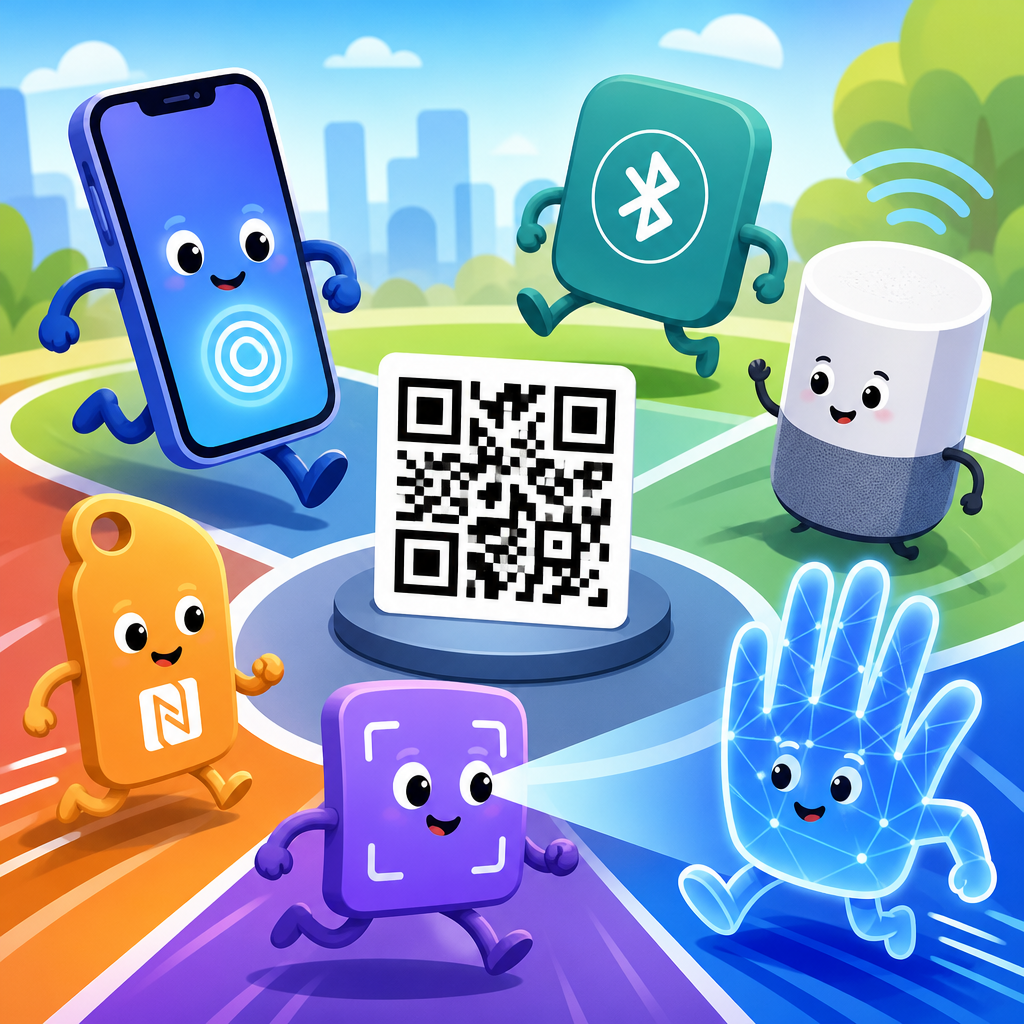
Near Field Communication is the most direct competitor to QR codes because it solves the same problem with less user friction. Instead of opening a camera and aligning a code, a user taps a phone against a tag embedded in packaging, posters, business cards, museum labels, or equipment. Modern smartphones support NFC widely, and Apple and Android devices both enable tap-based actions for payments, app launches, URLs, and automations. In my deployment work, NFC consistently reduced interaction time versus scanning, especially in low-light venues and fast-moving retail environments. A tap is also easier for accessibility in some settings because it avoids visual targeting.
NFC has tradeoffs. Tags cost more than printed QR codes, they require physical components rather than ink, and metal surfaces can interfere unless the tag is designed for that environment. A dynamic QR campaign can be updated through redirect logic after printing, while an NFC tag often needs more careful provisioning and security controls. Still, for premium packaging, loyalty programs, anti-counterfeit workflows, and access control, NFC is often superior. Luxury brands increasingly use encrypted NFC chips to prove authenticity, something a visible QR image cannot do by itself without a secure backend and serialization layer. For the future of QR code technology, NFC is not replacing QR everywhere, but it is taking the highest-value interactions where convenience and trust matter most.
Bluetooth beacons and proximity systems
Bluetooth Low Energy beacons compete with QR codes by removing the need for deliberate scanning altogether. A beacon can trigger location-aware content in an app when a user enters a zone such as an airport gate, stadium section, retail aisle, or hospital wing. This changes the interaction model from “scan to get information” to “arrive and receive context automatically.” Beacons were once overhyped, but in controlled environments they remain useful. Museums use them for exhibit audio. Warehouses use them for asset positioning. Venues use them for wayfinding and queue management.
The limitation is app dependency and permission friction. A QR code works with almost any smartphone camera and does not require an installed app. Beacon systems are stronger when an organization already owns the mobile app relationship and has a reason to request Bluetooth and location permissions. That makes them less universal than QR. They also do not create a visible call to action in the physical world. People can see a QR code and know what to do; a beacon is invisible, so design, signage, and onboarding have to carry the interaction. In future planning, Bluetooth systems are best understood as a companion technology for persistent environments, not a universal public replacement for QR codes.
Computer vision, image recognition, and visual search
Computer vision is one of the most important long-term challengers because it allows almost any object, package, logo, storefront, or product image to become scannable without a printed code. A user points a camera at an item, and image recognition identifies it through a trained model or visual database. Google Lens normalized this behavior by helping users search from images rather than text. Retailers and consumer packaged goods companies are increasingly exploring package recognition, where a camera identifies a specific product SKU and launches ingredient information, promotions, tutorials, or reorder pages.
This approach offers cleaner design because there is no visible code competing with branding. It can also support richer context, such as recognizing a product condition, shelf placement, or surrounding environment. However, image recognition demands strong training data, consistent packaging visuals, and backend systems that can match images reliably under real-world conditions. QR codes still outperform computer vision in speed, certainty, and implementation simplicity. A QR code encodes an exact payload; image recognition infers identity probabilistically. For logistics, payments, and regulated data access, deterministic behavior matters. The likely future is hybrid: visual search for discovery and aesthetics, QR for precise action and fallback reliability.
Ultra-wideband, RFID, and industrial identification
In industrial, healthcare, and supply chain settings, several identification technologies already outperform QR codes for specific use cases. Radio Frequency Identification, especially UHF RFID, is widely used in apparel inventory, warehousing, and asset tracking because many items can be read simultaneously without line of sight. Decathlon, Zara, and other major retailers have used RFID to improve stock visibility and cycle counts. A worker can scan hundreds of tagged items in seconds, something impossible with QR codes one by one. Ultra-wideband adds precise spatial awareness, enabling centimeter-level indoor positioning for tools, carts, medical equipment, and secure access use cases.
These systems are expensive compared with printed QR labels, and they usually require dedicated readers, antennas, or infrastructure. They are not consumer-friendly interaction tools in the way QR codes are. Yet they matter in the future of QR code technology because they absorb the operational use cases once assigned to visible codes: inventory lookup, chain-of-custody tracking, maintenance identification, and equipment status. QR remains common on industrial assets because any phone can read it during field service, but RFID and UWB increasingly handle the machine-readable layer behind the scenes. The strategic lesson is simple: QR dominates at human interaction edges; RFID and UWB dominate where automation and scale outweigh cost.
Digital watermarking and invisible codes
Digital watermarking is a serious contender because it addresses one of the biggest objections to QR codes: visual intrusion. A digital watermark embeds machine-readable information into packaging graphics, video, print, or audio in ways that are often imperceptible to people. Technologies associated with initiatives like Digimarc have been used in retail packaging and checkout experiments, where scanners can identify products from almost any package orientation. This is powerful because the entire package becomes the code, not a small square in one corner.
For consumer engagement, invisible codes can preserve design quality while still supporting scans through specialized software. For recycling and sustainability programs, watermarks can encode packaging composition and sorting instructions at scale. The challenge is ecosystem readiness. Standard camera apps do not universally detect these marks, and many deployments depend on custom software or retailer-specific infrastructure. That adoption barrier is why QR codes remain more practical for mass consumer interaction today. Still, invisible codes may influence the future of QR code technology by pushing it toward more design-friendly integrations, such as branded QR forms, microcodes, and less disruptive placements.
Comparing the main alternatives
The competing technologies differ less by novelty than by fit. The right choice depends on whether the goal is public access, industrial automation, trust, speed, or aesthetics. The table below summarizes the strengths and limitations I most often evaluate when choosing between QR and emerging alternatives.
| Technology | Best use cases | Main advantage over QR codes | Main limitation |
|---|---|---|---|
| NFC | Authentication, premium packaging, access, loyalty | Faster tap interaction and stronger secure chip options | Higher unit cost and hardware dependency |
| Bluetooth beacons | Wayfinding, venue experiences, location-aware apps | Hands-free contextual delivery | Requires app adoption and permissions |
| Computer vision | Visual search, packaging recognition, discovery | No visible code required | Probabilistic matching and backend complexity |
| RFID/UWB | Inventory, asset tracking, industrial operations | Bulk reading and no line-of-sight requirement | Infrastructure cost and weak consumer usability |
| Digital watermarking | Retail scanning, packaging design, recycling systems | Invisible integration into artwork | Limited universal reader support |
Where QR codes still retain a durable advantage
Any realistic discussion of technologies competing with QR codes has to explain why QR remains so resilient. First, the economics are unmatched. A QR code can be generated instantly, printed nearly anywhere, and deployed without embedded hardware. Second, interoperability is exceptional. Native smartphone cameras, payment apps, browsers, messaging tools, and enterprise systems already understand QR workflows. Third, the learning curve is near zero. During the pandemic, billions of people learned to scan menus, forms, health passes, and payment requests. That behavioral adoption created a global installed habit.
QR codes also support static and dynamic implementations. A static code encodes a fixed payload directly, while a dynamic code points to a managed short URL that can be updated, measured, geofenced, A/B tested, or localized after printing. That flexibility gives QR a software advantage many alternatives lack. Security remains a concern because malicious stickers and deceptive redirects exist, but secure domains, branded links, signed payloads, and app-level verification can reduce risk substantially. In practice, QR survives because it is good enough in many situations and excellent in enough of them. Emerging technologies are not defeating QR universally; they are fragmenting the market around specialized strengths.
What the future of QR code technology will actually look like
The future of QR code technology is not disappearance but specialization, layering, and smarter orchestration. I expect five clear developments. First, QR codes will become more deeply tied to identity and trust systems through item-level serialization, secure redirects, and product passport initiatives. Second, design quality will improve as brands use custom styling more carefully while preserving scan reliability. Third, analytics will become more operational, connecting scans to fulfillment, customer support, and physical journey data rather than treating QR as a campaign vanity metric. Fourth, QR will coexist with NFC on high-value items, giving users both scan and tap options. Fifth, AI-driven camera interfaces will blur the line between QR scanning and general visual recognition, making codes one input among many.
Regulation and standards will shape this future. The GS1 transition toward two-dimensional codes in retail is especially significant because it expands what scannable symbols can do at point of sale and across supply chains, including batch numbers, expiry dates, and traceability fields. That evolution strengthens QR-type infrastructure rather than weakening it. At the same time, industries that need stronger anti-counterfeit protection, passive detection, or bulk automation will continue shifting toward chips, radio tags, and invisible markers. The winning strategy for most organizations is not to bet against QR, but to place QR inside a broader interaction architecture.
How to choose the right technology for your use case
If you are deciding between QR codes and competing technologies, start with the environment, the user, and the consequence of failure. In public spaces with unknown users, QR is usually the baseline because no app, account, or hardware beyond a phone camera is required. If the interaction must feel premium, instant, and fraud-resistant, NFC deserves serious consideration. If the goal is warehouse speed, apparel inventory accuracy, or hidden machine-readable tracking, use RFID. If the brand experience cannot tolerate visible codes, test image recognition or watermarking. If users already rely on your app within a defined venue, Bluetooth or ultra-wideband can add passive context.
Build with redundancy where the stakes justify it. The strongest systems I have implemented use QR as a universal fallback, then layer in a better primary interaction for users who have the right device or app state. That approach protects accessibility, lowers support burden, and future-proofs the deployment. The main benefit of understanding emerging technologies competing with QR codes is better decision-making: you stop treating QR as the answer to every problem and start using it where it delivers the best blend of cost, reach, and reliability. Use this hub as your starting point, then map each candidate technology to a real workflow, a measurable outcome, and a clear user moment before you invest.
Frequently Asked Questions
What technologies are emerging as the main competitors to QR codes?
The strongest competitors to QR codes are not all trying to do the exact same job, but they are competing for the same moment of consumer interaction: the point where a person moves from a physical object, place, or product into a digital experience. Near Field Communication (NFC) is one of the most important alternatives because it allows a user to tap a phone on a package, poster, card, or product and instantly launch content without opening a camera app. Bluetooth Low Energy beacons also play a role, especially in retail, events, and indoor environments where proximity-based triggers can push information or activate app experiences automatically. Image recognition and visual search technologies are another major category, enabling a smartphone or app to identify a product, logo, label, or object itself rather than relying on a printed QR pattern.
Other contenders include augmented reality markers and markerless AR, ultra-wideband for precise location-based interactions, RFID in logistics and inventory-linked consumer experiences, digital watermarks embedded invisibly into packaging graphics, and geofencing systems that trigger content based on location. In premium packaging and authentication use cases, serialized IDs, secure chips, and cloud-linked product identity systems are becoming especially relevant. In practice, the competition is not simply about replacing a black-and-white square. It is about which technology delivers the best combination of convenience, reliability, cost, security, analytics, brand integration, and user trust. From campaign work and packaging deployments, one of the biggest lessons is that no single technology wins across every environment. The real market shift is toward a layered ecosystem where QR codes remain common, but brands increasingly evaluate whether tap, scan, detect, or proximity-based interactions create less friction and stronger engagement.
Why are brands and product teams looking beyond QR codes if QR codes are already so widely adopted?
QR codes succeeded because they are inexpensive, familiar, easy to generate, and compatible with nearly every smartphone. That said, widespread adoption does not eliminate their limitations. In many real-world deployments, teams run into issues around visual aesthetics, scan friction, environmental conditions, and misuse. A printed QR code takes up design space, can disrupt premium branding, and sometimes feels visually generic or overly promotional. The user must usually notice it, understand what it does, open a camera, aim correctly, and trust the destination enough to interact. If the code is damaged, poorly printed, placed on curved or reflective surfaces, or shown in low light, performance can suffer. In packaging and retail environments, these small frictions can meaningfully reduce engagement rates.
Brands are also looking beyond QR codes because newer technologies can solve more specialized business goals. NFC may feel more seamless for premium products, membership cards, smart packaging, and authentication. Image recognition can preserve package aesthetics by eliminating the need for a visible code. Digital watermarks can embed machine-readable functionality into the existing artwork. BLE, ultra-wideband, and geolocation tools can support context-aware interactions that a static QR code cannot provide on its own. Security is another factor. Although QR codes can be used securely, they are easy to copy visually, which is a concern in anti-counterfeit programs, ticketing, and identity-sensitive applications. The interest in alternatives is not always an indictment of QR codes; more often it reflects a maturing market. Once teams gain experience running campaigns, packaging systems, and omnichannel activations, they start optimizing for elegance, trust, personalization, and data quality rather than basic functionality alone.
Will NFC, digital watermarks, or image recognition replace QR codes completely?
In most industries, a complete replacement is unlikely in the near term. QR codes retain several structural advantages that are difficult for competing technologies to match all at once. They are cheap to print, simple to deploy, open-standard in practice, broadly recognizable to consumers, and usable without requiring a dedicated app in many cases. That combination matters. Even when an alternative offers a smoother experience under ideal conditions, the operational realities of scale often favor QR codes. For example, NFC chips add material and encoding costs, image recognition may depend on app integration or training data, and digital watermarks may require changes in printing workflows, scanning software, and quality control. For high-volume, low-margin packaging, those differences are significant.
What is more likely is a coexistence model. QR codes will remain the universal fallback and the most accessible default, while alternatives will grow in specific use cases where they offer a clear advantage. A luxury product might use NFC for authentication and concierge content, while still including a QR code for broad accessibility. A retailer might use image recognition inside its app for loyalty features and product discovery, while relying on QR codes in out-of-home media because they work across devices instantly. In this sense, the future of QR code technology is not extinction but adaptation. QR codes may become more dynamic, more branded, more secure, and more tightly connected to identity, traceability, and personalization systems. The better question is not which technology will eliminate the others, but which combination gives users the least friction and gives organizations the best control, analytics, and resilience.
How do these competing technologies compare in terms of user experience, cost, and implementation complexity?
User experience varies dramatically by context. NFC often provides the smoothest interaction because a simple tap can feel faster and more intuitive than scanning, especially on packaging, product labels, access cards, and in-store displays. Image recognition can also feel elegant because users interact with the product or visual itself instead of a separate code, but it often works best when supported by a brand app or a strong computer-vision experience. QR codes remain highly effective because consumers already understand them and modern smartphone cameras detect them quickly. BLE beacons and geolocation can reduce effort even further by enabling passive or proximity-based experiences, but they may require app permissions and can raise privacy expectations that need careful handling.
On cost and complexity, QR codes are still the most efficient entry point for many teams. They can be generated and printed at minimal expense, and dynamic QR management platforms are mature. NFC typically involves hardware costs, chip sourcing, encoding steps, testing across devices, and manufacturing integration. Digital watermarks can require print-production precision and compatible reading systems. Image recognition requires software development, training, support for edge cases, and often tighter ecosystem control. BLE beacon deployments add battery maintenance, placement planning, signal tuning, and app-layer coordination. Ultra-wideband and advanced authentication systems can deliver powerful functionality, but they are usually justified only when precision, security, or premium experience is critical.
Implementation complexity also includes governance. Teams must ask who owns the destination content, how analytics are collected, how links are updated, how failures are handled, and whether the interaction works offline, across operating systems, and across geographies. In hands-on campaign and packaging programs, the most successful deployments usually start with a very clear business objective. If the goal is broad reach at low cost, QR is still difficult to beat. If the goal is product authentication, premium interaction, hidden machine readability, or app-centric engagement, a competing technology may justify the extra investment. The smartest comparison is never abstract; it is tied to the environment, audience behavior, production constraints, and the lifetime value of the interaction.
What does the future of QR code technology look like as these alternatives mature?
The future of QR code technology is likely to be shaped by specialization, stronger security layers, and better integration into connected product ecosystems. Rather than remaining simple destination links, QR codes are increasingly being used as gateways into serialized product identity, supply-chain traceability, consumer engagement, post-purchase support, and circularity initiatives such as reuse, recycling, and digital product passports. As emerging technologies mature, QR codes will need to compete less on novelty and more on intelligence. That means more dynamic redirection, more contextual content, more first-party data integration, and more sophisticated measurement. In practical terms, the QR code of the future may look familiar on the surface while functioning as part of a much deeper infrastructure underneath.
Security and trust will also become more important. Expect continued development around signed URLs, anti-tamper workflows, authentication layers, and systems that link a visible code to cloud-based records, serialization, or secure packaging features. At the same time, design quality will improve. Brands increasingly want codes that fit within premium packaging rather than looking like afterthoughts, so visually integrated and branded QR implementations will continue to evolve. Another major trend is interoperability with competing technologies. The most resilient systems will not force an all-or-nothing choice. A package might combine QR for universal access, NFC for premium tap experiences, and invisible identifiers for internal automation or anti-counterfeit verification.
From a market perspective, QR codes are moving from being a standalone gimmick to being one interface among many in a connected physical-digital stack. That is an important distinction. The technologies competing with QR codes are pushing the standard to become more secure, more contextual, and more strategically deployed. As a result, the future is not a simple battle of winners and losers. It is a broader transition toward multimodal access, where QR codes remain highly relevant because of their ubiquity, but are expected to work alongside tap-based, vision-based, location-aware, and identity-driven systems that each solve different parts of the customer journey.