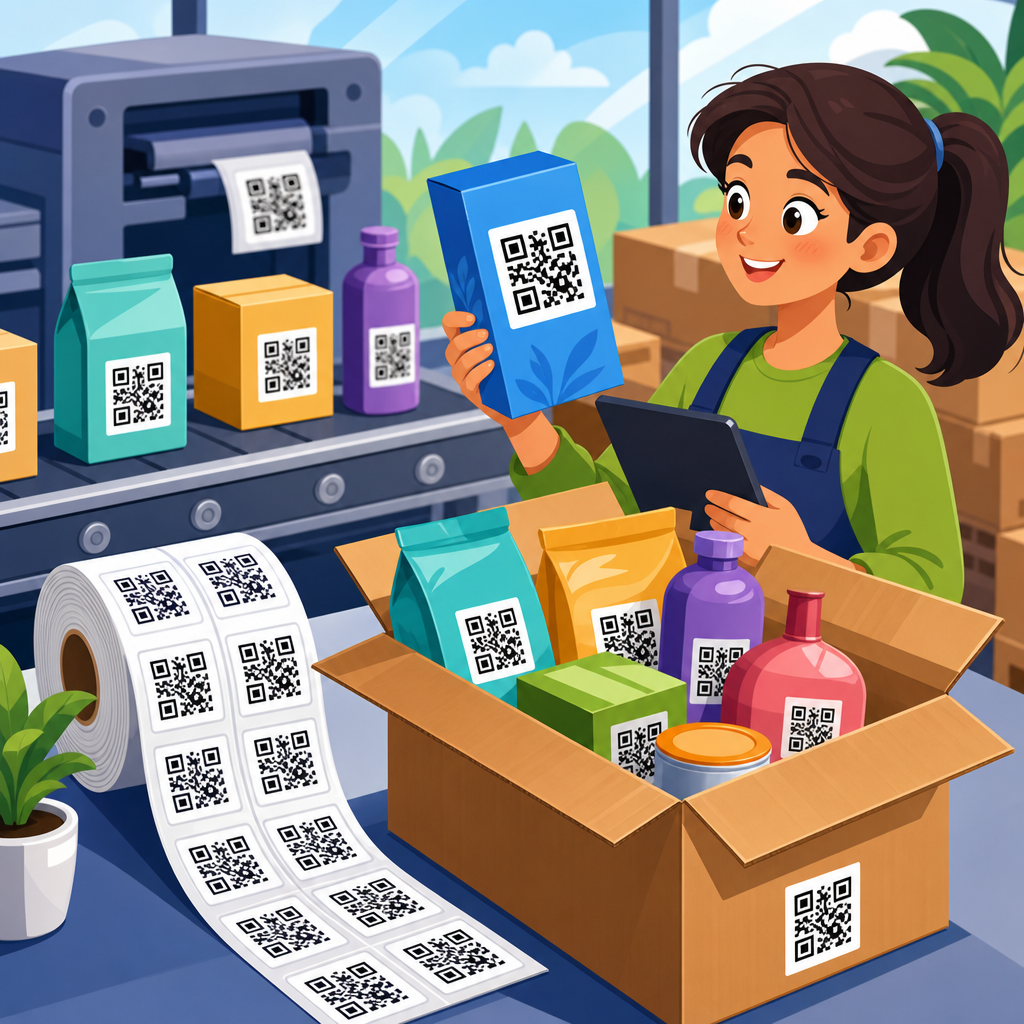
Bulk QR code automation strategies determine whether a team can produce ten codes in an afternoon or manage fifty thousand with consistent branding, accurate tracking, and reliable scans across packaging, print, retail, and operations. Bulk QR code creation means generating many QR codes at once from structured data such as URLs, serial numbers, vCard records, PDF links, Wi-Fi credentials, coupons, or inventory IDs, usually through spreadsheets, APIs, databases, or no-code workflows. I have implemented bulk campaigns for product labels, event badges, restaurant menus, direct mail, and warehouse assets, and the pattern is always the same: the hard part is not making the image files, but designing the data model, automation logic, and governance that keep every code useful after deployment. This matters because QR codes now sit at the junction of physical and digital customer journeys. A broken destination, duplicate identifier, weak print spec, or missing analytics parameter can undermine an entire campaign. A strong bulk QR process reduces manual work, prevents expensive reprints, supports personalization at scale, and gives marketers and operations teams a dependable way to connect each scan to a specific item, audience, or action.
Build the right bulk QR code system before generating anything
The most effective bulk QR code automation starts with architecture, not software selection. First, define whether you need static or dynamic QR codes. Static codes embed the final destination directly in the symbol and are useful for permanent information such as Wi-Fi credentials or plain text. Dynamic codes point to a short redirect URL that can be edited later, making them the standard choice for campaigns, product packaging, and any use case that may require destination changes or scan analytics. In practice, I recommend dynamic QR codes for most business workflows because they protect you from reprints when a landing page changes, and they support segmentation by item, location, or batch.
Next, establish your source of truth. For simple projects, that may be a CSV exported from Google Sheets or Excel. At larger scale, it is usually a CRM, PIM, DAM, ERP, ticketing system, or e-commerce catalog. Every record should have a stable primary key, a destination or payload field, ownership metadata, and status fields such as drafted, approved, generated, printed, and retired. If you skip this schema work, your bulk QR code creation pipeline becomes brittle immediately. Duplicate records, malformed URLs, and missing UTM parameters are common failure points. Validation rules should check URL formatting, enforce naming conventions, and ensure that campaign identifiers, language codes, and product SKUs match approved values. This is routine data hygiene, but it has a direct impact on scan reliability and reporting quality.
Automation also depends on output requirements. Decide early whether you need PNG, SVG, EPS, or PDF. For digital placements, PNG may be enough. For print, vector outputs such as SVG or EPS are safer because they scale cleanly. You also need standards for quiet zone, error correction level, minimum size, foreground and background contrast, and logo treatment. ISO/IEC 18004 defines the QR code symbology, but successful deployment still depends on practical print and display conditions. In my projects, I use conservative defaults: high contrast, adequate white space, and testing on mid-range Android and iPhone devices before release. Fancy styling is acceptable only after readability is proven under real conditions such as glossy labels, curved bottles, dim retail aisles, or low-quality office printers.
Choose an automation method that matches volume, complexity, and team skills
There is no single best method for bulk QR code creation; the right option depends on scale and operational maturity. Small teams often start with spreadsheet import features inside QR code generators such as QR Code Generator Pro, Beaconstac, QR TIGER, Scanova, or Flowcode. These tools let you upload rows of data and receive a batch of dynamic or static codes with templates for file naming and campaign tagging. They are fast to deploy and suitable for marketing teams that need control without engineering support. Their limitation is process depth. Once you need custom validation, approval logic, webhooks, or integration with multiple systems, spreadsheet-only workflows begin to strain.
APIs are the next step. With an API-driven workflow, your application or script creates codes automatically whenever a record enters a qualified state. For example, a Shopify app can generate a unique dynamic QR code for every product insert, or a ticketing platform can issue individualized admission codes linked to attendee records. APIs also make it easier to enforce naming rules, append analytics parameters, and store the returned image URL or redirect identifier back into your system. This architecture is more reliable than repeated manual exports because it removes handoffs. If your organization already uses Zapier, Make, Airtable, HubSpot, or Salesforce, no-code and low-code automations can bridge the gap between simple batch uploads and full custom development.
The following comparison helps teams choose a realistic path.
| Method | Best for | Strengths | Limitations |
|---|---|---|---|
| Spreadsheet import | Small campaigns, fast setup | Low technical effort, quick batch generation, easy for marketers | Manual QA, weaker integrations, harder version control |
| No-code automation | Growing teams with mixed tools | Connects forms, sheets, CRM, email, and storage | Can become fragile at high volume, limited custom logic |
| API workflow | High volume, recurring generation | Scalable, consistent, auditable, easy to integrate with databases | Requires development resources and monitoring |
| In-house generator library | Strict compliance or specialized payloads | Maximum control over rendering and data handling | Higher maintenance, no built-in dashboard or redirects |
In practice, many organizations use a hybrid model. Marketing owns campaign setup inside a dashboard, engineering maintains the API integration, and design controls output templates. That division works because each function handles the part it knows best while the automation layer keeps the data synchronized.
Standardize data, naming, and templates to avoid expensive errors
Bulk QR code automation fails most often because of inconsistent inputs. A robust naming convention should identify channel, campaign, market, asset type, version, and sequence number. For example, retail_summer24_us_shelf-talker_v2_00451 is much more useful than qr-final-new. Consistent names support search, reprints, archive cleanup, and traceability when a code is reported as broken. I also recommend a canonical folder and tagging structure in cloud storage or DAM software so teams can retrieve master files without recreating assets.
Template discipline matters just as much. If every campaign uses a different redirect path, UTM format, logo lockup, and color treatment, analytics become noisy and scan performance becomes unpredictable. Establish approved templates for common use cases: product packaging, event signage, menu cards, invoices, manuals, and direct mail. Each template should specify the encoded data type, default error correction, minimum print size, bleed guidance, and destination parameter rules. For example, a direct mail template may require source=dm, medium=print, campaign code, household ID, and creative version. A warehouse asset template may require asset ID, facility code, and service portal destination. Templates reduce cognitive load and make automation repeatable.
Version control is another overlooked area. When destinations change, teams need to know whether a QR code is safe to update in place or whether a new code must be issued. Dynamic codes usually support updates without replacing the printed symbol, but not every change should be silent. If a new landing page changes legal terms, language, offer eligibility, or user expectations, record that change and trigger approval. This is especially important in regulated sectors such as healthcare, finance, alcohol, and consumer products, where packaging claims and linked content may fall under compliance review.
Design for scan reliability, print production, and real-world use
A QR code that works on a designer’s monitor can still fail in the field. Scan reliability depends on symbol size, contrast, surrounding space, surface material, placement, and camera quality. For printed pieces viewed at arm’s length, I typically start around 0.8 by 0.8 inches for simple URLs and scale upward for longer payloads, curved packaging, or low-light environments. Dynamic QR codes often produce less dense symbols because they encode shorter redirect URLs, which is one reason they scan more reliably in constrained spaces. Avoid reversing a QR code to light-on-dark unless contrast has been tested thoroughly. Metallic inks, embossing, lamination glare, and cluttered backgrounds often reduce readability.
Testing must be systematic. Before approving a batch, sample across the shortest and longest payloads, every template variant, and every intended production method. Print samples on the actual substrate if possible: corrugated board, thermal labels, coated cartons, fabric tags, acrylic signs, or vinyl decals. Then test with multiple devices, distances, and lighting conditions. In warehouses, damaged labels and angled scans matter. In restaurants, steam, grease, and low ambient light matter. In public transit or outdoor posters, motion and glare matter. Good bulk QR code creation is not finished when files export; it is finished when representative users can scan quickly and reach the right destination without friction.
File delivery should align with production workflows. Printers may require vector art with bleed-safe placement, while e-commerce teams may need transparent PNG files for digital overlays. If serializing packaging, ensure the file naming convention maps directly to print imposition or variable data printing software. Adobe InDesign, Illustrator, Bartender, NiceLabel, and variable data print platforms can ingest QR assets or generate them on the fly, but they still depend on clean data mapping. A one-character mismatch between SKU and artwork record can place the wrong code on thousands of units.
Track performance, secure redirects, and govern the lifecycle
The business value of bulk QR code automation comes from measurement and control. Every dynamic QR deployment should answer basic questions: which item was scanned, where, when, and what happened next? Redirect platforms and analytics tools can capture scan counts, timestamps, device type, approximate location, and destination conversions when paired with campaign parameters and web analytics. Google Analytics 4, Adobe Analytics, and server-side logging can all support this. The key is consistent attribution. If one business unit uses UTMs and another uses custom query strings, cross-campaign analysis becomes messy. Define a single tagging taxonomy and enforce it inside the generation workflow.
Security and governance deserve equal attention. Redirect domains should use HTTPS, be owned by your organization or a trusted vendor, and be monitored for uptime. Access controls should limit who can edit destinations, pause codes, or export full code inventories. I have seen expired third-party accounts break live QR campaigns because no one documented ownership. Treat QR infrastructure as production infrastructure. Maintain backups of metadata, export redirect mappings regularly, and set alerts for destination failures or sudden scan anomalies. If personalized data is involved, avoid encoding sensitive information directly into static symbols. Use tokenized identifiers and resolve them securely server-side. This is essential for privacy compliance and for reducing exposure if a code image is copied publicly.
Lifecycle management is the final discipline. Not every code should live forever. Define retention rules for retired campaigns, expired offers, discontinued products, and obsolete documentation. A graceful fallback page is better than a dead link; it can explain that an offer ended, point to current resources, or route users to support. For physical assets with long shelf life, create review schedules so destinations remain relevant. This is where hub planning helps. A central bulk QR code creation page should connect related guidance on dynamic versus static QR codes, QR code design best practices, print sizing, analytics setup, API integrations, QR codes for packaging, variable data printing, and QR code security. That internal structure helps teams find the right implementation detail without reinventing standards for each project.
Bulk QR code automation strategies work when they treat QR generation as a managed system rather than a graphic export task. The core principles are straightforward: choose dynamic or static codes intentionally, create a clean source of truth, automate through spreadsheets, no-code tools, APIs, or in-house libraries according to your scale, and standardize naming, templates, and analytics so every code remains traceable. Then validate the outputs in real production conditions, not just on a screen, and protect the redirect and reporting layer with proper governance. When these disciplines are in place, bulk QR code creation becomes faster, cheaper, and far less error-prone, whether you are labeling warehouse assets or launching a nationwide packaging program.
As a hub under QR Code Creation and Tools, this topic should guide readers toward deeper implementation articles while giving them a complete operating model they can use immediately. The main benefit is not simply making more QR codes; it is building a repeatable process that connects physical items to accurate digital experiences at scale. Review your current workflow, document your data fields, test your templates, and automate the next batch with controls built in from the start.
Frequently Asked Questions
What is the most effective way to automate bulk QR code creation at scale?
The most effective approach is to build a repeatable pipeline around structured source data, a clear naming convention, and a generation method that fits your volume. In practice, that usually means storing each QR code record in a spreadsheet, database, CRM, ERP, or product information system, then generating codes through an API, batch generator, or no-code automation platform. Each row or record should contain the destination payload, a unique identifier, campaign or product metadata, output file requirements, and any branding rules needed for production. That structure makes it possible to generate ten codes or fifty thousand without changing the underlying process.
For larger operations, automation works best when generation is separated into stages: data validation, QR code creation, asset export, quality checks, and distribution to print or digital teams. Validation should confirm that links resolve correctly, serial numbers are unique, required fields are populated, and formatting is standardized before any QR image is produced. Generation can then create static or dynamic QR codes in the correct size, format, and error correction level. Export automation should organize files into predictable folders or send them directly to downstream systems. Finally, a quality-control layer should verify scanability, branding consistency, and record-to-code matching so the wrong code never appears on the wrong package, flyer, shelf tag, or operational document.
At scale, the winning strategy is not just “make many QR codes quickly,” but “make many QR codes reliably.” Teams that automate successfully treat QR generation like a production workflow, not a one-off design task. That means using templates, enforcing data rules, logging every batch, and making sure the system can support updates, reprints, and tracking over time. When those pieces are in place, bulk QR code automation becomes predictable, fast, and much less prone to expensive mistakes.
Should I use static or dynamic QR codes for bulk campaigns and operational workflows?
In most bulk environments, dynamic QR codes are the better long-term choice because they allow you to change the destination without reprinting the code itself. That flexibility is extremely valuable across packaging, retail, field operations, events, and multi-location campaigns. If a landing page changes, a PDF is replaced, a coupon expires, or a product support link needs to be updated, you can edit the destination behind the QR code rather than regenerate and redistribute thousands of printed assets. Dynamic codes also support centralized tracking, which makes them more useful for performance measurement and operational visibility.
Static QR codes still have a place, especially when the payload must be stored directly in the code and remain independent of any redirect service. Examples include plain text, Wi-Fi credentials, some vCard use cases, fixed inventory references, or environments where internet-based redirection is unnecessary or undesirable. Static codes can also be simpler and cheaper in some situations because they do not rely on a management platform to remain functional. However, once a static code is printed and distributed, its content is locked in. If there is an error in the URL, a product ID, or a contact record, the only fix is to replace the code everywhere it appears.
The right decision usually comes down to how often destinations may change, how important analytics are, and how much risk the organization can tolerate. For marketing, customer engagement, documentation, and any campaign requiring measurable scans, dynamic QR codes are typically the stronger option. For internal workflows with fixed data and low change frequency, static codes may be perfectly adequate. Many organizations end up using both: dynamic for customer-facing assets and static for simple, stable operational use cases.
How can I maintain consistent branding across thousands of QR codes without hurting scan reliability?
Consistent branding starts with a controlled design system rather than ad hoc customization. In a bulk QR code workflow, teams should define a small set of approved templates that specify colors, logo treatment, quiet zone spacing, file dimensions, error correction settings, and acceptable output formats. This ensures every code aligns with brand guidelines while remaining technically scannable. Instead of redesigning each QR code individually, automation should apply the same template logic across all records in a batch, whether the codes are going onto product packaging, retail signage, brochures, labels, or warehouse materials.
The key is understanding where branding helps and where it can cause problems. High contrast remains essential, so dark modules on a light background are still the safest choice. Logos can be embedded, but they should be sized conservatively and supported by an appropriate error correction level. Decorative frame elements and branded calls to action can improve response rates, but they should not crowd the quiet zone or distort the code pattern. Overly aggressive customization, especially low-contrast colors, gradient-heavy fills, or busy backgrounds, can reduce scan success in real-world conditions such as glare, curved packaging, poor lighting, and lower-end smartphone cameras.
To protect reliability, teams should test branded QR templates before deploying them broadly. That means scanning on multiple device types, from different distances, at different print sizes, and on the actual materials being used. A code that scans perfectly on a desktop proof may fail on corrugated packaging, glossy labels, or small shelf tags. The safest strategy is to automate from pre-approved templates, standardize output specs, and run periodic scan testing as part of production QA. That gives you strong visual consistency without sacrificing usability.
What data and quality-control checks should be included in a bulk QR code automation workflow?
A strong bulk QR code workflow should validate both the source data and the generated output. On the data side, every record should be checked for completeness, formatting consistency, duplicate entries, and payload accuracy. URLs should be validated for proper syntax and tested for successful resolution. Product IDs, serial numbers, coupon codes, and inventory references should be verified against the source system to prevent mismatches. If the workflow uses dynamic QR codes, redirect destinations and tagging parameters should also be confirmed before generation begins. These checks matter because even a tiny error rate becomes expensive when multiplied across thousands of labels, packages, or printed inserts.
On the output side, quality control should confirm that each generated QR code maps to the correct underlying record, uses the correct branding template, exports in the right file type, and meets minimum scanability standards. It is good practice to sample-scan generated codes automatically where possible, and manually test representative examples from each batch. The workflow should also verify quiet zone integrity, image resolution, dimensions, and naming conventions so files are production-ready. If the codes are going into print, preflight checks should ensure nothing in the layout software is resizing, clipping, or recoloring the QR asset in a way that could affect readability.
Just as important is traceability. Every bulk run should produce a log showing when the batch was created, which source file or database snapshot was used, who approved it, what template was applied, and where the outputs were delivered. That audit trail helps with troubleshooting, reprints, compliance needs, and performance analysis. The most mature teams do not rely on visual spot-checking alone; they build validation directly into the process so errors are caught before the codes ever reach customers, stores, or operations teams.
How do I track performance and measure ROI for bulk QR code deployments?
Tracking performance starts with deciding what success means for each use case. In marketing, that might be scan volume, unique users, conversion rate, revenue, or assisted sales. In retail, it may be engagement by store, region, or product line. In operations, performance could mean reduced lookup time, faster asset retrieval, improved inventory accuracy, or fewer support requests. Once those goals are defined, each QR code or group of codes should be tied to identifiers such as campaign, SKU, location, channel, batch, or employee process so scan activity can be attributed meaningfully rather than collected as generic traffic.
Dynamic QR codes are especially useful here because they allow scan analytics to be connected to broader reporting systems. Teams can use unique redirects, UTM parameters, campaign tags, or API-based event exports to connect scans with web analytics, CRM records, support platforms, or BI dashboards. That makes it possible to compare performance by packaging type, print placement, market, distributor, or time period. For example, a retailer might learn that shelf talkers generate more scans than product packaging, or that in-store support QR codes reduce service desk demand. Those insights help justify future investment and improve deployment strategy.
ROI should be measured in both direct and indirect terms. Direct value may come from conversions, lead generation, coupon redemption, or upsells tied to scans. Indirect value often includes fewer printing errors, faster updates through dynamic redirects, less manual work in code generation, and better consistency across high-volume programs. A well-automated bulk QR system reduces labor, speeds deployment, and lowers the risk of costly reprints. When performance data is paired with production efficiency metrics, organizations get a clearer picture of the full business impact, not just the number of scans.