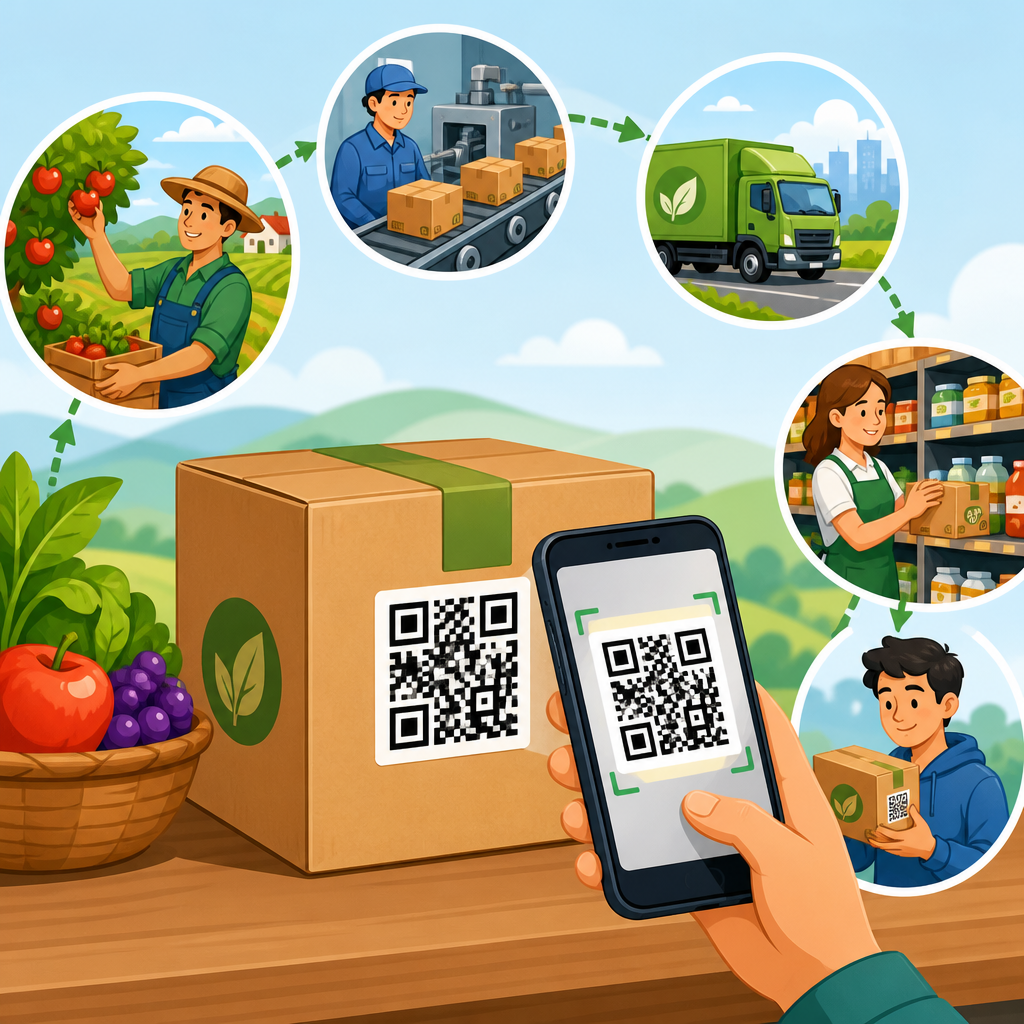
QR codes for product traceability give manufacturers and logistics teams a fast, low-cost way to identify items, capture movement data, and verify history from raw material intake to final delivery. In practical terms, product traceability means maintaining a reliable record of where a product came from, what happened to it during production, which batches or serial numbers are associated with it, and where it went after it left the facility. In manufacturing and logistics, that chain of evidence matters for quality control, recalls, warranty support, compliance, inventory accuracy, and customer trust. I have implemented QR-based tracking in plants and distribution operations, and the consistent lesson is simple: traceability improves when identification is easy for people to scan, systems can exchange data cleanly, and every handoff creates a usable digital event.
A QR code is a two-dimensional barcode that stores data in a compact, scannable format. Unlike a traditional one-dimensional barcode, it can hold more information and still scan reliably even when printed small or partially damaged, thanks to built-in error correction. For traceability programs, the code usually contains a unique product identifier, batch number, lot number, serial number, shipment reference, or a secure URL that points to a live record in a manufacturing execution system, warehouse management system, enterprise resource planning platform, or cloud database. The code itself is not the entire traceability strategy. It is the bridge between a physical item and a structured digital record that can be updated, searched, audited, and shared across departments and partners.
This matters because modern supply chains are under pressure from every direction. Regulators expect auditable records. Customers want proof of origin, sustainability, and authenticity. Operations teams need faster root-cause analysis when defects appear. Logistics leaders need better visibility into inventory, exceptions, and dwell time. A missed scan or an unreadable label can break that chain, which is why QR codes are increasingly used on unit packs, cartons, pallets, bins, work orders, and shipping documents. When deployed well, they reduce manual entry, support real-time visibility, and shorten the time required to isolate affected products during a recall. For manufacturing and logistics organizations building a scalable identification strategy, QR codes are no longer a nice extra; they are becoming standard infrastructure.
How QR codes support end-to-end traceability in manufacturing
In manufacturing, traceability starts earlier than many teams expect. It begins when incoming materials arrive with supplier identifiers, lot numbers, certificates of analysis, and receiving timestamps. A QR code can link each material batch to supplier data, inspection results, storage location, and expiration date. Once that material is issued to a production order, the traceability chain extends through work centers, machine settings, operator actions, process checkpoints, and final packaging. If a plant runs discrete manufacturing, each serialized part can carry its own identity. If it runs process manufacturing, QR codes can connect finished goods to the lots and ingredients used in the batch. The result is a searchable genealogy record that shows parent-child relationships between materials, subassemblies, and final products.
The strongest implementations do not rely on standalone scanning alone. They connect the QR event to core systems such as SAP, Oracle NetSuite, Microsoft Dynamics 365, Ignition, Plex, or a specialized MES or QMS platform. For example, a medical device manufacturer may scan component reels at kitting, scan assemblies at each test station, and generate a final QR code at packaging that carries the device serial number and device history reference. If a field failure occurs, quality engineers can review exactly which component lots, test results, and operators were associated with that unit. In an automotive environment, a QR code on a subassembly can tie torque records, station completions, and rework history to a VIN-linked genealogy. The code is the visible access point; the value comes from the event architecture behind it.
QR codes also improve shop-floor usability. Operators often struggle with long alphanumeric part numbers and manual transaction screens. A scan can trigger the correct work instruction, confirm line clearance, record consumption, and reduce picking errors. I have seen plants cut receiving and production reporting mistakes significantly simply by replacing clipboard entry with scan-based validation at the point of activity. That matters because traceability breaks down when data capture is delayed or pushed to the end of a shift. Real-time scanning creates cleaner records, and cleaner records create better quality decisions.
QR codes in logistics, warehousing, and distribution
In logistics, traceability depends on knowing not just what an item is, but where it is, when it moved, and under whose custody it traveled. QR codes are effective here because they can be printed on labels for cases, pallets, returnable transport items, racks, totes, and shipment paperwork. In a warehouse, a scan can record receiving, put-away, cycle counting, picking, packing, staging, loading, and proof of dispatch. During transportation, a QR code can support handoff confirmation between carrier, cross-dock, regional hub, and final delivery point. If the code resolves to a cloud record, external partners can access the latest status without exposing the entire internal system.
Distribution teams also use QR codes to improve exception management. If a pallet is short shipped, damaged, temperature-exposed, or delayed at a checkpoint, the scan event can trigger an alert, hold code, or investigation workflow. For cold chain products, the QR code can point to sensor data showing time out of range, helping teams determine whether a product remains usable. For export shipments, it can link customs documents, harmonized tariff data, and packing lists to one scannable label. In omnichannel operations, QR codes simplify returns by connecting an item to the original order, pick wave, and carrier tracking history, which reduces disputes and speeds disposition decisions.
One practical advantage over some legacy labeling methods is flexibility. Because QR codes can encode URLs or structured data strings, businesses can support internal warehouse processes and downstream customer-facing experiences with the same symbol. A distributor can scan the code internally for inventory control while a retailer or installer scans it later for receiving confirmation, installation guidance, or warranty registration. That shared identity layer becomes especially valuable when products pass through multiple legal entities, contract manufacturers, 3PLs, and service providers before reaching the end user.
What data should a traceability QR code contain?
The right data structure depends on the process, the regulatory environment, and the level of granularity required. At minimum, a traceability QR code should resolve to a globally or internally unique identifier. Common fields include SKU, GTIN, lot number, batch number, serial number, manufacturing date, expiration date, supplier code, plant code, line number, and shipment ID. For regulated industries, the code may also need to support standards such as GS1 Digital Link, Application Identifiers, or sector-specific serialization rules. The critical design principle is that the code should identify the item unambiguously, while detailed event history lives in the database rather than being overpacked into the symbol itself.
Teams often ask whether they should use static or dynamic QR codes. For traceability, dynamic implementations usually win because the printed code can point to a managed record that changes over time as new events are added. That supports recalls, status updates, redirected inventory, and customer service without relabeling the item. Static encoding still has a place when offline scanning is required or when systems expect a self-contained identifier. In either case, data governance matters. Naming conventions, master data quality, and role-based access control are just as important as print quality. If duplicate identifiers exist or site codes are inconsistent, no label technology will fix the underlying problem.
| Traceability level | Typical QR payload | Best use case | Main benefit |
|---|---|---|---|
| Batch or lot | Lot ID plus product code | Food, chemicals, process manufacturing | Fast recall targeting |
| Serialized unit | Unique serial or secure URL | Medical devices, electronics, high-value parts | Unit-level history and authenticity checks |
| Case or carton | Case ID linked to contained items | Warehouse picking and outbound shipping | Faster handling and aggregation |
| Pallet or load | SSCC or load reference | Distribution centers and transport | Custody tracking across handoffs |
Choosing among these levels is not just a technical decision. It affects labor, label cost, scanning frequency, storage requirements, and recall precision. A food processor may only need lot-level traceability for low-risk goods, while an aerospace supplier may require serialized tracking for each critical component. The best design balances compliance, operational value, and the total cost of data capture.
Implementation best practices and common mistakes
Successful QR traceability projects usually begin with process mapping, not label printing. Start by identifying critical control points: receiving, inspection, production issue, assembly completion, quality release, packaging, staging, shipment, receipt at destination, and returns. Then define what event must be captured at each step, who performs the scan, which device they use, and what system record should update. This approach prevents a common mistake: placing QR codes everywhere without deciding what operational decision each scan should support. If a scan does not trigger validation, status change, or usable visibility, it becomes noise.
Print quality and label durability are equally important. Manufacturing environments expose labels to heat, oil, abrasion, solvents, condensation, UV light, and repeated handling. Logistics environments add stretch wrap, forklift damage, and outdoor exposure. Use the right label stock, adhesive, quiet zone, contrast ratio, and module size for the surface and scanning distance. Verification against ISO/IEC barcode quality guidelines is worth the effort, especially when suppliers print labels for inbound materials. I have seen traceability projects stumble because excellent software was paired with labels that degraded after one wash cycle or became unreadable on curved metal parts.
Device strategy also matters. Smartphone scanning is convenient for supervisors, field teams, and low-volume workflows, but rugged handheld scanners, fixed-mount readers, and machine vision systems are often better for high-throughput operations. In automated lines, cameras can inspect the code, verify print quality, and log the read without human intervention. In warehouses, wearable scanners can reduce motion and improve pick speed. The right hardware depends on throughput, ergonomics, and integration needs.
Another frequent mistake is failing to plan for exceptions. Labels get damaged. Products are repacked. Lots are split and recombined. Contract manufacturers use different schemas. Carriers miss scans. A robust design includes reprint controls, parent-child aggregation logic, exception queues, audit trails, and fallback procedures for offline operations. Security deserves attention as well. If customers or partners can scan the same code, use tokenized URLs, authentication rules, or separate public and internal data layers to prevent unauthorized access to production details or customer information.
Industry applications across manufacturing and logistics
Different sectors use QR codes for product traceability in distinct ways. Food and beverage companies rely on them for ingredient lot tracking, allergen control, and targeted recalls. If a spice lot fails a test, the manufacturer can identify which finished batches consumed that lot and which distributors received them. Pharmaceutical and medical device companies use serialized identification to support chain of custody, anti-counterfeiting, complaint investigation, and post-market surveillance. Electronics manufacturers connect QR codes to component genealogy and test data because a single defective capacitor lot can affect thousands of boards across multiple SKUs.
Industrial equipment makers often use QR codes beyond outbound shipment. A code on the finished asset can support installation records, field service history, spare parts lookup, and warranty entitlement for years after production. In apparel and consumer goods, the traceability focus may include factory origin, sustainability claims, returns processing, and marketplace authenticity checks. In chemicals, QR-linked batch records can connect formulation data, safety documents, and transport handling requirements. In every case, the pattern is the same: a scannable identifier becomes the access point for trusted, time-stamped product history.
This hub page also sits naturally within broader manufacturing and logistics topics. Organizations evaluating QR codes for product traceability usually also need guidance on warehouse labeling, shipment visibility, asset tracking, digital work instructions, proof of delivery, recall management, supplier traceability, and inventory accuracy. Those related subjects build on the same foundation of consistent item identification and event capture. When a company treats QR codes as part of a larger operational data model rather than as isolated labels, the long-term return is much stronger.
How to measure ROI and long-term value
The return on QR-based traceability can be measured in both direct savings and risk reduction. Direct gains include faster receiving, fewer manual entry errors, improved picking accuracy, shorter investigation time, and lower labor for cycle counts or status checks. Quality teams often see value first because genealogy records make root-cause analysis faster and more defensible. During a recall, the financial difference between tracing one suspect lot precisely and quarantining broad swaths of inventory can be enormous. Warehousing teams benefit from better location accuracy and fewer search minutes. Customer service benefits from quicker answers on shipment status, warranty history, and product authenticity.
To evaluate performance, track metrics such as scan compliance by process step, read-rate success, inventory accuracy, time to trace backward to source material, time to trace forward to affected customers, recall containment scope, exception resolution time, and first-pass yield where scan validation is part of the process. Also measure adoption realities: how often users bypass scans, where labels fail, and which partners cannot yet exchange standardized identifiers. Those findings reveal whether the problem is technology, process design, training, or master data.
QR codes for product traceability work best when they are tied to disciplined process design, interoperable systems, and labels built for the real conditions of manufacturing and logistics. They help companies see product history clearly, respond to problems faster, and share trusted information across plants, warehouses, carriers, and customers. The core benefit is not the symbol itself; it is the reliable digital thread the symbol unlocks at every handoff. If you are building a manufacturing and logistics traceability program, start with one high-impact workflow, define the required events, and design your QR strategy around decisions that matter most.
Frequently Asked Questions
What does product traceability mean, and how do QR codes support it?
Product traceability is the ability to follow an item, component, or batch through every important stage of its lifecycle. That includes where raw materials came from, when they were received, how they were processed, which lot or serial number they were assigned, what quality checks were completed, where they were stored, when they were shipped, and who received them. In manufacturing and logistics, this record creates a reliable chain of evidence that helps teams confirm product history, investigate problems quickly, and meet internal and regulatory requirements.
QR codes support product traceability by giving each item, carton, pallet, or batch a scannable identifier that links physical products to digital records. Instead of relying on handwritten notes or manual lookups, workers can scan a code at key checkpoints to capture events in real time. A single scan can pull up production details, supplier information, inspection status, shipping records, and destination data. Because QR codes can store more information than traditional one-dimensional barcodes and are easy to print on labels, packaging, and documents, they offer a practical and low-cost way to improve visibility across the supply chain.
In day-to-day operations, that means fewer data entry errors, faster audits, better inventory accuracy, and stronger accountability. If a quality issue appears, teams can trace affected products back to a specific batch, machine run, supplier lot, or shipment much more efficiently. Just as importantly, they can identify unaffected products with confidence, which helps limit unnecessary recalls and reduce business disruption.
What information can be stored in a QR code for product traceability?
A QR code used for product traceability can contain either the actual data itself or, more commonly, a unique identifier that points to a cloud-based or internal database record. The exact structure depends on the company’s system, but common data elements include product SKU, item description, lot number, batch number, serial number, manufacturing date, expiration date, plant location, production line, operator ID, supplier reference, and shipment details. For serialized traceability, each individual unit can have its own unique code. For batch traceability, one QR code may represent a production lot, case, or pallet.
Many organizations prefer to keep the printed QR code simple and use it as a secure lookup key. This approach is flexible because the underlying record can include much more detail than would be practical to print directly. For example, one scan might open a complete history showing raw material receipts, processing steps, inspection results, hold or release status, warehouse movements, dispatch records, and proof of delivery. It can also connect to certificates of analysis, compliance documents, maintenance logs, or temperature monitoring records for sensitive goods.
That flexibility is one reason QR codes work well across different industries. A food producer may focus on farm source, lot genealogy, and expiration control. A manufacturer of industrial parts may prioritize component lineage, work orders, and serial number tracking. A logistics provider may use QR codes to capture handoffs, route checkpoints, and delivery confirmations. The goal is the same in each case: to connect the physical item to trustworthy, accessible data that supports visibility and fast decision-making.
How are QR codes used throughout manufacturing and logistics operations?
QR codes can be used at nearly every operational step where products move, change status, or need verification. At raw material intake, teams can scan incoming goods to confirm supplier details, purchase orders, lot numbers, and receiving dates. During production, QR codes can identify work-in-progress items, link components to assemblies, and document when products pass through mixing, machining, packaging, labeling, or inspection stages. In quality control, scans can record test results, nonconformance events, rework actions, and release approvals.
In warehouse operations, QR codes help track storage location changes, picking activity, packing verification, palletization, and inventory counts. In logistics, they support shipment creation, loading confirmation, transfer documentation, proof of dispatch, route visibility, and receipt at the next facility or final destination. Every scan adds a timestamped event to the product’s record, giving teams a more complete picture of where goods are and what has happened to them.
This matters because traceability is not just about knowing where a product started and ended. It is also about documenting the critical events in between. When QR code workflows are built into normal operational tasks, traceability becomes a byproduct of everyday scanning rather than an extra administrative burden. That improves compliance, speeds investigations, and gives managers better data for process improvement, inventory control, and customer communication.
What are the main benefits of using QR codes instead of manual tracking methods?
The biggest advantage is accuracy. Manual tracking often depends on paper forms, spreadsheets, or repetitive keyboard entry, all of which increase the risk of missing information, inconsistent formatting, and human error. QR codes simplify the process by turning identification and data capture into a quick scan. That reduces mistakes, saves time, and helps ensure that the right item, lot, or shipment is linked to the right record.
Another major benefit is speed. When a traceability system is built around QR codes, employees can retrieve product history almost instantly. That is valuable during receiving, production, inventory checks, order fulfillment, and especially during exceptions such as customer complaints, product holds, or recall investigations. Instead of piecing together disconnected records from multiple sources, teams can access a clearer chain of custody and event history in one place.
Cost and accessibility also make QR codes attractive. They are inexpensive to generate and print, can be scanned with dedicated devices or mobile phones, and do not always require highly specialized hardware. For many small and mid-sized manufacturers, that lowers the barrier to adopting stronger traceability practices. On top of that, QR codes can improve accountability by recording who scanned what, when, and where. Over time, that creates better operational discipline, stronger reporting, and more confidence in the data used for audits, compliance, and customer support.
What should companies consider when implementing QR codes for product traceability?
Successful implementation starts with process design, not just label printing. Companies should first define what they need to trace, whether that is individual units, serial numbers, production lots, cases, pallets, or all of the above. They should also identify the critical control points where scans need to happen, such as receiving, staging, production start, packaging, quality inspection, warehouse transfer, shipment, and delivery confirmation. If those checkpoints are unclear, the system may generate incomplete records that limit the value of traceability later.
Data structure is equally important. A QR code strategy works best when naming conventions, lot logic, serial rules, and master data standards are consistent across departments. The company should decide which information is encoded directly in the QR code and which data will be stored in connected software such as an ERP, WMS, MES, or traceability platform. Integration matters because traceability becomes far more useful when scan events update inventory status, production records, and shipment documentation automatically.
Practical execution also deserves attention. Labels need to be durable enough for the environment, whether that means heat, moisture, chemicals, abrasion, or long transit cycles. Employees need training so scanning becomes part of normal workflow rather than an afterthought. Companies should also plan for exception handling, such as damaged labels, rework, split lots, returned goods, and offline scanning scenarios. Finally, it is wise to think ahead about reporting and recall readiness. The best QR code traceability systems do more than collect scan data; they make it easy to search product history, isolate affected inventory, prove compliance, and respond quickly when something goes wrong.