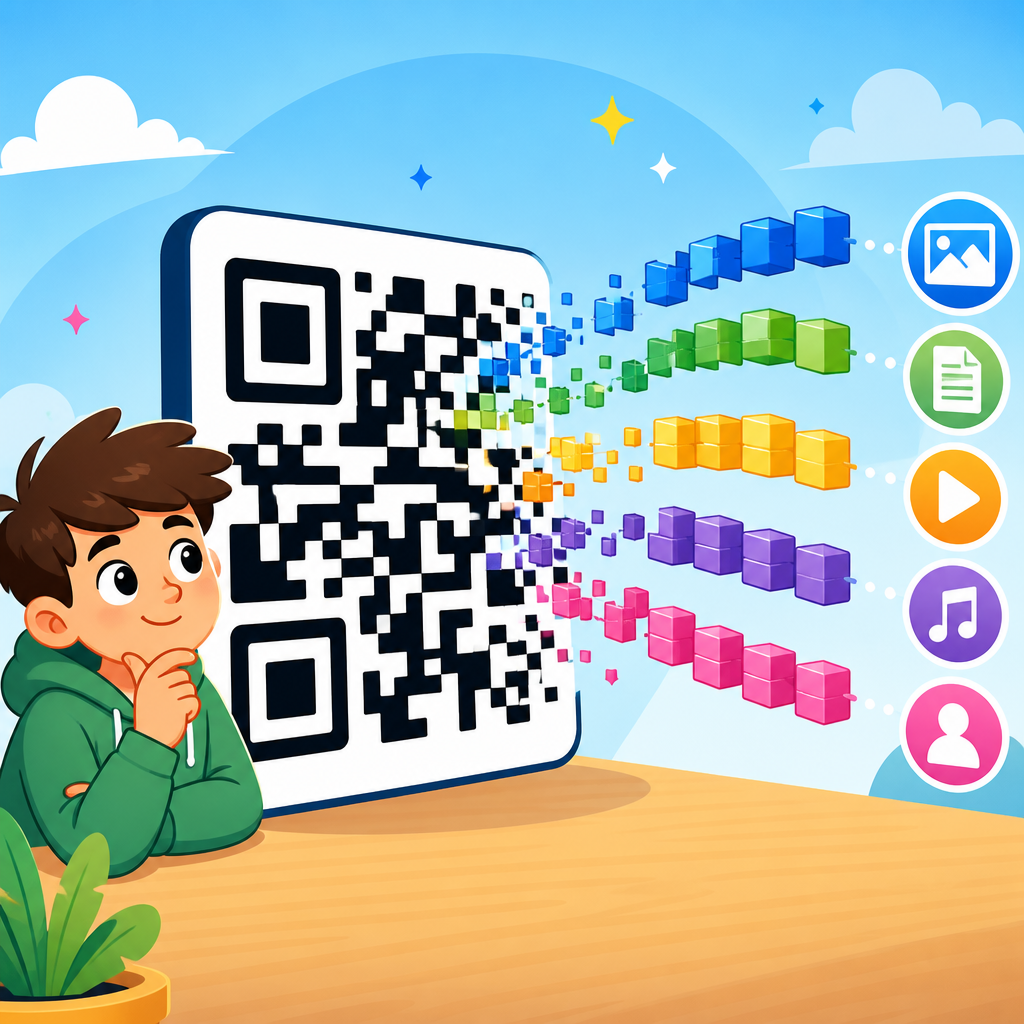
QR code APIs are software interfaces that let applications create, customize, track, decode, and manage QR codes programmatically, while QR code SDKs package similar capabilities into libraries for mobile, web, desktop, or embedded development. In practical terms, they replace manual code generation with repeatable workflows: a payment app can create one-time checkout codes, a logistics platform can encode shipment IDs, and an event system can validate attendee scans in real time. This matters because QR codes have moved far beyond static links on posters. They now support authentication, inventory control, digital menus, product traceability, ticketing, and omnichannel marketing, and each use case demands reliability, security, analytics, and scale.
When teams ask what a QR code API is, they usually mean one of four things. First, a generation API creates QR images from input data such as URLs, text, Wi-Fi credentials, vCards, or deep links. Second, a dynamic QR management API maps a short URL or token inside the code to a destination that can be edited later without reprinting the code. Third, a scan or decode API reads QR content from an uploaded image, camera frame, or device stream. Fourth, an analytics API records scans, timestamps, approximate location, device type, campaign source, and conversion events. In projects I have worked on, these functions are often mixed together, but separating them early helps teams choose the right architecture.
The distinction between APIs and SDKs is equally important. An API is typically a web service accessed over HTTP using JSON or image responses. An SDK is a developer toolkit, such as a JavaScript package, Android library, iOS framework, or C++ module, that runs inside the application and may call local device features like the camera. APIs are ideal when you want centralized management, shared templates, and server-side control. SDKs are better when you need low-latency scanning, offline reading, native camera optimization, or on-device security. Most mature implementations use both: an SDK for scanning in the app and an API for generation, routing, and reporting.
As a hub topic under QR Code Technology and Development, QR Code APIs and SDKs connect several disciplines: image encoding standards, URL routing, mobile camera performance, analytics pipelines, security controls, and lifecycle management. The real value is not the square pattern itself; it is the programmable layer around it. A well-designed QR stack reduces printing mistakes, enables campaign updates after deployment, shortens development time, and creates measurable user journeys from scan to action. For product teams, marketers, and engineers, understanding this layer is the difference between using QR codes as simple graphics and treating them as operational infrastructure.
Core capabilities of QR code APIs and SDKs
A comprehensive QR code API or SDK usually starts with encoding control. Developers can choose the data payload, error correction level, quiet zone, size, output format, and color styling. Error correction is especially important. QR codes support four levels—L, M, Q, and H—which balance data density against damage tolerance. Higher correction allows recovery when part of the code is obscured by a logo, crease, or dirt, but it also increases module density and can make scanning harder at small print sizes. Good APIs expose these settings directly rather than hiding them behind generic presets.
Customization is the next major capability. Teams often want branded colors, embedded logos, frame text such as “Scan me,” or batch templates for packaging and labels. However, styling is not purely aesthetic. In production, I have seen low-contrast brand palettes reduce scan success dramatically under poor lighting. Strong providers validate color contrast, preserve finder patterns, and warn when artwork creates unreadable codes. Output options also matter. PNG works for quick deployment, SVG is better for responsive web and large-format print because it scales cleanly, and PDF or EPS can fit print workflows.
Dynamic destination control is what turns a basic QR image into a maintainable system. Instead of encoding the final destination directly, the QR code points to a managed short URL. That redirect can then be updated to a new landing page, app deep link, coupon, regional storefront, or fallback destination after the code is already printed. This is essential for product packaging, restaurant tables, direct mail, and outdoor ads where replacing materials is costly. Better platforms also support rules-based routing by country, operating system, language, time window, or campaign source.
Decoding and scan assistance are equally central, especially in SDKs. A scanner library may include live camera autofocus, glare reduction, frame guidance, duplicate scan suppression, damaged-code recovery, and support for multiple symbologies such as QR Code, Data Matrix, Aztec, PDF417, and Code 128. On-device decoding is common with tools based on ZXing, ML Kit, and commercial engines such as Scandit or Dynamsoft. The best choice depends on environment: warehouse scanning at distance has different requirements than a consumer loyalty app reading glossy table tents in dim restaurants.
Finally, analytics and administration separate enterprise-grade QR tooling from basic generators. APIs can assign identifiers, tags, folders, campaign names, expiration dates, and access permissions. Webhooks can send scan events into a CRM, CDP, warehouse, or automation platform. Batch operations support thousands of unique codes for tickets, serialized products, classroom worksheets, or field assets. Without these operational features, teams quickly end up with unmanaged QR sprawl, duplicate campaigns, broken redirects, and no reliable way to measure performance.
How QR code APIs work in real applications
Most QR code API workflows follow a simple pattern. An application sends a request with payload data and desired settings, the service returns either an image or a managed resource ID, and subsequent calls update, track, or deactivate that code. For example, an ecommerce platform might request a dynamic code that routes to a seasonal promotion. The API returns a PNG for the webpage, an SVG for print inserts, and a short-code record stored in the campaign database. When the promotion changes, the team updates the destination through the API rather than reissuing every creative asset.
The same logic scales into operations. In logistics, each package label can receive a unique QR code tied to an order ID, handoff checkpoint, and proof-of-delivery workflow. Drivers scan with a mobile SDK, while the backend records status transitions through API calls. In manufacturing, serialized QR codes can link a unit to lot numbers, inspection data, manuals, and warranty registration. If a recall occurs, dynamic routing can push affected scans to a safety notice instantly. These use cases show why QR systems often sit between physical objects and digital records.
For marketers, dynamic QR codes solve attribution problems that plain links cannot. A single campaign can generate region-specific destinations, append UTM parameters automatically, and record device and timestamp for each scan. If the code appears on packaging, billboards, email, and in-store signage, APIs can create separate variants tied to the same landing experience while preserving source-level reporting. Teams then compare scan-through rate, landing-page conversion, and assisted revenue across channels. This turns QR from a novelty into a measurable acquisition and retention tool.
Authentication and access control are another fast-growing use case. Event platforms issue unique QR tickets through an API, and gate staff validate them with a scanning SDK that checks signature status, redemption state, and time rules. Employee badges, visitor passes, and temporary facility access can work similarly. In healthcare and field service, QR codes often point to secured records through tokenized URLs rather than exposing sensitive information directly. This distinction is crucial: a QR code should usually reference a protected lookup, not contain private data in plain text.
| Use case | Primary API or SDK function | Typical requirement | Example tools |
|---|---|---|---|
| Marketing campaigns | Dynamic generation, redirects, analytics | Editable destination and scan reporting | Bitly, QR Code Generator API, Beaconstac |
| Mobile app scanning | Camera SDK and on-device decoding | Fast reads in variable lighting | ZXing, ML Kit, Scandit |
| Tickets and access | Unique code issuance and validation | One-time redemption and fraud control | Custom API, PassKit workflows |
| Operations and logistics | Batch generation and status updates | High-volume unique identifiers | AWS Lambda pipelines, internal services |
Developers should also understand response models and hosting choices. Some APIs return a rendered image directly, while others return metadata plus a hosted short URL. Some platforms manage all redirects in their own infrastructure; others allow custom domains, which are preferable for brand trust, deliverability, and long-term control. Self-hosted options give more flexibility for compliance and cost management, but they require the team to handle uptime, redirect latency, analytics storage, abuse prevention, and image caching. Hosted services simplify these tasks but can create lock-in if export options are weak.
Choosing between APIs, SDKs, hosted platforms, and custom builds
The right approach depends on scale, security, latency, and the business model behind the QR workflow. If you need simple branded codes for campaigns with editable destinations and dashboards, a hosted API platform is usually the fastest route. If you are building a consumer app that scans codes continuously, a mobile SDK is the better core component because network calls for every scan add delay and fail offline. If your company prints millions of serialized labels or has strict compliance requirements, a custom or hybrid stack often makes more sense.
Hosted platforms are attractive because they combine code generation, asset management, analytics, and redirect rules in one interface. Products such as Bitly, Beaconstac, Flowcode, and QR Code Generator Pro target this market. They reduce engineering work, support custom domains, and offer nontechnical controls for marketing teams. The tradeoff is flexibility. Highly specialized workflows, such as encrypted token validation, factory serialization, or event redemption with offline fallback, can exceed what a generalized platform exposes. Cost can also rise quickly when scan volume, seats, or dynamic code counts increase.
Open-source and embedded SDKs give more control at the edge. ZXing remains a foundational library in many projects because it is widely supported and adaptable, though teams may need extra optimization for difficult scanning conditions. Google ML Kit provides straightforward mobile integration and performs well for common consumer scenarios. Commercial engines like Scandit and Dynamsoft typically offer better performance in low light, damaged labels, long range, and industrial settings, plus device tuning and support. The practical question is not whether a scanner works in perfect conditions, but how often it succeeds under the worst real conditions your users face.
Custom builds become attractive when QR codes are deeply tied to proprietary workflows. A direct-to-consumer brand might build its own dynamic QR service on AWS or Google Cloud using serverless functions, a redirect service, signed tokens, a PostgreSQL or DynamoDB backend, and a dashboard connected to Looker Studio or Power BI. This gives complete control over routing logic, retention policies, fraud checks, and first-party analytics. The cost is engineering ownership. Teams must maintain image generation libraries, observability, caching, rate limits, and incident response.
Evaluation should be systematic. Check output quality across PNG and SVG, custom domain support, uptime SLAs, API rate limits, webhook reliability, analytics granularity, export access, GDPR and CCPA handling, role permissions, and data retention controls. For SDKs, test scan speed, battery use, platform coverage, offline behavior, false positives, and camera UX. Run print tests at real sizes on real materials, not just on a laptop screen. A QR code stack fails or succeeds in the field, and the field is always harsher than the demo.
Implementation best practices, security, and common mistakes
Successful QR implementations start with payload discipline. Encode the minimum necessary data. For most business use cases, that means a short URL or token, not a long raw payload. Smaller payloads produce simpler codes that scan more reliably, especially on small labels or low-resolution surfaces. Use HTTPS, stable redirect logic, and descriptive naming conventions so code inventories remain manageable. If dynamic codes are used, document ownership and destination rules the same way you would for domains, tracking links, or API keys.
Security deserves special attention because QR codes are easy to distribute and hard for users to visually verify. Never place secrets, personal data, or internal identifiers in plaintext unless exposure is acceptable. Use signed or expiring tokens for tickets, coupons, and authentication flows. Validate redirect destinations to prevent open redirect abuse. Monitor for suspicious scan patterns, automated redemption attempts, and cloned print assets. In regulated environments, log administrative changes and apply least-privilege access to code management portals and API credentials.
Print and UX mistakes are extremely common. Codes are often made too small, placed on curved or reflective surfaces, or styled with weak contrast that hurts scan reliability. As a rule, testing should cover distance, glare, camera quality, and motion. Include a quiet zone around the symbol, preserve finder patterns, and confirm that logo overlays do not compromise error correction margins. If the code initiates a critical action, pair it with clear human-readable instructions and fallback options, such as a short URL or numeric code entry.
Analytics quality also depends on careful design. A scan is not the same as a conversion, and duplicate scans from the same user can distort results. Define event schemas before launch: scan started, redirect completed, landing loaded, form submitted, purchase completed, ticket redeemed. Connect those events using a consistent identifier so reporting can trace outcomes accurately. Server-side tagging, first-party cookies where permitted, and CRM synchronization all improve measurement. Without this structure, teams may know a QR code was scanned but not whether it produced business value.
The biggest mistake is treating QR as a one-off asset rather than a managed channel. Codes persist in the physical world long after campaigns change, staff turnover happens, or product pages move. Build for lifecycle management from day one: expiration policies, destination review, archive rules, monitoring, and ownership handoffs. That discipline is what turns QR code APIs and SDKs from convenient utilities into dependable infrastructure for commerce, operations, and customer experience.
QR code APIs and SDKs give organizations a programmable way to generate, control, scan, and measure QR experiences at scale. The core idea is simple, but the implementation choices matter. Generation settings affect readability, dynamic routing determines long-term flexibility, SDK quality shapes user experience, and analytics design decides whether scans become actionable insight. Across marketing, logistics, ticketing, authentication, and product engagement, the best systems treat QR codes as connected assets with governance, not isolated images.
For teams building within QR Code Technology and Development, this subtopic acts as the central map. It connects dynamic QR workflows, scan libraries, redirect architecture, security practices, batch generation, and performance measurement. If you choose a hosted platform, evaluate control and exportability. If you choose an SDK, test in real environments. If you build custom infrastructure, plan for maintenance, observability, and policy from the start. Each path can work when it matches the operational reality of the project.
The main benefit of understanding QR code APIs is confidence. You can select tools based on requirements instead of marketing claims, avoid common deployment failures, and design QR systems that remain useful after the first print run or app release. Use this hub as your starting point, then map each use case—generation, scanning, analytics, or security—to the right API, SDK, or hybrid stack before you build.
Frequently Asked Questions
1. What is a QR code API, and how does it work?
A QR code API is a software interface that allows applications to create, customize, read, track, and manage QR codes through code instead of through manual design tools. In simple terms, it gives developers a structured way to send requests to a service and receive QR-code-related results in return. For example, an app might send a request containing a URL, product ID, payment amount, or event ticket data, and the API responds with a QR code image or a payload that can be rendered directly in the application.
Most QR code APIs work through standard web requests. A developer specifies the content to encode, the QR code format, size, error correction level, colors, branding options, and sometimes advanced rules such as expiration times or scan limits. The API then generates the code and returns it in a usable format, such as PNG, SVG, PDF, or JSON metadata. More advanced platforms also support decoding, analytics, authentication, campaign tracking, and dynamic QR management, which means the destination or behavior of a QR code can be changed after it has already been printed or distributed.
This is especially valuable for businesses that need repeatable, scalable workflows. A payment app can automatically generate one-time checkout codes for each transaction. A logistics platform can encode shipment identifiers at high volume without human input. An event system can issue unique entry codes and validate scans in real time. Instead of treating QR codes as static images created one by one, a QR code API turns them into programmable assets that can be integrated into everyday business operations.
2. What is the difference between a QR code API and a QR code SDK?
A QR code API and a QR code SDK often solve related problems, but they do so in different ways. A QR code API is typically a remote service that applications communicate with over the internet. It handles tasks such as QR code generation, dynamic code management, analytics collection, or decoding on a server managed by the provider. The application sends requests and receives responses, which makes APIs a strong choice when centralized control, shared data, and cross-platform consistency are important.
A QR code SDK, by contrast, is a software development kit installed directly into an application. It usually comes as a library or package for mobile, web, desktop, or embedded environments. An SDK can provide on-device QR code scanning, local decoding, camera integration, image processing, and in some cases offline generation. Because the code runs inside the application itself, SDKs are often preferred when speed, low latency, hardware access, or offline capability matter. For instance, a warehouse scanner app may rely on an SDK to decode labels quickly even with inconsistent connectivity.
In practice, many organizations use both together. A mobile app might use an SDK to scan and decode QR codes instantly on the device, while also calling an API to validate the scanned data against a server, log the event, or generate a replacement code. The key distinction is that APIs provide functionality as a service over a network, while SDKs package functionality as developer tools embedded into software. Choosing between them depends on factors such as performance requirements, connectivity, security, platform support, and how much of the workflow needs to be centralized.
3. What can businesses do with QR code APIs in real-world applications?
QR code APIs are useful across a wide range of industries because they turn QR code creation and processing into automated workflows. In payments, they can generate transaction-specific codes containing checkout amounts, merchant details, and order references. This enables cashless, contactless experiences at retail counters, in self-service kiosks, or inside mobile apps. In logistics and supply chain operations, QR code APIs can encode package IDs, route details, inventory numbers, or proof-of-delivery data, helping teams track items accurately from warehouse to final destination.
Event and ticketing platforms are another strong use case. A QR code API can issue unique codes for each attendee, update ticket status dynamically, and validate scans at the entrance in real time. This reduces fraud, improves throughput, and allows organizers to monitor entry patterns as they happen. In healthcare, QR codes can link to patient records, lab samples, medication instructions, or appointment verification systems, provided privacy and compliance requirements are properly addressed. In manufacturing, APIs can support asset tracking, maintenance logs, and product authentication.
Marketing teams also benefit significantly. Dynamic QR code APIs make it possible to place codes on packaging, flyers, displays, or direct mail while retaining the ability to change the destination URL later. That means a code printed today could point to a product page now, a seasonal campaign next month, and a support resource later without requiring reprints. Combined with analytics, businesses can measure scan volume, timing, location trends, and campaign performance. Overall, QR code APIs help organizations move from one-off code generation to scalable systems that support automation, personalization, reporting, and operational control.
4. What features should you look for in a QR code API?
When evaluating a QR code API, the first thing to look for is core functionality: reliable code generation, support for common payload types, multiple output formats, and strong decoding capabilities if scanning or reading is part of the workflow. Beyond the basics, customization matters. A good API should let developers control size, margin, color, branding, logo overlays, error correction levels, and file formats so the resulting QR codes are both functional and aligned with brand requirements.
Dynamic QR code support is another major feature to prioritize. Static QR codes permanently contain their destination or data, but dynamic QR codes can be edited after creation through a redirect or managed record. This is especially useful for marketing, operations, and product lifecycle management because it allows organizations to update destinations without replacing printed materials. Analytics are equally important for many use cases. Businesses often need visibility into scans, timestamps, device types, campaign sources, or geographic patterns to understand how QR codes are being used in the real world.
Security, scalability, and developer experience should also be high on the checklist. Look for authentication options, HTTPS support, rate limit transparency, access controls, and documentation around data handling. If the API will support high-volume use cases, such as bulk code creation for inventory or high-traffic scan validation for events, it should offer dependable uptime and performance under load. Clear documentation, SDKs, sample code, webhook support, and a predictable pricing model can make integration much easier. In short, the best QR code API is not just one that generates images—it is one that fits the operational, technical, and compliance needs of the application it will support.
5. Are QR code APIs secure, and what challenges should developers consider?
QR code APIs can be secure, but security depends heavily on how they are implemented and managed. At the API level, best practices include encrypted connections, proper authentication, request validation, role-based access, and careful handling of any personal or sensitive data tied to the QR code workflow. If a QR code is being used for payments, ticket validation, identity checks, or access control, developers should make sure that the data encoded or referenced cannot be easily tampered with or reused maliciously. In many cases, it is safer to encode a short token or identifier and validate the full details server-side rather than placing sensitive information directly inside the QR code.
Another challenge is abuse prevention. Public-facing QR systems can be targets for fraud, phishing, replay attacks, and unauthorized redirects. Dynamic QR code platforms should include controls such as expiration rules, scan limits, audit logs, and destination validation. Event and credential systems may also need one-time-use logic or real-time redemption checks to prevent duplicate scans. If analytics are collected, developers should think carefully about privacy obligations, especially when location, device, or user behavior data is involved. Depending on the region and industry, regulations may require consent, data minimization, or stricter retention policies.
Developers should also account for technical challenges beyond security alone. QR codes must remain readable across varying print sizes, lighting conditions, surfaces, and camera qualities. Over-customization can reduce scannability if contrast is too low or logos interfere with the pattern. High-volume systems need resilience, caching strategies, and clear fallback behavior if the API becomes temporarily unavailable. The most successful implementations combine secure design, usability testing, operational monitoring, and thoughtful data governance. When handled well, QR code APIs are both practical and dependable tools for modern digital and physical workflows.