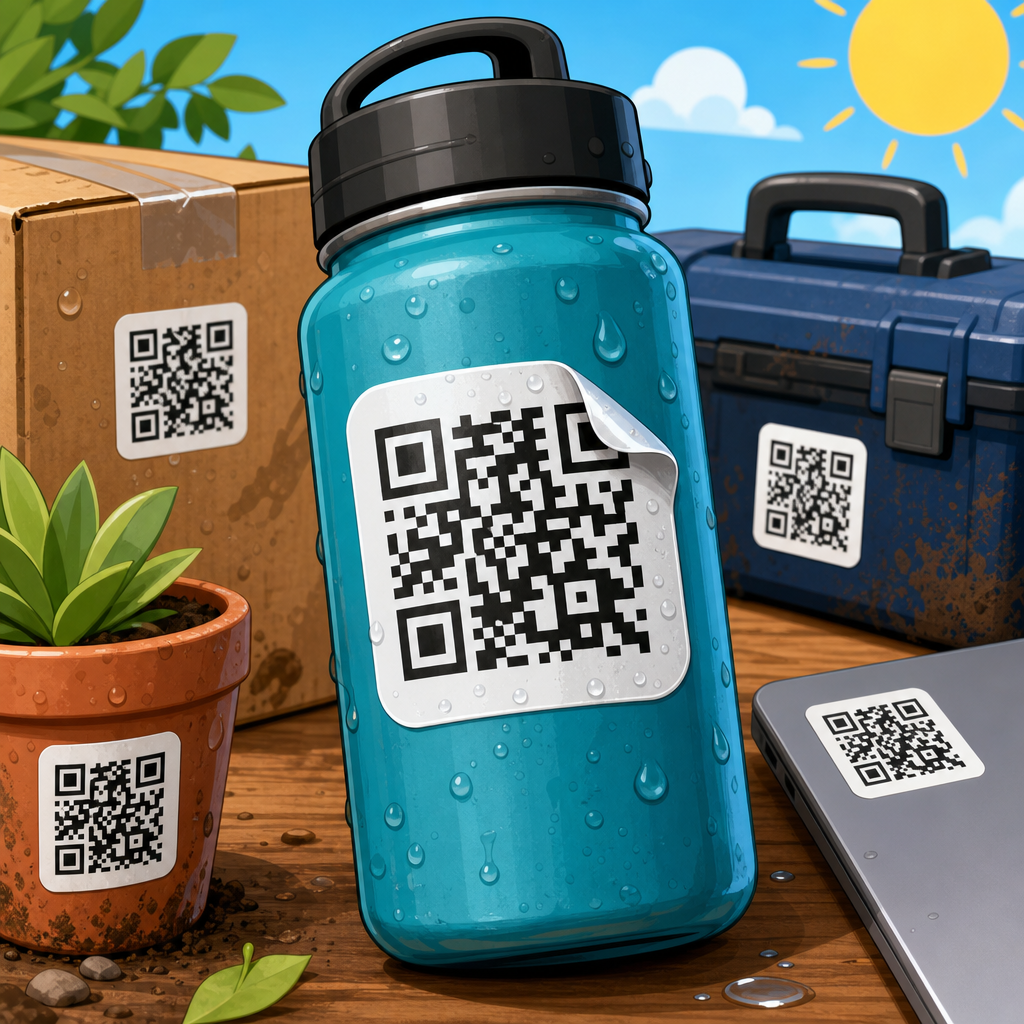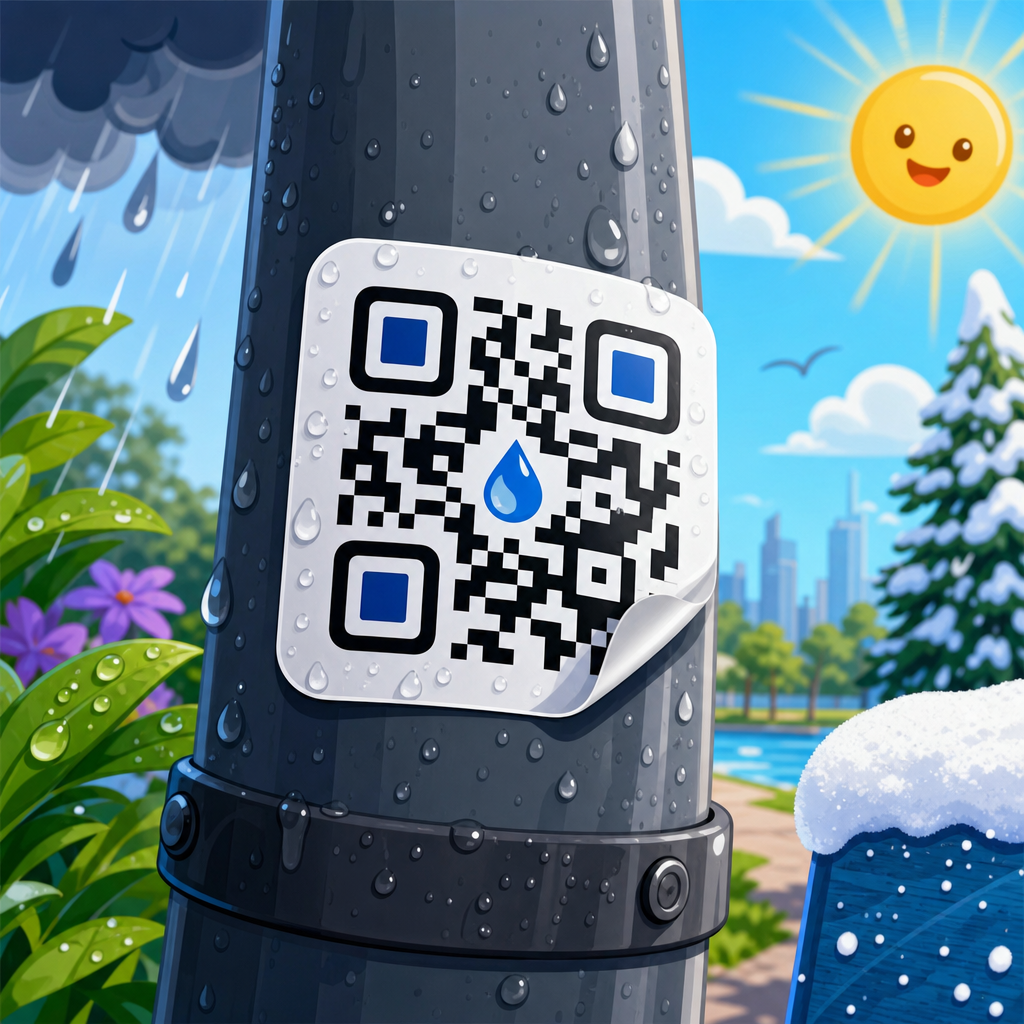
Weatherproof QR code stickers are printed labels engineered to keep a scannable code readable through rain, sun, abrasion, temperature swings, and routine handling. In practical terms, they combine durable face materials, strong adhesives, weather-resistant inks, and protective finishes so the QR code still opens the right destination months or years after installation. That matters because a QR code is only useful when a phone camera can detect contrast, finder patterns, and module edges quickly. Once water damage, fading, scratches, or adhesive failure distort those elements, scan rates drop and the campaign, asset tag, menu, instruction sheet, or product label stops doing its job.
I have specified outdoor QR labels for restaurant patios, municipal signage, warehouse racks, rental equipment, and consumer packaging, and the pattern is always the same: people focus on code generation first and substrate performance second. That is backwards. A perfect dynamic QR code printed on the wrong stock can fail in weeks. A well-built weatherproof sticker, by contrast, can survive years of UV exposure, washdowns, and friction while still scanning from a normal viewing distance. Durable QR code solutions sit at the intersection of design, materials science, printing method, and installation practice. You need all four working together.
Before choosing a sticker, define the environment. “Weatherproof” usually means resistance to moisture and moderate outdoor exposure, but not every label marketed that way is suitable for full sun, chemical splash, salt air, or pressure washing. “Waterproof” focuses on liquid exposure. “UV-resistant” addresses fading and embrittlement under sunlight. “Abrasion-resistant” concerns rubbing, scraping, and repeated contact. “Permanent adhesive” means the bond is meant to stay in place, though it may still fail on textured masonry, oily plastics, or powder-coated metals without proper surface preparation. These distinctions matter because the failure mode determines the specification.
This hub article explains how to choose durable QR code solutions that hold up in real conditions. It covers the best sticker materials, laminate and adhesive options, print methods, testing standards, placement rules, and maintenance practices that preserve scan performance. It also clarifies where standard vinyl is enough and where you need polyester, polycarbonate, tamper-evident film, or even metal tags instead of stickers. If you are building a labeling system for products, facilities, equipment, events, or packaging, the goal is simple: match the code, material, and environment so every scan works when the user needs it.
What makes a QR code sticker truly weatherproof
A weatherproof QR code sticker succeeds when four components are aligned: the face stock, the print, the protective layer, and the adhesive. Face stock is the base material, often vinyl, polyester, polypropylene, or polycarbonate. The print can be thermal transfer, resin ribbon, UV inkjet, screen printing, laser marking, or digital toner depending on durability requirements. The protective layer is usually a laminate or varnish that guards against UV, moisture, and abrasion. The adhesive must bond reliably to the target surface for the intended lifespan and temperature range.
For most outdoor uses, cast or calendered vinyl is the entry point because it is flexible, widely available, and economical. It works well on smooth surfaces such as windows, painted panels, and plastic containers. Polyester is typically stronger for industrial labeling because it resists tearing, holds shape better, and performs well with resin thermal transfer printing. Polycarbonate is used where impact resistance and dimensional stability matter, such as equipment overlays. Polypropylene can work for short-to-medium-term labels but is generally less robust than polyester for harsh environments.
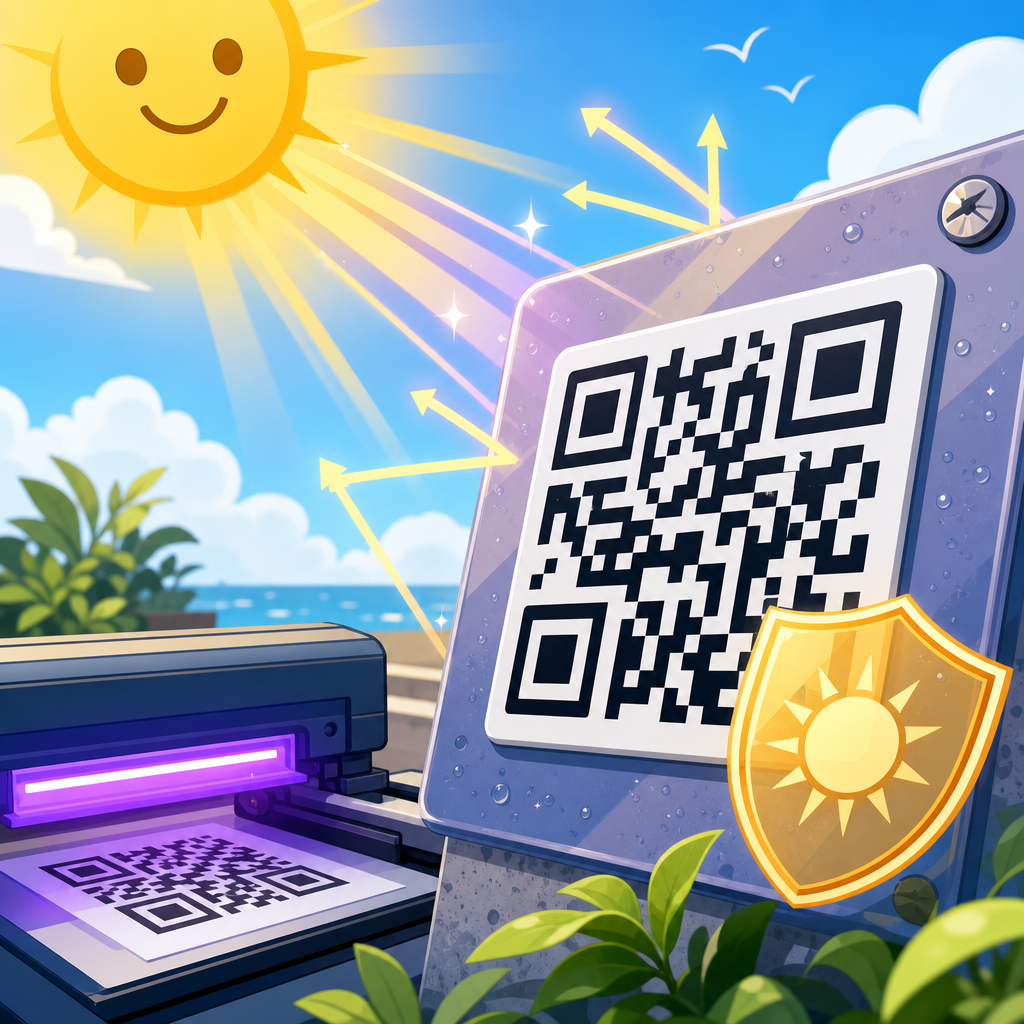
Weather resistance is not only about surviving the environment; it is about preserving optical readability. A QR code scanner needs clear light-dark separation. If black modules fade to charcoal, if a glossy overlaminate creates glare at common scan angles, or if dirt accumulates in a textured print surface, recognition slows or fails. I have seen technically intact labels underperform simply because the laminate was too reflective under direct sun. A matte or low-glare laminate often scans better outdoors than a high-gloss finish, even when both are equally durable.
Adhesive choice deserves equal attention. Acrylic adhesives are common for outdoor durability because they resist UV and temperature extremes better than many rubber-based systems. High-tack formulations help on low-surface-energy plastics, powder-coated metals, and rough surfaces. Removable adhesives are useful for short-term events but are rarely the right choice for long-term durable QR code solutions. If the label will face cold application conditions, check the minimum application temperature and service temperature separately; many failures come from applying labels too cold, not from the later operating temperature.
Best materials for durable QR code solutions
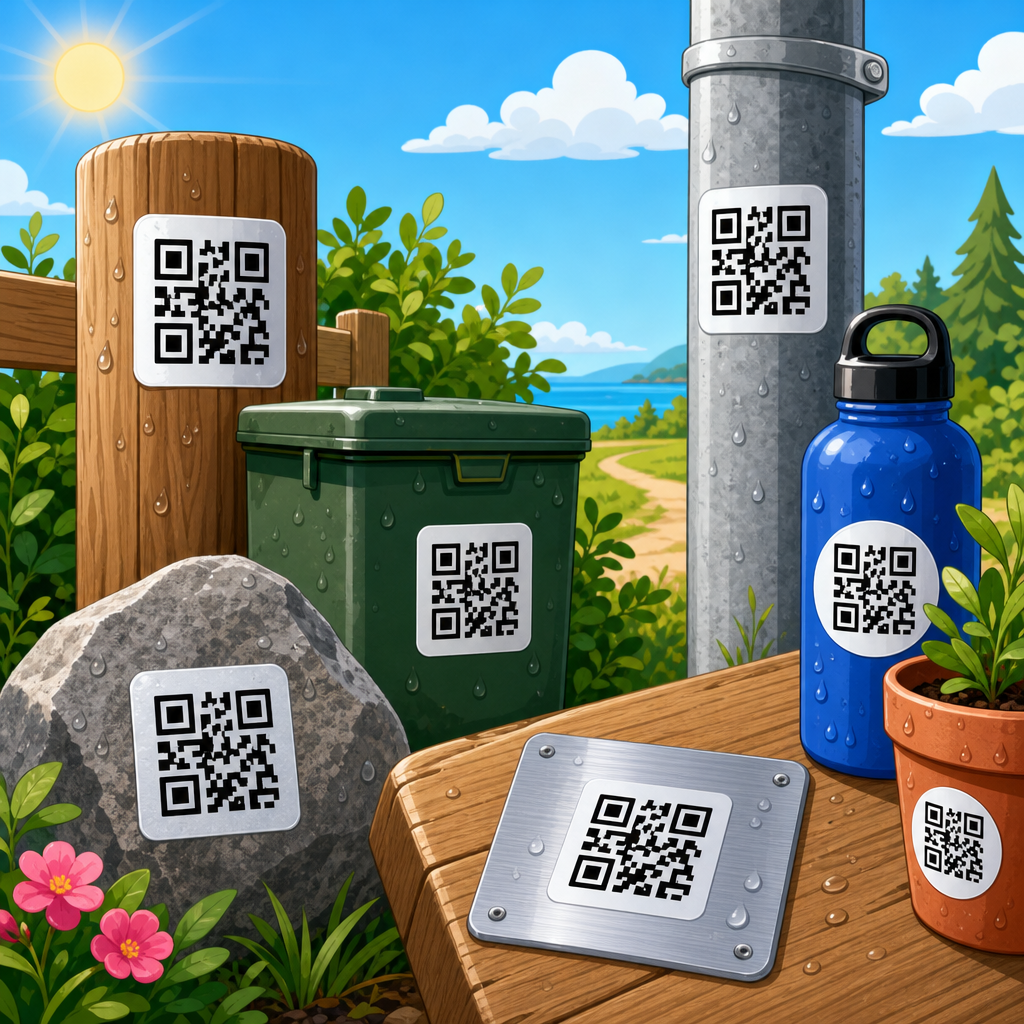
The best material depends on lifespan, surface type, and exposure. For general outdoor retail, hospitality, and local service use, premium outdoor vinyl with UV laminate is often sufficient for one to three years. For industrial assets, tools, medical carts, and warehouse locations, white polyester with permanent acrylic adhesive is usually the stronger choice because it resists tearing and maintains print definition. For extreme conditions such as chemical exposure, engine compartments, marine environments, or heavy abrasion, specialized polyester constructions, anodized aluminum plates, or laser-markable tags may outperform stickers entirely.
Material thickness also affects longevity. Thicker is not automatically better, but a flimsy film can wrinkle during installation and lift at edges sooner. A 2 to 4 mil face film with laminate is common for outdoor stickers, while industrial constructions may be thicker once adhesive and topcoat are included. Surface conformability matters too. Cast vinyl conforms to curves and rivets better than rigid films, making it suitable for helmets, bottles, and contoured equipment housings. Polyester is less conformable but usually superior for flat asset labels where dimensional stability is more important than stretch.
| Material | Best use case | Main strengths | Main limitation |
|---|---|---|---|
| Outdoor vinyl | General outdoor promotions, menus, windows, packaging | Flexible, economical, good weather resistance with laminate | Less resistant to tearing and harsh chemicals than polyester |
| White polyester | Asset tags, equipment labels, industrial QR codes | Tear resistant, stable, excellent print durability | Less conformable on curves and textured surfaces |
| Polycarbonate | Control panels, overlays, rugged equipment | Impact resistance, dimensional stability | Higher cost for many simple labeling jobs |
| Metal tag or plate | Extreme outdoor, marine, high heat, long lifecycle assets | Maximum longevity, strong resistance to abrasion and weather | Requires mechanical fastening or specialty attachment |
For food service, breweries, garden centers, and facilities with frequent washdowns, look beyond “waterproof” claims and verify resistance to cleaners, oils, and repeated moisture cycles. BOPP labels used in consumer packaging can handle condensation and brief water exposure, but they may not be ideal for years outdoors. In my projects, the most reliable all-around industrial option has been polyester paired with a resin ribbon or durable digital print plus overlaminate. It is not glamorous, but it consistently protects scanability longer than bargain vinyl bought without a specification sheet.
Printing methods that preserve scan performance outdoors
Printing method matters because the QR code’s edges must stay sharp. Thermal transfer printing with resin ribbons is one of the most dependable options for industrial durable QR code solutions. When matched to the right polyester stock, it produces dense blacks, crisp modules, and strong resistance to abrasion, solvents, and heat. That is why it is common in manufacturing, logistics, and compliance labeling. Wax ribbons are cheaper but usually too soft for hard-use outdoor labeling. Wax-resin sits in the middle and can work for medium-duty applications.
UV inkjet and screen printing are strong choices for larger production runs and branded outdoor stickers. UV-curable inks bond well to many synthetic stocks and resist fading when properly formulated, especially under laminate. Screen printing remains excellent for spot-color durability and opaque blacks, though it is less flexible for variable data. Digital toner presses can produce attractive short runs, but not all toner systems are equal outdoors; durability depends on substrate compatibility, toner adhesion, and topcoat protection. Always ask for outdoor life expectations based on the exact print system, not generic marketing language.
Resolution and contrast are critical. Use true black on a white or very light background for maximum readability. Reversed codes, decorative gradients, and pastel backgrounds may look distinctive but reduce tolerance when dirt, glare, or fading enter the equation. I recommend avoiding tiny codes on outdoor stickers unless scanning distance is very short. As a rule, increase code size before increasing complexity. If your QR code points to a dynamic URL, you can keep the module count lower than a dense static code, which generally improves scan reliability after wear.
Error correction helps but does not make a bad label indestructible. QR codes support several error correction levels, with higher settings allowing more damage before failure. In practice, moderate to high error correction is useful for outdoor labels, especially where logos or minor contamination are expected. However, every increase in error correction adds density, which can make small codes harder to scan. The right balance depends on print size, viewing distance, and expected damage. A larger simple code on durable material beats a tiny over-engineered code nearly every time.
Adhesives, surfaces, and installation mistakes that cause failure
Most sticker failures are adhesive failures. The wrong adhesive on the wrong surface leads to edge lift, bubbling, tunneling, or full release long before the print wears out. Smooth painted metal, glass, and sealed plastics are straightforward. Powder-coated surfaces, textured containers, polyethylene, polypropylene, unfinished wood, and masonry are not. These low-energy or rough surfaces require either a high-tack adhesive, a different label construction, or a non-adhesive mounting method. If the site gets hot, cold, or wet during installation, the margin for error becomes smaller.
Clean the surface with the correct method before application. Dust, oil, silicone residue, oxidation, and moisture all interfere with bond strength. Isopropyl alcohol is common, but on greasy surfaces a stronger degreasing step may be needed first. Let the surface fully dry. Apply with firm, even pressure, ideally using a squeegee or roller to remove trapped air and maximize adhesive wet-out. For industrial rollouts, I recommend a small pilot installation on every substrate type. A two-day test often reveals issues that a specification sheet does not predict.
Temperature is another frequent problem. Many permanent labels should be applied above a minimum temperature, often around 50°F or 10°C, though specific products vary. Applying below that can prevent the adhesive from flowing into the surface profile. Some installers try to solve this with a heat gun, but uneven heating can distort the film or trap moisture. Better practice is controlled indoor staging before installation or selecting a construction rated for cold application. Once bonded correctly, many outdoor acrylic adhesives tolerate much wider service temperatures than their application range suggests.
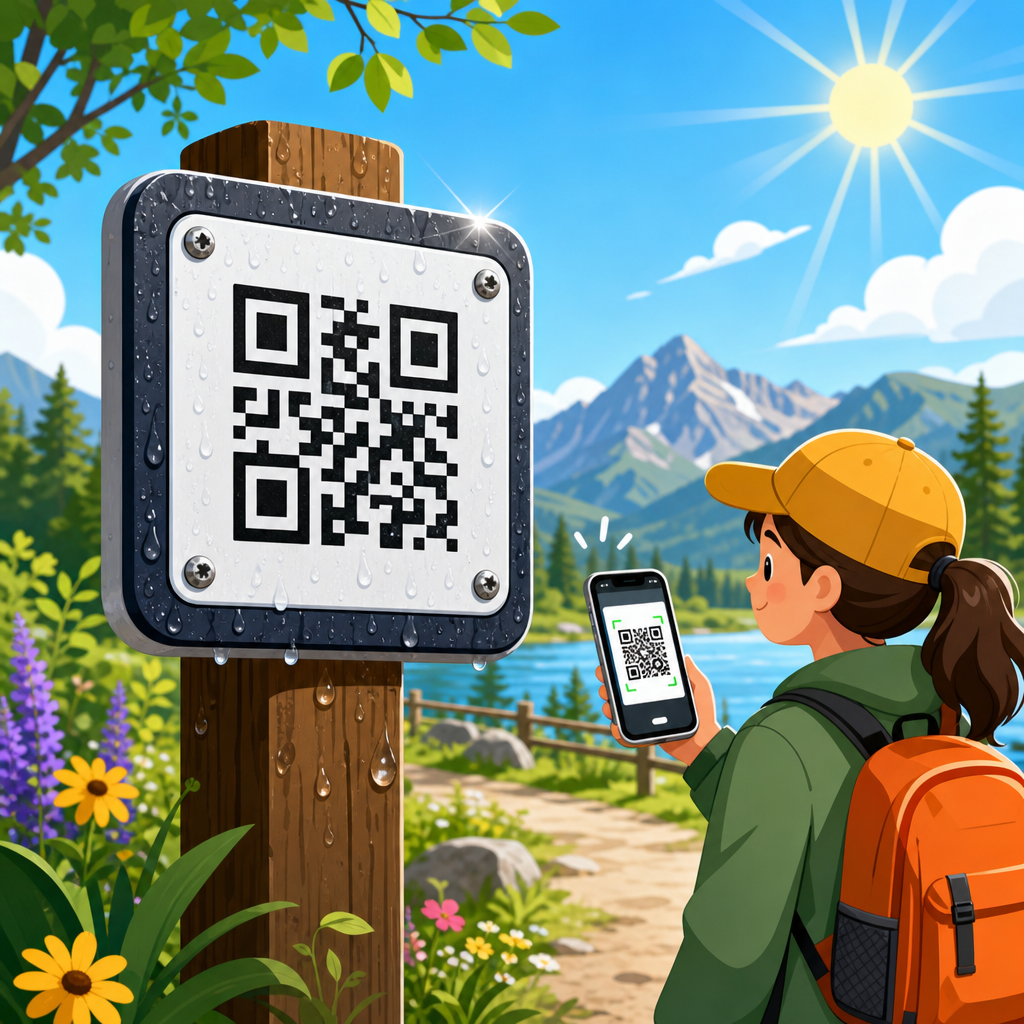
Placement affects both longevity and scan rate. Avoid edges exposed to constant rubbing, direct tire spray, or pooling water. Do not place codes across seams, fasteners, deep corrugations, or heavily textured coatings if you can avoid it. On equipment, put the label where a user can scan without awkward body position or glare. On public signage, mount at a comfortable height with enough surrounding quiet zone. A durable QR code solution fails functionally if the code survives but users cannot conveniently aim a phone at it.
Testing, maintenance, and lifecycle planning
The best way to validate weatherproof QR code stickers is to test them before full deployment and monitor them after installation. In formal product development, brands may use UV exposure testing, humidity cycling, abrasion testing, salt spray, or chemical resistance protocols. Even if you are not running laboratory evaluations aligned with UL, ASTM, or ISO methods, you can still conduct useful field tests. Install sample labels on each real surface, expose them to sun and water for several weeks, and scan them at different times of day using both iPhone and Android devices.
Verification should include more than “it scans once.” Check first-time scan speed, readability under glare, resistance after wiping, and performance when the label is slightly dirty. Use a QR code grading tool if the project is high stakes. ISO/IEC 15415 is commonly referenced for two-dimensional code print quality, and while many small businesses will not grade every label, understanding that measurable parameters exist is valuable. Print contrast signal, axial non-uniformity, modulation, and fixed pattern damage all influence how reliably a code scans as the label ages.
Maintenance is simple but important. Inspect exterior labels on a schedule that matches their environment. Clean off dirt, road film, or sunscreen residue using non-abrasive methods. Replace labels with lifting corners before moisture gets underneath and accelerates failure. If the code links to a campaign page, use a dynamic QR code platform so the destination can change without reprinting. I routinely advise teams to log installation date, substrate, printer, and material SKU for every deployment. That record turns future replacements from guesswork into repeatable procurement.
Lifecycle planning is what separates a one-off sticker order from a durable labeling system. Decide the expected service life, define the environment, standardize one or two approved constructions, and document placement and application steps. Then build related resources around that hub: outdoor QR code materials, UV-resistant label laminates, industrial asset tag options, adhesive selection guides, and QR code print testing procedures. This creates a consistent program rather than scattered labels with mixed performance. The result is lower replacement cost, fewer failed scans, and a better user experience across every touchpoint.
Weatherproof QR code stickers work when durability is designed in, not assumed. The right face stock, print method, laminate, adhesive, and installation process protect scanability against water, sunlight, abrasion, and temperature changes. For many outdoor uses, premium vinyl with a matte UV laminate is enough. For industrial or long-life applications, polyester constructions, resin printing, and higher-spec adhesives are usually the safer path. Where conditions are truly severe, move beyond stickers to metal or specialty tags. The decision should follow the environment, not the cheapest quote.
If you want durable QR code solutions that keep working in the field, start by auditing where each label will live, how long it must last, and what can damage it. Then test materials on the real surface before a full run. That discipline prevents most failures and improves every downstream metric, from scan rate to replacement cost. Use this hub as the starting point for your broader QR code design, printing, and materials strategy, and build your next label program around proven specifications instead of assumptions.
Frequently Asked Questions
What makes a QR code sticker truly weatherproof?
A truly weatherproof QR code sticker is more than just a label with a code printed on it. It is a combination of materials and production choices designed to protect scannability in real-world conditions. The face stock is usually made from durable materials such as vinyl, polyester, or polypropylene rather than standard paper, because these substrates resist moisture, tearing, and expansion from temperature changes. The adhesive also matters. A weatherproof sticker needs an adhesive formulated to hold on surfaces exposed to rain, sun, cleaning, and daily wear without curling or peeling at the edges.
Print quality is equally important. QR codes rely on clean contrast, sharp module edges, and intact finder patterns for fast scanning, so weather-resistant inks or thermal transfer methods are often used to reduce fading, smearing, and breakdown over time. Many weatherproof QR code stickers also include a laminate or protective coating that helps defend against UV exposure, scratches, chemicals, and abrasion. Without that protective layer, even a well-printed code can become difficult for a smartphone camera to read after repeated handling or outdoor exposure.
In short, weatherproofing is not one feature but a system. A sticker can only be called weatherproof when the material, adhesive, print method, and finish all work together to preserve both physical durability and scan performance over months or years of use.
How long do weatherproof QR code stickers usually last outdoors?
The outdoor lifespan of a weatherproof QR code sticker depends on the material, environment, and how it is installed, but high-quality products commonly last anywhere from one to several years. Premium laminated vinyl or polyester labels typically perform much longer than low-cost, uncoated alternatives. A sticker placed in full sun, exposed to rain, snow, road grime, and temperature swings every day will usually age faster than one installed in a shaded or partially protected location.
Ultraviolet light is one of the biggest long-term threats because it can fade dark print and reduce the contrast needed for reliable scanning. Abrasion is another major factor. If the sticker is mounted where people frequently touch it, where equipment rubs against it, or where it is cleaned aggressively, the protective surface can wear down over time. Surface preparation also affects lifespan. Even the best outdoor adhesive can fail early if applied to a dirty, oily, textured, or poorly matched surface.
For long-term results, it helps to choose a sticker rated for outdoor use, with UV resistance and a protective laminate, and to follow proper installation steps. In practical terms, many businesses treat weatherproof QR code stickers as durable assets but still inspect them periodically. If the code starts looking faded, scratched, or partially lifted, replacing it before scan failures begin is the smart move.
Will a weatherproof QR code still scan after rain, sun exposure, and everyday wear?
Yes, that is exactly what a well-made weatherproof QR code sticker is designed to do. The goal is to maintain the visual structure the phone camera needs in order to read the code quickly and accurately. Even after exposure to rain, sunlight, dust, and normal handling, the code should still show strong contrast between light and dark areas, with crisp square modules and clear finder patterns in the corners. If those elements remain intact, scanning performance remains strong.
That said, weatherproof does not mean indestructible. Severe fading, heavy scratches, mud buildup, glare from the wrong finish, or physical damage to part of the code can still reduce readability. Placement also matters. A perfectly printed outdoor sticker may scan poorly if it is applied to a curved surface that distorts the code, mounted too high to frame easily with a camera, or installed in a location with strong reflections. Good design practices, such as leaving enough quiet space around the code and sizing it appropriately for the expected scanning distance, are just as important as weather resistance.
The best way to ensure dependable performance is to test the code before production, after application, and periodically throughout its service life. If it scans quickly under normal conditions and remains protected with the right materials, a weatherproof QR code sticker can stay functional through substantial environmental stress.
What surfaces and environments are best for weatherproof QR code stickers?
Weatherproof QR code stickers work best on clean, smooth, and compatible surfaces such as metal, glass, painted panels, sealed plastic, and finished equipment housings. These surfaces allow the adhesive to make full contact, which improves long-term bonding and reduces the chance of edge lift. They are commonly used on storefront windows, product packaging, outdoor signs, vehicles, machinery, bins, tools, and facility labels where durability and consistent scanning matter.
They can also be used in more demanding environments, including industrial sites, warehouses, construction areas, marine settings, refrigerated spaces, and outdoor public installations, but the sticker needs to be matched to the environment. For example, a label exposed to salt spray, frequent washing, solvents, or large temperature swings may require a stronger adhesive, a thicker laminate, or a higher-performance synthetic material. In cold environments, special adhesives may be necessary for reliable application and hold. In high-heat or chemical-heavy settings, not all “outdoor” labels will be suitable.
Surface condition is critical. Rough, dusty, oily, porous, or highly textured materials can make adhesion less reliable and may shorten lifespan. Before applying the sticker, it is best to clean and dry the area thoroughly and, when possible, test one label first. Choosing the right sticker for the specific environment is what turns a good-looking QR code into a durable, dependable scanning tool.
How can you choose the right weatherproof QR code sticker for your use case?
Start with the environment. Ask where the sticker will live, how long it needs to last, and what kinds of stress it will face. Outdoor sunlight, rain, freezing temperatures, heat, abrasion, chemical exposure, frequent handling, and pressure washing all point to different material and adhesive needs. A temporary promotional sticker on a window may only need moderate durability, while an asset tracking label on industrial equipment may need a much tougher construction with strong adhesion and high scratch resistance.
Next, focus on scan reliability. The QR code should be printed at a size appropriate for how far away people will scan it, with strong black-on-white contrast or an equally readable combination, sufficient quiet space around the code, and a finish that does not create excessive glare. Matte laminates are often preferred when reflections could interfere with smartphone cameras, while gloss may work well in other contexts. The destination behind the code matters too. If the linked page is expected to change, a dynamic QR code can offer flexibility without replacing the sticker itself.
Finally, think about production quality and testing. Choose a supplier that understands both label durability and QR code readability, not just printing. Ask about face material, adhesive type, UV resistance, laminate, ink system, expected outdoor lifespan, and compatibility with the target surface. Then test samples in realistic conditions before committing to a large order. The right weatherproof QR code sticker is the one that stays attached, stays readable, and keeps delivering the intended scan experience long after installation.