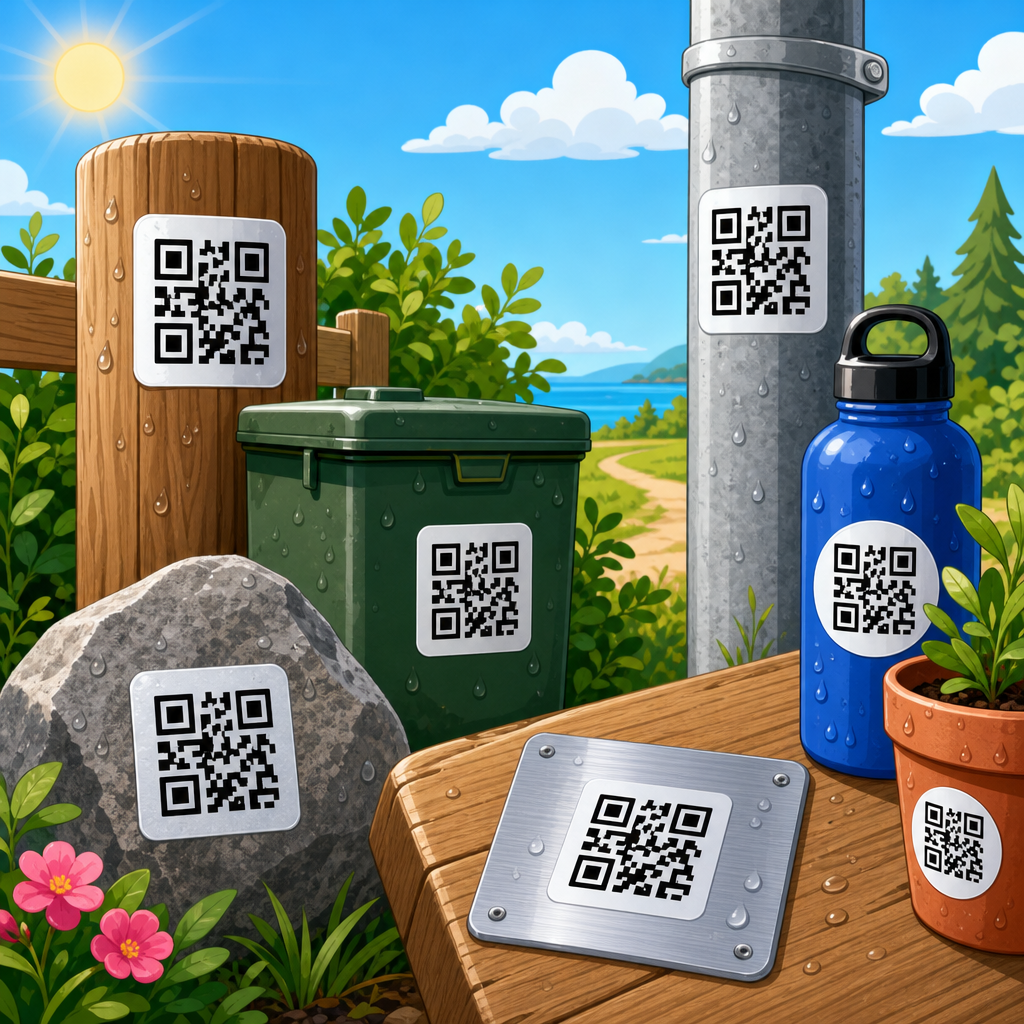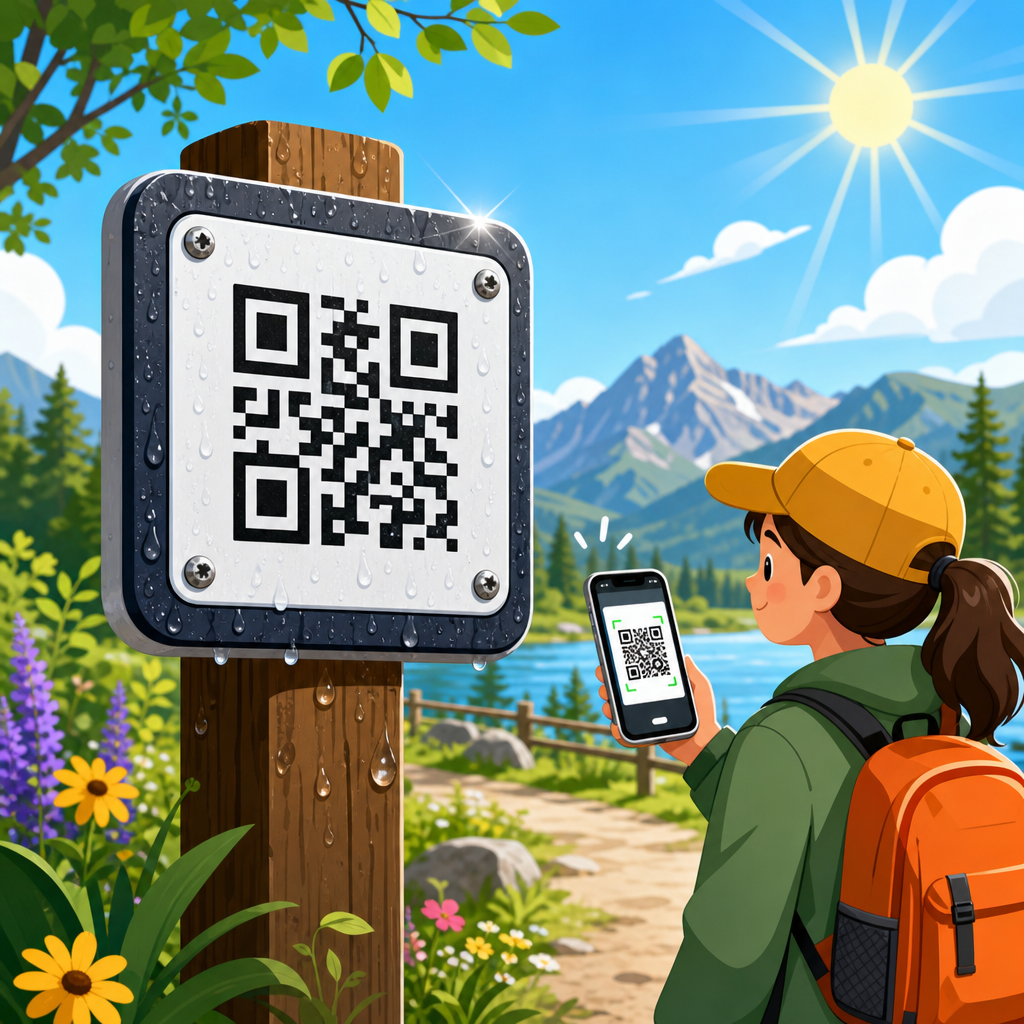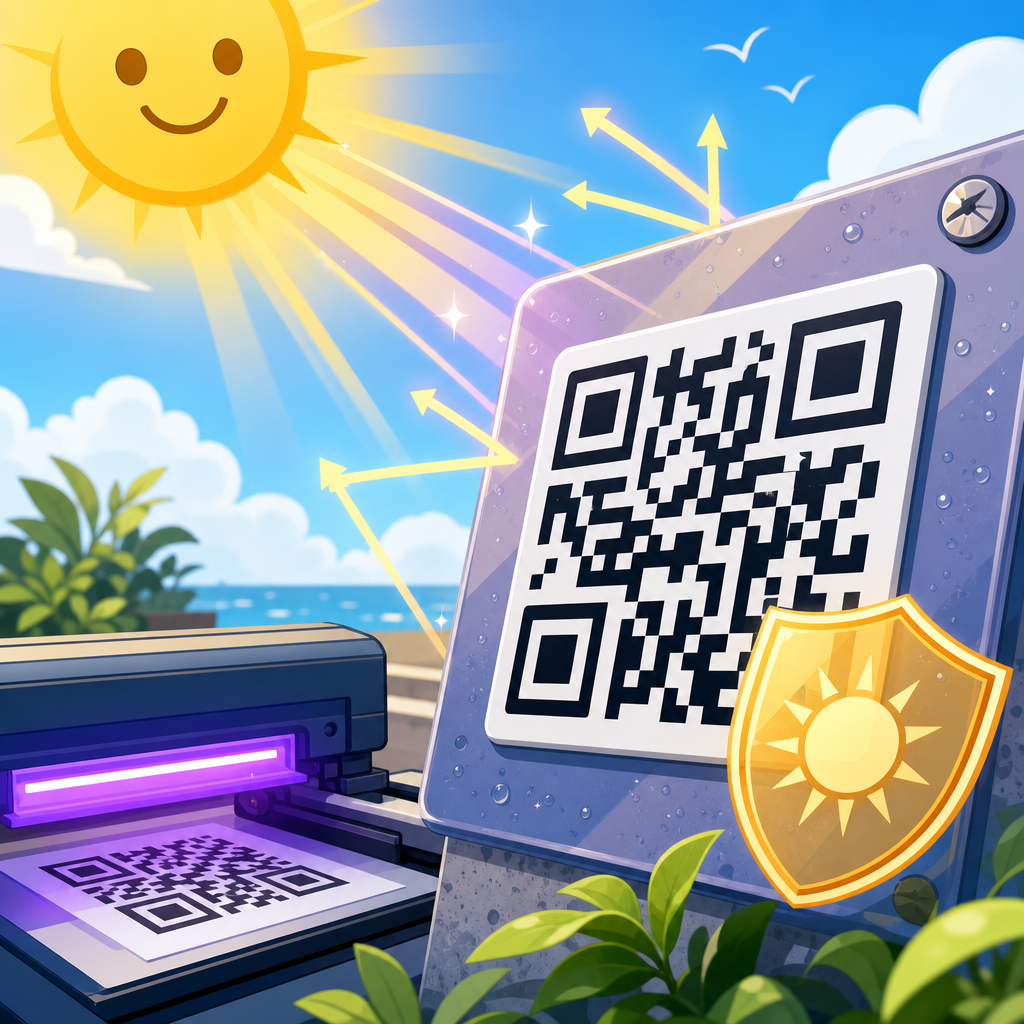
UV-resistant QR code printing is the process of producing scannable codes that remain readable after prolonged exposure to sunlight, heat, moisture, abrasion, and outdoor chemicals. In practical terms, it combines durable substrates, fade-resistant inks, protective laminates or clear coats, and print methods that preserve contrast so a phone camera can still decode the symbol months or years later. For companies using QR codes on equipment tags, outdoor signage, asset labels, packaging, construction materials, utility infrastructure, or hospitality displays, UV resistance is not a cosmetic upgrade. It is the difference between a code that keeps working in the field and one that silently fails when a customer, technician, or inspector needs it most.
Durable QR code solutions matter because QR performance depends on more than the data pattern itself. A code can be perfectly generated and still become unscannable when black modules fade to gray, white space yellows, adhesive lifts, or surface glare interferes with a camera. I have seen outdoor labels pass a print inspection on day one and fail within a season because material selection was treated as an afterthought. Sunlight is especially destructive. Ultraviolet radiation breaks down pigments, plastics, adhesives, and coatings over time, while heat accelerates expansion, contraction, and bond failure. If the application includes salt spray, cleaners, oils, or foot traffic, degradation happens faster.
Understanding UV-resistant QR code printing starts with a few key terms. UV resistance refers to a material’s ability to maintain physical and visual properties after light exposure. Lightfastness describes how well an ink or pigment resists fading. Contrast is the tonal difference between dark and light areas that scanning software relies on to detect finder patterns, timing patterns, and data modules. Quiet zone means the blank margin around the code; if it becomes dirty, cracked, or visually crowded, scan reliability drops. Substrate is the base material being printed on, such as polyester, anodized aluminum, rigid PVC, acrylic, vinyl, or powder-coated metal. Overlaminate and clear coat are protective top layers used to shield the print from abrasion and weathering.
This hub article explains how to choose durable QR code solutions, which print methods hold up best outdoors, what materials survive demanding environments, and how to test long-term readability before deployment. It also serves as the central guide within QR code design, printing, and materials, so it connects the decisions you make here to related topics such as label adhesives, print contrast, code sizing, and industrial asset tagging. If your goal is a QR code that lasts, scans quickly, and avoids replacement costs, UV resistance has to be engineered into the whole system, not added at the end.
Why QR Codes Fail Outdoors and What UV Resistance Prevents
Outdoor QR code failure usually begins with one of four issues: fading, surface damage, adhesion loss, or optical interference. Fading occurs when UV radiation breaks chemical bonds in dyes and lower-grade pigments, reducing the density of dark modules and shrinking the contrast ratio. Surface damage includes scratching, chalking, cracking, and delamination, which distort the module edges scanners need to interpret. Adhesion loss happens when temperature swings, moisture ingress, or incompatible surfaces weaken the bond between label and substrate. Optical interference appears when gloss, dirt films, condensation, or textured surfaces scatter light and confuse camera autofocus and decoding.
UV-resistant printing prevents these problems by building durability at multiple layers. Pigment-based inks resist fading better than dye-based systems. Thermal transfer resin ribbons outperform wax ribbons in harsh environments. Screen printing with exterior-grade inks can deliver strong opacity and weather resistance on metal, plastic, and rigid sign stock. For the highest permanence, laser marking and photo anodized aluminum embed or alter the image within the material itself, reducing reliance on a vulnerable surface layer. A proper laminate can also filter UV, improve scratch resistance, and create a cleanable surface without sacrificing scan performance.
The hidden cost of failure is often operational, not just material. A faded QR code on a restaurant patio menu creates friction and lost orders. A degraded asset tag on a solar farm slows maintenance and increases labor time. A utility pole inspection code that cannot be scanned forces manual data entry and raises compliance risk. In each case, the printed symbol is part of a workflow. When it fails, the process around it fails too. That is why durable QR code solutions should be specified with the same discipline used for barcodes, safety labels, and nameplates.
Materials and Print Methods for Durable QR Code Solutions
The best substrate depends on lifespan, environment, mounting surface, and budget. Polyester labels are a strong default for industrial indoor and light outdoor use because they offer dimensional stability, good print receptivity, and compatibility with aggressive adhesives. Cast vinyl works well on curved outdoor surfaces but can shrink over time if the film and adhesive are not matched to heat exposure. Rigid PVC and acrylic are common for signs, though lower grades may embrittle outdoors. Stainless steel and anodized aluminum are the premium choices when long service life, chemical resistance, and temperature stability are required.
In my projects, anodized aluminum consistently performs best when clients need five to twenty years of durability. The image can be sealed beneath the anodic layer, which protects it from abrasion and UV degradation far better than surface printing alone. Stainless steel tags marked by fiber laser are ideal for oil and gas, manufacturing, and marine settings because the code survives solvents, impact, and heat. For lower-cost programs, laminated polyester labels printed by thermal transfer with resin ribbon can last several years outdoors if they are placed thoughtfully and not exposed to constant abrasion.
| Option | Typical Lifespan | Best Use Case | Main Limitation |
|---|---|---|---|
| Laminated polyester label | 2 to 5 years outdoors | Asset labels, equipment tags, general industrial use | Can fail under heavy abrasion or poor surface prep |
| Cast vinyl with UV laminate | 3 to 7 years outdoors | Curved surfaces, vehicle decals, outdoor displays | May shrink or lift on high-heat surfaces |
| Screen-printed rigid sign panel | 3 to 10 years outdoors | Wayfinding, parking, hospitality, site signage | Requires careful control of glare and viewing distance |
| Photo anodized aluminum | 7 to 20 years outdoors | Utilities, infrastructure, long-life asset ID | Higher unit cost and longer production time |
| Laser-marked stainless steel | 10+ years outdoors | Chemical plants, marine, heavy industry | Higher material cost and limited visual branding |
Print method matters as much as material. Inkjet can work for short-term outdoor graphics if paired with solvent, eco-solvent, latex, or UV-curable inks plus laminate, but commodity desktop inkjet is unsuitable for durable QR code solutions. Thermal transfer is excellent for label programs because resin ribbons create dense, chemical-resistant images. Screen printing produces durable, opaque marks at scale, especially on signs. UV flatbed printing is versatile for rigid substrates, though not all inks and primers perform equally in prolonged sun. Laser marking and chemical etching remain the standards when permanence overrides full-color design flexibility.
Design Rules That Preserve Scan Reliability Over Time
A durable print can still fail if the QR code design is fragile. The first rule is to preserve contrast. Black on white remains the most reliable combination because scanners and camera sensors detect it quickly under varied lighting. In harsh outdoor use, avoid trendy low-contrast palettes such as dark green on tan or metallic gray on brushed silver unless they have been field tested. I recommend aiming for strong reflectance difference, matte finishes when possible, and a clean quiet zone on all sides. Decorative backgrounds, tight framing, and overprinting on textured materials all increase scan risk.
Size should be based on scan distance and environmental wear, not just minimum theoretical dimensions. A very small code may scan in a lab but fail after minor fading or dirt accumulation. For labels read at arm’s length, many applications perform well at 0.75 to 1.5 inches square, but industrial and public-facing installs often benefit from larger formats. Error correction helps, but it is not a license to print tiny symbols. Higher error correction increases resilience to damage, logos, and contamination, yet it also increases module density. The better approach is balanced encoding, adequate physical size, and realistic testing with the target phones.
Data strategy affects longevity too. Short URLs usually outperform long encoded strings because they create simpler patterns with larger modules. Dynamic QR codes are often preferable for durable installations because the destination can be updated without replacing the printed asset. That is especially useful on signs, equipment labels, property markers, and packaging with long shelf lives. The tradeoff is platform dependence. If the redirect service changes or expires, a physically durable code can still fail functionally. Use a provider with export options, custom domains, access controls, and strong uptime history, or manage redirects on your own domain for maximum control.
Testing, Compliance, and Installation Best Practices
The fastest way to waste a print budget is to skip environmental testing. Before full rollout, run accelerated aging and real-world trials. Useful benchmarks include UV exposure, temperature cycling, humidity exposure, salt fog for marine or coastal applications, and abrasion resistance. Standards such as ASTM G154 for fluorescent UV exposure and ASTM B117 for salt spray are widely recognized reference points for materials evaluation. Barcode verification standards like ISO/IEC 15415 are designed for two-dimensional symbols and help quantify print quality, though a code that grades well in controlled conditions should still be tested with common smartphone cameras under realistic lighting and angles.
Installation discipline is equally important. Adhesive labels fail early when surfaces are oily, chalked, wet, or too cold during application. Clean with the recommended solvent, verify compatibility with painted or powder-coated finishes, and observe dwell time so the adhesive can build bond strength. For riveted or screwed plates, choose mounting locations that avoid direct impact, standing water, and repetitive flex. On machinery, place the code where it can be scanned safely without reaching into moving parts. On signage, avoid extreme gloss near south-facing exposure where glare and sun angle reduce readability at peak use times.
Maintenance should be planned, not improvised. Durable QR code solutions still benefit from inspection intervals, especially in environments with dust, grease, fertilizer, road film, or harsh cleaners. A simple field checklist works well: confirm the code scans with standard phones, inspect edges for lifting, look for color shift or haze, verify the redirect still resolves correctly, and clean the surface with approved materials. In regulated settings, document replacement thresholds before deployment. That creates consistency across teams and prevents a failed code from lingering because nobody owns the decision.
How to Choose the Right UV-Resistant QR Code System
The right system is the one matched to service life, environment, workflow, and replacement economics. Start by defining the required lifespan: event signage may need six months, consumer outdoor packaging one season, fleet decals three years, and utility assets ten years or more. Then map the threats: direct sun, high heat, freezing cycles, abrasion, chemicals, pressure washing, or salt exposure. After that, choose the least complex construction that reliably survives those conditions. Overengineering raises cost, but underengineering creates repeated replacement, labor inefficiency, and reputational damage.
For many organizations, a practical selection framework looks like this. Use laminated polyester or cast vinyl for moderate outdoor conditions and lower replacement cost. Choose rigid sign panels with exterior inks when visibility and branding matter. Move to anodized aluminum or laser-marked metal when failure is expensive, locations are hard to access, or codes must remain readable for years with minimal maintenance. Keep the encoded data simple, print larger than the minimum, preserve quiet zones, and test with the actual devices people will use. When in doubt, prioritize contrast, material stability, and installation quality over decorative styling.
As the hub for durable QR code solutions, this guide should inform every related decision in your QR code design, printing, and materials program. Material, ink, adhesive, finish, code structure, and placement all influence whether a symbol survives outdoor use. The strongest results come from treating the QR code as a functional component, not just a graphic. Audit your current labels and signs, identify where sunlight and wear are causing failures, and upgrade the construction before the next print run. A QR code that remains readable in the real world protects customer experience, supports operations, and lowers total cost over time.
Frequently Asked Questions
What does UV-resistant QR code printing actually mean?
UV-resistant QR code printing refers to the production of QR codes that are specifically designed to stay scannable even after long-term exposure to sunlight and other harsh environmental conditions. Standard printed QR codes can fade, discolor, crack, or lose contrast when they are placed outdoors or used in demanding environments. Once that happens, phone cameras and scanners may struggle to read the code accurately. UV-resistant printing addresses that problem by combining durable materials, stable inks, and protective finishes so the code retains the sharp light-and-dark contrast needed for reliable scanning.
In practice, this usually involves several layers of durability working together. The base material may be a weather-resistant film, polyester, vinyl, metal plate, or industrial label stock. The printed code is then created using inks or print technologies chosen for resistance to ultraviolet light, heat, moisture, and abrasion. A laminate, varnish, or clear protective coating may be added to shield the printed surface from fading, scratching, and chemical exposure. The result is a QR code that performs well on equipment tags, outdoor signage, asset labels, packaging, construction materials, and other applications where standard paper labels would fail quickly.
The key idea is not just that the code survives physically, but that it remains readable over time. A QR code can still be attached to a product and yet become useless if the black modules fade to gray, the white background yellows, or the surface becomes too damaged to scan. UV-resistant QR code printing is about preserving readability, durability, and long-term function in real-world conditions.
Why are UV-resistant QR codes important for outdoor and industrial applications?
UV-resistant QR codes are important because outdoor and industrial settings are unforgiving to ordinary printed materials. Sunlight, especially ultraviolet radiation, is one of the biggest causes of print degradation. It can bleach dark areas, discolor backgrounds, and reduce the contrast that scanners depend on. On top of that, many environments include heat, rain, humidity, freeze-thaw cycles, dirt, oils, cleaning chemicals, and physical wear from handling or abrasion. In these conditions, a basic printed QR code may work well at first and then fail much sooner than expected.
For businesses, that failure creates practical problems. If a QR code on an equipment tag no longer scans, technicians may lose quick access to maintenance records, inspection data, safety instructions, or replacement part information. If a code on outdoor signage stops working, customers may not reach product pages, maps, registration forms, or promotions. If a code on an asset label becomes unreadable, inventory tracking and field service workflows can slow down. In industries where speed, traceability, and compliance matter, a failed scan can mean wasted labor, service delays, data errors, or missed customer interactions.
UV-resistant printing helps prevent those issues by extending the useful life of the code under the exact conditions where durability matters most. It supports consistent scanning, reduces replacement frequency, and protects the value of systems built around QR-based access to information. For companies that rely on QR codes as part of operations, maintenance, logistics, or customer engagement, durability is not a cosmetic upgrade. It is a functional requirement.
What materials and print methods are commonly used to make QR codes UV-resistant?
Durable QR codes are usually created by combining the right substrate, print method, ink system, and surface protection. On the material side, common choices include polyester labels, vinyl films, polypropylene, polycarbonate, anodized aluminum plates, stainless steel tags, and other synthetic or industrial-grade stocks. These materials hold up better than ordinary paper when exposed to sun, moisture, rough handling, and temperature changes. The best substrate depends on the use case. Flexible films may work well for packaging and labels, while metal tags are often preferred for machinery, tools, and long-life outdoor assets.
For printing, manufacturers often use thermal transfer, screen printing, UV inkjet, laser marking, or other industrial processes selected for permanence and contrast retention. Thermal transfer can be very effective when paired with high-performance resin ribbons on durable synthetic labels. Screen printing is valued for strong ink laydown and outdoor longevity in signage and industrial marking. UV inkjet can produce detailed, variable data codes efficiently, especially when matched with outdoor-rated inks and coatings. Laser marking is also used on metals and certain plastics where long-term durability is critical, since it can create highly permanent marks without relying on surface inks in the same way conventional printing does.
Protective layers are equally important. Clear laminates, overlaminates, UV-blocking films, and chemical-resistant topcoats help shield the code from fading, abrasion, and contamination. In many cases, the difference between a code that lasts a few months and one that lasts several years comes down to the full construction, not a single component. The most reliable UV-resistant QR codes are engineered as a system, with every element chosen to preserve contrast and scannability in the intended environment.
How long do UV-resistant printed QR codes typically last?
The lifespan of a UV-resistant QR code depends on where and how it is used, but well-made codes can remain scannable for months or years in demanding environments. There is no single universal lifespan because performance is affected by direct sun exposure, climate, altitude, heat levels, moisture, chemical contact, abrasion, and the quality of the materials and print process. A code used indoors near a sunny window may last much longer than a code mounted on outdoor equipment in full sun, exposed to rain, dust, and frequent cleaning.
In general, higher-quality constructions using outdoor-rated substrates, fade-resistant inks, and protective laminates will far outperform standard printed labels. Industrial tags and durable asset labels may be engineered for multiyear service lives, while short-term packaging applications may only need seasonal durability. The expected lifespan should always be matched to the business requirement. If the QR code needs to support maintenance access for years, the print specification should be built for long-term exposure, not just initial readability.
Testing and validation matter here. Reputable printers and label manufacturers often evaluate performance through accelerated weathering, abrasion testing, chemical exposure testing, and field-use assessments. These tests help estimate how a code will hold up over time. The most reliable approach is to define the actual environment first, then select materials and production methods accordingly. Rather than asking for a generic “weatherproof QR code,” businesses get better results when they specify whether the code will face constant UV exposure, washdowns, heavy handling, or industrial chemicals. That context determines realistic lifespan expectations.
How can businesses make sure a UV-resistant QR code stays easy to scan over time?
Long-term scannability starts with smart QR code design, not just durable materials. Even a rugged printed label can become difficult to scan if the code is too small, the contrast is weak, or the quiet zone around the symbol is crowded by other graphics. Businesses should use a code size appropriate for the expected scanning distance, keep the design high-contrast, and avoid unnecessary visual styling that interferes with readability. Error correction can also help by allowing the code to remain scannable even if part of the surface becomes damaged or dirty, though it should not be treated as a substitute for proper printing and protection.
Material and finishing choices come next. Select substrates and coatings that match the environment, and make sure any laminate or clear coat does not create excessive glare that makes scanning harder in bright light. For outdoor and industrial use, it is important to think about the full lifecycle of the label or tag. Will it be pressure washed? Exposed to solvents? Rubbed against tools or pallets? Mounted on curved, textured, or hot surfaces? Those details influence the best material, adhesive, and print process. A code that survives sunlight but peels off the surface still fails in practice.
Finally, businesses should verify performance before large-scale deployment. Test the QR code with multiple smartphone models, under different lighting conditions, and after simulated wear if possible. It is also wise to inspect live installations periodically, especially in high-exposure settings. In many operations, the best strategy is to work with an experienced industrial printer or label specialist who can recommend a construction based on the actual use case. When design, print quality, protection, and testing all come together, UV-resistant QR codes can deliver dependable scanning performance long after standard labels would have become unreadable.