QR codes are moving from simple link carriers to programmable trust layers, and blockchain integration is one of the clearest signals of that shift. In the earliest deployments, a quick response code usually pointed to a website, payment page, app download, or product manual. Today, the same black-and-white matrix can trigger a supply-chain query, verify a luxury item’s provenance, unlock a token-gated experience, or confirm that a document hash recorded on a distributed ledger has not been altered. That combination matters because the future of QR code technology is no longer only about faster scanning. It is about verifiable data, portable identity, interoperable payments, and physical-to-digital trust.
When I have worked on QR code programs for packaging, event access, and digital product passports, the biggest challenge was rarely code generation itself. The hard part was deciding what a scan should prove. A plain dynamic QR code can redirect users efficiently, but it cannot by itself prove that a product is authentic, that a ticket has not been copied, or that a certificate has not been tampered with. Blockchain, used carefully, addresses that gap by storing transaction records, asset states, or cryptographic proofs in a ledger that multiple parties can verify without relying on one database administrator.
To understand QR codes and blockchain integration, define the two pieces precisely. A QR code is a two-dimensional barcode standardized under ISO/IEC 18004 that stores machine-readable data in modules arranged within a square grid. Blockchain is a distributed ledger architecture in which transactions are grouped into blocks, validated through a network consensus mechanism, and linked cryptographically so records are resistant to undetected change. In practice, the QR code usually holds a pointer, identifier, wallet address, signed payload, or decentralized resource locator, while the blockchain stores ownership history, issuance records, token metadata, audit trails, or integrity hashes.
This topic matters to businesses because consumers increasingly expect instant verification with a phone camera, regulators increasingly expect traceability, and digital commerce increasingly demands interoperable proof across platforms. It matters to developers because QR codes are already ubiquitous, cheap to print, and familiar to users, while blockchain systems offer composable ways to represent assets, credentials, and events. It matters to product teams because the next phase of QR code technology will be defined by what happens after the scan: identity checks, provenance confirmations, micropayments, loyalty rewards, and cross-channel customer journeys that can be trusted, measured, and automated.
As a hub for the future of QR code technology, this article maps where QR and blockchain fit together, where they do not, and which use cases are likely to scale first. It covers authentication, payments, supply chains, decentralized identity, technical architecture, user experience, standards, and practical implementation tradeoffs. The headline lesson is simple: QR codes are the interface, blockchain is the verification layer, and the strongest systems combine both without forcing users to think about either.
Why QR Codes Need a Trust Layer
QR codes solved a distribution problem long before they solved a trust problem. They gave marketers, manufacturers, transit operators, restaurants, and payment providers a low-cost bridge from physical surfaces to digital actions. The weakness is that a QR code can be copied, replaced, spoofed, or redirected unless the destination and payload are validated. That is why phishing campaigns now place malicious stickers over legitimate payment codes, and why counterfeit goods often carry packaging that looks authentic enough to pass a casual scan.
Blockchain integration becomes useful when the business requirement is not merely “open this page” but “prove this object, event, or claim is genuine.” For example, if a pharmaceutical carton includes a serial number encoded in a QR code, the scan can query a ledger-backed record that shows when the batch was produced, which distributor handled it, and whether the unit has already been redeemed or reported stolen. If the same identifier appears in two different geographies within impossible time windows, the system can flag likely diversion or duplication. In that scenario, the QR code is the carrier, but the ledger provides the tamper-evident history.
Not every QR deployment needs blockchain. A restaurant menu, museum guide, or campaign landing page often works best with a conventional dynamic QR platform and strong analytics. The future of QR code technology depends on applying blockchain where immutable records, multi-party coordination, or user-controlled ownership genuinely matter. That distinction is important because overengineering harms adoption. The most successful systems hide complexity, preserve scan speed, and surface only the proof users need.
Core Use Cases Shaping the Future of QR Code Technology
The most credible future use cases fall into a few categories: product authentication, supply-chain traceability, digital identity, compliant payments, smart ticketing, and persistent ownership of digital or physical assets. In luxury goods, brands can assign each item a unique QR code tied to a ledger entry recording manufacture, shipment, retail activation, and resale events. A buyer scans the code and sees whether the item’s lifecycle matches the brand’s records. This is stronger than static packaging art because the identifier can be checked against a live state history.
In food and agriculture, QR codes linked to blockchain records can support farm-to-shelf traceability. Walmart’s widely discussed food traceability work using IBM Food Trust illustrated the commercial value of faster source identification during recalls. A consumer scanning produce can theoretically access harvest dates, packing facilities, certifications, and transport checkpoints, while internal teams gain sharper recall management. The value is operational before it is promotional: reducing the time needed to isolate affected inventory lowers waste and response costs.
In document verification, a QR code can encode a reference to a credential whose hash was anchored on-chain. Universities, training providers, and licensing bodies can issue certificates that employers verify instantly without requesting manual transcripts. In ticketing, each QR code can represent a token or controlled issuance record, allowing event organizers to track transfers, enforce resale rules, and invalidate duplicates at the gate. In loyalty, brands can reward verified purchases or usage events without relying entirely on closed databases.
| Use case | What the QR code carries | What the blockchain verifies | Main benefit |
|---|---|---|---|
| Product authentication | Unique item ID or signed URL | Origin, ownership, activation status | Counterfeit reduction |
| Supply chain traceability | Batch or shipment identifier | Chain of custody, timestamps, audits | Faster recalls and compliance |
| Digital credentials | Credential reference or hash pointer | Issuer authenticity, integrity, revocation | Instant verification |
| Payments | Wallet address or payment request | Settlement record and transaction finality | Interoperable transfer |
| Ticketing and access | Tokenized ticket ID | Ownership, transfer history, validity | Fraud control |
These examples show why this subject sits at the center of the future of QR code technology. The next generation of codes will increasingly represent stateful interactions rather than one-time redirects. A scan will check status, permissions, ownership, and authenticity in real time.
How the Integration Works in Practice
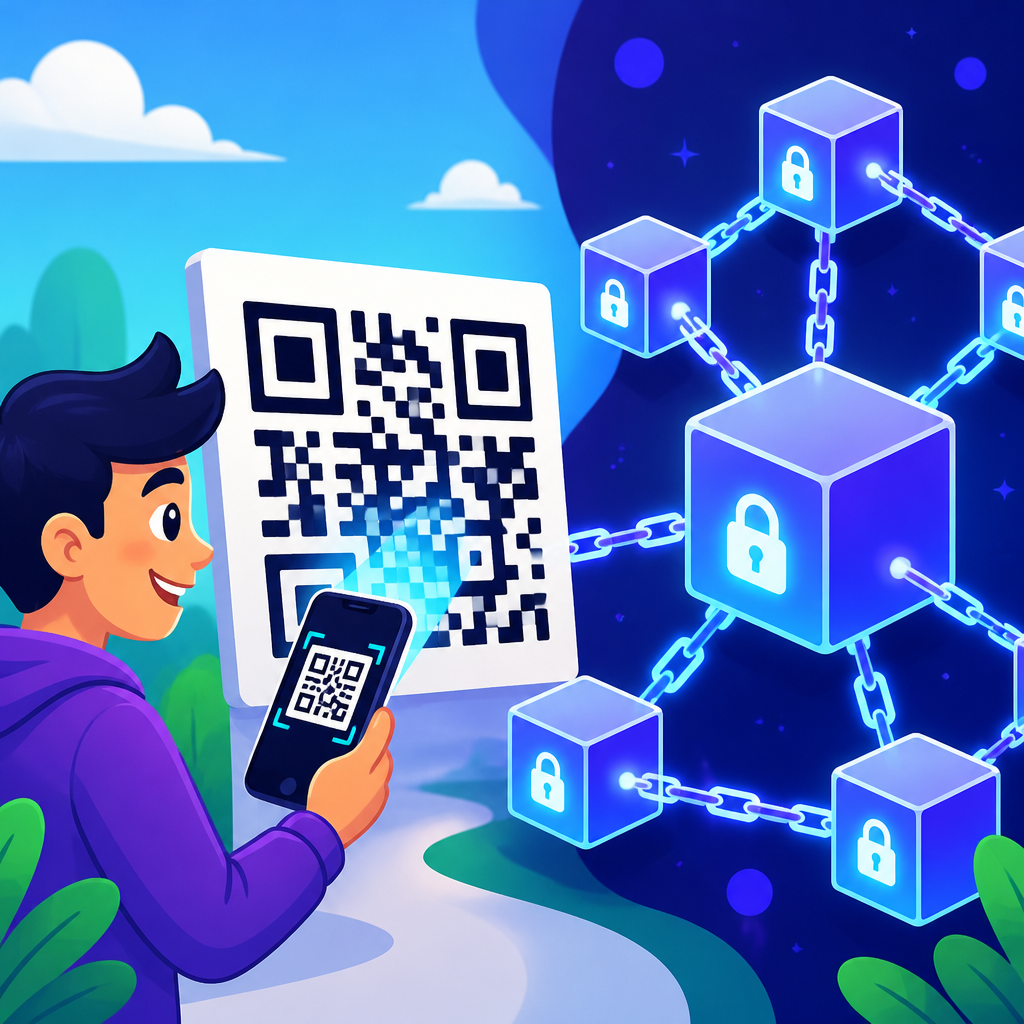
A practical architecture starts with the scan flow. The QR code may contain a secure URL, a decentralized identifier, a wallet payment string such as those used in EMVCo merchant-presented QR systems, or a compressed payload with a digital signature. After scanning, a mobile app or web client retrieves associated data from an application server, decentralized storage network, or indexer. The app then verifies one or more facts against blockchain data: whether an NFT or token exists, whether a credential is revoked, whether a product ID has already been claimed, or whether a transaction reached sufficient confirmations.
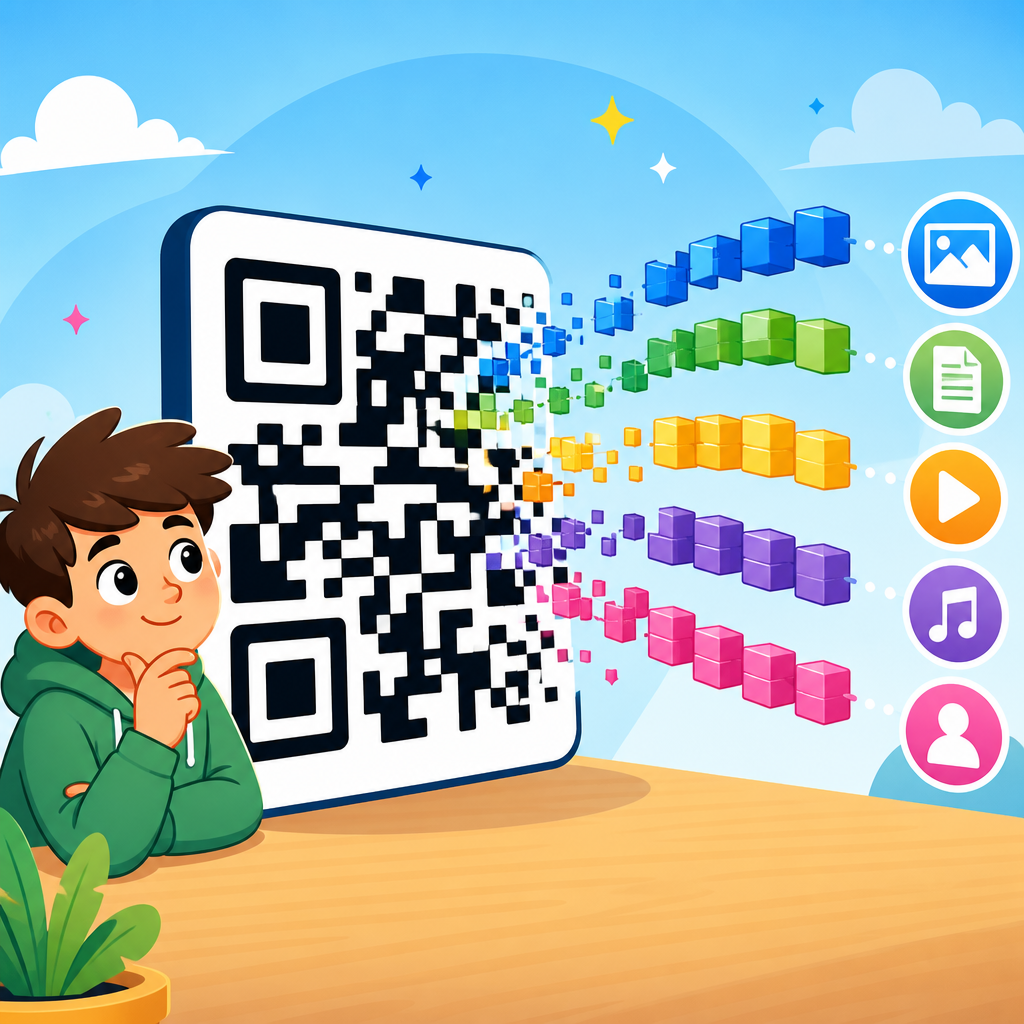
Because blockchains are inefficient storage layers for large files, most production systems keep heavy content off-chain. Product images, manuals, certificates, and media usually sit in cloud storage or decentralized networks such as IPFS, while the ledger stores hashes, identifiers, and event records. This design keeps costs manageable and improves performance. The hash is crucial because it lets the system prove that the referenced content has not changed since registration. If the stored file is edited, the hash mismatch exposes tampering immediately.
Smart contracts often govern the business logic. They can mint a token when a manufacturer creates a product passport, transfer a ticket to a new owner under resale rules, release loyalty points after a verified purchase, or mark a credential as revoked. Wallet integration may be visible to users in payment or digital asset scenarios, but many enterprise deployments deliberately abstract it away. In those cases, the user sees only a familiar QR scan and a clear result: verified, redeemed, expired, transferred, or pending review.
Payments, Identity, and Ownership Converge
One reason experts watch QR codes and blockchain integration closely is that three major digital systems are converging around the scan: payments, identity, and ownership. QR payments are already mainstream in markets such as China, India, and parts of Southeast Asia. India’s UPI ecosystem demonstrated that QR codes can scale to billions of transactions when they are standardized, inexpensive, and accepted by merchants of every size. Add blockchain-based settlement rails or tokenized money, and the QR code becomes an interface for near-instant value transfer across wallets, merchants, and potentially borders.
Digital identity follows a similar pattern. Verifiable credentials, decentralized identifiers, and selective disclosure systems allow a person to present proof without exposing unnecessary data. A QR code can request a credential, deliver a signed presentation challenge, or point to a verifier endpoint. For age verification, venue access, healthcare intake, and professional licensing, that model is more privacy-conscious than repeatedly handing over full documents. Standards work from the W3C around verifiable credentials and decentralized identifiers gives this area real structure, not just concept-stage enthusiasm.
Ownership is the third pillar. A QR code attached to a bicycle, appliance, collectible, or industrial part can link the physical item to a digital asset history. That history may include manufacturing origin, warranty activation, service events, resale records, and recycling status. The concept is especially relevant as regulators push digital product passports and sustainability disclosures. In that environment, the future of QR code technology is tied not only to commerce but to compliance, repairability, and circular economy tracking.
Standards, Security, and UX Challenges
The strongest implementations respect standards and acknowledge security limits. ISO/IEC 18004 governs the symbol itself, but interoperability depends on more than print geometry. Payment systems rely on frameworks such as EMVCo specifications. Identity layers may use W3C standards. Serialization programs in pharmaceuticals follow GS1 conventions and jurisdiction-specific rules. Ignoring these frameworks creates brittle systems that work in demos but fail in ecosystems where scanners, wallets, and enterprise platforms must cooperate.
Security also demands realism. A QR code printed on a box can still be copied, so high-assurance programs often combine unique codes with tamper-evident labels, secure elements, holographic features, geolocation analysis, or one-time activation logic. Blockchain does not make false input true. If a dishonest actor registers bad data at the start of the chain, the ledger preserves that bad data immutably. This is the classic garbage-in, garbage-forever problem, and it is why governance, onboarding controls, and audit procedures matter as much as cryptography.
User experience is equally decisive. Scans must resolve quickly on low-end devices, under poor lighting, and across native camera apps when possible. Asking mainstream users to install a wallet, manage keys, and understand gas fees will kill many otherwise good ideas. The practical path is progressive disclosure: give casual users a clean verification result, and let power users inspect deeper ledger details if they choose. If the interface cannot explain what was verified in plain language, the trust benefit gets lost.
What Businesses Should Build Next
For companies planning future QR investments, the right approach is phased, measurable, and use-case specific. Start by identifying where scans need proof, not just clicks. Counterfeit-prone categories, regulated supply chains, transferable tickets, maintenance-heavy equipment, and credential verification are strong candidates. Map the event lifecycle, choose what belongs on-chain versus off-chain, and define the exact user promise. “Scan to verify authenticity” is meaningful. “Scan for blockchain” is not.
Next, design for data stewardship and analytics. Dynamic QR management platforms, manufacturing execution systems, ERP records, and customer engagement tools still matter. Blockchain should extend these systems, not replace them blindly. Establish revocation rules, recovery procedures, and fallback behavior for offline or degraded network conditions. Measure scan completion rates, verification failures, duplicate claims, and support tickets. These metrics reveal whether the trust layer is improving outcomes or simply adding novelty.
The future of QR code technology will favor systems that connect the physical world to trustworthy digital records without burdening users. Businesses that pilot now, using real standards and narrow objectives, will be better positioned as digital credentials, product passports, and tokenized commerce mature. The opportunity is substantial, but the winners will be disciplined builders, not trend chasers.
QR codes and blockchain integration represent a practical evolution in how people verify products, payments, credentials, and ownership. The QR code remains the fastest familiar bridge from physical touchpoint to digital action, while blockchain adds persistence, shared verification, and tamper-evident records when those features are genuinely needed. Together, they can reduce counterfeit risk, improve traceability, streamline compliance, and create better user experiences across retail, logistics, education, events, and finance.
The key takeaway is that the future of QR code technology is not about the code alone. It is about the integrity of the data behind the scan, the standards supporting interoperability, and the clarity of the user journey. Strong implementations keep content off-chain when appropriate, use hashes and smart contracts carefully, and prioritize speed, privacy, and understandable verification results. Weak implementations treat blockchain as decoration and overlook governance, onboarding, and operational design.
If you are building within QR Code Technology and Development, use this topic as your hub: evaluate where trust, traceability, and transferable digital rights matter most, then design scan experiences around those outcomes. Start with one high-value workflow, test it with real users, and expand only after the verification model proves its value.
Frequently Asked Questions
How do QR codes and blockchain work together in real-world applications?
QR codes and blockchain complement each other by combining easy physical-world access with tamper-resistant digital records. A QR code acts as the user-facing entry point: someone scans it with a phone, and that action can open product data, trigger a verification workflow, connect to a wallet, or retrieve information associated with a blockchain record. The blockchain, in turn, serves as the trust infrastructure behind that experience by storing or referencing immutable events such as manufacturing milestones, ownership transfers, authenticity certificates, token issuance, or document hashes.
In practical terms, this means a QR code on a wine bottle, medicine package, luxury handbag, event ticket, or legal document can do far more than redirect to a generic webpage. It can initiate a lookup against a distributed ledger to confirm where an item came from, whether it has already been redeemed, whether a digital certificate matches the physical object, or whether a file has been changed since it was recorded. In supply chains, brands may use QR-linked blockchain records to log sourcing, processing, shipping, and inspection events. In ticketing, organizers can use blockchain-backed QR codes to reduce duplication and improve transfer tracking. In digital identity and credentialing, a QR code can point to a verifiable credential or a blockchain-anchored proof that confirms authenticity without exposing unnecessary personal data.
The key takeaway is that the QR code itself is not the blockchain. It is the bridge between a physical label or printed symbol and a trusted digital history. That bridge is what makes the combination so powerful: users get a fast, familiar scan experience, while organizations gain an audit trail that is much harder to manipulate than a standard centralized database alone.
Why is blockchain integration considered such an important evolution for QR codes?
Blockchain integration matters because it changes the role of QR codes from simple routing tools into programmable trust layers. Traditionally, a QR code’s main job was to move a user from an offline object to an online destination, such as a website, app store listing, payment page, or PDF manual. That was useful, but it did not inherently guarantee authenticity, data integrity, or transparency. A QR code could still lead to a compromised page, reference outdated information, or sit on a counterfeit item with no reliable way for a consumer to know.
When blockchain enters the picture, the scan can be tied to verifiable records instead of just content delivery. That shift is significant for industries where trust is essential. Consumers increasingly want proof of origin, proof of sustainability, proof of ownership, and proof that a product or document has not been altered. Regulators and enterprise buyers want stronger traceability. Brands want better defenses against counterfeiting and gray-market diversion. Blockchain-backed QR workflows address these demands by allowing each scan to reference time-stamped ledger entries, digital signatures, or tokenized identities that can be independently checked.
This evolution also opens the door to richer experiences. A QR code can unlock token-gated content, register ownership of a physical product, connect an item to a digital twin, or trigger smart contract logic. For example, scanning a code might prove that a collectible is genuine and also grant the owner access to member-only events or resale benefits. In that sense, the importance of blockchain integration is not just technical. It expands what QR codes can represent: not merely a shortcut to information, but a verifiable relationship between physical objects, digital assets, and trusted records.
Can a blockchain-backed QR code prevent counterfeiting and fraud completely?
No system can eliminate fraud completely, and it is important to be precise about what blockchain-backed QR codes can and cannot do. What they do exceptionally well is improve verification, traceability, and resistance to record tampering. If a product has a unique identifier linked to a blockchain record, a user can check whether the item’s provenance, ownership path, or manufacturing data aligns with what the brand recorded. That makes it much harder for counterfeiters to pass off fake goods as authentic, especially when combined with serialization, secure packaging, tamper-evident labels, cryptographic signatures, or NFC and IoT technologies.
However, a QR code by itself can still be copied visually. A bad actor might duplicate a genuine code and place it on fake goods. That is why the strongest implementations go beyond a static code printed on a box. They may use one-time scans, dynamic URLs, unique per-item identifiers, scan frequency analysis, geolocation monitoring, encrypted payloads, or backend systems that flag suspicious activity. For example, if the same supposedly unique product code is scanned in multiple countries within a short period, the system can identify that anomaly and mark the item for investigation.
Another limitation is that blockchain only secures the integrity of the data recorded to it; it does not guarantee that the original input was truthful. If false information is entered at the source, the ledger preserves that falsehood reliably. That is why trusted onboarding processes, auditable data capture, and secure issuer controls matter just as much as the blockchain layer itself. So while blockchain-integrated QR codes are a major upgrade for anti-counterfeiting and fraud reduction, they work best as part of a broader trust architecture rather than as a standalone cure-all.
What are the main business benefits of using QR codes with blockchain in supply chains and product authentication?
The business benefits are substantial because this approach improves transparency, operational efficiency, customer trust, and post-sale engagement all at once. In supply chains, blockchain-linked QR codes can provide a shared, time-stamped record of where goods came from, how they moved, and what happened to them at each checkpoint. That visibility can reduce disputes, support compliance reporting, simplify recalls, and help companies identify bottlenecks or unauthorized diversions. Instead of relying on fragmented spreadsheets or siloed systems, multiple stakeholders can reference a common history of events tied to specific products or batches.
For product authentication, the value is even more direct. Brands in luxury, pharmaceuticals, electronics, food, and collectibles can give customers an easy way to verify authenticity with a simple scan. That strengthens brand credibility and can reduce losses associated with counterfeit products. It also creates a more informed customer journey. A scan can show provenance details, certificates, care instructions, warranty activation, service records, or sustainability claims backed by verifiable data. In other words, the same authentication moment can also become a conversion, retention, and loyalty opportunity.
There are strategic advantages as well. A blockchain-integrated QR system can support resale ecosystems, circular economy programs, and digital ownership models. Companies can track repairs, refurbishment, ownership transfers, and recycling events tied to a single item over time. That is increasingly valuable as brands look to participate in recommerce, tokenized memberships, and connected product experiences. From a business perspective, the combination of trust, efficiency, and richer customer interaction is what makes this model so attractive. It turns a low-cost printed interface into a gateway for data integrity, operational intelligence, and long-term brand value.
What should companies consider before implementing QR code and blockchain integration?
Companies should begin with a clear use case rather than adopting blockchain simply because it sounds innovative. The first question is what problem needs to be solved: counterfeit prevention, document integrity, chain-of-custody tracking, digital ownership, loyalty access, regulated compliance, or consumer transparency. Once that objective is defined, the business can decide whether blockchain is truly necessary, which data should be on-chain versus off-chain, and how the QR experience should work for end users. Not every use case needs a public blockchain, and not every data point belongs on a ledger. Good architecture usually balances transparency, privacy, performance, and cost.
Implementation design also matters. Companies need to think about whether codes will be static or dynamic, whether each item will receive a unique identity, how updates will be managed, what happens if a code is copied, and how scans will be validated. They should also evaluate wallet requirements, user friction, mobile compatibility, and accessibility. If the scan experience is confusing or slow, adoption will suffer even if the backend is technically sophisticated. Security and governance are equally important: who can write data to the chain, how issuer identities are protected, how errors are corrected, and how integrations connect with ERP, CRM, manufacturing, or logistics systems.
Finally, legal and operational issues should not be overlooked. Data privacy rules, jurisdictional compliance, smart contract risks, and long-term maintenance all deserve attention. Organizations should also plan for education, because users may not understand what is being verified when they scan. The strongest deployments make the trust model simple and visible: explain what the scan confirms, show meaningful proof in plain language, and avoid unnecessary technical jargon. When executed thoughtfully, QR code and blockchain integration can be highly effective. But success depends on aligning the technology with a practical business goal, a secure data model, and a user experience that feels effortless.