QR code SDKs let mobile apps scan, generate, and manage QR codes with far more speed, accuracy, and control than building those capabilities from scratch. In practical terms, a software development kit bundles camera access patterns, image processing routines, decoding libraries, security checks, and platform-specific components into a package your iOS or Android team can ship quickly. I have implemented QR code SDKs in retail checkout flows, ticketing apps, warehouse tools, and patient intake systems, and the same pattern appears every time: the SDK choice shapes performance, maintenance cost, and user trust.
To use QR code SDKs in mobile apps effectively, you need to understand what the SDK actually does. A QR code scanner SDK typically handles live camera frames, image preprocessing, barcode localization, decoding, and result callbacks. A QR code generator SDK creates standards-compliant symbols from text, URLs, payment payloads, or app-specific identifiers while letting developers control size, error correction, encoding mode, and branding. Some vendors also package analytics, dynamic code management, cloud dashboards, or anti-fraud checks. That broader toolkit matters because many teams discover too late that scanning is only one piece of a larger product workflow.
This topic matters because QR codes now sit inside critical customer journeys. Restaurants use them for menus and payments. Airlines use them for boarding. Logistics teams use them for chain-of-custody events. Healthcare organizations use them for specimen tracking and patient identification, often under strict privacy controls. In each case, a missed scan, slow autofocus loop, or unreadable generated code creates immediate operational friction. Mobile developers therefore need a clear view of QR code APIs and SDKs, how they differ, and when to choose one over another. This hub article covers the core decisions, integration steps, testing methods, and security practices that determine whether your QR code experience feels effortless or fragile.
What QR Code SDKs Include and When to Use APIs Instead
A QR code SDK is usually embedded directly inside the mobile app, while a QR code API is often called over the network for generation, management, analytics, or dynamic redirection features. In app architecture terms, SDKs are best when low latency, offline use, and direct camera processing matter. APIs are best when business logic changes frequently, when you need centralized campaign controls, or when nontechnical teams must manage codes after release. Most production systems use both: the mobile SDK scans or renders codes locally, and an API handles code issuance, metadata lookup, expiration, or event logging on the backend.
On iOS, developers often start by evaluating native frameworks such as AVFoundation and Vision. On Android, ML Kit, CameraX, and Google code scanner options are common starting points. Cross-platform teams may look at ZXing, ML Kit wrappers, or commercial vendors that support Flutter, React Native, Xamarin, Kotlin Multiplatform, and Unity. Commercial SDKs such as Scandit, Dynamsoft, and Zebra often outperform basic open-source stacks in low light, high-motion, damaged-code, or multi-code scenarios. That premium matters in enterprise field use, where a one-second delay repeated thousands of times per day turns into real labor cost.
The practical decision is simple: use a QR code SDK when scan quality and in-app responsiveness are core to the user experience, and use a QR code API when server-side control and centralized data matter. If your app validates event tickets at a stadium gate with weak connectivity, on-device scanning is mandatory. If your marketing team changes landing pages behind printed codes, dynamic API-managed routing is mandatory. A good hub strategy links these implementation decisions to separate deep dives on native scanning, dynamic QR code systems, analytics pipelines, and QR code generation services.
How to Choose a QR Code SDK for iOS, Android, and Cross-Platform Apps
The best QR code SDK for mobile apps is the one that matches your scan environment, device mix, compliance obligations, and engineering capacity. Start with decode performance. Ask how the SDK handles small codes, curved surfaces, glare, inverse codes, dense payloads, and damaged finder patterns. In warehouses, I test at arm’s length and under fluorescent flicker. In consumer apps, I test on cracked midrange Android phones in dim kitchens and moving cars. Lab demos are not enough. Your acceptance criteria should include time to first decode, success rate across target devices, and battery impact during extended scanning sessions.
Next, evaluate platform fit and maintenance burden. Native iOS and Android SDKs usually expose the deepest camera controls and best performance. Cross-platform wrappers save time, but they can lag on new operating system changes and create debugging complexity around camera permissions, lifecycle events, and texture rendering. Review documentation quality, sample apps, release cadence, and support SLAs. Check whether the vendor supports arm64, simulator builds, offline licensing, CI integration, and privacy-friendly operation without forced telemetry. Teams underestimate support quality until a production rollout is blocked by a vendor-specific crash.
Security and compliance belong in the selection phase, not after launch. If the app scans personally identifiable information, health data, or payment payloads, review how data is processed, stored, and transmitted. A strong vendor should explain on-device processing boundaries, encryption options, and logging controls clearly. Also review standards support. QR implementations often intersect with GS1 Digital Link, EMVCo payment specifications, FIDO device onboarding, or ISO-aligned encoding conventions depending on the use case. Choosing a generic decoder without understanding these payload formats often creates expensive rework later.
| Selection Factor | What to Check | Why It Matters |
|---|---|---|
| Scan performance | Low light, glare, motion, damaged codes, dense payloads | Determines real-world read rate and user friction |
| Platform support | iOS, Android, Flutter, React Native, Unity, updates | Affects implementation speed and long-term maintenance |
| Offline capability | Local decode, local validation, offline licensing | Critical for field operations and poor connectivity |
| Security controls | Data handling, local processing, redaction, encryption | Reduces privacy and compliance risk |
| Generation features | Error correction, vector output, logo handling, sizing | Prevents unreadable or brand-damaged codes |
| Vendor reliability | Documentation, sample apps, SLA, release cadence | Lowers support delays during production incidents |
Integrating a QR Code Scanner SDK into a Mobile App
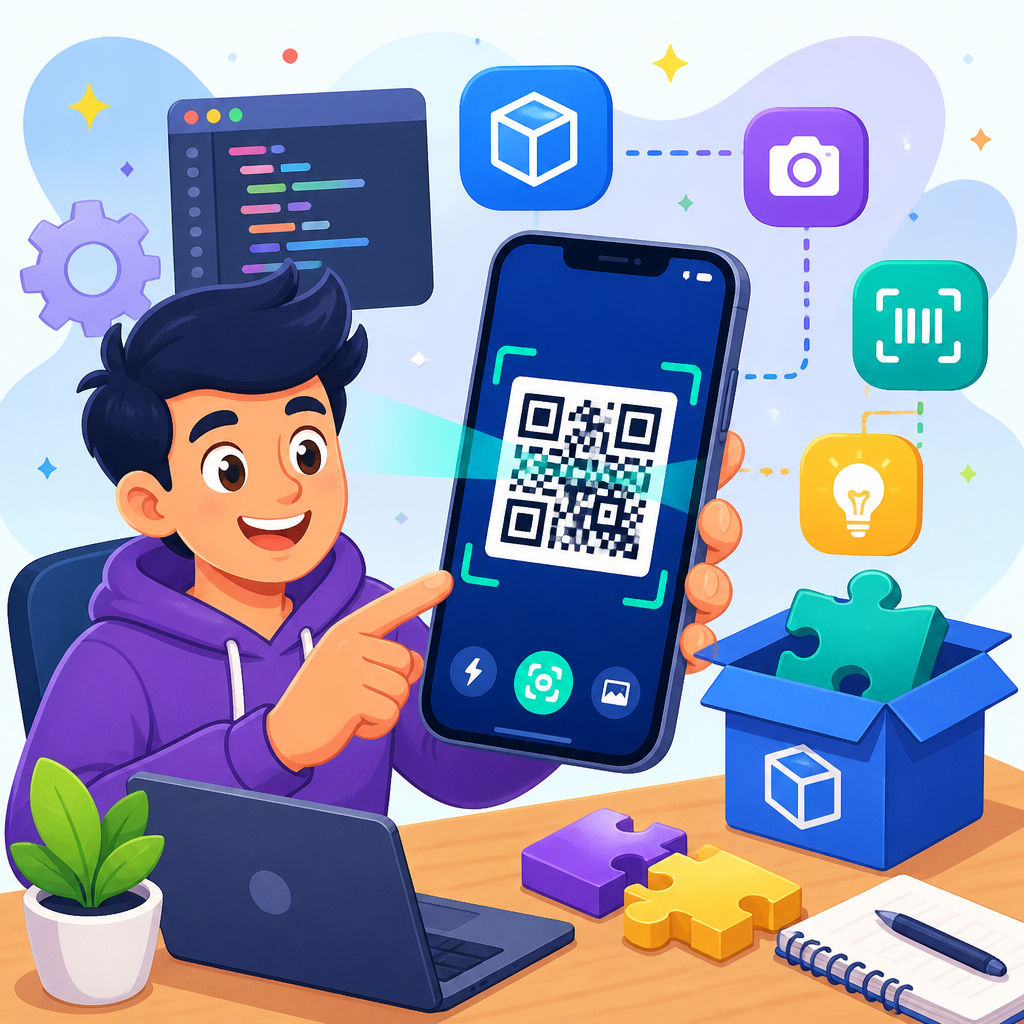
Integration starts with camera permissions, lifecycle management, and a stable preview pipeline. On iOS, that usually means configuring AVCaptureSession or the vendor’s abstraction, selecting the rear camera, setting focus and exposure behavior, and handling app foreground and background transitions. On Android, CameraX has become the safest default for many teams because it abstracts device fragmentation better than the older Camera API. The scanner SDK then receives image frames, analyzes them, and emits structured results through listeners, delegates, or coroutines. The key engineering task is reducing latency between frame capture and decode callback.
The user interface matters as much as the decoder. Good scan flows guide the user with a visible framing box, haptic feedback on success, duplicate-scan suppression, torch control, and clear fallback paths. In ticketing apps, I typically pause scanning briefly after a successful decode to prevent accidental double admissions. In inventory apps, I keep continuous scanning on and pair each scan with an audible confirmation because workers may not be looking directly at the screen. Those design choices sit above the SDK, but they determine whether the feature feels polished or chaotic.
You also need to decide what happens after the SDK returns data. Never assume the decoded string is safe or complete. Normalize whitespace, validate the payload format, and decide whether the code should trigger in-app navigation, an API lookup, or a guarded browser handoff. If the QR code contains a URL, inspect the domain before opening it. If it contains structured data such as vCard, Wi-Fi credentials, or payment instructions, parse according to the relevant specification instead of using ad hoc string splitting. Most QR code production bugs happen after decoding, not during it.
Generating QR Codes That Stay Scannable in Real Conditions
Generating a QR code in a mobile app looks simple, but producing one that scans reliably after resizing, branding, printing, or screenshot compression requires discipline. Start with payload design. Shorter content creates less dense symbols, and less dense symbols scan more easily. If you control the backend, encode a compact identifier and resolve it server-side instead of embedding long URLs with tracking parameters. Choose an appropriate error correction level. Higher correction improves resilience to damage or logos but increases symbol density. In practice, moderate settings are often safer than pushing correction too high on small codes.
Quiet zone preservation is nonnegotiable. Every generated QR code needs sufficient blank margin around the symbol so scanners can isolate it. Logos, gradients, and decorative frames are common reasons codes fail. If brand styling is required, test variants across multiple devices and print conditions. Export vector assets such as SVG or PDF when codes will be printed, because raster images can blur module edges when scaled. For in-app display, generate at a pixel size matched to screen density and avoid image smoothing. Crisp contrast, especially dark modules on a light background, still beats visual flair.
Dynamic QR code systems change the destination or metadata behind a stable visible code, which is useful for campaigns, support flows, and product packaging. Static codes permanently encode the final payload, which is better for offline verification, fixed identifiers, and simpler threat models. Neither approach is universally better. A hospital wristband system should usually prefer static or tightly controlled tokenized codes with clear expiration logic. A restaurant promotion should usually prefer dynamic routing with analytics. The right generation approach depends on lifespan, edit frequency, audit needs, and the consequences of a bad scan.
Performance, Testing, Analytics, and Security Best Practices
Performance tuning starts with measurable baselines. Track scan success rate, median time to decode, low-light performance, crash-free sessions, and battery consumption during repeated scans. Test on flagship phones and low-end devices, because autofocus speed, camera sensor quality, and thermal throttling vary widely. Build a test matrix that includes glossy labels, wrinkled paper, partially obscured codes, different screen brightness levels, and varying code sizes. I also recommend testing from both printed materials and another phone’s display because moiré patterns and refresh artifacts can affect readability.
Analytics should answer operational questions, not just marketing ones. Measure where scans happen, what percentage require torch use, which devices underperform, and how often decoded payloads fail downstream validation. Those signals tell you whether you have a camera problem, a code design problem, or a backend problem. If you use dynamic QR code APIs, log redirect latency and destination availability too. For privacy, store only what you need. Tokenize identifiers where possible, redact sensitive payloads from logs, and ensure observability tools do not capture raw code contents unnecessarily.
Security requires layered controls because QR codes can encode malicious links, credential traps, or misleading instructions. Apps should validate domains against an allowlist when codes are expected to point only to trusted properties. Use signed payloads or short-lived tokens for sensitive actions such as payments, login approvals, or identity verification. Expire one-time codes promptly and tie them to session or device context where appropriate. Finally, document fallback procedures. If scanning fails at a gate, counter, or bedside, staff need a manual lookup path. Reliable mobile QR code systems are not just technically correct; they are operationally resilient.
Building a Strong QR Code APIs and SDKs Content Hub
A strong QR Code APIs & SDKs hub should guide readers from broad decisions to implementation detail. This page should connect naturally to supporting articles on iOS QR scanner development, Android QR scanner development, Flutter and React Native integrations, QR code generation libraries, dynamic QR code APIs, secure QR authentication, GS1 and payment payload formats, testing frameworks, and analytics setup. That internal linking structure helps developers find the next specific answer quickly while signaling topical depth across the broader QR Code Technology & Development cluster.
The main takeaway is straightforward: successful QR features depend on much more than dropping a scanner into a camera view. You need the right SDK architecture, realistic performance testing, standards-aware payload handling, careful generation settings, and security controls that match the business risk. Teams that treat QR code SDKs as infrastructure rather than a cosmetic add-on ship faster and spend less time fixing edge cases later. If you are planning a new mobile implementation, audit your scan environment, payload types, platform stack, and compliance needs first, then choose the QR code APIs and SDKs that fit those realities.
Use this article as the starting point for your subtopic strategy, then map each requirement to a dedicated build guide or comparison page. The clearer your architecture decisions are now, the easier it becomes to create fast, reliable, and secure QR experiences at scale.
Frequently Asked Questions
What is a QR code SDK, and why should mobile teams use one instead of building QR features from scratch?
A QR code SDK is a software development kit that gives your mobile app the core tools needed to scan, decode, generate, and often validate QR codes without forcing your team to build the entire pipeline themselves. In most cases, that pipeline includes camera handling, real-time frame processing, image cleanup, decoding logic, error correction support, barcode format detection, and platform-specific integration for iOS and Android. A well-designed SDK wraps those capabilities into APIs, sample code, and documentation so developers can move from concept to production much faster.
For most teams, the biggest advantage is reliability. Scanning a QR code sounds simple until you account for poor lighting, motion blur, damaged labels, reflective packaging, low-end cameras, awkward scan angles, or dense codes with a lot of data. SDKs are designed to deal with these real-world conditions using optimized image processing and decoding routines that have already been tested across many devices. That usually means faster scan times, fewer false negatives, and a much smoother user experience.
There is also a major speed-to-market benefit. Building a scanner or generator from scratch requires deep work in computer vision, camera lifecycle management, native device optimization, and security review. That effort can be hard to justify when your app’s core value is retail checkout, ticket validation, warehouse operations, or patient intake rather than barcode research. An SDK lets your team focus on business logic and workflow design while still delivering high-quality QR functionality. In practice, that can shorten development cycles substantially and reduce long-term maintenance because the SDK vendor keeps improving performance, device compatibility, and operating system support over time.
What features should I look for when choosing a QR code SDK for iOS and Android?
The right QR code SDK should do more than simply read a code in perfect lab conditions. Start by evaluating scan performance in realistic scenarios: low light, cracked screens, wrinkled labels, glossy surfaces, angled cameras, and moving targets. A strong SDK should provide fast detection, accurate decoding, and stable behavior across both premium and lower-powered devices. If your app will be used in stores, warehouses, transport hubs, healthcare settings, or outdoor environments, real-world performance matters more than a polished demo.
Next, look at platform support and integration flexibility. Some SDKs offer native libraries for Swift, Objective-C, Kotlin, and Java, while others provide wrappers for cross-platform frameworks such as Flutter, React Native, or Xamarin. Make sure the SDK fits your mobile stack and does not create unnecessary friction in your build pipeline. You should also review whether it supports offline scanning, front and rear camera use, custom scan overlays, continuous scanning modes, batch scanning, and QR code generation with configurable size, color, and error correction levels.
Security and maintainability are just as important. If your app handles login tokens, payments, tickets, or health information, the SDK should support secure parsing practices and help you manage untrusted input safely. Good documentation, sample apps, release notes, and responsive vendor support are strong indicators of a mature product. Finally, review licensing carefully. Some SDKs charge per app, per scan volume, per seat, or per platform, and those costs can become significant as usage grows. The best choice is usually the SDK that balances decoding quality, integration simplicity, customization options, vendor reliability, and total cost of ownership.
How do you integrate a QR code SDK into a mobile app workflow?
Integration usually starts by adding the SDK through your platform’s package manager or dependency system, then configuring camera permissions and initializing the scanner component according to the vendor’s documentation. From there, you create the scan screen, connect the live camera preview, and define what should happen when a QR code is detected. In a retail app, that might mean retrieving product or payment data. In a ticketing app, it could trigger pass validation. In a warehouse tool, the app may map the code to an inventory location or shipment record. In a patient intake flow, it might pull appointment context or verify a registration token.
The most effective implementations treat scanning as part of a broader business process rather than as an isolated feature. That means designing for success states, failure states, and edge cases. For example, you may need duplicate scan prevention, timeout handling, invalid code messaging, poor camera permission recovery, and offline fallback logic. If your app supports both scanning and generating QR codes, the generation flow should also be integrated cleanly into the user journey, such as creating check-in passes, payment codes, pickup confirmations, or device-pairing tokens.
It is also important to optimize the experience around the SDK itself. Add visual guidance with a scan frame, clear instructions, and feedback when a code is recognized. Consider whether you need continuous scanning for high-throughput scenarios or single-shot scanning for consumer flows. Log scan outcomes so you can monitor performance and identify bottlenecks in production. Finally, test on a wide range of devices and operating system versions. A technically correct integration is only the starting point; a production-ready integration is one that feels fast, clear, and dependable in the specific workflow your users follow every day.
Are QR code SDKs secure, and what security best practices should developers follow?
QR code SDKs can absolutely be used securely, but the SDK itself is only one part of the security picture. A QR code is really just a container for data, and your app has to decide how much it trusts that data. If a QR code points to a URL, contains a token, or embeds structured information, your app should validate it before taking any sensitive action. That means checking expected formats, verifying signatures where applicable, enforcing domain allowlists, rejecting malformed payloads, and avoiding blind redirects or automatic execution of embedded instructions.
Developers should also think about transport and backend security. If a scan triggers an API request, use encrypted connections, authenticated endpoints, and short-lived tokens where possible. In payment, ticketing, healthcare, and enterprise use cases, it is common to pair QR scanning with server-side validation so the app does not rely solely on what is encoded locally. This can help prevent replay attacks, forged passes, fake inventory labels, or unauthorized access attempts. If personally identifiable or regulated data is involved, the app should minimize what is stored on-device and follow the relevant compliance requirements for logging, retention, and encryption.
From an implementation standpoint, choose an SDK from a reputable vendor that publishes updates, addresses vulnerabilities, and maintains compatibility with current mobile operating systems. Keep the SDK version current, review changelogs, and include QR-related logic in your normal security testing process. That should include malformed input testing, unexpected payload lengths, suspicious URLs, and behavior under weak network conditions. In short, a QR code SDK can provide a secure foundation, but secure results come from pairing it with strong validation rules, backend controls, and careful app-level decision-making.
How can I improve scan speed and accuracy when using a QR code SDK in real-world mobile apps?
Improving scan speed and accuracy starts with choosing an SDK that is already optimized for difficult conditions, but implementation details matter just as much. Camera configuration is one of the first levers to tune. Use a resolution high enough for reliable decoding without overloading the device with unnecessary image data. Some apps benefit from limiting the scan region so the SDK processes only the area inside the on-screen frame. That reduces work per frame and often produces faster, more stable detection, especially on older phones.
User interface design also has a major impact. Give users clear instructions to center the code, hold the phone steady, and move closer if needed. Use strong visual contrast in the scan area and immediate feedback when detection starts or succeeds. In high-volume environments like warehouse aisles or event entry lines, continuous scanning modes, duplicate suppression, and automatic focus strategies can make a noticeable difference. In consumer apps, you may prefer a simpler single-scan flow that prioritizes clarity over throughput.
Testing is where real optimization happens. Measure performance across different phone models, operating system versions, lighting conditions, code sizes, print qualities, and display surfaces. Test damaged and partially obscured codes, because production environments are rarely clean. If your app generates QR codes too, make sure you are producing codes with an appropriate size, quiet zone, and error correction level for the intended use case. A code displayed on a checkout terminal has different constraints than one printed on a shipping label or embedded in a patient form. The best results come from treating scanning as a system: the SDK, the camera setup, the UI, the code quality, and the workflow all have to work together.