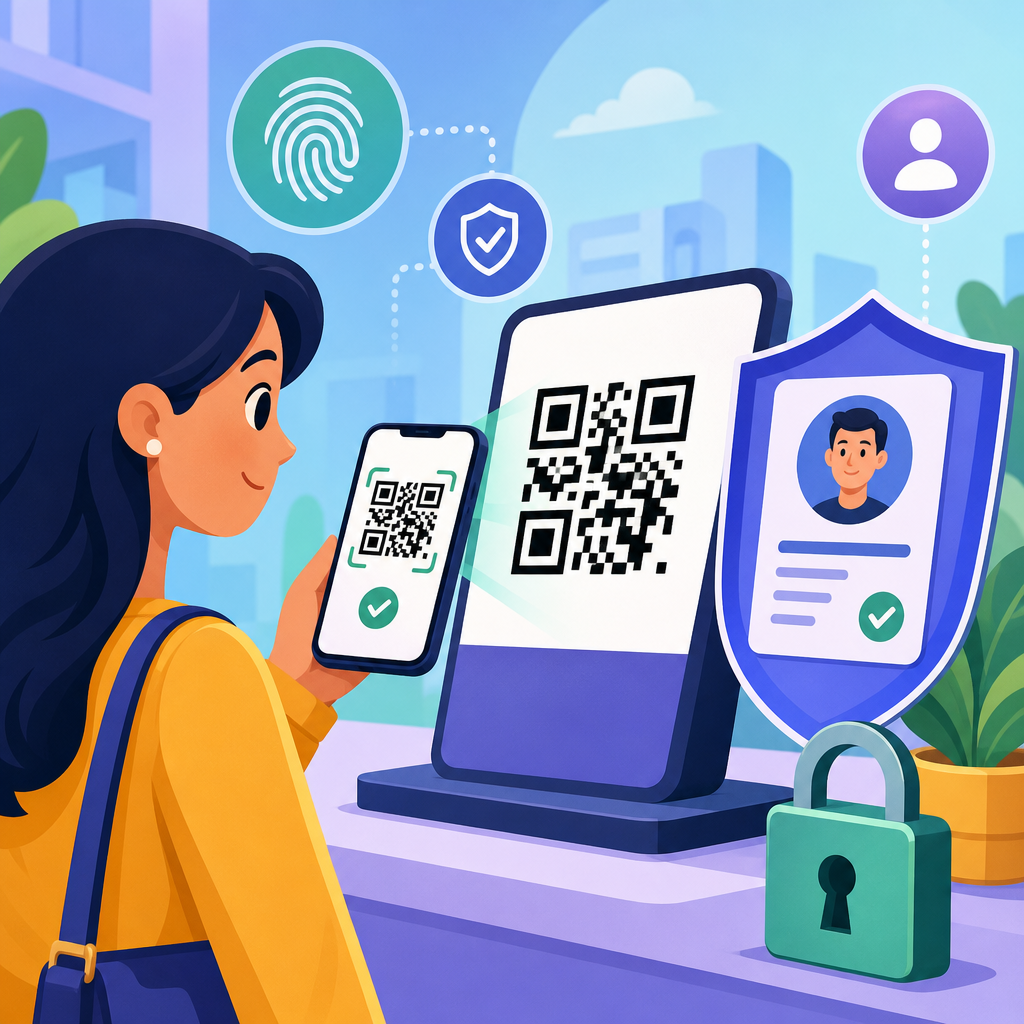
QR codes for digital identity and authentication are moving from a niche convenience to a core part of how people prove who they are, access services, and protect accounts across physical and digital environments. A QR code is a machine-readable matrix barcode that stores data such as a URL, token, or signed credential reference, while digital identity is the collection of attributes, documents, and cryptographic proofs that represent a person, device, or organization online. Authentication is the process of verifying that identity claim, whether through a login, a boarding pass, a health record, or a secure building entry flow.
I have worked on QR-based onboarding, event access, and account recovery systems, and the lesson is consistent: the code itself is rarely the product. The value lies in the trust framework behind it. A static QR code that simply opens a webpage offers convenience, but a dynamic QR code tied to short-lived tokens, device binding, public key cryptography, and audit controls can support far stronger identity assurance. That distinction matters because organizations increasingly need login methods that reduce password dependence, limit phishing exposure, and still work well on ordinary smartphones.
This topic matters because digital identity has become infrastructure. Banks must verify customers under know your customer rules, employers issue workforce credentials, healthcare providers share records, and governments expand mobile identity programs. At the same time, users expect sign-in journeys that are fast and familiar. QR code authentication sits at the intersection of those demands. It can connect a desktop login to a trusted mobile app, deliver verifiable credentials, initiate wallet-based identity exchange, or act as a bridge for passwordless access. As the future of QR code technology develops, identity and authentication are among the highest-impact use cases because they combine usability, security, interoperability, and broad consumer reach.
How QR Codes Power Digital Identity and Authentication
At a practical level, QR codes for authentication usually do one of three things. First, they can carry a signed payload directly, such as a verifiable pass or offline credential. Second, they can encode a pointer, often a URL or URI, that opens an identity transaction with a server. Third, they can transfer a challenge between devices, such as when a laptop shows a QR code and a mobile authenticator scans it to approve login. The third model is now common in messaging apps, enterprise single sign-on deployments, and passwordless login experiences because it reduces manual entry and links the session to a device the user already trusts.
A secure implementation depends on more than the visual code. Good systems issue short-lived challenges, bind approvals to a private key stored in secure hardware, and verify the relying party before the user consents. Standards bodies and large platform vendors have pushed this direction for years. FIDO-based passkey ecosystems, OpenID Connect flows, and W3C Verifiable Credentials all influence modern QR identity design. In a well-built flow, the QR code is only the carrier for a transaction request. The actual proof happens through cryptographic signatures, token exchange, attestation, or wallet-mediated consent. That is why QR code authentication can be both simple for users and strong enough for regulated environments.
One reason adoption is rising is cross-device convenience. Consider a customer using a desktop browser to access a tax portal. Typing a long password, receiving an SMS one-time code, and completing identity verification can create friction and support costs. A QR code on the desktop can instead trigger the government mobile ID app. The app confirms the website origin, prompts for biometrics, signs the authentication challenge, and returns an assertion to the browser. The user completes login in seconds, and the agency avoids many of the weaknesses associated with knowledge-based authentication and SMS interception.
Core Models Shaping the Future of QR Code Technology
The future of QR code technology in identity is being shaped by four models: login initiation, credential presentation, document verification, and device pairing. Login initiation is the most familiar. A service displays a code, a mobile app scans it, and the app approves access. Credential presentation is broader. Here, a QR code can request specific claims such as age over eighteen, employee status, or vaccination history, and a digital wallet can share only the needed data. Document verification uses QR codes embedded in IDs, certificates, or permits so a verifier can check signatures and revocation status. Device pairing links hardware, kiosks, TVs, or workstations to a known identity account with minimal typing.
These models differ in risk and architecture. Login initiation usually requires online connectivity and session management. Credential presentation may support offline verification if the credential and issuer signature can be validated locally. Document verification often needs robust anti-tampering controls, especially when screenshots or printed copies are accepted. Device pairing has lifecycle concerns such as revocation, re-enrollment, and recovery when a phone is lost. Teams that treat every QR flow as identical often create avoidable security gaps. In deployments I have reviewed, the strongest designs begin with a threat model: what is being proven, to whom, for how long, and under what adversarial conditions.
Regional policy is also accelerating change. The European Union Digital Identity Wallet initiative, mobile driver’s license programs based on ISO/IEC 18013, and expanding digital travel credential pilots all point toward credential exchange experiences where QR codes remain a practical bridge between wallets and verifiers. Even when near-field communication or deep app integration exists, QR codes retain an advantage: they are cheap to display, easy to print, camera-readable at scale, and usable across consumer devices without specialized hardware. That universality is why they continue to appear in future-facing identity architectures rather than being displaced by newer interfaces.
Security Strengths, Risks, and Design Requirements
QR-based identity systems improve security when they replace shared secrets with possession-based and cryptographic proofs, but they also create new attack surfaces. The main strengths are phishing resistance, reduced password reuse, and better cross-device login ergonomics. If a user approves a challenge inside a trusted app that validates the service domain and signs with a private key, the flow is materially safer than typing credentials into a browser form. This is especially true when the private key is protected by a device secure enclave or trusted execution environment and unlocked with biometrics.
The main risks are QR code substitution, malicious redirection, replay attacks, session fixation, and insecure fallback paths. I have seen production pilots where a printed code linked to a generic login page without origin binding, making it easy for an attacker to replace signage or inject a lookalike destination. Another common mistake is allowing long-lived QR tokens that can be photographed and reused. Effective controls are well established: use transaction-specific nonces, set expiry windows in seconds rather than minutes, require mutual context between scanning device and relying service, sign requests, pin expected domains in the authenticator, and maintain revocation and audit logs. Accessibility matters too; if a user cannot scan the code, the backup method must remain secure rather than quietly reverting to email links or weak recovery questions.
| Use Case | What the QR Code Carries | Main Security Control | Primary Risk |
|---|---|---|---|
| Desktop login approval | Short-lived authentication challenge | Device-bound cryptographic signing | Phishing through fake login screens |
| Credential presentation | Request for specific claims or credential URI | Selective disclosure and verifier validation | Oversharing personal data |
| Printed certificate verification | Signed document reference or embedded payload | Signature and revocation checking | Screenshot or copy misuse |
| Device pairing | Enrollment token and device metadata | One-time use token plus user confirmation | Unauthorized device binding |
Real-World Applications Across Industries
Financial services use QR codes for account onboarding, step-up authentication, and branch-assisted identity proofing. A bank may display a QR code during a desktop application flow so the customer can continue identity verification in a secure mobile app with document capture, liveness checks, and consent logging. In workforce environments, QR codes are used for visitor management, privileged workstation login, and shared device access on factory floors where typing passwords is impractical. Healthcare providers use them to link patients to portals, verify appointment check-in, or exchange signed records. Travel and events rely on them for boarding, ticketing, and membership verification, often combining identity attributes with fraud detection and expiration rules.
Government and education may see the largest long-term transformation. Universities already issue digital student IDs and can use QR-driven wallet flows for campus access, exam verification, and library privileges. Public agencies can use the same pattern for benefits access, permit validation, and in-person service authentication. During large-scale deployments, operational details determine success. Staff need verifier apps that clearly show whether a credential is valid, expired, or revoked. Connectivity assumptions must be tested in low-signal environments. Privacy notices must explain what data is collected during each scan. The systems that earn trust are not the flashiest; they are the ones that make verification dependable, transparent, and easy to audit.
What Comes Next for QR Identity Systems
The next phase of QR identity will be defined by wallet interoperability, selective disclosure, stronger anti-phishing patterns, and better offline verification. Users will increasingly scan a code not just to sign in, but to share exactly the claims required for a transaction. A bar serving alcohol may only need proof that a customer is above the legal age threshold, not a full address and date of birth. A hiring platform may only need proof of a certification issued by a recognized body. As standards mature, these exchanges will become more portable across issuers, wallets, and verifiers, reducing the lock-in that has limited many early pilots.
Artificial intelligence will also influence implementation, though mostly on the verifier side. Fraud systems already analyze device reputation, network anomalies, and behavioral signals around QR-initiated sessions. Computer vision can help detect tampered codes in physical environments, while risk engines can trigger stronger checks when a scan occurs from an unusual location or on a compromised device. Still, AI is an enhancer, not the trust anchor. The future of QR code technology for identity will remain grounded in cryptography, policy, and standards-based interoperability. Organizations planning now should map use cases, choose open protocols where possible, minimize retained personal data, and pilot with clear metrics such as completion rate, fraud reduction, help desk volume, and recovery success. The payoff is substantial: a faster, safer, and more portable identity experience that works across devices people already carry. Start by auditing one login or verification journey where passwords, paper documents, or manual checks create the most friction, and redesign it around a secure QR flow.
Frequently Asked Questions
1. How are QR codes used for digital identity and authentication?
QR codes act as a fast, scannable bridge between a person, a device, and an identity system. In digital identity workflows, a QR code can contain a secure login request, a one-time token, a cryptographic challenge, a link to a verified credential, or a reference that tells an identity wallet or authentication app what action to perform. When a user scans the code with a trusted mobile app, the app can prompt them to approve sign-in, present a verified identity attribute, or confirm possession of a registered credential.
This model is increasingly common in passwordless login, account recovery, access control, event check-in, healthcare registration, workforce identity, and customer onboarding. For example, a website may display a QR code during sign-in. The user scans it with an identity app on their phone, verifies themselves using biometrics or a PIN, and the app cryptographically confirms the login back to the service. In another case, a venue or service provider may scan a QR code displayed by the user’s identity wallet to verify age, membership, employee status, or eligibility without manually checking paper documents.
The reason QR codes fit so well into authentication is that they simplify handoff between screens, devices, and trust systems. Instead of typing passwords, copying codes, or clicking potentially risky links, the user can complete a secure interaction with a single scan. When backed by strong cryptography and well-designed identity protocols, QR-based authentication can improve convenience while also reducing friction and limiting exposure to common credential-based attacks.
2. Are QR codes secure enough for identity verification and account authentication?
QR codes themselves are not inherently secure or insecure; they are simply a method for encoding data in a visual format. The real security depends on what the QR code contains, how long it remains valid, what system processes it, and what protections surround the scan and approval flow. A static QR code that links to a generic webpage offers very little protection on its own. By contrast, a dynamic QR code tied to a short-lived cryptographic challenge, device binding, and user verification can support a very strong authentication process.
In secure implementations, QR codes are often used to initiate a transaction rather than carry all sensitive information directly. The code may reference a one-time session, a signed request, or a nonce that expires quickly and can be redeemed only by an authorized app or identity wallet. After scanning, the user may still need to verify with biometrics, a passcode, or hardware-backed keys. The service then validates signatures, checks device trust, confirms token freshness, and ensures the request has not been altered or replayed.
That said, there are real risks. Attackers can replace legitimate QR codes with malicious ones, trick users into scanning fake login prompts, or direct them to phishing sites designed to capture credentials. This is why trustworthy user interfaces, origin verification, certificate validation, app-level warnings, and strong anti-phishing design matter. The best way to think about QR codes in identity is not as a security feature by themselves, but as a delivery and interaction mechanism that becomes secure when paired with modern authentication controls, cryptographic verification, and sound operational practices.
3. What are the main benefits of using QR codes for passwordless authentication?
One of the biggest advantages is convenience. QR codes remove the need to remember or type passwords, especially on shared terminals, smart TVs, kiosks, or desktop systems where entering credentials can be tedious or risky. A user can simply scan the code with a trusted mobile device that is already enrolled with their identity provider. That creates a smoother sign-in experience and often leads to higher completion rates, fewer login errors, and less support burden related to password resets.
QR-based passwordless authentication also improves security in several important ways. Because the user authenticates through a registered device or identity wallet, the service can rely on stronger factors such as biometrics, device-bound private keys, and cryptographic signing. This reduces dependence on reusable shared secrets, which are often stolen through phishing, credential stuffing, or poor password hygiene. In well-built systems, the QR code initiates a challenge-response flow, meaning the user is not exposing a password at all.
There are also operational and business benefits. Organizations can use QR-based authentication across physical and digital touchpoints, making it easier to unify access control, customer identity, employee login, and service verification under one architecture. It can support bring-your-own-device models, reduce hardware distribution costs, and improve interoperability between apps, browsers, and identity platforms. For many organizations, the appeal is the combination of lower friction, stronger assurance, and a more modern user experience that fits the way people already use their phones.
4. What is the difference between a QR code used for login and a QR code used for digital identity verification?
A QR code used for login typically helps prove that the person trying to access an account is the legitimate account holder. Its main purpose is authentication. In that scenario, the QR code often appears on a website, terminal, or application and contains a login session request or cryptographic challenge. The user scans it with a trusted authentication app, verifies themselves locally, and approves the request. The service then grants access based on the successful authentication response.
A QR code used for digital identity verification, on the other hand, is more focused on proving or sharing specific identity attributes. Instead of simply confirming “this is the rightful user,” the workflow may confirm details such as legal name, age, residency, employee status, student affiliation, professional certification, or eligibility for a service. In these cases, the QR code may point to a verifiable credential request, a signed presentation request, or a machine-readable claim exchange handled by a digital identity wallet.
The distinction matters because authentication and identity verification solve related but different problems. Authentication answers, “Are you the legitimate holder of this account or credential?” Identity verification answers, “What can be reliably asserted about you?” In modern systems, the two are often combined. A user may scan a QR code, authenticate with their device, and then selectively share only the required attributes from their digital identity wallet. This selective disclosure model is especially important for privacy, compliance, and minimizing unnecessary data collection.
5. What best practices should organizations follow when implementing QR codes for digital identity and authentication?
Organizations should start by treating the QR code as one component of a broader trust framework, not as the security control itself. The implementation should use short-lived, single-use codes whenever possible, with strong server-side validation and replay protection. The QR code should initiate a secure protocol, such as a signed challenge-response flow, rather than expose sensitive personal data directly. Systems should also require user verification through biometrics, a PIN, or another high-assurance factor before any credential is released or authentication is approved.
It is equally important to defend against phishing and tampering. QR codes displayed in public or semi-public spaces should be monitored to detect physical replacement or overlay attacks. Applications should clearly show the relying party, requested action, and data being shared so users can recognize suspicious prompts. Trusted apps should verify domains, certificates, and signatures before completing a transaction. Organizations should also invest in user education, because many attacks succeed when people scan unknown codes without confirming the source or context.
From an architectural perspective, privacy, interoperability, and lifecycle management should be built in from the beginning. That includes minimizing data exposure, supporting selective disclosure where possible, logging transactions for auditability, rotating keys, revoking compromised credentials, and integrating with existing identity and access management systems. Teams should test across mobile devices, browsers, kiosks, and physical access points to ensure a reliable user experience. When QR-based identity and authentication are implemented with strong cryptography, clear consent, and disciplined operational controls, they can deliver both security and usability at scale.