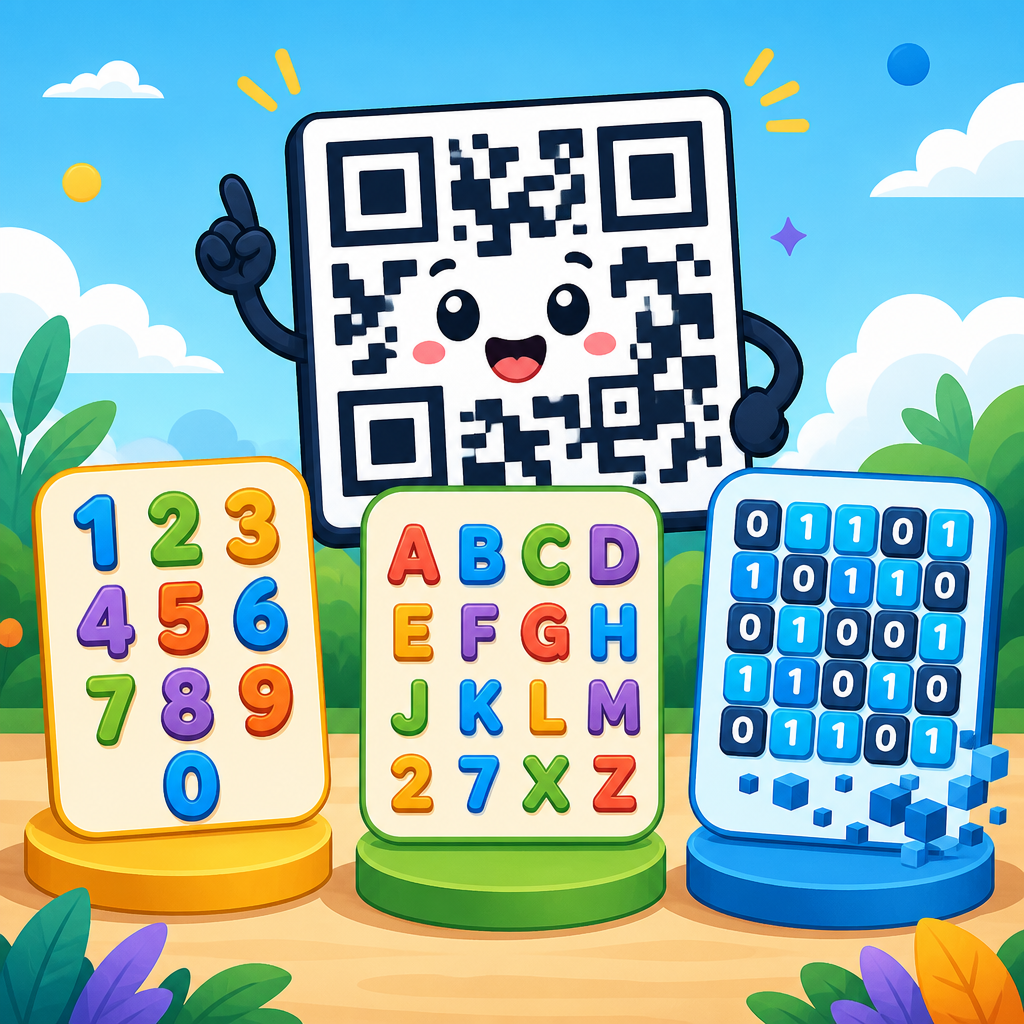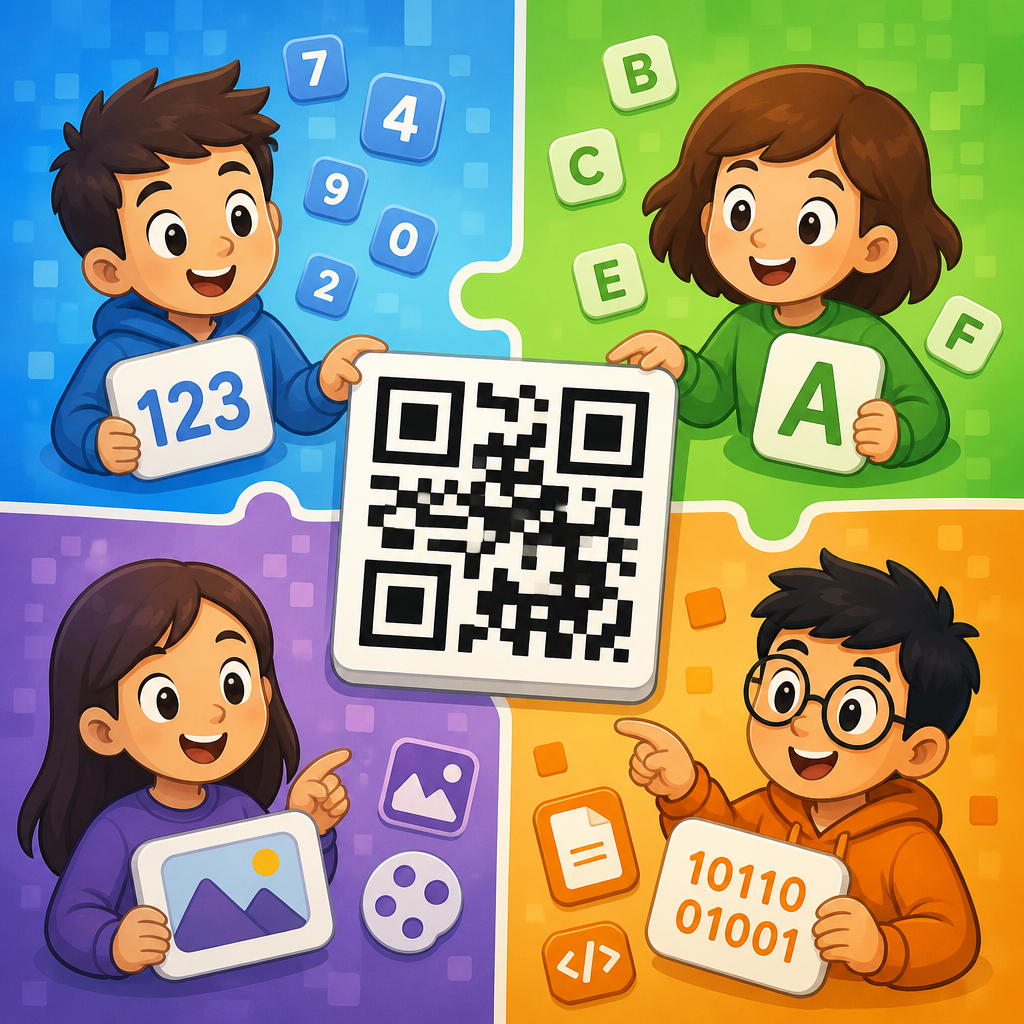
QR code encoding modes determine how characters are converted into bits, which directly affects symbol size, error correction capacity, and scanning reliability. In the QR Code standards and formats landscape, encoding modes are one of the most important concepts to understand because they sit at the intersection of data structure, interoperability, and practical implementation. If you are building, specifying, or auditing QR systems, you need to know not only what each mode does, but when the standard requires one mode over another and how mixed-mode optimization changes the final code.
A QR code is a two-dimensional matrix symbol defined by ISO/IEC 18004. Inside that matrix, data is not stored as plain text. It is transformed into a sequence of mode indicators, character count indicators, encoded data bits, terminator bits, padding, and error correction codewords. The term encoding mode refers to the rule set used to represent a specific type of content efficiently. Standard QR Code supports numeric mode, alphanumeric mode, byte mode, Kanji mode, and structured mechanisms such as Extended Channel Interpretation, or ECI, that modify how byte data should be interpreted. Micro QR and rMQR variants use related but not identical constraints, while Model 1 and Model 2 historical distinctions still appear in legacy documentation.
This matters because mode selection changes the economics of the symbol. A serial number encoded in numeric mode may fit in a lower version than the same characters encoded in byte mode. A multilingual URL may require UTF-8 through ECI, increasing bit length but preserving meaning across devices. In production, I have seen teams blame printer resolution or scanner quality for failures that were actually caused by inefficient encoding choices, unsupported character sets, or assumptions about reader defaults. A strong grasp of QR Code standards and formats prevents those mistakes and makes every downstream decision, from payload design to testing, more predictable.
As a hub for QR Code standards and formats, this article explains the core encoding modes, how the specification organizes them, where interoperability breaks, and what developers should check before generating symbols at scale. It also points to the surrounding standards questions that usually arise next, including version sizing, mask patterns, Reed-Solomon error correction, GS1 formatting, character set signaling, and scanner compatibility. If you understand the content below, you will be able to read most QR payload diagrams, evaluate encoder libraries intelligently, and choose the right format rules for real-world deployments.
How QR code encoding works at the bit level
Every QR symbol begins as a stream of bits assembled according to the specification. The encoder first analyzes the payload and chooses one or more modes. Each segment starts with a mode indicator, a short binary value that tells the decoder how to interpret the following data. After that comes a character count indicator whose bit length depends on both the encoding mode and the QR version group. The payload bits for the segment follow, and once all segments are encoded, the encoder adds a terminator, zero padding to align to codeword boundaries, pad bytes, and then Reed-Solomon error correction words. Those final codewords are placed into the matrix, masked, and combined with format and version information.
The practical consequence is simple: the same visible text can produce very different bitstreams depending on segmentation. The string 1234567890 in numeric mode is packed three digits at a time into 10-bit groups, with the remainder compressed into 7 or 4 bits. In byte mode, each ASCII character normally consumes 8 bits before overhead, so the symbol grows faster. Good encoders therefore evaluate content rather than blindly using byte mode. High-quality libraries such as ZXing, Nayuki QR Code Generator, and commercial SDKs from DENSO WAVE partners all implement some form of optimization, but their support for ECI, Kanji, FNC1, or structured append may differ, so standards review still matters.
Numeric, alphanumeric, byte, and Kanji modes explained
Numeric mode is the most efficient standard mode for digits 0 through 9. It is ideal for IDs, one-time codes, timestamps without separators, and long purely numeric references. Because three digits fit into 10 bits, numeric mode outperforms all other options when the content allows it. Alphanumeric mode expands the supported set to 45 characters: digits, uppercase A through Z, space, and nine symbols including dollar sign, percent sign, asterisk, plus, hyphen, period, slash, and colon. Characters are encoded in pairs using 11 bits, with a final single character using 6 bits. This makes alphanumeric mode excellent for uppercase invoice references, tracking numbers, and some compact URLs, but it cannot represent lowercase letters directly.
Byte mode is the general-purpose workhorse. It stores data as 8-bit bytes and is commonly used for UTF-8, ISO-8859 variants, binary payloads, and arbitrary text. Many generators default to byte mode because it can represent almost anything, but that convenience comes with lower density than numeric or alphanumeric mode. Kanji mode is specialized for characters in the Shift JIS double-byte set mapped through the QR standard’s compression formula. For eligible characters, Kanji mode is much denser than plain byte mode. In Japanese industrial workflows, I have seen version reductions large enough to improve print quality margins on tiny labels. The catch is compatibility: if your source text is Unicode, the encoder must correctly determine whether each character is representable in the required Shift JIS ranges.
| Mode | Best for | Character scope | Efficiency note |
|---|---|---|---|
| Numeric | IDs, codes, digits-only payloads | 0-9 | Most compact for numbers |
| Alphanumeric | Uppercase references, compact text | 45-character set | Denser than byte for supported text |
| Byte | URLs, UTF-8 text, binary data | 8-bit bytes plus charset signaling | Flexible but less compact |
| Kanji | Eligible Shift JIS Kanji | Defined double-byte ranges | Very efficient for supported Japanese text |
The right choice depends on the exact payload, not the business use case label. A payment reference that looks textual may still qualify for alphanumeric mode if you normalize it to uppercase and remove unsupported punctuation. A web link may partly fit alphanumeric mode, but the presence of lowercase path elements usually forces byte mode unless the encoder splits it into segments. That is why standards-aware generators segment automatically when the bit savings justify the added overhead.
Mixed-mode segmentation and optimization strategies
Mixed-mode encoding lets a single QR code use multiple modes in sequence. This is not an edge feature; it is a core efficiency technique. Consider AB123456cd. Encoding the full string in byte mode is straightforward, but a better encoder may use alphanumeric for AB123456 and byte mode for cd. The gain depends on segment overhead versus payload savings, so the encoder must calculate the total bit cost. Advanced implementations use dynamic programming to find the minimum-size segmentation across the entire string. This matters most for long payloads where small savings compound into lower symbol versions or higher error correction levels.
Optimization also involves character normalization and format discipline. Converting lowercase tracking IDs to uppercase can shift data from byte to alphanumeric mode with no business impact. Removing decorative separators can make a payload numeric. Replacing human-facing labels like Order: with application-side metadata can shrink the symbol dramatically. In shipping and manufacturing projects, I have repeatedly found that payload redesign delivers more scan robustness than increasing error correction, because the smaller symbol has larger modules at the same print area. The standard gives you the toolbox; good architecture decides what truly belongs inside the code.
ECI, character sets, and international text handling
ECI extends QR encoding by signaling how byte data should be interpreted. Without ECI, many readers assume ISO-8859-1 or apply implementation-specific heuristics. That can work for plain ASCII, but it becomes unreliable for accented Latin characters, Cyrillic, Arabic, or mixed-language content. ECI assigns a designator before the affected segment, allowing the decoder to interpret subsequent bytes as UTF-8, Shift JIS, or another registered character set. For modern multilingual applications, UTF-8 via ECI is usually the safest choice because it aligns with web and mobile software stacks.
However, support is uneven. Some enterprise scanners decode ECI consistently, while older mobile apps ignore it or mishandle less common assignments. That is why standards planning must include scanner matrix testing, not just theoretical compliance. If broad consumer scanning is the goal, a multilingual landing page URL may be safer than embedding long native-language text directly. If closed-system scanners are under your control, ECI can be mandatory for fidelity. The key rule is to match charset strategy to the decoder ecosystem. QR standards permit powerful options, but the ecosystem determines which options are dependable in practice.
GS1, FNC1, and application-specific formatting rules
Not all QR content is free-form. In retail, healthcare, and logistics, QR codes often follow sector rules layered on top of the core symbol specification. GS1 QR Code uses FNC1 in first position to indicate that the payload follows GS1 syntax with application identifiers. A scanner then parses fields such as GTIN, batch or lot number, serial number, and expiration date according to GS1 General Specifications. The encoding mode still matters, but field structure, separator handling, and data titles become equally important. A technically valid QR code can still be operationally wrong if the element strings do not comply with GS1 formatting.
This is one reason standards and formats should be treated as a family, not isolated topics. Encoding mode selection affects symbol size. GS1 syntax affects parser behavior. Error correction affects resilience. Print process affects contrast and module deformation. Reader firmware affects character interpretation. When teams only ask, “Can it scan?” they miss the more important question: “Will every intended scanner extract the intended fields consistently?” In regulated environments, consistency is the true success metric.
Version sizing, error correction, and why mode choice changes capacity
QR versions range from 1 to 40, with each step increasing matrix dimensions by four modules per side. Capacity tables published by ISO references and reputable vendors show how many characters fit for each mode at each error correction level: L, M, Q, and H. Those tables are not interchangeable across modes. A version that fits 100 numeric characters may not fit 100 bytes. Mode overhead, character count indicator length, and segmentation all change the calculation. Therefore, capacity planning should always start from the exact encoded bitstream, not from a rough character count.
Error correction creates a classic tradeoff. Higher levels recover more damage but reduce available data capacity. In practice, teams often compensate by moving to a larger version, which shrinks module size if the print area stays fixed. That can hurt scanning more than the extra redundancy helps. The best solution is usually balanced optimization: choose the most efficient encoding mode, simplify the payload, then select the lowest version that preserves comfortable module size and the highest error correction level justified by the environment. For labels exposed to abrasion, level Q or H may be wise. For on-screen consumer links, M is often sufficient.
Common implementation mistakes and how to avoid them
The most common mistake is forcing all content into byte mode because it seems universal. That increases symbol size unnecessarily. Another frequent issue is assuming Unicode text will decode correctly without ECI across all readers. Developers also overlook that different libraries make different default choices for mode optimization, mask evaluation, and charset signaling. During audits, I compare outputs from at least two encoders, inspect the raw segments if the library exposes them, and test with representative scanners rather than one favorite phone app.
A second class of mistakes involves standards mismatch. Teams generate plain QR when the use case requires GS1 QR. They include lowercase data in fields expected to remain uppercase. They exceed practical symbol density for the print method, especially on thermal transfer labels or direct part marks. They shorten URLs with third-party services that later expire, undermining long-term interoperability. Avoiding these problems requires a documented data specification, encoder configuration control, print verification, and field testing under actual lighting, angle, distance, and device conditions.
How to choose the right encoding approach for a project
Start with the payload purpose, then map it to the narrowest valid character set. If the content is digits only, use numeric. If it fits the 45-character set, prefer alphanumeric. If you need lowercase, punctuation outside the alphanumeric set, binary data, or multilingual text, use byte mode and decide whether ECI is required. If the data contains eligible Japanese characters and symbol size is constrained, evaluate Kanji mode. Next, determine whether the application imposes a higher-level syntax such as GS1 or a proprietary parser contract. Then test segmentation, version, and error correction as a combined system rather than isolated settings.
The main benefit of understanding QR code encoding modes is control. You can create smaller symbols, preserve international text accurately, meet industry formatting rules, and predict scanner behavior before deployment. That knowledge also makes related standards easier to navigate, from version capacity tables to FNC1 handling and charset signaling. As you build out your QR Code Technology and Development documentation, use this page as the hub for standards and formats, then validate every implementation with real payloads, real devices, and the exact reading conditions your users will face.
Frequently Asked Questions
What are QR code encoding modes, and why do they matter so much?
QR code encoding modes are the rules a QR symbol uses to convert source data into binary form before that data is arranged into codewords, protected with error correction, and placed into the final matrix. In practical terms, an encoding mode tells the QR generator how to interpret the content: as numeric digits, alphanumeric characters, arbitrary bytes, Japanese Kanji values, or specialized control data. This matters because the chosen mode directly affects how efficiently information is stored. Efficient encoding means fewer bits are needed, which can produce a smaller symbol, leave more room for error correction, or improve scanning performance in real-world conditions.
Encoding modes are important because QR codes are not just images; they are structured data containers governed by standards. If the data is encoded in a mode that matches the content well, the symbol is more compact and typically more robust. If the mode is poorly chosen, the code may become larger than necessary, reducing print flexibility and increasing the chance of scanning issues on small labels, low-contrast surfaces, or damaged media. For anyone designing, specifying, or auditing QR implementations, understanding encoding modes is essential because they influence interoperability, storage efficiency, capacity planning, and reader behavior across different devices and software environments.
What are the main QR code encoding modes, and what type of data is each one designed for?
The main QR code encoding modes defined in standard QR implementations are Numeric, Alphanumeric, Byte, and Kanji, with additional function-related modes used for control purposes in certain scenarios. Numeric mode is the most efficient for strings made only of digits from 0 to 9. Because it compresses decimal digits very efficiently, it is ideal for values such as IDs, account numbers, timestamps, and purely numeric tracking data.
Alphanumeric mode supports a limited but useful character set: digits, uppercase Latin letters, space, and a specific group of symbols such as dollar sign, percent sign, asterisk, plus, hyphen, period, slash, and colon. It is often a strong choice for inventory codes, reference strings, part numbers, and other structured values that fit within that restricted set. Because it is more efficient than full byte encoding for those characters, it can reduce symbol size significantly.
Byte mode is the general-purpose option. It is used when the content includes lowercase letters, punctuation beyond the alphanumeric set, extended characters, binary payloads, or encoded text such as UTF-8 in implementations that support it appropriately. Byte mode is flexible and widely used, especially for URLs, vCards, JSON payloads, and application data. The tradeoff is that it is usually less space-efficient than Numeric or Alphanumeric mode when the data could have fit into one of those specialized modes.
Kanji mode is designed for encoding certain double-byte characters efficiently based on a defined character mapping. When the data qualifies, Kanji mode can represent those characters more compactly than generic byte encoding. However, it is more specialized and depends on both the content and the character encoding expectations of the QR creation and reading systems. In addition to these data modes, QR codes may also include structured append, ECI, FNC1, and other control mechanisms. These are not general text modes in the same sense, but they are part of the broader encoding framework because they affect how the data should be interpreted by compliant readers.
How does the choice of encoding mode affect QR code size, capacity, and error correction?
Encoding mode has a direct impact on bit efficiency, and bit efficiency determines how much data can fit into a given QR version at a given error correction level. Put simply, the more efficiently the content is encoded, the fewer bits are consumed, and the more room remains for either additional data or stronger resilience. Numeric mode packs data more tightly than Alphanumeric, and Alphanumeric is usually more compact than Byte for eligible characters. That means the exact same human-readable string can produce meaningfully different QR sizes depending on how it is encoded.
This has important practical consequences. A smaller QR symbol is often easier to place on packaging, labels, tickets, components, or marketing materials. It may also scan more reliably when printed at small dimensions because the modules can remain larger and clearer relative to the available area. Alternatively, if the symbol size must stay fixed, a more efficient mode can free up capacity that may be used for higher error correction. Higher error correction improves tolerance to damage, dirt, glare, poor print quality, and partial obstruction, but it also consumes capacity. Encoding efficiency and error correction are therefore part of the same design tradeoff.
For system designers, this means mode selection should not be treated as a cosmetic implementation detail. It is part of capacity engineering. If a QR code needs to work in demanding environments such as warehouses, manufacturing lines, medical labeling, or outdoor signage, every saved bit can matter. Efficient mode choices can support stronger robustness without forcing a jump to a larger symbol version. Conversely, choosing Byte mode by default for data that could have been encoded numerically or alphanumerically may produce oversized symbols and tighter scanning margins for no real benefit.
When should you use mixed-mode encoding instead of a single encoding mode?
Mixed-mode encoding should be used when different portions of the payload are best represented by different modes and the QR generator can switch between them intelligently. This is a common optimization technique in standards-compliant encoders. For example, a string might contain a long numeric sequence followed by uppercase identifiers and then a few lowercase or special characters. Encoding the entire payload in Byte mode would be simple, but not necessarily efficient. A mixed-mode encoder can place the numeric section in Numeric mode, the uppercase structured section in Alphanumeric mode, and only the remaining characters in Byte mode.
The reason this works is that QR codes can contain mode indicators and segment boundaries, allowing the encoder to change strategies midstream. There is some overhead involved in switching modes, so mixed-mode encoding is not automatically better in every case. The savings must outweigh the cost of introducing a new segment. Good encoders evaluate this tradeoff and choose the shortest valid bitstream rather than blindly applying one mode to all content.
In practice, mixed-mode encoding is especially valuable for structured business data, identifiers, payment strings, industrial labels, and application payloads that combine numeric tokens, uppercase field markers, separators, and free-text elements. It is also relevant in QR auditing, because two tools can generate visibly different symbol sizes from the same source string depending on how well they optimize segmentation. If you are comparing encoders, verifying conformance, or troubleshooting unexpectedly large QR symbols, mixed-mode behavior is one of the first things to inspect.
What implementation mistakes are most common with QR code encoding modes, and how can they be avoided?
One of the most common mistakes is assuming Byte mode is always the safest default and never revisiting that choice. While Byte mode is flexible, overusing it can waste capacity and create larger symbols than necessary. Another frequent problem is misunderstanding the supported character set of Alphanumeric mode. Developers may expect lowercase letters or unsupported punctuation to fit there, only to discover that the data silently falls back to Byte mode or is transformed in unexpected ways. These errors can affect not just size, but also interoperability between generators and scanners.
A second class of mistakes involves character encoding and interpretation. Byte mode does not magically guarantee universal text handling unless the producing and consuming systems agree on how bytes map to characters. If multilingual text, extended symbols, or application-specific byte payloads are involved, the implementation must handle encoding declarations and decoder expectations correctly. In more advanced scenarios, failing to use mechanisms such as ECI where appropriate can lead to data being displayed incorrectly even when the QR code itself is structurally valid.
There are also optimization and validation issues. Some systems do not segment content efficiently, resulting in larger-than-necessary symbols. Others generate technically valid QR codes but fail under operational constraints because the larger symbol forces smaller module sizes in print. To avoid these problems, teams should test with representative payloads, verify actual encoding mode selection, compare output across trusted libraries, and confirm scan performance under realistic printing and lighting conditions. The best approach is to treat encoding mode as a deliberate engineering decision, not a hidden library detail. If the QR code is part of a regulated, industrial, or customer-facing workflow, documenting the intended mode behavior and validating it during QA can prevent costly downstream failures.